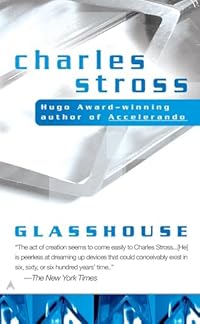
Glasshouse
by Charles Stross
On This Page
Description
When Robin wakes up in a clinic with most of his memories missing, it doesn't take him long to discover that someone is trying to kill him. It's the 27th century, when interstellar travel is by teleport gate and conflicts are fought by network worms that censor refugees' personalities and target historians. The civil war is over and Robin has been demobilized, but someone wants him out of the picture because of something his earlier self knew. On the run from a ruthless pursuer, he show more volunteers to participate in a unique experimental polity, the Glasshouse, constructed to simulate a pre-accelerated culture. Participants are assigned anonymized identities: it looks like the ideal hiding place for a posthuman on the run. But in this escape-proof environment, Robin will undergo an even more radical change, placing him at the mercy of the experimenters--and the mercy of his own unbalanced psyche.--From publisher description. show lessTags
Recommendations







Member Recommendations
oldnick42 Creative sci-fi with memory-erasing elements.
ianturton A similar world of interchangeable bodies/minds

paradoxosalpha far future espionage stories where the protagonist must infiltrate an experimental world in an effort to discover its true purpose, knowing only that there is some great culpability involved
Member Reviews
Several hundred years from now, humanity has just finished the Censorship Wars. Using an electronic virus called Curious Yellow, it targeted the brains of historians as they used teleportation gates (the major method of transportation). Robin has just emerged from a medical clinic with most of his memory wiped. Perhaps he was one of those targeted historians; he does have memories of being in a tank regiment during the war, not as a soldier, but as a tank. He joins a research program to recreate the "dark ages," the late 20th and early 21st centuries, by having volunteers live in an actual, recreated "town." It sounds like a good way to get away from whoever is trying to kill him; whatever he did, or was, before his wipe, it must have show more been important.
The participants are given random, anonymous identities (Robin is turned into a woman named Reeve). Along with Sam, her "husband," they are placed into what looks like Smalltown, USA. They are given little, or no, idea as to just what they are supposed to do. All the couples are electronically monitored; during mandatory church services on Sunday, any faults or misdeeds are pointed out to everyone. Reeve is one of the few who begins to realize that something is really wrong. Their contract specifies a minimum amount of time to be in the study, approximately 3 years, but does not specify a maximum amount of time. The town has become a very high-tech panopticon. The women have suddenly become fertile, and several female participants have become pregnant. Perhaps the idea is to create a new race of people who don't know that there is an outside world. Perhaps it has to do with this new race re-infecting the rest of humanity with a new and improved version of Curious Yellow.
Here is a wonderful piece of writing. The best part is the author's look at present-day life. He does not just needle it or poke fun at it, he rips it to pieces and stomps on what is left. The rest of the book is also very much worth reading. This gets two strong thumbs-up. show less
The participants are given random, anonymous identities (Robin is turned into a woman named Reeve). Along with Sam, her "husband," they are placed into what looks like Smalltown, USA. They are given little, or no, idea as to just what they are supposed to do. All the couples are electronically monitored; during mandatory church services on Sunday, any faults or misdeeds are pointed out to everyone. Reeve is one of the few who begins to realize that something is really wrong. Their contract specifies a minimum amount of time to be in the study, approximately 3 years, but does not specify a maximum amount of time. The town has become a very high-tech panopticon. The women have suddenly become fertile, and several female participants have become pregnant. Perhaps the idea is to create a new race of people who don't know that there is an outside world. Perhaps it has to do with this new race re-infecting the rest of humanity with a new and improved version of Curious Yellow.
Here is a wonderful piece of writing. The best part is the author's look at present-day life. He does not just needle it or poke fun at it, he rips it to pieces and stomps on what is left. The rest of the book is also very much worth reading. This gets two strong thumbs-up. show less
"Memory is liberty" (226). Charles Stross has a way with abstract nouns. In this book, he'll remember it for you at medicare rates.
Glasshouse is a sequel of sorts to Accelerando, set in the same narrative future, but without any shared characters or locations. Unlike Accelerando, it is really a novel, and plotted like one, rather than a necklace of linked novellas. The plot is vividly phildickian, and emphasizes the ambivalence of prison/sanctuary, therapy/coercion, and similar concepts, along with conundrums of self-identification and possible paranoia. Stross uses the present-tense narration of Accelerando here, but the pacing and mood of Glasshouse are closer to Stross' Laundry series.
Stross might have called the story Decelerando, show more since it mostly takes place in an attempted simulation of the "dark ages," i.e. the terrestrial 20th/21st-century. Having his male narrating character enter that simulation as a housewife allows Stross to make a variety of observations about contemporary gender roles, reminding me somewhat of Sturgeon's Venus Plus X.
Ultimately, though, this book is an espionage thriller with the sort of psychological touches that only the post-Singularity science fictional setting could afford. It reads very quickly, with a fair share of drollery. show less
Glasshouse is a sequel of sorts to Accelerando, set in the same narrative future, but without any shared characters or locations. Unlike Accelerando, it is really a novel, and plotted like one, rather than a necklace of linked novellas. The plot is vividly phildickian, and emphasizes the ambivalence of prison/sanctuary, therapy/coercion, and similar concepts, along with conundrums of self-identification and possible paranoia. Stross uses the present-tense narration of Accelerando here, but the pacing and mood of Glasshouse are closer to Stross' Laundry series.
Stross might have called the story Decelerando, show more since it mostly takes place in an attempted simulation of the "dark ages," i.e. the terrestrial 20th/21st-century. Having his male narrating character enter that simulation as a housewife allows Stross to make a variety of observations about contemporary gender roles, reminding me somewhat of Sturgeon's Venus Plus X.
Ultimately, though, this book is an espionage thriller with the sort of psychological touches that only the post-Singularity science fictional setting could afford. It reads very quickly, with a fair share of drollery. show less
It's been pointed out by many people that all SF is a reflection of current society. It uses exceptional circumstances to show us ourselves from perspectives that are unique and unusual. It comments on the world we live in by showing us how different things could be.
Very few hard SF novels are as overt in their reflection as Glasshouse. Which is particularly interesting to me, as I didn't expect it from an author like Stross.
It's not that his books aren't political or socio-culturally oriented. They are. But this book is the most character-driven of his (that I've read, anyway) and that makes the story much more personal. It's also set in a world that's (more or less, without giving anything away) basically the present day. (But not show more really. It makes sense when you read it.) This gives Stross a platform to write some extremely incisive commentary on our social mores and institutions. Glasshouse is directly tied to the real world in which we live in ways that his other works are not. This is his most overtly political book.
He's not kind in his assessment of us. Insightful, hopeful, interested the the things that truly make us who we are - absolutely. But it's obvious that he's not at all happy with the way our society is currently going.
Glasshouse has all the techno-wonder and Big Ideas I've come to expect from Stross. But I found the personal tone of this book to be a refreshing change from some of his other work. show less
Very few hard SF novels are as overt in their reflection as Glasshouse. Which is particularly interesting to me, as I didn't expect it from an author like Stross.
It's not that his books aren't political or socio-culturally oriented. They are. But this book is the most character-driven of his (that I've read, anyway) and that makes the story much more personal. It's also set in a world that's (more or less, without giving anything away) basically the present day. (But not show more really. It makes sense when you read it.) This gives Stross a platform to write some extremely incisive commentary on our social mores and institutions. Glasshouse is directly tied to the real world in which we live in ways that his other works are not. This is his most overtly political book.
He's not kind in his assessment of us. Insightful, hopeful, interested the the things that truly make us who we are - absolutely. But it's obvious that he's not at all happy with the way our society is currently going.
Glasshouse has all the techno-wonder and Big Ideas I've come to expect from Stross. But I found the personal tone of this book to be a refreshing change from some of his other work. show less
A historian-turned-tank-turned some kind of memory-wiped criminal and/or victim, in a posthuman world where body modification and memory modification are standard responses to trauma and extended lifespans, signs up for an experimental emulation of the Dark Ages (1950s-1990s) and gets way more than he/she bargained for. There’s a lot of ideas going on here, and I appreciate the way Stross has the protagonist encounter today’s ordinary things, think they’re weird, and then use the period-appropriate names for them for ease of narrative understanding, but it’s so busy that it’s a bit chilly, even when it’s about horrific trauma or nonconsensual personality modification. Warning for rape, including rape committed by a show more sympathetic character back when he/she was brain-colonized by a fascist meme. show less
I found this while looking for science fiction stories about mind uploading and life extension. It's set in a world where people can rebuild their bodies basically at will; the main character is a (seemingly male) military operative forcibly remade into a 1950s American housewife as part of a bizarre social experiment. I thoroughly enjoyed reading it. It's a very weird, very solid thriller, about escaping from prison—only the prison is society itself in a sense. Cool ideas, played with in interesting ways. This was my first Charles Stross novel, but I suspect it will not be my last.
[a: John Scalzi|4763|John Scalzi|https://d.gr-assets.com/authors/1407277112p2/4763.jpg] claims to be a gateway drug into science fiction literature, I suppose he may well be but I believe Charles Stross is almost the opposite of that. Stross is deservedly one of the most popular active sci- fi authors today but readers not familiar with the genre may find him a little bewildering. His target readership seems to be those who are quite au fait with the common tropes of the genre and also some computer programming terms. Those “in the know” love the science he puts in books like [b: Accelerando|17863|Accelerando|Charles Stross|https://d.gr-assets.com/books/1388240687s/17863.jpg|930555] and [b: The Atrocity Archives|101869|The Atrocity show more Archives (Laundry Files, #1)|Charles Stross|https://d.gr-assets.com/books/1439096114s/101869.jpg|322252] while the likes of me struggle. I certainly had problems understanding much of these two books but less so with [b: Singularity Sky|81992|Singularity Sky (Eschaton, #1)|Charles Stross|https://d.gr-assets.com/books/1386924988s/81992.jpg|1192005]. It did occur to me that his fiction is probably not for me but I keep coming back to try again because I like his wit and imagination, plus he is a great guy and very approachable to readers in online forums and such. Today I am happy to say I have finally found a Stross novel that I absolutely love and works completely for me. It is Glasshouse.
This Hugo nominated novel is set in the 27th century when our 21st century is viewed as part of “The Dark Ages”, presumably pre-singularity (called “the acceleration” here). Most of the book takes place in a sealed experimental environment where participants sign up to reenact life in the 21st century for research purposes. The protagonist starts off as a man named Robin who has part of his memory deleted for reasons unknown, presumably to forget some traumatic experience that he wants to do without. After he signed up for the isolated social experiment he backs himself up and his backed up personality wakes up inside the experiment as a woman called Reeve who has no idea why she has chosen to change her gender. She soon settles down to a married life of a nuclear family as part of the experiment, but begins to feel that the “experiment” is not really an experiment and some very disturbing things are going on.
Io9 calls Glasshouse “One of Stross' most challenging books”, I have not read enough of his books to confirm or deny this but I do find it to be his most accessible book so far. Certainly some tech expositions still go over my head but they never impede the storytelling. Whenever I don’t feel inclined to Google the programming terms I was able to gloss over them and enjoy the story. I do hope many more Stross books are like this, and I intend to find out.
I don’t remember any of Stross’ characters from his other books that I have read but I doubt I will forget the main characters in this book. This is particularly true for Robin/Reeve whose experience and character growth is unlike anything I have read before. The book is surprisingly feministic in tone after Robin becomes Reeve. Stross seems to have a lot of empathy for the trials and tribulations of womanhood. The emotions, the interactions with other women, the social pressure etc. are all convincingly portrayed (I hesitate to say accurately portrayed as I am not of the gender). Interestingly once Robin’s backup is activated as Reeve we have no idea what becomes of the original Robin, but with all these backups and restores we don’t even know whether the original Robin ever appears in this book. As for Reeve, she has to be one of the most unreliable narrators ever (I won't tell you why though).
Of course regularly readers of Charles Stross are probably not exactly looking for books that deal with feminist issues, I imagine the cool tech to be his main attraction. Glasshouse is stuffed to the gills with cool sci-fi tech. The posthumanism reminds me of both [b: Altered Carbon|40445|Altered Carbon (Takeshi Kovacs, #1)|Richard K. Morgan|https://d.gr-assets.com/books/1387128955s/40445.jpg|2095852] and [b: Permutation City|156784|Permutation City|Greg Egan|https://d.gr-assets.com/books/1287341300s/156784.jpg|1270567]*, the memory editing is similar to PKD’s short story [b: We Can Remember It for You Wholesale|6561374|We Can Remember It for You Wholesale|Philip K. Dick|https://d.gr-assets.com/books/1245689437s/6561374.jpg|857342] (filmed a couple of times as “Total Recall”). However, this is not a derivative novel, the sum of the different influences make for a very original book which is mind blowing, thought provoking and even poignant at times. The wilds ideas and amazing tech are underpinned by a surprisingly touching story of a loving relationship.
Glasshouse is definitely the best Charles Stross book I have read so far and I hope that even better ones are in store for me.
__________________________
* Unlike the virtual world featured in Permutation City, the social experiment of Glasshouse takes place in an actual physical environment where the activated digitized personalities are stored in human bodies. show less
This Hugo nominated novel is set in the 27th century when our 21st century is viewed as part of “The Dark Ages”, presumably pre-singularity (called “the acceleration” here). Most of the book takes place in a sealed experimental environment where participants sign up to reenact life in the 21st century for research purposes. The protagonist starts off as a man named Robin who has part of his memory deleted for reasons unknown, presumably to forget some traumatic experience that he wants to do without. After he signed up for the isolated social experiment he backs himself up and his backed up personality wakes up inside the experiment as a woman called Reeve who has no idea why she has chosen to change her gender. She soon settles down to a married life of a nuclear family as part of the experiment, but begins to feel that the “experiment” is not really an experiment and some very disturbing things are going on.
Io9 calls Glasshouse “One of Stross' most challenging books”, I have not read enough of his books to confirm or deny this but I do find it to be his most accessible book so far. Certainly some tech expositions still go over my head but they never impede the storytelling. Whenever I don’t feel inclined to Google the programming terms I was able to gloss over them and enjoy the story. I do hope many more Stross books are like this, and I intend to find out.
I don’t remember any of Stross’ characters from his other books that I have read but I doubt I will forget the main characters in this book. This is particularly true for Robin/Reeve whose experience and character growth is unlike anything I have read before. The book is surprisingly feministic in tone after Robin becomes Reeve. Stross seems to have a lot of empathy for the trials and tribulations of womanhood. The emotions, the interactions with other women, the social pressure etc. are all convincingly portrayed (I hesitate to say accurately portrayed as I am not of the gender). Interestingly once Robin’s backup is activated as Reeve we have no idea what becomes of the original Robin, but with all these backups and restores we don’t even know whether the original Robin ever appears in this book. As for Reeve, she has to be one of the most unreliable narrators ever (I won't tell you why though).
Of course regularly readers of Charles Stross are probably not exactly looking for books that deal with feminist issues, I imagine the cool tech to be his main attraction. Glasshouse is stuffed to the gills with cool sci-fi tech. The posthumanism reminds me of both [b: Altered Carbon|40445|Altered Carbon (Takeshi Kovacs, #1)|Richard K. Morgan|https://d.gr-assets.com/books/1387128955s/40445.jpg|2095852] and [b: Permutation City|156784|Permutation City|Greg Egan|https://d.gr-assets.com/books/1287341300s/156784.jpg|1270567]*, the memory editing is similar to PKD’s short story [b: We Can Remember It for You Wholesale|6561374|We Can Remember It for You Wholesale|Philip K. Dick|https://d.gr-assets.com/books/1245689437s/6561374.jpg|857342] (filmed a couple of times as “Total Recall”). However, this is not a derivative novel, the sum of the different influences make for a very original book which is mind blowing, thought provoking and even poignant at times. The wilds ideas and amazing tech are underpinned by a surprisingly touching story of a loving relationship.
Glasshouse is definitely the best Charles Stross book I have read so far and I hope that even better ones are in store for me.
__________________________
* Unlike the virtual world featured in Permutation City, the social experiment of Glasshouse takes place in an actual physical environment where the activated digitized personalities are stored in human bodies. show less
Charles Stross is one of the current writers of what I like to term “intelligent science fiction”. Following in the footsteps of icons such as Philip Dick and Frank Herbert, Stross demands the attention and concentration of his readers. If you let your mind wander for just a moment, you lose comprehension of the story. However, unlike “Saturn’s Children”, I found this novel somewhat more approachable and reader friendly.
The setting is the far future. Individual consciousness has become largely transferrable and malleable, to the extent that beings can inhabit any number of bodily vessels and memories can be adjusted or even totally wiped in order to forge new beginnings. Our narrator in this tale has just undergone such a show more “memory wipe” and finds himself the target of assassins, for reasons unknown to him. Under these circumstances, he enrolls in a psychiatric experiment which he believes provides him safety from his pursuers. The experiment involves immersion into a controlled environment meant to simulate life in the first Dark Ages (1950-2040). You can imagine how some of our current (and recently past) customs and mores, especially in the realm of sexual politics, might appear to more highly advanced cultures.
In any event, there are surprises in store for our narrator as he enters and becomes familiar with Glasshouse (the experimental polity). As I mentioned before, reading Stross is not akin to reading Asimov or Scalzi. There are layers upon layers of meaning in much of his writing, along with social commentary not usually associated with other science fiction writing, or handled in a far more subtle manner. Nevertheless, this novel is certainly approachable (though it takes a turn toward the confusing at about page 225), and can be enjoyed by virtually any fan of good, hard science fiction. show less
The setting is the far future. Individual consciousness has become largely transferrable and malleable, to the extent that beings can inhabit any number of bodily vessels and memories can be adjusted or even totally wiped in order to forge new beginnings. Our narrator in this tale has just undergone such a show more “memory wipe” and finds himself the target of assassins, for reasons unknown to him. Under these circumstances, he enrolls in a psychiatric experiment which he believes provides him safety from his pursuers. The experiment involves immersion into a controlled environment meant to simulate life in the first Dark Ages (1950-2040). You can imagine how some of our current (and recently past) customs and mores, especially in the realm of sexual politics, might appear to more highly advanced cultures.
In any event, there are surprises in store for our narrator as he enters and becomes familiar with Glasshouse (the experimental polity). As I mentioned before, reading Stross is not akin to reading Asimov or Scalzi. There are layers upon layers of meaning in much of his writing, along with social commentary not usually associated with other science fiction writing, or handled in a far more subtle manner. Nevertheless, this novel is certainly approachable (though it takes a turn toward the confusing at about page 225), and can be enjoyed by virtually any fan of good, hard science fiction. show less
Members
- Recently Added By
Lists

Best Feminist Science Fiction
188 works; 35 members

Favourite Science Fiction Books of the 21st Century
47 works; 8 members

Singularity
12 works; 1 member

Prometheus Award Winners
16 works; 1 member

Simulated Reality in Fiction
124 works; 7 members

Books Read in 2020
4,379 works; 123 members
Author Information

119+ Works 45,384 Members
Born in Leeds, England, Charles Stross knew he wanted to be a science fiction writer from the age of six. Despite this, he went to university in London and qualified as a Pharmacist. He made his first writing sale to Interzone in 1986, and sold about a dozen stories elsewhere throughout the late 1980s and early 1990s. He now writes fiction show more full-time, has sold about 16 novels, has won one Hugo award and been nominated nearly a dozen times, and has been translated into about a dozen languages. He is the author of the Merchant Princes series. His latest book, The Revolution Business, is the fifth in this series. He lives in Edinburgh, Scotland, with his wife Feorag. (Bowker Author Biography) show less
Awards and Honors
Awards
Distinctions
Notable Lists
Work Relationships
Has as a commentary on the text
Common Knowledge
- Canonical title
- Glasshouse
- Original publication date
- 2006-06
- People/Characters
- Robin; Janis; Kay; Bishop Yourdan
- Epigraph
- "This apparatus," said the Officer, grasping a connecting rod and leaning against it, "is our previous Commandant's invention.... Have you heard of our previous Commandant? No? Well, I'm not claiming too much when I say that ... (show all)the organization of the entire penal colony is his work. We, his friends, already knew at the time of his death that the administration of the colony was so self-contained that even if his successor had a thousand new plans in mind he would nt be able to alter anything of the old plan, at least not for several years . . . It's a shame that you didn't know the old Commandant!"
-- "In the Penal Colony," Franz Kafka
Who still talks nowadays about the Armenians?
-- Adolf Hitler, 1939 - Dedication
- For Ken MacLeod
- First words
- A dark-skinned human with four arms walks toward me across the floor of the club, clad only in a belt strung with human skulls.
- Last words
- (Click to show. Warning: May contain spoilers.)Good night.
- Publisher's editor
- Buchanan, Ginjer
- Blurbers
- Dozois, Gardner
- Original language
- English
- Canonical DDC/MDS
- 813.6
- Canonical LCC
- PR6119.T79
Classifications
Statistics
- Members
- 2,432
- Popularity
- 7,974
- Reviews
- 77
- Rating
- (3.77)
- Languages
- English, German, Polish, Spanish
- Media
- Paper, Audiobook, Ebook
- ISBNs
- 16
- ASINs
- 9