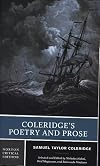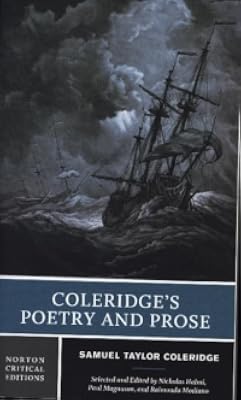
Coleridge's Poetry and Prose [Norton Critical Edition]
by Samuel Taylor Coleridge, Nicholas Halmi (Editor), Paul Magnuson (Editor), Raimonda Modiano (Editor)
214 Members (4.24)
On This Page
Description
Coleridge combined the genius of a poet with the mind of a philosophical critic. His writings are wide-ranging in form and content, and vast in number. This eagerly awaited Norton Critical Edition is the most comprehensive and accessible student edition available and has been prepared to meet the needs of both students and scholars. The editors present Coleridge's writing in its historical context to indicate the public resonance of his work. The poetry selections highlight the development show more of his poetic canon, the construction of his volumes of poetry, and the evolution of his poetic style. The editors have arranged the poems as they first appeared in collections under Coleridge's name. The prose writings represent Coleridge's public and private voices and include selections from all the major prose published during his lifetime as well as from his notebooks, letters, and marginalia. Supporting apparatus includes detailed headnotes, authorial and editorial annotations, a biographical register, a glossary, and an index of poems and first lines. "Criticism" collects twenty assessments of Coleridge's poetry and prose by nineteenth- and twentieth-century British and American authors, including William Wordsworth, Thomas Carlyle, Harriet Martineau, Ralph Waldo Emerson, Edgar Allan Poe, Margaret Fuller, Robert Penn Warren, M. H. Abrams, Frances Ferguson, Karen Swann, Nicholas Roe, and Jerome McGann. show lessTags
Recommendations




Member Reviews
Members
- Recently Added By
Author Information

516+ Works 14,214 Members
Born in Ottery St. Mary, England, in 1772, Samuel Taylor Coleridge studied revolutionary ideas at Cambridge before leaving to enlist in the Dragoons. After his plans to start a communist society in the United States with his friend Robert Southey, later named poet laureate of England, were botched, Coleridge instead turned his attention to show more teaching and journalism in Bristol. Coleridge married Southey's sister-in-law Sara Fricker, and they moved to Nether Stowey, where they became close friends with William and Dorothy Wordsworth. From this friendship a new poetry emerged, one that focused on Neoclassic artificiality. In later years, their relationship became strained, partly due to Coleridge's moral collapse brought on by opium use, but more importantly because of his rejection of Wordworth's animistic views of nature. In 1809, Coleridge began a weekly paper, The Friend, and settled in London, writing and lecturing. In 1816, he published Kubla Kahn. Coleridge reported that he composed this brief fragment, considered by many to be one of the best poems ever written lyrically and metrically, while under the influence of opium, and that he mentally lost the remainder of the poem when he roused himself to answer an ill-timed knock at his door. Coleridge's The Rime of the Ancient Mariner, Christabel, and his sonnet Ozymandias are all respected as inventive and widely influential Romantic pieces. Coleridge's prose works, especially Biographia Literaria, were also broadly read in his day. Coleridge died in 1834. (Bowker Author Biography) show less
Nicholas Halmi is Associate Professor of English and Comparative Literature at the University of Washington, Seattle.
All Editions
Series
Belongs to Publisher Series
Common Knowledge
- Canonical title
- Coleridge's Poetry and Prose [Norton Critical Edition]
- Original publication date
- 2003-07
Classifications
Statistics
- Members
- 214
- Popularity
- 153,011
- Rating
- (4.24)
- Languages
- English
- Media
- Paper
- ISBNs
- 1
- ASINs
- 2