
Thomas de Quincey (1785–1859)
Author of Confessions of an English Opium Eater
About the Author
Thomas de Quincey, born in 1785, was an English novelist, essayist, and literary critic. He is best known for his Confessions of an English Opium Eater, an insightful autobiographical account of his addiction to opium. The death of de Quincey's older sister when he was seven years old shaped his show more life through the grief and sadness that forced him to seek comfort in an inner world of imagination. He ran away to Wales when he was 17. He then attended Oxford University. It was at Oxford that he first encountered opium, and he subsequently abandoned his study of poetry without a degree, hoping to find a true philosophy. de Quincey wrote essays for journals in London and Edinburgh in order to support his large family. His prose writings and essays contain psychological insights relevant to the modern reader of today. In addition to his voluminous works of criticism and essays, he wrote a novel, Klosterheim or The Masque. Thomas de Quincey died in 1859. (Bowker Author Biography) show less
Image credit: From Wikipedia
Works by Thomas de Quincey
Confessions of an English Opium-Eater: and Other Writings (Oxford World's Classics) (1821) 676 copies, 8 reviews
Les Confessions d'un mangeur d'opium anglais / Suspiria de profundis /La Malle-poste anglaise (1821) 14 copies, 1 review
Confessions of an English Opium-Eater Together With Selections From the Autobiography of Thomas De Quincey (1950) 11 copies
Ann of Oxford Street 5 copies
The Uncollected Writings of Thomas de Quincey, Vol. 2 With a Preface and Annotations by James Hogg (2008) 4 copies
The Opium Eater and Other Writings 3 copies
Theological essays, and other papers 3 copies
Confessions of an English Opium-Eater To Which Is Added Suspiria de Profundis , The English Mail Coach, The Revolt of the Tart (1890) 3 copies
The Hasheesh Eater's Companion: Accompanying Fitz Hugh Ludlow's "The Hasheesh Eater" (2007) 3 copies
An Essay on Novels 3 copies
The Collected Writings of Thomas De Quincey. Volume VIII: Speculative and Theological Essays 2 copies
De Quincey (Volume 2); On Murder, Considered as One of the Fine Arts. the English Mail-Coach. the Last Days of Immanuel Kant. Recollections of (2010) 2 copies
Essays 2 copies
The Collected Writings of Thomas De Quincey. Volume IV: Biographies and Biographic Sketches 2 copies
The Collected Writings of Thomas De Quincey. Volume II: Autobiography and literary reminiscences 2 copies
Tales and Romances 2 copies
الراهبة الإسبانية 2 copies
Historical Essays and Researches 2 copies
The Avenger 2 copies
Biographical and Historical Essays 2 copies
The Way of the World 1 copy
Walladmor: And Now Freely Translated from the German into English. In Two Volumes. Vol. I. (2011) 1 copy
An Excerpt from "On the Knocking at the Gate in 'Macbeth' " (SHAKESPEARE, ELIZABETHAN THEATER) 1 copy
Essays in Philosophy 1 copy
La Tragédie grecque 1 copy
Joan of Arc: Selections: I. Joan of Arc. Ii. Affliction of Childhood. Iii. Levana and Our Ladies of Sorrow. Iv. Dream Fugue (2018) 1 copy
Walladmor: And Now Freely Translated from the German into English. In Two Volumes. Vol. II. (2011) 1 copy
Miscellanies: Works IV 1 copy
The collected writings of Thomas de Quincey, Vol. 02: Autobiography and literary reminiscences 1 copy
The English mail coach 1 copy
LibriVox Short Ghost and Horror Collection 040 — Author — 1 copy
Conversation 1 copy
LA FARSA DE LOS CIELOS 1 copy
Herodotova filosofija 1 copy
De l'assassinat considéré comme un des beaux-arts. traduit de l'anglais par andré fontainas. (1944) 1 copy
New essays 1 copy
Thomas De Quincey, His Life and Writings: With Unpublished Correspondence (Classic Reprint) (2016) 1 copy
Miscellanea and Index 1 copy
The Collected Works of Thomas De Quincey: The Complete Works PergamonMedia (Highlights of World Literature) (2015) 1 copy
A Signet Classic 1 copy
On style and conversation 1 copy
Romances and Extravaganzas 1 copy
O Camponês de Portugal | The Peasant of Portugal Um conto das Invasões Francesas | A tale of the Peninsula War (2020) 1 copy
İngiliz Posta Arabası 1 copy
The Literature of Knowledge and the Literature of Power (Interpreting Literature - 5th Edition) 1 copy
Critical Suggestions on Style and Rhetoric With German Tales and Other Narrative Papers, Works XI 1 copy
The Works of Thomas De Quincey: vol 2 : Recollections of the Lakes and the Lake Poets; Coleridge, Wordsworth and Southey (2007) 1 copy
dequince appraisal 1 copy
The Dice 1 copy
The Works Of Thomas De Quincey: Judas Iscariot; Richard Bentley; Cicero; Secret Societies; And Milton V6 (2007) 1 copy
Romances and Extravaganzas, Narrative and Miscellaneous Papers (The Works of Thomas de Quincey) (1877) 1 copy
De Quincey memorials 1 copy
Associated Works
The Norton Anthology of English Literature, 4th Edition, Volume 2 (1979) — Contributor — 270 copies, 1 review
Great British Tales of Terror: Gothic Stories of Horror and Romance 1765-1840 (1972) — Contributor — 86 copies
The Dedalus Book of English Decadence: Vile Emperors and Elegant Degenerates (2004) — Contributor — 60 copies
The Moons at Your Door: An Anthology of Hallucinatory Tales (Strange Attractor Press) (2016) — Contributor — 54 copies, 1 review
English Short Stories from the Fifteenth Century to the Twentieth Century; #743 (1921) — Contributor — 29 copies
Library of the World's Best Mystery and Detective Stories: English, Irish (1907) — Contributor — 11 copies
Tagged
Common Knowledge
- Canonical name
- de Quincey, Thomas
- Legal name
- de Quincey, Thomas Penson
- Birthdate
- 1785-08-15
- Date of death
- 1859-12-08
- Gender
- male
- Education
- University of Oxford (Worcester College)
Middle Temple, London
Winkfield School
Manchester Grammar School
Bath Grammar School
King Edward's School - Occupations
- essayist
editor
translator
journalist
critic - Organizations
- Portico Library, Manchester
- Relationships
- Quincey, Thomas (father)
Penson, Elizabeth (mother)
Penson, William (son)
De Quincey, Horace (son)
Simpson, Margaret (wife) - Short biography
- Notably associated with William Wordsworth, Charles Lamb & Samuel Taylor Coleridge. (His wife Margaret bore him eight children before her death in 1837. Five, however, predeceased their father; three of De Quincey's daughters survived him.)
- Nationality
- Great Britain
- Birthplace
- Manchester, Lancashire, England, UK
- Places of residence
- Bath, Somerset, England, UK
Grasmere, Cumbria, England, UK
Wiltshire, England, UK
Oxford, Oxfordshire, England, UK
London, Middlesex, England, UK
Lasswade, Midlothian, Scotland, UK (show all 7)
Glasgow, Lanarkshire, Scotland, UK - Place of death
- Edinburgh, Midlothian, Scotland, UK
- Burial location
- St Cuthbert's Churchyard, Edinburgh, Midlothian, Scotland, UK
- Map Location
- England, UK
Members
Discussions
Confessions of an English Opium-Eater by De Quincey Thomas - LIMITED EDITIONS CLUB 1930 in George Macy devotees (May 2023)
Reviews

Brilliant, rhythmic, poetical prose. The story itself is quite good too, combining honesty without self-pitying, dark side of 19th century London, tragic and dramatic experiences of the protagonist which are mitigated through detached self-observation and author’s tendency to poke fun at himself, current state of medical science, writers, philosophers and everything else. BTW, it might be one of the first accounts of fighting and beating drug addiction (possibly, with the help of a public show more diary). show less

As far as I know, this book is the original addiction memoir, so it set the template for those that have followed. It has a three-part structure, written from the standpoint of one who has kicked the habit: First, one’s previous life, which helps illuminate why one took to the drug in the first place; secondly, the exquisite pleasures of what De Quincey calls “just, subtle, and mighty opium,” and finally, the terrors of a habit gone out of control.
Only a postscript reveals the coda: show more the stance of one having overcome his addiction was a fiction. It wasn’t true at the time he wrote, nor had his subsequent efforts been successful. Perhaps the most frightening sentence in the book is “not the Opium-eater, but the opium, is the true hero of the tale.”
De Quincey was a precocious scholar, especially of classical Greek. His awareness of attainment in it beyond that of his schoolmasters (and his masters’ awareness of it), combined with his inability to persuade his guardians (De Quincey was an orphan) to “go up” to Oxford ahead of time, led him to run away from school. This brought on years of intense poverty and hunger, resulting in chronic stomach pains (the cause, he asserts, of his opium abuse). This book shows evidence that the analytic ability he claims is no idle boast. He shows a keen insight into the workings of the human mind and society.
Along the way, De Quincey also challenges some of the common assumptions about the drug. One mistake, he asserts, is its designation as a narcotic. In his experience during the days of his occasional recreational use (a small dose every three weeks or so), his sip of laudanum (despite the title, he didn’t “eat” the opium, but drank it in a tincture) led to as much as eight hours of euphoria. Why waste that time sleeping! Instead, he went to the opera. Sounds appealing, but even then, he notes, “its pleasures even are of a grave and solemn complexion.”
When his stomach pain worsened, he increased both the dosage and the frequency, which soon led to harrowing experiences. In particular, his sleep becomes a nightly phantasmagoria, peopled by those he had lost through death. Even worse were the excursions to an Orient of the mind: a jumble of what he knew of China, India, and ancient Egypt. At the culmination of his description of the pains of opium, he reached the point where he felt that continued use would kill him; he was faced with a choice of two agonies: either continuing or quitting.
In rough outlines, a familiar tale. Though evident in the background, what is little expressed are the sufferings of his wife and children.
Some readers may be put off by the subject matter, others by the prose that is of its time and to current taste can seem purple. I, however, was fascinated by the combination of honesty and self-deception. Similarly, his acute insight into society didn’t keep him from failing to recognize aspects he took for granted: Part of the horror of his nocturnal dream excursions to Asia was being thrust into “the mystic sublimity of castes that have flowed apart, and refused to mix, through such immemorial tracts of time,” causing him to shudder, for as an Englishmen, he believed, he was “not bred in any knowledge of such institutions.”
Blind spots, self-deception: in the end, these are not just hallmarks of the addict. They are part of being human, and not even the sharpest mind is immune to them. It’s syllogistic then that I have them too, although, of course, I don’t know what they are. show less
Only a postscript reveals the coda: show more the stance of one having overcome his addiction was a fiction. It wasn’t true at the time he wrote, nor had his subsequent efforts been successful. Perhaps the most frightening sentence in the book is “not the Opium-eater, but the opium, is the true hero of the tale.”
De Quincey was a precocious scholar, especially of classical Greek. His awareness of attainment in it beyond that of his schoolmasters (and his masters’ awareness of it), combined with his inability to persuade his guardians (De Quincey was an orphan) to “go up” to Oxford ahead of time, led him to run away from school. This brought on years of intense poverty and hunger, resulting in chronic stomach pains (the cause, he asserts, of his opium abuse). This book shows evidence that the analytic ability he claims is no idle boast. He shows a keen insight into the workings of the human mind and society.
Along the way, De Quincey also challenges some of the common assumptions about the drug. One mistake, he asserts, is its designation as a narcotic. In his experience during the days of his occasional recreational use (a small dose every three weeks or so), his sip of laudanum (despite the title, he didn’t “eat” the opium, but drank it in a tincture) led to as much as eight hours of euphoria. Why waste that time sleeping! Instead, he went to the opera. Sounds appealing, but even then, he notes, “its pleasures even are of a grave and solemn complexion.”
When his stomach pain worsened, he increased both the dosage and the frequency, which soon led to harrowing experiences. In particular, his sleep becomes a nightly phantasmagoria, peopled by those he had lost through death. Even worse were the excursions to an Orient of the mind: a jumble of what he knew of China, India, and ancient Egypt. At the culmination of his description of the pains of opium, he reached the point where he felt that continued use would kill him; he was faced with a choice of two agonies: either continuing or quitting.
In rough outlines, a familiar tale. Though evident in the background, what is little expressed are the sufferings of his wife and children.
Some readers may be put off by the subject matter, others by the prose that is of its time and to current taste can seem purple. I, however, was fascinated by the combination of honesty and self-deception. Similarly, his acute insight into society didn’t keep him from failing to recognize aspects he took for granted: Part of the horror of his nocturnal dream excursions to Asia was being thrust into “the mystic sublimity of castes that have flowed apart, and refused to mix, through such immemorial tracts of time,” causing him to shudder, for as an Englishmen, he believed, he was “not bred in any knowledge of such institutions.”
Blind spots, self-deception: in the end, these are not just hallmarks of the addict. They are part of being human, and not even the sharpest mind is immune to them. It’s syllogistic then that I have them too, although, of course, I don’t know what they are. show less

"On the Knocking at the Gate in Macbeth" is a one-inch punch of psychological criticism in which de Q's absurdly excessive self-insight finds its finest expression in a single scene from Shakespeare. "The English Mail-Coach" is a phantasmagoric Wild Hunt of an essay, jouncing through the national character, empire, the author's fancy-free youth, and detouring into slow-motion opium nightmares and a delirious symbolical dream-sequence that reminded me of the hurtling, headlong dreams I'm show more prone to on planes. But "On Murder Considered as One of the Fine Arts" doesn't live up to its tantalising title, and the interminable piece on Roman eating habits is extremely pointless. There's also an essay on Joan of Arc, who I've never been too excited about, which is described in a 1981 NYT article as a "necrophiliac paean", an assessment I think I agree with. Still and all, there's really no medicine like de Quincey's patent tonic, a bona fide strange brew. show less
Confessions of an English Opium-Eater and Other Writings (Oxford World's Classics) by Thomas de Quincey
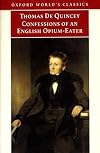
Confessions maybe, but not by any means complete contrition. De Quincey rhapsodises on the pleasures of Opium eating (Laudanum tincture) at pains to dissipate the image of oriental men smoking their life away in opium dens. Opium makes us feel like the diviner part of ones nature is paramount, with moral affections in a state of cloudless serenity. For De Quincey, opium taken in small quantities sharpened him up, invigorated his senses; he tells us how it is so much more effective than show more alcohol in producing a feeling of well being and a feeling of being in tune and in control of oneself :
"For opium (like the bee that extracts it's materials indiscriminately from roses and the soot of chimneys) can overrule all feelings in compliance with the master key"
My first thoughts were "where can I get some". It would not have been a problem in 1822 when the "Confessions" were published as Laudanum could be bought over the counter at many chemist/drug stores. It was quite popular and De Quincey says that many people he knew regularly took it and he goes on to tell how many people in the upper echelons of society were habitual opium eaters. The issue for some people would have been the expense, it was never very cheap although well within the reaches of the working classes. Today of course it can only be got legally by prescription and because of the impure nature of the drug is only rarely prescribed.
De Quincey's Confessions of an English Opium eater when published as an essay in Blackwood's magazine was an instant success. It was one of the first pieces that dwelt on the positive effects of drug taking and while it would be inaccurate to say that it launched a genre of drug culture literature, it certainly opened the way for others to follow. It was successful at the time because it was in tune with the thoughts and ideas of some of the Romantic writers. De Quincey hero worshipped William Wordsworth and while this was not reciprocated by the great man of poetry, nevertheless De Quincey was able to refer to his poems liberally in his essays.
The Confessions of an English Opium Eater is much more than just a peon to the pleasures of opium; it is an essay written by an intelligent, well educated, sensitive human being who does his duty in pointing out the addictive nature of the drug and points out the pain that it can bring to those people who overuse it. It can easily lead to depression, a withdrawal from daily life, nightmares, anxiety, and a darkness of the soul and these are all well described so as to give the essay some balance. Before we get to the pleasures and pains of taking opium we have to read an autobiography of De Quincey's early life which takes up over half the essay and serves as reasons for his taking of opium in the first place and then reasons for his refuge in the drug itself. The essay ends with De Quincey almost giving us words of warning, saying that although he was able to escape from addiction his nightmares still persist.
The longest essay in the collection is Suspira de Profundis where De Quincey revisits and expands much of the ground that he covered in the Confessions. While the reader can believe that the Confessions were written by a man not under the influence of opium, this is not the case with "Suspira" which contains some genuinely druggy writing and would have served as an inspiration to many writers of that genre. The essay is uneven and incomplete, but is does contain some sublime sections. Although we have to follow De Quincey again through an expanded autobiography he is much more inclined to wander off at a tangent, there are brilliant passages on how opium makes time elastic; stretching out immeasurably, there is a long section where he dwells on the wording of the funeral service with references to Christianity and to Agrippa's "Natural Magic", he talks lovingly about his classical studies and his collection of books that he holds so dear. This essay like The Confessions is written in the first person and the reader becomes more aware of the personality of the writer, his passions and his feeling of being out of step with the world in which he lives and his need for a sort of privacy, a refuge where he can be alone with his thoughts. This is a man who is coming to terms with his childhood ordeals through his dreams and/or nightmares induced by his opium eating. He uses the extended metaphor of a palimpsest to explain how the opium can blast through the veils that have attached themselves to his memories, his personality, but he is aware of the dangers that this can bring. Another section tells of a fantasy he has on seeing apparitions on top of the mountain; Brocken in North Germany in some fine Romantic prose. Finally we are left with a feeling of how incomplete and disjoined is the "Suspira" that has come down to us, but it is still a marvellous reading experience.
In perhaps my favourite essay in the collection "The English Mail Coach". De Quincey takes us into the world of riding the mail coaches in the mid nineteenth century. Again it is in the first person and we experience the thrills of riding one of the mail coaches as it carries to the people of England the news of Napoleons defeat at Waterloo. De Quincey is still taking opium and he says he fortified himself with some before embarking on a night time ride to the lake district where he watched helplessly as the driver of the carriage fell asleep and they were on collision course with a carriage coming the opposite way. "I am miserably and shamefully deficient in that quality as regards action" he tells us and this is an over weaning theme to his personality. De Quincey is a dreamer, with or without opium, repeatedly he tells us the modern world is moving too fast for him, he looks backwards to a more natural world, the coming of the railways is an anathema to him. He says:
"Some people have called me procrastinating. Now you are witness, reader, that I was in time for them. But can they lay their hands on their heart, and say that they were in time for me? I, during my life have often had to wait for the post office: The post office never waited a minute for me"
Yes, there is plenty of humour and amusement in the writing of this intelligent man, who, while well aware of the deficiencies in his character that hinders him in day to day business, can still make a case for his world view. It was in some respects in tune with the Romantics and today will strike a chord with some disaffected people. The confessions can often be seen listed among the genre of fantasy and even science fiction, but I would not put it there at all. These are the writings of a man with both feet firmly planted in the 19th century, looking backward rather than forward and while his drug induced dreams could be seen as fantasies; to De Quincey they were essential parts of his very being that he was keen to explore. De Quincey was a prolific writer of essays, as that was how he earned his living and I am keen to read some more, but I would not hesitate in recommending this collection to all readers. 4.5 stars. show less
"For opium (like the bee that extracts it's materials indiscriminately from roses and the soot of chimneys) can overrule all feelings in compliance with the master key"
My first thoughts were "where can I get some". It would not have been a problem in 1822 when the "Confessions" were published as Laudanum could be bought over the counter at many chemist/drug stores. It was quite popular and De Quincey says that many people he knew regularly took it and he goes on to tell how many people in the upper echelons of society were habitual opium eaters. The issue for some people would have been the expense, it was never very cheap although well within the reaches of the working classes. Today of course it can only be got legally by prescription and because of the impure nature of the drug is only rarely prescribed.
De Quincey's Confessions of an English Opium eater when published as an essay in Blackwood's magazine was an instant success. It was one of the first pieces that dwelt on the positive effects of drug taking and while it would be inaccurate to say that it launched a genre of drug culture literature, it certainly opened the way for others to follow. It was successful at the time because it was in tune with the thoughts and ideas of some of the Romantic writers. De Quincey hero worshipped William Wordsworth and while this was not reciprocated by the great man of poetry, nevertheless De Quincey was able to refer to his poems liberally in his essays.
The Confessions of an English Opium Eater is much more than just a peon to the pleasures of opium; it is an essay written by an intelligent, well educated, sensitive human being who does his duty in pointing out the addictive nature of the drug and points out the pain that it can bring to those people who overuse it. It can easily lead to depression, a withdrawal from daily life, nightmares, anxiety, and a darkness of the soul and these are all well described so as to give the essay some balance. Before we get to the pleasures and pains of taking opium we have to read an autobiography of De Quincey's early life which takes up over half the essay and serves as reasons for his taking of opium in the first place and then reasons for his refuge in the drug itself. The essay ends with De Quincey almost giving us words of warning, saying that although he was able to escape from addiction his nightmares still persist.
The longest essay in the collection is Suspira de Profundis where De Quincey revisits and expands much of the ground that he covered in the Confessions. While the reader can believe that the Confessions were written by a man not under the influence of opium, this is not the case with "Suspira" which contains some genuinely druggy writing and would have served as an inspiration to many writers of that genre. The essay is uneven and incomplete, but is does contain some sublime sections. Although we have to follow De Quincey again through an expanded autobiography he is much more inclined to wander off at a tangent, there are brilliant passages on how opium makes time elastic; stretching out immeasurably, there is a long section where he dwells on the wording of the funeral service with references to Christianity and to Agrippa's "Natural Magic", he talks lovingly about his classical studies and his collection of books that he holds so dear. This essay like The Confessions is written in the first person and the reader becomes more aware of the personality of the writer, his passions and his feeling of being out of step with the world in which he lives and his need for a sort of privacy, a refuge where he can be alone with his thoughts. This is a man who is coming to terms with his childhood ordeals through his dreams and/or nightmares induced by his opium eating. He uses the extended metaphor of a palimpsest to explain how the opium can blast through the veils that have attached themselves to his memories, his personality, but he is aware of the dangers that this can bring. Another section tells of a fantasy he has on seeing apparitions on top of the mountain; Brocken in North Germany in some fine Romantic prose. Finally we are left with a feeling of how incomplete and disjoined is the "Suspira" that has come down to us, but it is still a marvellous reading experience.
In perhaps my favourite essay in the collection "The English Mail Coach". De Quincey takes us into the world of riding the mail coaches in the mid nineteenth century. Again it is in the first person and we experience the thrills of riding one of the mail coaches as it carries to the people of England the news of Napoleons defeat at Waterloo. De Quincey is still taking opium and he says he fortified himself with some before embarking on a night time ride to the lake district where he watched helplessly as the driver of the carriage fell asleep and they were on collision course with a carriage coming the opposite way. "I am miserably and shamefully deficient in that quality as regards action" he tells us and this is an over weaning theme to his personality. De Quincey is a dreamer, with or without opium, repeatedly he tells us the modern world is moving too fast for him, he looks backwards to a more natural world, the coming of the railways is an anathema to him. He says:
"Some people have called me procrastinating. Now you are witness, reader, that I was in time for them. But can they lay their hands on their heart, and say that they were in time for me? I, during my life have often had to wait for the post office: The post office never waited a minute for me"
Yes, there is plenty of humour and amusement in the writing of this intelligent man, who, while well aware of the deficiencies in his character that hinders him in day to day business, can still make a case for his world view. It was in some respects in tune with the Romantics and today will strike a chord with some disaffected people. The confessions can often be seen listed among the genre of fantasy and even science fiction, but I would not put it there at all. These are the writings of a man with both feet firmly planted in the 19th century, looking backward rather than forward and while his drug induced dreams could be seen as fantasies; to De Quincey they were essential parts of his very being that he was keen to explore. De Quincey was a prolific writer of essays, as that was how he earned his living and I am keen to read some more, but I would not hesitate in recommending this collection to all readers. 4.5 stars. show less
Lists
substances (1)
Read These Too (1)
Awards


You May Also Like


Associated Authors
Statistics
- Works
- 308
- Also by
- 28
- Members
- 6,478
- Popularity
- #3,792
- Rating
- 3.6
- Reviews
- 101
- ISBNs
- 495
- Languages
- 20
- Favorited
- 26

