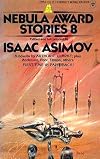
Nebula Award Stories 8
by Isaac Asimov (Editor, Foreword)
Nebula-Preis Stories (4), Nebula Award Stories (8)
On This Page
Tags
Recommendations








Member Reviews
After a somewhat disappointing Nebula 4 (1968) read, Nebula 8 (1972) is a vast improvement. The 3 winners and 5 runners-up provide some solid reading here. Missing is LeGuin's "The Word For World is Forest" which took the Hugo that year for best novella, although it placed third for the Nebula. I remind myself that the "Science Fiction Writers of America" choose and vote for the Nebulas as opposed to the general reader and fan rabble that is a member of the World Conventions each year that gets to vote for the Hugo. Between the two awards each year most of the very good ones get at least nominated but the "best" each year is always a bit of a gamble. So here are the contents (from ISFDB):
ix • Introduction: So Why Aren't We Rich? show more (1973) • essay by Isaac Asimov
3 • A Meeting With Medusa • (1971) • novella Nebula winner by Arthur C. Clarke
50 • Shaffery Among the Immortals • (1972) • short story by Frederik Pohl
67 • Patron of the Arts • (1972) • novelette by William Rotsler
90 • When It Changed • (1972) • short story Nebula winner by Joanna Russ
100 • On the Downhill Side • (1972) • short story by Harlan Ellison
117 • The Fifth Head of Cerberus • (1972) • novella by Gene Wolfe
181 • When We Went to See the End of the World • (1972) • shortstory by Robert Silverberg
191 • Goat Song • (1972) • novelette Nebula winner by Poul Anderson
Notable among the stories to me were:
Clarke's "A Meeting With Medusa" starts this off very well with a hard science fiction tale of the first manned exploration of Jupiter and the surprising discovery of Jovian life forms. I really liked this one. I've read this story at least once before but long ago so that it was fresh to me. There is a lot of action and excitement in this one. Something that popped out at me was Clarke using the "Prime Directive" and first contact rules when the aliens are encountered and deemed possibly intelligent. As far as I know, the Prime Directive originated in the Star Trek TV series just a few years before this novella.
Russ's "When It Changed" is a powerful story about an all female society that has lived and survived without men for 600 years after a plague that left no men alive. And then men return. I have read this before and was pleased to revisit. Very deserving of the Nebula Award for short story.
In his introduction to Gene Wolfe's now classic "The Fifth Head of Cerebus," Asimov notes that it lost the Nebula by a hair to the Clarke story. I liked Clarke's story but I think this one is superior. Once I started reading I could scarcely put it down. To discuss the story itself would be to really spoil the pleasure in reading it. Broadly it is a future colonial society not on earth. Two brothers are kept apart from almost everything and everyone, but slowly as the years go by they are exposed to more and mysteries are revealed. They have a tutor from whom they learn much in early years. Interesting story.
I didn't really care for Silverberg's "When We Went To See The End of the World." I found each of the other stories interesting, with the singular exception of Pohl's "Shaffery Among the Immortals." show less
ix • Introduction: So Why Aren't We Rich? show more (1973) • essay by Isaac Asimov
3 • A Meeting With Medusa • (1971) • novella Nebula winner by Arthur C. Clarke
50 • Shaffery Among the Immortals • (1972) • short story by Frederik Pohl
67 • Patron of the Arts • (1972) • novelette by William Rotsler
90 • When It Changed • (1972) • short story Nebula winner by Joanna Russ
100 • On the Downhill Side • (1972) • short story by Harlan Ellison
117 • The Fifth Head of Cerberus • (1972) • novella by Gene Wolfe
181 • When We Went to See the End of the World • (1972) • shortstory by Robert Silverberg
191 • Goat Song • (1972) • novelette Nebula winner by Poul Anderson
Notable among the stories to me were:
Clarke's "A Meeting With Medusa" starts this off very well with a hard science fiction tale of the first manned exploration of Jupiter and the surprising discovery of Jovian life forms. I really liked this one. I've read this story at least once before but long ago so that it was fresh to me. There is a lot of action and excitement in this one. Something that popped out at me was Clarke using the "Prime Directive" and first contact rules when the aliens are encountered and deemed possibly intelligent. As far as I know, the Prime Directive originated in the Star Trek TV series just a few years before this novella.
Russ's "When It Changed" is a powerful story about an all female society that has lived and survived without men for 600 years after a plague that left no men alive. And then men return. I have read this before and was pleased to revisit. Very deserving of the Nebula Award for short story.
In his introduction to Gene Wolfe's now classic "The Fifth Head of Cerebus," Asimov notes that it lost the Nebula by a hair to the Clarke story. I liked Clarke's story but I think this one is superior. Once I started reading I could scarcely put it down. To discuss the story itself would be to really spoil the pleasure in reading it. Broadly it is a future colonial society not on earth. Two brothers are kept apart from almost everything and everyone, but slowly as the years go by they are exposed to more and mysteries are revealed. They have a tutor from whom they learn much in early years. Interesting story.
I didn't really care for Silverberg's "When We Went To See The End of the World." I found each of the other stories interesting, with the singular exception of Pohl's "Shaffery Among the Immortals." show less
* xi • Introduction: So Why Aren't We Rich? • essay by Isaac Asimov
- Asimov having fun exploring an idea.
* 3 • A Meeting With Medusa • (1971) • novelette by Arthur C. Clarke
- Very hard science, with a little bit of a 'character' study about 'what it means to be human'
* 52 • Shaffery Among the Immortals • (1972) • shortstory by Frederik Pohl
- typical Pohl, as it's kinda funny satire, until it's not... almost a shaggy dog story, so watch out
* 70 • Patron of the Arts • (1972) • novelette by William Rotsler - women are only objects of beauty and sexuality; ridiculously offensive
* 95 • When It Changed • (1972) • shortstory by Joanna Russ
- the women were doing just fine; could not Russ have said that the return of show more men would show women prevailing, rather than be victimized yet again?
* 106 • On the Downhill Side • (1972) • shortstory by Harlan Ellison
- experimental-ish writing and a lack of understanding of what 'love' is... sorry if you 'love' this
* 124 • The Fifth Head of Cerberus • (1972) • novella by Gene Wolfe
- ugly content, but often beautiful writing
* 191 • When We Went to See the End of the World • (1972) • shortstory by Robert Silverberg
- relevant right now, as I agree we really are facing 'the end of the world' and ignoring that fact
* 202 • Goat Song • (1972) • novelette by Poul Anderson
- mix of myth and science, eerie, but also sorta inspirational, especially to 12 year-olds*
1.5 stars rounded down... if you rated it higher, you really need to think about what you got out of it, and read other sorts of works.
*"The Golden Age of SF is 12." show less
- Asimov having fun exploring an idea.
* 3 • A Meeting With Medusa • (1971) • novelette by Arthur C. Clarke
- Very hard science, with a little bit of a 'character' study about 'what it means to be human'
* 52 • Shaffery Among the Immortals • (1972) • shortstory by Frederik Pohl
- typical Pohl, as it's kinda funny satire, until it's not... almost a shaggy dog story, so watch out
* 70 • Patron of the Arts • (1972) • novelette by William Rotsler - women are only objects of beauty and sexuality; ridiculously offensive
* 95 • When It Changed • (1972) • shortstory by Joanna Russ
- the women were doing just fine; could not Russ have said that the return of show more men would show women prevailing, rather than be victimized yet again?
* 106 • On the Downhill Side • (1972) • shortstory by Harlan Ellison
- experimental-ish writing and a lack of understanding of what 'love' is... sorry if you 'love' this
* 124 • The Fifth Head of Cerberus • (1972) • novella by Gene Wolfe
- ugly content, but often beautiful writing
* 191 • When We Went to See the End of the World • (1972) • shortstory by Robert Silverberg
- relevant right now, as I agree we really are facing 'the end of the world' and ignoring that fact
* 202 • Goat Song • (1972) • novelette by Poul Anderson
- mix of myth and science, eerie, but also sorta inspirational, especially to 12 year-olds*
1.5 stars rounded down... if you rated it higher, you really need to think about what you got out of it, and read other sorts of works.
*"The Golden Age of SF is 12." show less
Indeholder "Isaac Asimov: Introduction. So why aren't we rich?", "Arthur C. Clarke: A Meeting with Medusa", "Frederik Pohl: Shafferty among the immortals", "William Rotssler: Patron of the arts", "Joanna Russ: When it changed", "Harlan Ellison: On the downhill side", "Gene Wolfe: The fifth head of Cerberus", "Robert Silverberg: When we went to see the end of the world", "Poul Anderson: Goat Song", "Award-winning science fiction, 1965-1972", "The Nebula awards", "The Hugo awards".
"Isaac Asimov: Introduction. So why aren't we rich?" handler om ???
"Arthur C. Clarke: A Meeting with Medusa" handler om at et heliumluftskib med fusionsreaktor forulykker, piloten kommer slemt til skade, men bliver genopbygget, styrer den første bemandede sonde show more til Jupiter og møder her kæmpemæssige livsformer.
"Frederik Pohl: Shafferty among the immortals" handler om ???
"William Rotssler: Patron of the arts" handler om ???
"Joanna Russ: When it changed" handler om ???
"Harlan Ellison: On the downhill side" handler om ???
"Gene Wolfe: The fifth head of Cerberus" handler om ???
"Robert Silverberg: When we went to see the end of the world" handler om ???
"Poul Anderson: Goat Song" handler om ???
"Award-winning science fiction, 1965-1972" handler om ???
"The Nebula awards" handler om ???
"The Hugo awards" handler om hvem der har vundet hugo priserne fra og med 1965 til og med 1972.
??? show less
"Isaac Asimov: Introduction. So why aren't we rich?" handler om ???
"Arthur C. Clarke: A Meeting with Medusa" handler om at et heliumluftskib med fusionsreaktor forulykker, piloten kommer slemt til skade, men bliver genopbygget, styrer den første bemandede sonde show more til Jupiter og møder her kæmpemæssige livsformer.
"Frederik Pohl: Shafferty among the immortals" handler om ???
"William Rotssler: Patron of the arts" handler om ???
"Joanna Russ: When it changed" handler om ???
"Harlan Ellison: On the downhill side" handler om ???
"Gene Wolfe: The fifth head of Cerberus" handler om ???
"Robert Silverberg: When we went to see the end of the world" handler om ???
"Poul Anderson: Goat Song" handler om ???
"Award-winning science fiction, 1965-1972" handler om ???
"The Nebula awards" handler om ???
"The Hugo awards" handler om hvem der har vundet hugo priserne fra og med 1965 til og med 1972.
??? show less
Oct 11, 2012 (Edited)Danish
Ratings
Members
- Recently Added By
Author Information

Isaac Asimov was born in Petrovichi, Russia, on January 2, 1920. His family emigrated to the United States in 1923 and settled in Brooklyn, New York, where they owned and operated a candy store. Asimov became a naturalized U.S. citizen at the age of eight. As a youngster he discovered his talent for writing, producing his first original fiction at show more the age of eleven. He went on to become one of the world's most prolific writers, publishing nearly 500 books in his lifetime. Asimov was not only a writer; he also was a biochemist and an educator. He studied chemistry at Columbia University, earning a B.S., M.A. and Ph.D. In 1951, Asimov accepted a position as an instructor of biochemistry at Boston University's School of Medicine even though he had no practical experience in the field. His exceptional intelligence enabled him to master new systems rapidly, and he soon became a successful and distinguished professor at Columbia and even co-authored a biochemistry textbook within a few years. Asimov won numerous awards and honors for his books and stories, and he is considered to be a leading writer of the Golden Age of science fiction. While he did not invent science fiction, he helped to legitimize it by adding the narrative structure that had been missing from the traditional science fiction books of the period. He also introduced several innovative concepts, including the thematic concern for technological progress and its impact on humanity. Asimov is probably best known for his Foundation series, which includes Foundation, Foundation and Empire, and Second Foundation. In 1966, this trilogy won the Hugo award for best all-time science fiction series. In 1983, Asimov wrote an additional Foundation novel, Foundation's Edge, which won the Hugo for best novel of that year. Asimov also wrote a series of robot books that included I, Robot, and eventually he tied the two series together. He won three additional Hugos, including one awarded posthumously for the best non-fiction book of 1995, I. Asimov. "Nightfall" was chosen the best science fiction story of all time by the Science Fiction Writers of America. In 1979, Asimov wrote his autobiography, In Memory Yet Green. He continued writing until just a few years before his death from heart and kidney failure on April 6, 1992. (Bowker Author Biography) show less
All Editions
Some Editions
Series


Belongs to Publisher Series
Playboy Science Fiction (6728)
Work Relationships
Contains
Common Knowledge
- Canonical title
- Nebula Award Stories 8
- Original title
- Nebula Award Stories 8
- Original publication date
- 1973
- Original language*
- Englisch
*Some information comes from Common Knowledge in other languages. Click "Edit" for more information.
Classifications
Statistics
- Members
- 208
- Popularity
- 156,776
- Reviews
- 3
- Rating
- (3.58)
- Languages
- English, German
- Media
- Paper
- ISBNs
- 6
- ASINs
- 9