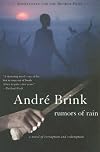
Gerugte van Reën
by André Brink
On This Page
Description
Just before the shocking violence that brings South African apartheid to an end, Martin decides to return to the family farm for a weekend. A highly successful businessman and Afrikaans Nationalist, he hopes to sell the property to the government in a deal both highly profitable and corrupt. The moment he steps onto the farm, his plans are derailed. The repercussions of a society's endemic violence catch up to him, and shake the relationships that frame his life.Tags
Recommendations























Member Reviews
Many of us have met a man like Martin Mynhardt: white, middle-aged, fit, educated, cultured, powerful, charming but only when required. There's an elegant wife and a series of quiet affairs. After all, a person married to him would expect such a thing wouldn't she? Men like this never question their progress through life - it is the natural and deserved course of things. However, if the gods are paying attention, there will be a rare crashing comeuppance for the Martins of the world, unforseen and unexpected.
It was 1976. Mynhardt had just flown to London from Johannesburg to make a presentation to an international group of mining executives. When an embarrassing statement by a member of his group resulted in the withdrawal of his show more delegation, he decided not to return home, but rather to stay on in London until his meeting in Tokyo the next week. He would write the story of his 45 years, leading up to this week.
Martin started out ever so self assured, in keeping with the certainty which guides the lives of those of his ilk. There were self congratulations for the progress he felt he had made from Afrikaans farm boy to pillar of industry. He congratulated himself on his company's efforts at integration, never realizing the sheer tokenism it represented.
Over the course of the week, uncertainty started to creep into his account. Land deals, politics, his best friend's "desertion" to the anti-apartheid movement, his son's radicalization after being sent to fight in Angola: all were questioned and rationalized, for Martin was a man for whom certainty in thought and deed was paramount. In the midst of all this, there had been a crisis with his widowed mother on her farm. Why would she just not fall in with Martin's pre-arranged plans?
Perhaps there are a few too many "types" here that appear in a number of South African books from this era. They may have been necessary at the time though for a reading public outside South Africa. Brink has written a masterful portrayal of a man completely out of touch with the world around him, and suddenly coming to realize it. If Brink had not allowed Mynhardt to reveal himself so well, it might almost have been possible to feel sympathy with him and his final plea: I've tried so hard, I've acted with the best of intentions. I've tried to remain loyal to the simple fact of my being here and the need to survive. Isn't that enough? However, this is a man who gave no quarter, and consistent with his own philosophy, none should be given to him. show less
It was 1976. Mynhardt had just flown to London from Johannesburg to make a presentation to an international group of mining executives. When an embarrassing statement by a member of his group resulted in the withdrawal of his show more delegation, he decided not to return home, but rather to stay on in London until his meeting in Tokyo the next week. He would write the story of his 45 years, leading up to this week.
Martin started out ever so self assured, in keeping with the certainty which guides the lives of those of his ilk. There were self congratulations for the progress he felt he had made from Afrikaans farm boy to pillar of industry. He congratulated himself on his company's efforts at integration, never realizing the sheer tokenism it represented.
Over the course of the week, uncertainty started to creep into his account. Land deals, politics, his best friend's "desertion" to the anti-apartheid movement, his son's radicalization after being sent to fight in Angola: all were questioned and rationalized, for Martin was a man for whom certainty in thought and deed was paramount. In the midst of all this, there had been a crisis with his widowed mother on her farm. Why would she just not fall in with Martin's pre-arranged plans?
Perhaps there are a few too many "types" here that appear in a number of South African books from this era. They may have been necessary at the time though for a reading public outside South Africa. Brink has written a masterful portrayal of a man completely out of touch with the world around him, and suddenly coming to realize it. If Brink had not allowed Mynhardt to reveal himself so well, it might almost have been possible to feel sympathy with him and his final plea: I've tried so hard, I've acted with the best of intentions. I've tried to remain loyal to the simple fact of my being here and the need to survive. Isn't that enough? However, this is a man who gave no quarter, and consistent with his own philosophy, none should be given to him. show less
Brink's narrator Martin Mynhardt must have been constructed to personify the most unpalatable elements of apartheid South Africa and its Afrikaner ruling class. He is a rich and successful businessman and mine owner, who is arrogant, insensitive, exploitative, and misogynistic. As a narrative voice this takes some getting used to, but Brink's talent is such that one almost feels sorry for him by the end of this tale, which sees the cosy complacencies of his world, and his attempts to keep its various elements separate, dismantled piece by piece over the course of a long weekend. He emerges as a nuanced character, deeply flawed but very human. The portrayals of his friends and family are skilfully drawn but also somewhat symbolic - his show more best friend Bernard is a lawyer who has decided he has to fight the system and is on trial, and his son Louis has come back from military service in Angola deeply disillusioned and questioning.
The foreground events of the story cover Martin's reminiscences of a trip with his son to visit his mother on the family farm, which he needs to persuade his mother to agree to leave and sell. The narrative is full of asides and back stories, with many events and people alluded to long before their stories are revealed in detail. The events of the book seem all the more relevant given what happened a dozen years later - Brink's analysis of why the system had to change is impressive, perceptive and prophetic show less
The foreground events of the story cover Martin's reminiscences of a trip with his son to visit his mother on the family farm, which he needs to persuade his mother to agree to leave and sell. The narrative is full of asides and back stories, with many events and people alluded to long before their stories are revealed in detail. The events of the book seem all the more relevant given what happened a dozen years later - Brink's analysis of why the system had to change is impressive, perceptive and prophetic show less
There comes a day when, for the first time, violence is used not because it is unavoidable but because it is easier. There comes a day when, for the first time, a leader is allowed to promote his own interests simply because he happens to be the leader. There comes a day when, for the first time, the weak one is exploited, not in ignorance but because he cannot offer resistance. There comes a day when, for the first time, a verdict in a court case is given, not on the basis of what is right but on the basis of what is expedient.
This long and angry dispatch from the heart of apartheid South Africa can be an oppressive read, though for understandable reasons. Less understandable, perhaps, were the frankly terrifying number of modern show more parallels that emerged from this putatively historical document.
The narrator at the core of the novel, Martin Mynhardt, is a hugely successful Afrikaner businessman and one of the very pillars of white-supremacist society, who thinks of himself as contributing to the good of his community and his country. He doesn't hate black people; rather, he likes to believe that apartheid is probably good for them, on balance. Extending real political power would be a mistake: ‘they've simply not developed far enough to handle such sophisticated forms of Western organisation. A matter of evolution.’
Through Mynhardt we're introduced to a complex web of interlinked friends, colleagues, lovers and family members who represent a cross-section of 1970s South African society, from the rural farmstead matron to the idealistic city student, the determined black businessman to the angry white activist; lawyers, witchdoctors, religious figures and expatriates, all of them ultimately grappling with the same basic fact of life.
If you have the stomach for it, experiencing the world through the eyes of a proponent of apartheid should be an educational experience. My problem was that – despite his ingratiating and plausible self-justifications – Mynhardt is made into something a bit too much like a cartoon villain. It is not enough for him to be a stalwart of racism; he is also a neglectful father, an unfaithful husband, an appalling friend, a heartless capitalist (‘people are essentially economic propositions’), a manipulative son and a serial user of the women he eyes up as ‘ripe and more than ready to be bruised’.
It may be that Brink is making a point about what's now called ‘intersectionality’ – the ways racism can be related to other social or sexual hierarchies and privileges. Indeed at one point, these links are made quite explicitly by one of Mynhardt's playthings:
“You're an Afrikaner, so you must be a male chauvinist.”
“I fail to see what the two can have in common.”
“Everything.” She sat down opposite me again, on the edge of the chair, her knees primly together. “Because this is a man's land, don't you see? Big-game, rugby, industries, power politics, racism. You Afrikaners have no room for women. The only place you assign to us is flat on our backs with our legs open for the Big Boss to in-and-out as he pleases.”
But I don't believe this is representative; the whole issue with apartheid, and similar systems, is that the people who support it are very often kind-hearted folks, good family-men, attentive partners and loving parents, who simply live by means of colossal, sustained acts of cognitive dissonance. By making Mynhardt wholly objectionable, Brink loses, I think, several opportunities to make us as readers sympathise with him, which would have been a much more troubling and interesting response than simply loathing him completely from start to finish.
‘I have tried with so much care,’ Mynhardt says towards the end, ‘to keep all the elements of my life apart and intact.’ His emotional apartheid is heading for a violent collapse that will mirror the one about to overtake society; as the riots break out in Soweto, there are symmetrical eruptions of tragedy and abuse in his own circle. Despite the novel's conceptual issues, it all makes for a very dark and powerful climax, as the rumours of rain finally end in the kind of downpour only Africa can produce. Read it for future tips as well as historical context. show less
This long and angry dispatch from the heart of apartheid South Africa can be an oppressive read, though for understandable reasons. Less understandable, perhaps, were the frankly terrifying number of modern show more parallels that emerged from this putatively historical document.
The narrator at the core of the novel, Martin Mynhardt, is a hugely successful Afrikaner businessman and one of the very pillars of white-supremacist society, who thinks of himself as contributing to the good of his community and his country. He doesn't hate black people; rather, he likes to believe that apartheid is probably good for them, on balance. Extending real political power would be a mistake: ‘they've simply not developed far enough to handle such sophisticated forms of Western organisation. A matter of evolution.’
Through Mynhardt we're introduced to a complex web of interlinked friends, colleagues, lovers and family members who represent a cross-section of 1970s South African society, from the rural farmstead matron to the idealistic city student, the determined black businessman to the angry white activist; lawyers, witchdoctors, religious figures and expatriates, all of them ultimately grappling with the same basic fact of life.
If you have the stomach for it, experiencing the world through the eyes of a proponent of apartheid should be an educational experience. My problem was that – despite his ingratiating and plausible self-justifications – Mynhardt is made into something a bit too much like a cartoon villain. It is not enough for him to be a stalwart of racism; he is also a neglectful father, an unfaithful husband, an appalling friend, a heartless capitalist (‘people are essentially economic propositions’), a manipulative son and a serial user of the women he eyes up as ‘ripe and more than ready to be bruised’.
It may be that Brink is making a point about what's now called ‘intersectionality’ – the ways racism can be related to other social or sexual hierarchies and privileges. Indeed at one point, these links are made quite explicitly by one of Mynhardt's playthings:
“You're an Afrikaner, so you must be a male chauvinist.”
“I fail to see what the two can have in common.”
“Everything.” She sat down opposite me again, on the edge of the chair, her knees primly together. “Because this is a man's land, don't you see? Big-game, rugby, industries, power politics, racism. You Afrikaners have no room for women. The only place you assign to us is flat on our backs with our legs open for the Big Boss to in-and-out as he pleases.”
But I don't believe this is representative; the whole issue with apartheid, and similar systems, is that the people who support it are very often kind-hearted folks, good family-men, attentive partners and loving parents, who simply live by means of colossal, sustained acts of cognitive dissonance. By making Mynhardt wholly objectionable, Brink loses, I think, several opportunities to make us as readers sympathise with him, which would have been a much more troubling and interesting response than simply loathing him completely from start to finish.
‘I have tried with so much care,’ Mynhardt says towards the end, ‘to keep all the elements of my life apart and intact.’ His emotional apartheid is heading for a violent collapse that will mirror the one about to overtake society; as the riots break out in Soweto, there are symmetrical eruptions of tragedy and abuse in his own circle. Despite the novel's conceptual issues, it all makes for a very dark and powerful climax, as the rumours of rain finally end in the kind of downpour only Africa can produce. Read it for future tips as well as historical context. show less
If you took the best 15 pages out of this book, it would be a very good 15 pages. But there are about 400 other pages. This is a tendentious novel written as a retrospective rambling by a less than admirable Afrikaner businessman. It does cohere into a surprisingly dramatic whole in the end, but getting there through the thicket of trifle and annoyance is a trudge.
Een Afrikaner die zich op eigen kracht heeft opgewerkt tot een invloedrijk persoon begrijpt niets meer van de wereld als om hem heen vriend, maîtresse en zoon twijfelen aan identiteit van de blanken en zich inzetten voor niet-blanken. Als zijn vriend hem hulp vraagt (een paar dagen onderduiken) weigert hij, omdat dat tegen de wet is en gevaarlijk kan zijn. Hij kan de wereld alleen vanuit zijn eigen perspectief bekijken. Dat is wel beperkt aan de vooravond van de gebeurtenissen in Soweto.
Mar 24, 2012Dutch
Ratings
Members
- Recently Added By
Lists

Booker Prize
491 works; 62 members

Man Booker Prize Longlist 1978
6 works; 2 members

Booker Prize Shortlist: Titles Not Yet Read
161 works; 4 members
Author Information

94+ Works 4,919 Members
André Brink was born on May 29, 1935 in Vrede, South Africa. He studied English and Afrikaans at the University in Potchefstroom and comparative literature in Paris. He was a South African writer and educator. He became a part of a group of writers known as Die Sestigers upon returning to South Africa in the 1960s. The group aimed to broaden show more Afrikaner fiction by writing about sexual and moral matters and the failings of the traditional political system. His books included Rumors of Rain, Looking on Darkness, A Dry White Season, and States of Emergency. Some of his books were banned in South Africa. He became a professor of Afrikaans and Dutch literature at Rhodes University and professor of English at the University of Cape Town. He has received the 1980 Martin Luther King Prize, the 1980 French Prix Medicis Etranger, and the 1982 Chevalier of the Legion d'Honneur. He was shortlisted for the Booker Prize twice and nominated for the Nobel Prize for literature on several occasions. He died on February 6, 2015 at the age of 79. (Bowker Author Biography) show less
Awards and Honors
Awards
Common Knowledge
- Canonical title
- Gerugte van Reën
- Original title
- Rumours of Rain
- Original publication date
- 1978
- Important places
- South Africa
Classifications
Statistics
- Members
- 264
- Popularity
- 122,633
- Reviews
- 5
- Rating
- (3.67)
- Languages
- 9 — Afrikaans, Danish, Dutch, English, Finnish, French, Hungarian, Norwegian (Bokmål), Swedish
- Media
- Paper, Ebook
- ISBNs
- 22
- UPCs
- 1
- ASINs
- 4