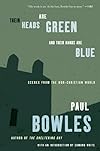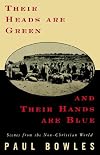
Their Heads Are Green and Their Hands Are Blue
by Paul Bowles
On This Page
Description
In the nineteenth century there flourished a peculiar breed of Englishmen-often the second sons of the aristocracy, or ambitious men from a lower class-who as soldiers, consuls and tea planters, were largely responsible for making England a great colonial power.Save for the fact that he is a staunch anticolonialist, Paul Bowles resembles these men in many respects. Like them, he appears to be happiest away from civilization as we know it; like them, he thrives when the traveling is hardest, show more the food ghastly or infrequent, water scarce, heat intolerable, or mosquitoes abundant.This engaging collection of eight travel essays by the author of such noted fiction as The Sheltering Sky and The Delicate Prey deals largely with places in the world that few Westerners have ever heard of, much less seen-places as yet unencumbered by the trappings, luxuries, and corruptions of modern civilization. Except for one essay on Central America, all of these pieces are concerned with remote spots in the Hindu, Buddhist, or Mohammedan worlds. The author is a sympathetic and discerning interpreter of these alien cultures, and his eyes and ears are especially alert both to what is bizarre and what is wise in the civilizations in which he settles. He is also acutely aware of the transitions occurring on the fringes of many of these regions, and he is disturbed and indignant about the corrosive effect of Western culture on the non-Christian way of life.Above all, however, Paul Bowles is a superb and observant traveler-born wanderer who finds pleasure in the inaccessible and who cheerfully endures the concomitant hardships matter-of-factly and with humor.These essays provide us with Paul Bowles's characteristic insightfulness and bring us closer to a world we frequently hear about, but often find difficult to understand. show lessTags
Recommendations










































Member Reviews
Bowles wrote a smooth, glinting prose well-suited to capturing the sensation of seeing an unfamiliar place for the first time. In the Foreword to this collection of essays written in the 1950s, he expresses the wish that every new place be as different as possible from the places he already knows—but what his writing makes clear is that wonder at the unfamiliar is less about the features of location and more about one’s mental furniture. Bowles' uncluttered perception bespeaks impartiality and a generosity of spirit that in a world of contentious identities looks very much like sagacity and sound judgment. Would that his observations on the diversity of Muslim cultures from sixty years ago held broader currency today.
Abdeslam is show more not a happy person. He sees his world, which he knows is a good world, being assailed from all sides, slowly crumbling before his eyes. He has no means of understanding me should I try to explain to him that in this age what he considers to be religion is called superstition, and that religion today has come to be a desperate attempt to integrate metaphysics with science. Something will have to be found to replace the basic wisdom which has been destroyed, but the discovery will not be soon; neither Abdeslam nor I will ever know of it.
Dogfish Head Indian Brown Ale
Paper City Holyoke Dam Ale show less
Abdeslam is show more not a happy person. He sees his world, which he knows is a good world, being assailed from all sides, slowly crumbling before his eyes. He has no means of understanding me should I try to explain to him that in this age what he considers to be religion is called superstition, and that religion today has come to be a desperate attempt to integrate metaphysics with science. Something will have to be found to replace the basic wisdom which has been destroyed, but the discovery will not be soon; neither Abdeslam nor I will ever know of it.
Dogfish Head Indian Brown Ale
Paper City Holyoke Dam Ale show less
Full review, complete with the odd bit of related multimedia embedding, is HERE.
Bellissima testimonianza sul Marocco frutto di appunti, riflessioni, pagine diaristiche di Bowles, in un arco di dieci anni, dal 1950 al 1960. L'amore per il Maghreb non è ispirato da alcun esotismo, né da gusto etnografico, piuttosto scaturisce dalla bellezza dei paesaggi e della cultura locale, dal rispetto per le genti a lungo sfiancate dal colonialismo e incomprese dal turismo di massa.
Jul 29, 2013Italian
> Babelio : https://www.babelio.com/livres/Bowles-Leurs-mains-sont-bleues/52853
> Leurs mains sont bleues, de Paul Bowles. C’est la perpétuelle rencontre de l’inconnu à travers plusieurs voyages en des terres différentes : “Chaque fois que je me rends dans un endroit où je ne suis encore jamais allé, j’espère qu’il sera aussi différent que possible de ceux que je connais.“ Ed. Points.
—Nouvelles Clés, (6), Juin/Juillet/Août 1989, (p. 75)
> LEURS MAINS SONT BLEUES, de Paul Bowles. — « CHAQUE FOIS que je me rends dans un endroit où je ne suis encore jamais allé, j’espère qu’il sera aussi différent que possible de ceux que je connais déjà. Je présume qu’il est naturel, de la part d’un voyageur, de show more rechercher la diversité et que l’élément humain est ce qui lui donne le plus le sens des différences. Si les gens et leur manière de vivre étaient partout identiques, il ne servirait à rien de se déplacer d’un endroit à un autre. » C’est la philosophie du nomade Paul Bowles dont on reproduit ici les carnets de voyage. Collection : Quai Voltaire, 302 pages.
—Le devoir, 3 juin 1989 show less
> Leurs mains sont bleues, de Paul Bowles. C’est la perpétuelle rencontre de l’inconnu à travers plusieurs voyages en des terres différentes : “Chaque fois que je me rends dans un endroit où je ne suis encore jamais allé, j’espère qu’il sera aussi différent que possible de ceux que je connais.“ Ed. Points.
—Nouvelles Clés, (6), Juin/Juillet/Août 1989, (p. 75)
> LEURS MAINS SONT BLEUES, de Paul Bowles. — « CHAQUE FOIS que je me rends dans un endroit où je ne suis encore jamais allé, j’espère qu’il sera aussi différent que possible de ceux que je connais déjà. Je présume qu’il est naturel, de la part d’un voyageur, de show more rechercher la diversité et que l’élément humain est ce qui lui donne le plus le sens des différences. Si les gens et leur manière de vivre étaient partout identiques, il ne servirait à rien de se déplacer d’un endroit à un autre. » C’est la philosophie du nomade Paul Bowles dont on reproduit ici les carnets de voyage. Collection : Quai Voltaire, 302 pages.
—Le devoir, 3 juin 1989 show less
Oct 19, 2020 (Edited)French
Ratings
Members
- Recently Added By
Author Information

127+ Works 10,843 Members
Series
Belongs to Publisher Series
Work Relationships
Common Knowledge
- Canonical title
- Their Heads Are Green and Their Hands Are Blue
- Original title
- Their Heads Are Green and Their Hands Are Blue
- Original publication date
- 1963
- Important places
- Morocco
- Epigraph
- Far and few, far and few Are the lands where the Jumblies live; Their heads are green, and their hands are blue, And they went to sea in a Sieve. - from The Jumblies by Edward Lear
- First words
- The landscape is restless - a sea of disorderly hills rising steeply.
Classifications
Statistics
- Members
- 342
- Popularity
- 91,537
- Reviews
- 4
- Rating
- (3.73)
- Languages
- 6 — Dutch, English, French, German, Italian, Spanish
- Media
- Paper, Ebook
- ISBNs
- 20
- ASINs
- 5