On This Page
Description
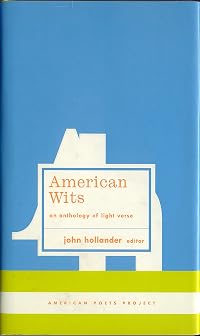
In this book John Hollander offers a buoyant guided tour of American light verse-a tradition he pursues from Ambrose Bierce's sardonic The devil's dictionary quatrains to the latter-day comic inventions of Edward Gorey, Kenneth Koch, and James Merrill. Along the way, American wits gathers a rich harvest of couplets, clerihews, epigrams, parodies, burlesques, and other forms of fractured verse. The varied and often surprising list of contributors includes Edwin Arlington Robinson, Don show more Marquis, T. S. Eliot, Christopher Morley, Dorothy Parker, F. Scott Fitzgerald, Ogden Nash, Phyllis McGinley, and Anthony Hecht. show lessTags
Recommendations

Member Reviews
I came to this book in a round-about way looking for more info about Edwin Arlington Robinson after confusing him with Edgar Lee Masters. This was one of the few books that carried his work. The collection of poems found here are clever and sharp, mostly highlighting the 20th century. The usual suspects appear: Dorothy Parker, Ogden Nash, Kenneth Koch whose riffs on William Carlos Williams are hilarious. But there are also a few from Robert Frost, E.B. White and W.H. Auden who seem less playful in the works I've read prior to this. The fun part of this is that many of the poems and poets skewer each other and famous people of the time. Cultural and literary references abound showing the writers to have a good pulse on their generation.
A great collection with many laugh-out-loud poems. My personal standouts were "A Colloquial Reply: To Any Newsboy," by Vachel Lindsay, which ponders the difference between hating a person's morals (the Kaiser) and hating the person (Iago), David McCord's ode to waistcoats, "Sportif," and Ogden Nash's madcap drunken tongue-twister, "The Private Dining Room." Other notables include Dorothy Parker, E.E. Cummings, W.H. Auden, and even F. Scott Fitzgerald. A book which is both light and enlightening.
This is an anthology of light verse of 20th century American authors. Many of the authors in this anthology are writers of verse without being poets per se. Dorothy Parker is a good example of the writers whose work appear in this book. Her verse receives the largest amount of space in the book. She made her living as a journalist but was a very skilled writer of verse. There are poets whose work was selected but they are in the minority.
The editor points out that there is a difference between wit and humor like the difference between wisecracks and jokes. There is a good example set forth in the foreword by John Hollander, the editor. He uses the poem "Miniver Cheevy" by Edward Arlington Robinson. The poem is really somewhat depressing show more about someone who is born in the wrong time and cannot be happy in the modern world. The humor comes in stanza,
" Miniver scorned the gold he sought,
But sore annoyed was he without it;
Miniver thought, and thought, and thought,
And thought about it."
The way Hollander tells the story Ezra Pound and Robert Frost were in London reading the poem together. It was the fourth use of the word "thought" that emphasizes that all Miniver is ever going to do is think about his predicament that caused the two poets to fall down laughing together. This is a story I will always remember and also shows the value of the contributions of the editors in all of the Poet Project books.
One of my favorites is a verse satire of Carmen that I find very funny.
The writers often poke fun at themselves and others. While reading I spent more time chuckling than laughing. I read the book twice. The second time I got a better appreciation of the verse elements that provides a lot of the enjoyment. It is a book I can always reach for when live is overwhelming and I need to get an attitude adjustment.
The editor emphasizes that the authors made a serious craft of their work. The book is one of the American Poets Project series and upholds the standards of the Library of America editions. As mehitabel would say, wotthehell, wotthehell just read the book toujours gai. show less
The editor points out that there is a difference between wit and humor like the difference between wisecracks and jokes. There is a good example set forth in the foreword by John Hollander, the editor. He uses the poem "Miniver Cheevy" by Edward Arlington Robinson. The poem is really somewhat depressing show more about someone who is born in the wrong time and cannot be happy in the modern world. The humor comes in stanza,
" Miniver scorned the gold he sought,
But sore annoyed was he without it;
Miniver thought, and thought, and thought,
And thought about it."
The way Hollander tells the story Ezra Pound and Robert Frost were in London reading the poem together. It was the fourth use of the word "thought" that emphasizes that all Miniver is ever going to do is think about his predicament that caused the two poets to fall down laughing together. This is a story I will always remember and also shows the value of the contributions of the editors in all of the Poet Project books.
One of my favorites is a verse satire of Carmen that I find very funny.
The writers often poke fun at themselves and others. While reading I spent more time chuckling than laughing. I read the book twice. The second time I got a better appreciation of the verse elements that provides a lot of the enjoyment. It is a book I can always reach for when live is overwhelming and I need to get an attitude adjustment.
The editor emphasizes that the authors made a serious craft of their work. The book is one of the American Poets Project series and upholds the standards of the Library of America editions. As mehitabel would say, wotthehell, wotthehell just read the book toujours gai. show less
Ratings
Members
- Recently Added By
Author Information

John Hollander has edited several Everyman's Library Pocket Poet volumes, including "Robert Frost", "Christmas Poems", "War Poems", "Marriage Poems", "Animal Poems", & "Garden Poems". He is the A. Bartlett Biamatti Professor of English at Yale University, & the author of numerous books of poetry & criticism. He was made a MacArthur Fellow in 1990. show more (Publisher Provided) John Hollander was born in Manhattan, New York on October 28, 1929. He received a B.A. in 1950 and a master's degree in 1952 from Columbia University and a doctorate in 1959 from Indiana University. He taught at Connecticut College, Hunter College, and Yale University, where he was named Sterling Professor of English in 1995 and retired in 2002. As a young poet, he fell under the influence of W. H. Auden and it was Auden who selected Hollander's first collection of poems, A Crackling of Thorns, for the Yale Series of Younger Poets, which was published it in 1958 with an introduction by Auden. During his lifetime he wrote several collections of poetry including The Night Mirror: Poems, Harp Lake, Tesserae, and A Draft of Light. He also wrote many works of criticism including The Untuning of the Sky: Ideas of Music in English Poetry, 1500-1700, Vision and Resonance, The Gazer's Spirit, and The Work of Poetry. He edited the two-volume collection American Poetry: The Nineteenth Century for the Library of America. He died of pulmonary congestion on August 17, 2013 at the age of 83. (Bowker Author Biography) show less
All Editions
Series

Work Relationships
Contains
Is an abridged version of
Common Knowledge
- Canonical title
- American Wits: An Anthology of Light Verse
- Original title
- American Wits: An Anthology of Light Verse
- Original publication date
- 2003
Classifications
- Genres
- Poetry, Fiction and Literature, Literature Studies and Criticism
- DDC/MDS
- 811.0708 — Literature & rhetoric American literature in English American poetry Specific kinds of poetry {only by more than one author} Satirical and humorous
- LCC
- PS595 .H8 .A44 — Language and Literature American literature American literature Collections of American literature Poetry
- BISAC
Statistics
- Members
- 146
- Popularity
- 224,815
- Reviews
- 3
- Rating
- (3.93)
- Languages
- English
- Media
- Paper
- ISBNs
- 1
- ASINs
- 1