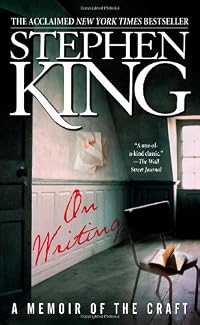
On Writing: A Memoir of the Craft
by Stephen King
On This Page
Description
Twentieth Anniversary Edition with Contributions from Joe Hill and Owen KingONE OF TIME MAGAZINE'S TOP 100 NONFICTION BOOKS OF ALL TIME
Immensely helpful and illuminating to any aspiring writer, this special edition of Stephen King's critically lauded, million-copy bestseller shares the experiences, habits, and convictions that have shaped him and his work.
"Long live the King" hailed Entertainment Weekly upon publication of Stephen King's On Writing. Part memoir, part master class by one show more of the bestselling authors of all time, this superb volume is a revealing and practical view of the writer's craft, comprising the basic tools of the trade every writer must have. King's advice is grounded in his vivid memories from childhood through his emergence as a writer, from his struggling early career to his widely reported, near-fatal accident in 1999—and how the inextricable link between writing and living spurred his recovery. Brilliantly structured, friendly and inspiring, On Writing will empower and entertain everyone who reads it—fans, writers, and anyone who loves a great story well told. show less
Tags
Recommendations


Member Recommendations



Member Reviews
So Stephen King was my first writer; at 10 years old my mother wouldn't let me watch MTV but she certainly didn't care if I read "It" (although she did draw the line at "Gerald's Game"). King's books were the first I read with the slow movement up the consciousness-ladder that "holy shit I fucking love this." So King holds a special place for me. I don't like everything he's done but even the books I hate I still care about because when I was an awkward and ugly preteen girl Stephen King said through his words "hey there's worlds and worlds you can love and it'll be no one's business but yours and mine, friend."
Which is why I'm mad it took me so long to read this book.
I wrote before I knew what it meant. I wrote stories about lost dogs show more finding their way home, about cardboard-characterized children surviving hurricanes and earthquakes and volcanoes (I had a disaster-kink as a middle school-er); I wrote for the worlds I didn't have, the worlds I desperately needed. And King was always there beside me, not only a friend but a cheerleader "Hey look what you can do!" And though I'm nowhere near there yet, I'm on my way. And having finally sat down and read this book, I'm so happy, so very happy that King was my first writer, my first friend. What he says here is immensely useful and never condescending. It's not mystical and it's not business-like, it just is because for King--writing just is. And I'm so glad he shared this with us. He didn't have to but he did and I'm grateful. What a great way to start off the new year. show less
Which is why I'm mad it took me so long to read this book.
I wrote before I knew what it meant. I wrote stories about lost dogs show more finding their way home, about cardboard-characterized children surviving hurricanes and earthquakes and volcanoes (I had a disaster-kink as a middle school-er); I wrote for the worlds I didn't have, the worlds I desperately needed. And King was always there beside me, not only a friend but a cheerleader "Hey look what you can do!" And though I'm nowhere near there yet, I'm on my way. And having finally sat down and read this book, I'm so happy, so very happy that King was my first writer, my first friend. What he says here is immensely useful and never condescending. It's not mystical and it's not business-like, it just is because for King--writing just is. And I'm so glad he shared this with us. He didn't have to but he did and I'm grateful. What a great way to start off the new year. show less
I am not sure how this one got by me and I’ve been a fan, since the mid-70s. Maybe it was released during a period that I was taking a break from Mr. King. There were some weak stretches in his bibliography, along with the amazing ones. Whatever the reason, I am glad I finally picked it up. It’s quite a joy to read.
The first half of the book is a memoir, taking the reader through his hard-scrabble childhood, raised by his tough hard-working mother. We look at his college years and his many attempts to publish his short stories and then there is his early marriage, struggling to support a growing family on a teacher’s salary and then the eventual sale of a little book called Carrie. All perfectly told in his smart, amusing, no show more nonsense style.
The 2nd half is about the craft of writing and it’s equally as fascinating. He keeps his advice pretty simple:
"I believe the road to hell is paved with adverbs and I will shout it from the rooftops."
or
"... there is a huge difference between story and plot. Story is honorable and trustworthy; plot is shifty and best kept under house arrest."
Even if you are not a King fan, I know there are a few of you out there, give it a try. I have a feeling you’ll be pleasantly surprised. show less
The first half of the book is a memoir, taking the reader through his hard-scrabble childhood, raised by his tough hard-working mother. We look at his college years and his many attempts to publish his short stories and then there is his early marriage, struggling to support a growing family on a teacher’s salary and then the eventual sale of a little book called Carrie. All perfectly told in his smart, amusing, no show more nonsense style.
The 2nd half is about the craft of writing and it’s equally as fascinating. He keeps his advice pretty simple:
"I believe the road to hell is paved with adverbs and I will shout it from the rooftops."
or
"... there is a huge difference between story and plot. Story is honorable and trustworthy; plot is shifty and best kept under house arrest."
Even if you are not a King fan, I know there are a few of you out there, give it a try. I have a feeling you’ll be pleasantly surprised. show less
Having read quite a few books on writing, I now expect to disagree with some rules that writers put out there -- no joke, Stephen King is quite the master, but I'm not as offended by adverbs as he is. His process of drafting is also vastly different from mine. However, I have found that writing is more of a personal discovery, and it really does differ with each writer.
There is a lot to appreciate in this book, though. I like the fact that King gives a lot of examples to prove his points. I learn so much more from examples than from simple explanations, so I really appreciated that. I also like that when King sets down a rule, he doesn't make it an absolute and even admits to falling victim to sloppy/indulgent writing himself. When he show more talks about how you shouldn't use adverbs, he straight-out admits that he wishes he used fewer, which is nice. It gives the book a very helpful, conversational feel instead of a "I know everything, so this is what you should do" kind of thing.
The one thing that I really loved about On Writing: you can tell, throughout the entire thing how much King loves to write. He completely lays out the magic, and the utter pleasure of creating a story. I so enjoyed that. Besides giving solid writing advice, he inspires his readers by making them want to write. While reading, I kept thinking to myself, "I want to start on my story right now." Few books have that power.
Anyone interested in writing should read this book. It's a fast-paced, entertaining read -- not at all like the dry reference-type book I think of when I think of "how-to" books. You'll enjoy it, you'll learn some good tips, and you'll be inspired. There's nothing more anyone can ask for. show less
There is a lot to appreciate in this book, though. I like the fact that King gives a lot of examples to prove his points. I learn so much more from examples than from simple explanations, so I really appreciated that. I also like that when King sets down a rule, he doesn't make it an absolute and even admits to falling victim to sloppy/indulgent writing himself. When he show more talks about how you shouldn't use adverbs, he straight-out admits that he wishes he used fewer, which is nice. It gives the book a very helpful, conversational feel instead of a "I know everything, so this is what you should do" kind of thing.
The one thing that I really loved about On Writing: you can tell, throughout the entire thing how much King loves to write. He completely lays out the magic, and the utter pleasure of creating a story. I so enjoyed that. Besides giving solid writing advice, he inspires his readers by making them want to write. While reading, I kept thinking to myself, "I want to start on my story right now." Few books have that power.
Anyone interested in writing should read this book. It's a fast-paced, entertaining read -- not at all like the dry reference-type book I think of when I think of "how-to" books. You'll enjoy it, you'll learn some good tips, and you'll be inspired. There's nothing more anyone can ask for. show less
The title is dead on. What works best about this book is King's ability to capture the essence of his life as a writer, his process, and most importantly, the thrill writing provides. His enthusiasm is infectious.
It's a bonus that the guy is flat out funny. The few anecdotes he tells about his early life veer between documenting a hard scrabble childhood and hilarious moments that capture a kids ability to find the humor in it all and a writer's ability to show that it did not beat him down but made him what he is. The long, unsupervised periods when he and his brother kicked about while their mother worked provided the space for him to develop his own interests and sensibility.
As for his process....I wish something resembling his show more process was mine...could be mine.
Mini-spoiler alert regarding his writing advice.
King uses the analogy of writing being for him like the careful unearthing of a fossil. This trope reveals his stories arrive more or less full blown (in a psychological sense at least) ready to be excavated. This does not mean the work is not dynamic and hard but that he is pretty certain that if he works at it dutifully and relatively quickly he is confident he can reveal it to the world. He is an experienced writer who has done this enough to know how things work for him.
His method is linear taking off from "What if..." questions. Everything is subordinated to the story (especially any obsession with plot) which makes perfect sense for writers who are archeologists or like bloodhounds on a scent. What does this tell us about King? He is through and through a natural story teller in the genres he works.
Many writers--no real surprise here--are not very good story tellers or, at least, not natural ones. They are less like a bloodhound hot on a scent and more like a bloodhound asked to put together a jigsaw puzzle. For such writers, the work of plotting is detailed and excruciating. (If you don't think that someone working in this way can put together good stories try reading a few things by Joseph Conrad.)
If you are interested in King, read this book. If you are a writer--natural storyteller or not--read this book. You will come away with some serviceable writing advice and feeling more sanguine about the task itself.
Finally, it may be helpful to know that this is the first book that I have ever read by Stephen King. Ever. I do not say this as a badge of pride just as fact. Having read this work, it's a lot more likely that I will do some poking around to see if I like his stories as much as I like reading about how he came to write them. show less
It's a bonus that the guy is flat out funny. The few anecdotes he tells about his early life veer between documenting a hard scrabble childhood and hilarious moments that capture a kids ability to find the humor in it all and a writer's ability to show that it did not beat him down but made him what he is. The long, unsupervised periods when he and his brother kicked about while their mother worked provided the space for him to develop his own interests and sensibility.
As for his process....I wish something resembling his show more process was mine...could be mine.
Mini-spoiler alert regarding his writing advice.
King uses the analogy of writing being for him like the careful unearthing of a fossil. This trope reveals his stories arrive more or less full blown (in a psychological sense at least) ready to be excavated. This does not mean the work is not dynamic and hard but that he is pretty certain that if he works at it dutifully and relatively quickly he is confident he can reveal it to the world. He is an experienced writer who has done this enough to know how things work for him.
His method is linear taking off from "What if..." questions. Everything is subordinated to the story (especially any obsession with plot) which makes perfect sense for writers who are archeologists or like bloodhounds on a scent. What does this tell us about King? He is through and through a natural story teller in the genres he works.
Many writers--no real surprise here--are not very good story tellers or, at least, not natural ones. They are less like a bloodhound hot on a scent and more like a bloodhound asked to put together a jigsaw puzzle. For such writers, the work of plotting is detailed and excruciating. (If you don't think that someone working in this way can put together good stories try reading a few things by Joseph Conrad.)
If you are interested in King, read this book. If you are a writer--natural storyteller or not--read this book. You will come away with some serviceable writing advice and feeling more sanguine about the task itself.
Finally, it may be helpful to know that this is the first book that I have ever read by Stephen King. Ever. I do not say this as a badge of pride just as fact. Having read this work, it's a lot more likely that I will do some poking around to see if I like his stories as much as I like reading about how he came to write them. show less
I first read this not long after it came out. FTR, I am not a Stephen King fan, mostly because I don't enjoy the horror genre. I think I've read Carrie and Insomnia, and that's it. But a lot of writers seemed impressed with his book about writing, so I picked it up. At the time, I felt it was one of the most honest and inspirational books on writing I had ever read.
Ten years later, I'm of the same opinion. I stopped reading "books on writing" a long time ago because they often all say the same tired things about talent, skill, and practice. Anyone who has been a serious (much less professional) writer for more than, oh, a couple of days has heard the admonitions: "Write what you know! Read Strunk&White! Write every day! Persist against show more all odds!" Yes, thank you, got the memo.
And, honestly, King does retread those very things. But he does so as a drive by, knowing that his readers have mostly likely heard it all before (we have). Instead he focuses on his story as a writer, what he faced and the challenges he solved. He talks about writing as a job, not just a sacred calling -- in fact there are no sacred cows in this book. You might be offended by some of what he talks about, even by what he advises, but ignore it at your peril.
I think what resonated with me most is that this is a book for storytellers, not writers. King has no pretensions, and expects his readers to get over theirs or get out of line. He goal is to help us learn to be good storytellers, not great literary giants, and he does so with refreshing honesty and tremendously valuable advice.
Every writer will glean something of value from this book. I highly recommend it. show less
Ten years later, I'm of the same opinion. I stopped reading "books on writing" a long time ago because they often all say the same tired things about talent, skill, and practice. Anyone who has been a serious (much less professional) writer for more than, oh, a couple of days has heard the admonitions: "Write what you know! Read Strunk&White! Write every day! Persist against show more all odds!" Yes, thank you, got the memo.
And, honestly, King does retread those very things. But he does so as a drive by, knowing that his readers have mostly likely heard it all before (we have). Instead he focuses on his story as a writer, what he faced and the challenges he solved. He talks about writing as a job, not just a sacred calling -- in fact there are no sacred cows in this book. You might be offended by some of what he talks about, even by what he advises, but ignore it at your peril.
I think what resonated with me most is that this is a book for storytellers, not writers. King has no pretensions, and expects his readers to get over theirs or get out of line. He goal is to help us learn to be good storytellers, not great literary giants, and he does so with refreshing honesty and tremendously valuable advice.
Every writer will glean something of value from this book. I highly recommend it. show less
A better title for this book would be "On being a Writer" as it seems to be concerned less with writing itself and more with everything else that writers do or that happens to them. Additionally, a better subtitle would be "How to be a writer that Stephen King would like to hang out with" as it is heavily biased toward the preferences of the author.
This book is a kind of Frankenstein monster, created from different books that were too short to be published separately. This means everyone will find something interesting, but only the most devoted King fans (I'm not one of them) will be fully satisfied with all the parts.
In the writing-related part, the author argues that one either is a good writer already or never will be, so he show more addresses only those who want to get serious about professional writing and have the basics covered. However, the specific tips given here are still pretty basic, e.g.:
- build up an extensive vocabulary, use a variety of words but avoid long ones
- use proper grammar, unless you are certain you can get away with an improper one
- provide descriptions but don't make them too long
The author refers to The Elements of Style at least 15 times, stating that writing principles are better explained there and there's no point in repeating them. I agree.
The writer-related parts are much more interesting. they deal mostly with designing a sustainable and efficient process for writing - environment, cadence, creating/editing phases, having a target audience of one, overcoming writer's block, etc. The author shares his own experiences, presenting the "behind the scenes" of writing his bestsellers. Even though I haven't read them all, I enjoyed stories about how he has written himself into a corner or needed to restore a passion for a project that he lost hope for. Also, there is a recurring theme of life circumstances impacting the creative process and how to persevere and stay focused, which is relatable for all of us and will never get old. This rather can't be said about tips on how to get published or find an agent, which shows the pre-Internet days of the industry.
The King-related parts are for the fans. They will find here accounts of finding his passion for writing in his childhood as well as his accident and how this passion helped him recover. They will get lists of books he enjoyed, an interview with his son, and some memories of the other son. It's fine but hardly connected with the rest of the book.
This book is a highly subjective guide to being a writer that Stephen King will enjoy reading. He's praising things that work for him but at the same time disrespecting, mocking, or ignoring everything else. There is honesty and authenticity in this approach - love it or hate it. It is written well and often shows more than it tells, so one needs to read "between the lines" to extract real value. +1 star for King's fans, +2 stars for his devotees. show less
This book is a kind of Frankenstein monster, created from different books that were too short to be published separately. This means everyone will find something interesting, but only the most devoted King fans (I'm not one of them) will be fully satisfied with all the parts.
In the writing-related part, the author argues that one either is a good writer already or never will be, so he show more addresses only those who want to get serious about professional writing and have the basics covered. However, the specific tips given here are still pretty basic, e.g.:
- build up an extensive vocabulary, use a variety of words but avoid long ones
- use proper grammar, unless you are certain you can get away with an improper one
- provide descriptions but don't make them too long
The author refers to The Elements of Style at least 15 times, stating that writing principles are better explained there and there's no point in repeating them. I agree.
The writer-related parts are much more interesting. they deal mostly with designing a sustainable and efficient process for writing - environment, cadence, creating/editing phases, having a target audience of one, overcoming writer's block, etc. The author shares his own experiences, presenting the "behind the scenes" of writing his bestsellers. Even though I haven't read them all, I enjoyed stories about how he has written himself into a corner or needed to restore a passion for a project that he lost hope for. Also, there is a recurring theme of life circumstances impacting the creative process and how to persevere and stay focused, which is relatable for all of us and will never get old. This rather can't be said about tips on how to get published or find an agent, which shows the pre-Internet days of the industry.
The King-related parts are for the fans. They will find here accounts of finding his passion for writing in his childhood as well as his accident and how this passion helped him recover. They will get lists of books he enjoyed, an interview with his son, and some memories of the other son. It's fine but hardly connected with the rest of the book.
This book is a highly subjective guide to being a writer that Stephen King will enjoy reading. He's praising things that work for him but at the same time disrespecting, mocking, or ignoring everything else. There is honesty and authenticity in this approach - love it or hate it. It is written well and often shows more than it tells, so one needs to read "between the lines" to extract real value. +1 star for King's fans, +2 stars for his devotees. show less
This is a much-loved and dog-eared book you will have to pry out of my cold, dead hands. And it's not that I'm a huge Stephen King fan. I don't rush to buy everything he puts out, and I haven't read all his novels. Though I do think The Shining and Salem's Lot are the scariest novels I've ever read, and I think he's at his strongest in his shorter works--the short stories and novellas, especially Rita Hayworth and the Shawshank Redemption. And of course, purely in terms of selling books, King is one of the most successful of living authors. All of which means, if he's going to talk about writing and the writing life, I'm going to listen. As it was--and I have a shelf full of books on writing, this is my favorite, the one I find the most show more valuable.
One of the things King said that resonated with me was this:
I'm convinced fear is at the root of most bad writing.
That was in a passage against loading dialogues with book-saids. ("said" is transparent, things like "he ejaculated" and "she retorted" is not.) The reason he felt people often used them, is that writers felt insecure that the dialogue itself wasn't enough to convey information to the reader: fear. But really, that says so much about every kind of writing fault. Writer's block? Fear. Plagiarism. Fear. Overuse of adverbs, adjectives purple prose. Fear. show less
One of the things King said that resonated with me was this:
I'm convinced fear is at the root of most bad writing.
That was in a passage against loading dialogues with book-saids. ("said" is transparent, things like "he ejaculated" and "she retorted" is not.) The reason he felt people often used them, is that writers felt insecure that the dialogue itself wasn't enough to convey information to the reader: fear. But really, that says so much about every kind of writing fault. Writer's block? Fear. Plagiarism. Fear. Overuse of adverbs, adjectives purple prose. Fear. show less
Members
- Recently Added By
Lists

The Guardian's 100 best books of the 21st century
100 works; 21 members

Non-Fiction Worth Reading
1,015 works; 260 members

Best Autobiographies and Memoirs
370 works; 67 members

100 New Classics
101 works; 13 members

Top Five Books of 2017
757 works; 231 members

Top Five Books of 2014
1,064 works; 397 members

The Writing Life
7 works; 1 member

Top Five Books of 2019
387 works; 111 members

2021
26 works; 1 member

Top 5 Books by Stephen King
27 works; 18 members

Mind Expanding Books by hackerkid
581 works; 8 members

Books Read in 2022
5,164 works; 113 members

Stuff from Bard
70 works; 1 member

Best Books on Writing for Writers
36 works; 19 members

Reading Glasses Podcast
410 works; 3 members
Stephen King Bibliography
77 works; 3 members

Sinister AudioTales
65 works; 1 member

Books recommended by Calgary Public Library staff
1,588 works; 4 members

Top Five Books of 2024
795 works; 264 members

Rereads list from my library
23 works; 1 member
Memoirs by Writers
6 works; 1 member

Non-Fiction
68 works; 1 member

CXB Books read in 2025
16 works; 1 member

Eerie eTales
192 works; 3 members
Book Club Suggestions for 2020
27 works; 2 members

Books Read in 2007
323 works; 8 members

Books Read in 2021
5,361 works; 114 members

Books Read in 2018
4,360 works; 110 members

Books Read in 2019
4,052 works; 110 members

KIB Non-Fiction Book Cloud
41 works; 1 member

To Read
617 works; 7 members

Works with inappropriate subject headings on LibraryThing
35 works; 5 members

Bram Stoker Award
238 works; 5 members

Allie's Wishlist
217 works; 2 members

Blue Pyramid 1,276 Best Books of All Time
1,248 works; 32 members

Craft Books
41 works; 1 member

Books tagged favorites
390 works; 29 members

Best 21st Century Books (So Far)
670 works; 86 members
Books tagged unread
41 works; 1 member

Stephen King books
81 works; 1 member

Unread books
1,063 works; 83 members
Author Information

966+ Works 867,771 Members
Stephen King was born in Portland, Maine, on September 21, 1947. After graduating with a Bachelor's degree in English from the University of Maine at Orono in 1970, he became a teacher. His spare time was spent writing short stories and novels. King's first novel would never have been published if not for his wife. She removed the first few show more chapters from the garbage after King had thrown them away in frustration. Three months later, he received a $2,500 advance from Doubleday Publishing for the book that went on to sell a modest 13,000 hardcover copies. That book, Carrie, was about a girl with telekinetic powers who is tormented by bullies at school. She uses her power, in turn, to torment and eventually destroy her mean-spirited classmates. When United Artists released the film version in 1976, it was a critical and commercial success. The paperback version of the book, released after the movie, went on to sell more than two-and-a-half million copies. Many of King's other horror novels have been adapted into movies, including The Shining, Firestarter, Pet Semetary, Cujo, Misery, The Stand, and The Tommyknockers. Under the pseudonym Richard Bachman, King has written the books The Running Man, The Regulators, Thinner, The Long Walk, Roadwork, Rage, and It. He is number 2 on the Hollywood Reporter's '25 Most Powerful Authors' 2016 list. King is one of the world's most successful writers, with more than 100 million copies of his works in print. Many of his books have been translated into foreign languages, and he writes new books at a rate of about one per year. In 2003, he received the National Book Foundation Medal for Distinguished Contribution to American Letters. In 2012 his title, The Wind Through the Keyhole made The New York Times Best Seller List. King's title's Mr. Mercedes and Revival made The New York Times Best Seller List in 2014. He won the Edgar Allan Poe Award in 2015 for Best Novel with Mr. Mercedes. King's title Finders Keepers made the New York Times bestseller list in 2015. Sleeping Beauties is his latest 2017 New York Times bestseller. (Bowker Author Biography) Stephen King is the author of more than thirty books, all of them worldwide bestsellers. Among his most recent are "Hearts in Atlantis", "The Girl Who Loved Tom Gordon", "Bag of Bones", & "The Green Mile". "On Writing" is his first book of nonfiction since "Danse Macabre", published in 1981. He served as a judge for Prize Stories: The Best of 1999, The O. Henry Awards. He lives in Bangor, Maine with his wife, novelist Tabitha King. King's book, The Bazaar of Bad Dreams: Stories, made the 2015 New York Times bestseller list. (Publisher Provided) show less
Some Editions
Awards and Honors
Awards
Distinctions
Series
Belongs to Publisher Series
Heyne Allgemeine Reihe (13496)
Work Relationships
Is contained in
Has as a student's study guide
Common Knowledge
- Canonical title
- On Writing: A Memoir of the Craft
- Original title
- On Writing. A Memoir of the Craft
- Alternate titles*
- Kirjoittamisesta : muistelma leipätyöstä
- Original publication date
- 2000
- People/Characters
- Stephen King; Tabitha King
- Epigraph
- Honesty's the best policy. — Miguel de Cervantes
Liars prosper. — Anonymous - Dedication
- This book is dedicated to Amy Tan, who told me in a very simple and direct way that it was okay to write it.
C. V. - First words
- I was stunned by Mary Karr's memoir, The Liar's Club.
[Foreword] In the early nineties (it might have been 1992, but it's hard to remember when you're having a good time) I joined a rock-and-roll band composed mostly of writers.
[Second Foreword] This is a short book because most books about writing are filled with bullshit.
[Third Foreword] One rule of the road not directly stated elsewhere in this book: "The editor is always right." - Quotations
- "I believe the road to hell is paved with adverbs and I will shout it from the rooftops."
"... there is a huge difference between story and plot. Story is honorable and trustworthy; plot is shifty and best kept under house arrest." (page 170)
(p79) Look — here's a table covered with a red cloth. ... Do we see the same thing? We'd have to get together and compare notes to make absolutely sure, but I think we do. There will be necessary variations, of course: some... (show all) receivers will see a cloth which is turkey red, some will see one that's scarlet, while others may see still other shades. ... and a cat with an 8, clearly marked on its back in blue ink ... This is what we're looking at, and we all see it. I didn't tell you. You didn't ask me. I never opened my mouth and you never opened yours. We're not even in the same year together, let alone the same room ... except we are together. We're close. We're having a meeting of the minds.
(p102) The object of fiction isn't grammatical correctness but to make the reader welcome and then tell a story ... - Last words
- (Click to show. Warning: May contain spoilers.)This is about engine maintenance, not joyriding.
(Click to show. Warning: May contain spoilers.)Drink and be filled up.
(Click to show. Warning: May contain spoilers.)[Foreword] It's about the day job; it about the language.
(Click to show. Warning: May contain spoilers.)[Second Foreword] I will try to do that here.
(Click to show. Warning: May contain spoilers.)[Third Foreword] And as usual, Chuck, you were divine. - Original language
- English
- Canonical DDC/MDS
- 813.54
- Canonical LCC
- PS3561.I483
*Some information comes from Common Knowledge in other languages. Click "Edit" for more information.
Classifications
Statistics
- Members
- 21,151
- Popularity
- 261
- Reviews
- 548
- Rating
- (4.22)
- Languages
- 25 — Catalan, Chinese, Czech, Danish, Dutch, English, Estonian, Finnish, French, German, Greek, Hungarian, Italian, Japanese, Norwegian (Bokmål), Polish, Portuguese, Romanian, Russian, Slovak, Spanish, Swedish, Turkish, Ukrainian, No linguistic content
- Media
- Paper, Audiobook, Ebook
- ISBNs
- 123
- UPCs
- 1
- ASINs
- 54