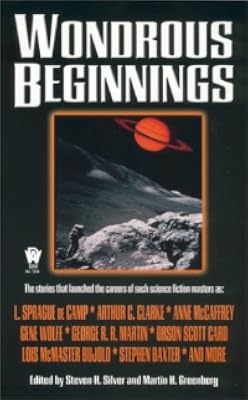
Wondrous Beginnings
by Steven H. Silver (Editor), Martin Harry Greenberg (Editor)
Beginnings Anthologies
On This Page
Description
Every great writer has to begin somewhere. Here, in one star-studded volume, are the debut stories from some of science fiction's best and brightest-with insightful new introductions by the authors themselves. These are stories that launched the careers of Ray Bradbury, Arthur C. Clarke, Anne McCaffrey, Orson Scott Card, L. Sprague de Camp, George R.R. Martin, Murray Leinster, Hal Clement, and other stellar talents.Tags
Recommendations









Member Reviews
Greenberg was a rather maniacal creator of anthologies. His name appeared on a bewildering number of anthologies as co-editor for many years. I have to think that he came up with the idea and the co-editor did all the work. He came up with a lot of good themes such as Catfantastic. I like the idea for this collection - the first published science fiction or fantasy story "the stories that launched the careers of such science fiction masters as ..."
Wikipedia tells me "he compiled 1,298 anthologies and commissioned over 8,200 original short stories" from 1974 through 2011, the year of his death. I thought the authors selected were a little odd, although I couldn't help but be impressed at the quality of the first published stories.
The show more stories in the 2003 collection range from 1919 to 1997 in chronological order, except Anne McCaffrey's is oddly out of place. The stories are (adapted from ISFDB):
13 • Introduction to Wondrous Beginnings • (2003) • essay by Steven H Silver
15 • Introduction to "The Runaway Skyscraper" • (2003) • essay by Betty Dehardit
17 • The Runaway Skyscraper • (1919) • novelette by Murray Leinster
59 • Introduction to "The Isolinguals" • (2003) • essay by L. Sprague de Camp
60 • The Isolinguals • (1937) • shortstory by L. Sprague de Camp
79 • Introduction to "Freedom of the Race" • (2003) • essay by Anne McCaffrey
80 • Freedom of the Race • (1953) • shortstory by Anne McCaffrey
83 • About "Proof," of Course • (2003) • essay by Hal Clement
84 • Proof • (1942) • shortstory by Hal Clement
101 • Loophole • (1946) • shortstory by Arthur C. Clarke
101 • Introduction to "Loophole" • (2003) • essay by Arthur C. Clarke
108 • Deadeye: Writing "The Dead Man" • (2003) • essay by Gene Wolfe
109 • The Dead Man • (1965) • shortstory by Gene Wolfe
114 • Introduction to "We're Coming Through the Window" • (2003) • essay by Barry N. Malzberg
116 • We're Coming Through the Window • (1967) • shortstory by Barry N. Malzberg as by K. M. O'Donnell
119 • Introduction to "The Hero" • (2003) • essay by George R. R. Martin
123 • The Hero • (1971) • shortstory by George R. R. Martin
136 • My (Other) World and Welcome to it: Writing "Lunchbox" • (2003) • essay by Howard Waldrop
141 • Lunchbox • (1972) • shortstory by Howard Waldrop
147 • The Origin of "Ender's Game" • (2003) • essay by Orson Scott Card
157 • Ender's Game • (1977) • novelette by Orson Scott Card
196 • Introduction to "The Emerson Effect" • (2003) • essay by Jack McDevitt
198 • The Emerson Effect • (1981) • shortstory by Jack McDevitt
216 • The Writing of "Much Ado About Nothing" • (2003) • essay by Jerry Oltion
217 • Much Ado About Nothing • (1982) • shortstory by Jerry Oltion
232 • Introduction to "Barter" • (2003) • essay by Lois McMaster Bujold
235 • Barter • (1985) • shortstory by Lois McMaster Bujold
244 • Introduction to "The Xeelee Flower" • (2003) • essay by Stephen Baxter
245 • The Xeelee Flower • Xeelee • (1987) • shortstory by Stephen Baxter
255 • Introduction to "Dance in Blue" • (2003) • essay by Catherine Asaro
256 • Dance in Blue • (1993) • novella by Catherine Asaro
278 • Introduction to "TeleAbsence" • (2003) • essay by Michael A. Burstein
280 • TeleAbsence • (1995) • shortstory by Michael A. Burstein
298 • Introduction to "First Contact Inc." • (2003) • essay by Julie E. Czerneda
299 • First Contact Inc. • (1997) • shortstory by Julie E. Czerneda
I think what surprised me most here is how well done the first story was for 1919 - one hundred years ago - although the theory of what happened and how to fix it was just too screwball. Still, "The Runaway Skyscraper" impressed me. I was also pleased to re-read the original Ender's Game. The original Ender's was a long short story and I read it when it was newish in the late 70's either in a Year's Best collection or a magazine. I had scarcely been reading science fiction for several years and it helped revived my interest in the genre. It amazed me then and still impresses me.
I won't detail my reactions to most of the stories. Each one comes with an intro, usually by the author, that varied in interest. For Hal Clement, an author I like, I was surprised that both his intro and the story were not enjoyable to me. Most of these intros are very good to terrific, giving us a little glimpse back in time to the author's life. In some ways they are the best part of this book. Orson Scott Card writes a very long intro to Ender's Game, giving us a look at his early life and the long path to the story that became Ender's Game. It is also a disturbing read as prejudices and beliefs ooze out even when they aren't brazenly put forth. Creeped me out. I stopped reading Card's stories a long time ago and I still think Ender's Game was one of the best stories to come out of the late 70's but I'll never seek out another one of Card's stories.
I loved George R. R. Martin's intro to "The Hero" in which he also gives us a glimpse at his early life leading to be a writer and the publication of "The Hero". The story itself was pretty good for a first story. Howard Waldrop's intro was also very good. I also enjoyed Jack McDevitt's "The Emerson Effect", a story I would not have encountered without this book. It only appeared in a Rod Serling's Twilight Zone issue of December 1981. Stephen Baxter's short but sweet "The XeeLee Flower', about a small alien artifact that allows the finder to survive a nova was a fun read.
"The Isolinguals" by Sprague de Camp is kind of a cute story but I couldn't help but feel there was a clever idea that could have been handled better. Overall this is a really good anthology. The only three stories I didn't care for were the ones by Clement and Bujold which really surprised me, and the one by Czerneda which just did not click with me. (I'm actually surprised that Bujold's short was published anywhere but it made it into a Rod Serling TZ issue (like McDevitt's)). I also really liked Asaro's "Dance in Blue." An impressive debut. show less
Wikipedia tells me "he compiled 1,298 anthologies and commissioned over 8,200 original short stories" from 1974 through 2011, the year of his death. I thought the authors selected were a little odd, although I couldn't help but be impressed at the quality of the first published stories.
The show more stories in the 2003 collection range from 1919 to 1997 in chronological order, except Anne McCaffrey's is oddly out of place. The stories are (adapted from ISFDB):
13 • Introduction to Wondrous Beginnings • (2003) • essay by Steven H Silver
15 • Introduction to "The Runaway Skyscraper" • (2003) • essay by Betty Dehardit
17 • The Runaway Skyscraper • (1919) • novelette by Murray Leinster
59 • Introduction to "The Isolinguals" • (2003) • essay by L. Sprague de Camp
60 • The Isolinguals • (1937) • shortstory by L. Sprague de Camp
79 • Introduction to "Freedom of the Race" • (2003) • essay by Anne McCaffrey
80 • Freedom of the Race • (1953) • shortstory by Anne McCaffrey
83 • About "Proof," of Course • (2003) • essay by Hal Clement
84 • Proof • (1942) • shortstory by Hal Clement
101 • Loophole • (1946) • shortstory by Arthur C. Clarke
101 • Introduction to "Loophole" • (2003) • essay by Arthur C. Clarke
108 • Deadeye: Writing "The Dead Man" • (2003) • essay by Gene Wolfe
109 • The Dead Man • (1965) • shortstory by Gene Wolfe
114 • Introduction to "We're Coming Through the Window" • (2003) • essay by Barry N. Malzberg
116 • We're Coming Through the Window • (1967) • shortstory by Barry N. Malzberg as by K. M. O'Donnell
119 • Introduction to "The Hero" • (2003) • essay by George R. R. Martin
123 • The Hero • (1971) • shortstory by George R. R. Martin
136 • My (Other) World and Welcome to it: Writing "Lunchbox" • (2003) • essay by Howard Waldrop
141 • Lunchbox • (1972) • shortstory by Howard Waldrop
147 • The Origin of "Ender's Game" • (2003) • essay by Orson Scott Card
157 • Ender's Game • (1977) • novelette by Orson Scott Card
196 • Introduction to "The Emerson Effect" • (2003) • essay by Jack McDevitt
198 • The Emerson Effect • (1981) • shortstory by Jack McDevitt
216 • The Writing of "Much Ado About Nothing" • (2003) • essay by Jerry Oltion
217 • Much Ado About Nothing • (1982) • shortstory by Jerry Oltion
232 • Introduction to "Barter" • (2003) • essay by Lois McMaster Bujold
235 • Barter • (1985) • shortstory by Lois McMaster Bujold
244 • Introduction to "The Xeelee Flower" • (2003) • essay by Stephen Baxter
245 • The Xeelee Flower • Xeelee • (1987) • shortstory by Stephen Baxter
255 • Introduction to "Dance in Blue" • (2003) • essay by Catherine Asaro
256 • Dance in Blue • (1993) • novella by Catherine Asaro
278 • Introduction to "TeleAbsence" • (2003) • essay by Michael A. Burstein
280 • TeleAbsence • (1995) • shortstory by Michael A. Burstein
298 • Introduction to "First Contact Inc." • (2003) • essay by Julie E. Czerneda
299 • First Contact Inc. • (1997) • shortstory by Julie E. Czerneda
I think what surprised me most here is how well done the first story was for 1919 - one hundred years ago - although the theory of what happened and how to fix it was just too screwball. Still, "The Runaway Skyscraper" impressed me. I was also pleased to re-read the original Ender's Game. The original Ender's was a long short story and I read it when it was newish in the late 70's either in a Year's Best collection or a magazine. I had scarcely been reading science fiction for several years and it helped revived my interest in the genre. It amazed me then and still impresses me.
I won't detail my reactions to most of the stories. Each one comes with an intro, usually by the author, that varied in interest. For Hal Clement, an author I like, I was surprised that both his intro and the story were not enjoyable to me. Most of these intros are very good to terrific, giving us a little glimpse back in time to the author's life. In some ways they are the best part of this book. Orson Scott Card writes a very long intro to Ender's Game, giving us a look at his early life and the long path to the story that became Ender's Game. It is also a disturbing read as prejudices and beliefs ooze out even when they aren't brazenly put forth. Creeped me out. I stopped reading Card's stories a long time ago and I still think Ender's Game was one of the best stories to come out of the late 70's but I'll never seek out another one of Card's stories.
I loved George R. R. Martin's intro to "The Hero" in which he also gives us a glimpse at his early life leading to be a writer and the publication of "The Hero". The story itself was pretty good for a first story. Howard Waldrop's intro was also very good. I also enjoyed Jack McDevitt's "The Emerson Effect", a story I would not have encountered without this book. It only appeared in a Rod Serling's Twilight Zone issue of December 1981. Stephen Baxter's short but sweet "The XeeLee Flower', about a small alien artifact that allows the finder to survive a nova was a fun read.
"The Isolinguals" by Sprague de Camp is kind of a cute story but I couldn't help but feel there was a clever idea that could have been handled better. Overall this is a really good anthology. The only three stories I didn't care for were the ones by Clement and Bujold which really surprised me, and the one by Czerneda which just did not click with me. (I'm actually surprised that Bujold's short was published anywhere but it made it into a Rod Serling TZ issue (like McDevitt's)). I also really liked Asaro's "Dance in Blue." An impressive debut. show less
http://nhw.livejournal.com/205953.html
Nice idea, getting the first published story of numerous well-known sf authors - to be specific, Murray Leinster, L Sprague de Camp, Anne McCaffrey, Hal Clement, Arthur C Clarke and so on, and publishing it in an anthology together with an introduction by the author in question (or in one case from his daughter). The stories are a bit variable in quality, but less than one might have thought, and the autobiographical material from each author more than makes up for it, especially for those who have since died (de Camp and Clement).
I did wonder what the rationale for choosing particular authors was. Why Clarke, but not Asimov or Heinlein? Why include authors as recent as Catherine Asaro (first story show more published 1993), Michael Burstein (1995), Julie Czerneda (1997)? And there's a definite leaning towards the hard end of the sf spectrum. None of these are necessarily bad things but it would have enlightened me if the editors had explained them. As it is the choice looks a little strange - and why is the Ann McCaffrey story apparently out of the order-of-initial-publication sequence that seems to link the rest? show less
Nice idea, getting the first published story of numerous well-known sf authors - to be specific, Murray Leinster, L Sprague de Camp, Anne McCaffrey, Hal Clement, Arthur C Clarke and so on, and publishing it in an anthology together with an introduction by the author in question (or in one case from his daughter). The stories are a bit variable in quality, but less than one might have thought, and the autobiographical material from each author more than makes up for it, especially for those who have since died (de Camp and Clement).
I did wonder what the rationale for choosing particular authors was. Why Clarke, but not Asimov or Heinlein? Why include authors as recent as Catherine Asaro (first story show more published 1993), Michael Burstein (1995), Julie Czerneda (1997)? And there's a definite leaning towards the hard end of the sf spectrum. None of these are necessarily bad things but it would have enlightened me if the editors had explained them. As it is the choice looks a little strange - and why is the Ann McCaffrey story apparently out of the order-of-initial-publication sequence that seems to link the rest? show less
Ratings
Members
- Recently Added By
Lists

Books Read in 2016
4,666 works; 197 members
Author Information

All Editions
Series

Belongs to Publisher Series
DAW Book Collectors (1245)
Work Relationships
Contains
Proof by Hal Clement
Common Knowledge
- Original publication date
- 2003-01
- People/Characters
- Bean; Ender Wiggin
- Important places
- Battle School; Mars; New York, USA; New York, New York, USA; USA
- Dedication
- To Elaine
- First words
- The whole thing started when the clock on the Metropolitan Tower began to run backward. ("The runaway skyscraper")
- Last words
- (Click to show. Warning: May contain spoilers.)"They already like our stuff." ("First Contact Inc.")
Classifications
Statistics
- Members
- 69
- Popularity
- 454,012
- Reviews
- 2
- Rating
- (3.67)
- Languages
- English
- Media
- Paper
- ISBNs
- 1