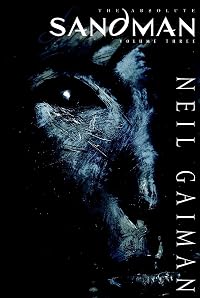
The Absolute Sandman Volume Three
by Neil Gaiman
The Sandman (The Absolute Sandman — Issues 40–56, Special 1, Vertigo Preview 1, Winter's Edge 3), The Sandman {1989-1996} (Absolute — Absolute, issues 40-56, Special 1)
On This Page
Description
"The third volume collecting Neil Gaiman's seminal, award-winning series starring the Dream King in deluxe format. ABSOLUTE SANDMAN VOL. 3 presents several key SANDMAN tales in a slipcased hardcover edition, including "Brief Lives," in which the Sandman's sister Delirium prevails upon her older brother to help her find their missing sibling, Destruction. But their journey through the Waking World has dramatic repercussions for their family and also for the relationship between the Sandman show more and his wayward son, Orpheus. Also included is the spectacular short story "Ramadan," a tale of a young king of ancient Baghdad and the deal he strikes with The Sandman to grant his city immortality, with spectacular illustrations by P. Craig Russell (Fairy Tales of Oscar Wilde, The Jungle Book). Never-before-collected bonus features include pin-up pages from galleries in THE SANDMAN #50 and SANDMAN SPECIAL #1, the Desire story from VERTIGO: WINTER'S EDGE #3, THE ENDLESS GALLERY #1, script and thumbnails from THE SANDMAN #50, and a section on the Endless retail products (poster, statues, t-shirts, Little Endless and more)! Plus, an introduction by artist Jill Thompson."--Publisher description. show lessTags
Recommendations

Member Reviews
As I'd mentioned earlier, I was somewhat lukewarm towards the earlier volumes of The Absolute Sandman. There was certainly an amazing mythology at work, but I found it hard to be interested in Dream as a character; often, I was more invested in the random people who got caught up in his adventures. (Curiously, all of these substitute protagonists seem to usually be women. I wonder if there's anything in that.) But the substory Brief Lives, collected here, changed all that. This story features Dream and his sister Delirium searching for their lost brother Destruction-- and in the process of that, Dream finally has to come to terms with his relationship with his son. It's half a road-trip comedy, half a meditation on knowing when to move show more on, and half a very dark fairy tale. It's definitely the funniest of the Sandman storylines... but it's also the most touching. I enjoyed every aspect of this one a lot, from Delirium's inane attempts to try to drive a mortal car, to Dream and Destruction's conversation on reuniting, from the first appearance of Merv, the pumpkinheaded janitor of the Dreaming, to the moment where Dream finally goes and sees Orpheus. Most of all, it's great to finally get a sense of Dream as a person. (Inasmuch as an anthropomorphic personification of an abstract universal concept can be one, I suppose.)
What struck me as I was reading it is that The Sandman really is a literary comic book. I mean, there have been plenty of literary graphic novels produced-- non-superhero fare that is done in one sitting. But The Sandman unlike most "highbrow" sequential art pieces, is completely and utterly a comic book: an ongoing, indefinite story. In total, the series comprises some 75 issues, and stories and characters and ideas weave in and out of these issues the same way they might in a Superman or Spider-Man ongoing. Gaiman really utilizes the potential of the comic ongoing to its maximum here, and that is the reason I like The Sandman as much as I do. It might have taken until Brief Lives for me to like The Sandman, but Brief Lives would never have worked without all the preceding issues to lead up to it. Gaiman has utterly mastered one of my favorite aspects of the medium here, and I find that delightful.
A brief word about the other storyline collected in this volume, Worlds' End. This is a collection of one-issue stories set in the world of The Sandman, but unlike many of the other ones, they're connected with a frame narrative. They're also the weakest; most of these did nothing at all for me. Strangely dull for Gaiman.
Neil Gaiman's The Sandman: « Previous in sequence | Next in sequence » show less
What struck me as I was reading it is that The Sandman really is a literary comic book. I mean, there have been plenty of literary graphic novels produced-- non-superhero fare that is done in one sitting. But The Sandman unlike most "highbrow" sequential art pieces, is completely and utterly a comic book: an ongoing, indefinite story. In total, the series comprises some 75 issues, and stories and characters and ideas weave in and out of these issues the same way they might in a Superman or Spider-Man ongoing. Gaiman really utilizes the potential of the comic ongoing to its maximum here, and that is the reason I like The Sandman as much as I do. It might have taken until Brief Lives for me to like The Sandman, but Brief Lives would never have worked without all the preceding issues to lead up to it. Gaiman has utterly mastered one of my favorite aspects of the medium here, and I find that delightful.
A brief word about the other storyline collected in this volume, Worlds' End. This is a collection of one-issue stories set in the world of The Sandman, but unlike many of the other ones, they're connected with a frame narrative. They're also the weakest; most of these did nothing at all for me. Strangely dull for Gaiman.
Neil Gaiman's The Sandman: « Previous in sequence | Next in sequence » show less
Well, this is of course, brilliant. But why? It occurs to me that the world Gaiman set up for himself was in fact the perfect tool for him: He could incorporate any mythology, religion, genre, location or time and still make it all self-consistent, hence allowing his imagination to go wherever it wanted or needed to. This particular volume is a great showcase for this variety and it is enhanced by the various changes in art style accompanying the changes in mood, atmosphere, character and location.
Bring on Vol. IV!
Bring on Vol. IV!
I started being diligent about reviewing the books I read here as a form of diary. I've never been vey good at diaries but I do like writing about books, and I tend to associate books with the times and places I read them. I regret that I was a bit slow about including graphic novels, but that's neither here not there. So I'm prefacing this review with a remark almost entirely of interest to none but myself.
The reason for the gap between the review of volume one in this series and the subsequent volumes was because volume three and four arrived from the library weeks ago and volume two only arrived the other day. I'm not complaining, I'm amazed and delighted to have them, even of only on loan, and I'm delighted that they're out there show more in the system for others to enjoy. I was searching for a copy of Overture, actually, when I came across the Absolutes in the system and promptly decided that it was time to read the whole series. Volume five is there too, but, apparently, 'for library use only.' Since it consists of ancillary stories, and the main story ends in volume four, I'll get by without it for now.
Anyway, yay libraries, as Lucien would no doubt agree.
Onto Brief Lives, then, the longest story so far. Delirium decides it's time to find the lost brother of the Endless and ask him to come back. After some toing and froing, Dream, on the rebound from a break-up, goes along with her, half as a distraction, half in the hopes of running into hos lady-love, whoever she may be. Throughout the series it has become apparent that Dream is his own worst enemy or his own best friend, depending on how you view things. Certainly he is making decisions that lead to certain inescapable conclusions all the while insisting that he's doing them for other reasons and he hasn't really changed at all. Their search sets of events which damage and destroy certain lives, and this actually bothers him. In order to find his brother he has to make a certain sacrifice. Why does he do it? His sense of obligation and responsibility has broadened, perhaps, or he has become aware of blind spots and gaps in his approach to them, and maybe this is the breaking point. It's all there now, all ready to go. What's next is inevitable.
After Brief Lives comes Worlds End, more masterful stories, including the great Wolfe homage and big sign saying SOMEONE IS GOING TO DIE which, in case you were slow on the uptake, is followed by a massive vision of a funeral. Artists include Mike Zulli, and there's another cruel but lush Zulli story right at the end. The script for Ramadan is included, and it's possibly the least informative of all the scripts, except to compare it to Russel's gorgeous execution of the story and the layouts is stunning. show less
The reason for the gap between the review of volume one in this series and the subsequent volumes was because volume three and four arrived from the library weeks ago and volume two only arrived the other day. I'm not complaining, I'm amazed and delighted to have them, even of only on loan, and I'm delighted that they're out there show more in the system for others to enjoy. I was searching for a copy of Overture, actually, when I came across the Absolutes in the system and promptly decided that it was time to read the whole series. Volume five is there too, but, apparently, 'for library use only.' Since it consists of ancillary stories, and the main story ends in volume four, I'll get by without it for now.
Anyway, yay libraries, as Lucien would no doubt agree.
Onto Brief Lives, then, the longest story so far. Delirium decides it's time to find the lost brother of the Endless and ask him to come back. After some toing and froing, Dream, on the rebound from a break-up, goes along with her, half as a distraction, half in the hopes of running into hos lady-love, whoever she may be. Throughout the series it has become apparent that Dream is his own worst enemy or his own best friend, depending on how you view things. Certainly he is making decisions that lead to certain inescapable conclusions all the while insisting that he's doing them for other reasons and he hasn't really changed at all. Their search sets of events which damage and destroy certain lives, and this actually bothers him. In order to find his brother he has to make a certain sacrifice. Why does he do it? His sense of obligation and responsibility has broadened, perhaps, or he has become aware of blind spots and gaps in his approach to them, and maybe this is the breaking point. It's all there now, all ready to go. What's next is inevitable.
After Brief Lives comes Worlds End, more masterful stories, including the great Wolfe homage and big sign saying SOMEONE IS GOING TO DIE which, in case you were slow on the uptake, is followed by a massive vision of a funeral. Artists include Mike Zulli, and there's another cruel but lush Zulli story right at the end. The script for Ramadan is included, and it's possibly the least informative of all the scripts, except to compare it to Russel's gorgeous execution of the story and the layouts is stunning. show less
This volume collects the Brief Lives storyline, where Dream and Delirium go looking for their missing brother, and the World's End story, where several strangers are marooned in a mysterious inn during a reality storm. It also contains some short, one-issue stories, including the story Ramadan where the caliph of Baghdad sells his city, as well as extensive galleries and the full script of Ramadan.
Neither of the two longer storylines are among my favourite Sandman stories. World's End in particular, I feel is on the weaker side, I don't care much about the characters involved, or about their stories, which only become interesting when there are fleeting glimpses of the larger mythology of the series. Only towards the very end does show more something happen which is of interest to me, so it took me quite some time to get through it, I kept taking pauses and reading other things along the way.
Brief Lives, on the other hand, is quite good. Though I say it is not among my favourites, this has more to do with so much of Sandman being extremely good than Brief Lives being poor. Possibly, the reason I don't go nuts for it is that it heavily features Delirium, whom I've never quite seen the attraction of. It is an interesting story, not least because it finally introduces us to the missing Endless, and for its connection to the Orpheus myth. And, of course, it contains important set-up for the rest of the series. In general I quite enjoy stories where the mundane is invaded by the fantastic, so I'm not really sure why this one doesn't sit so well with me.
Ramadan, however, is one of my favourites. It is a beautiful story, written to resemble a tale from One Thousand and One Nights, and though it's been a while since I last looked in a copy of that, it seems to me a very good emulation of the style.
The writing here is superb, and aside from some of the one-shots in World's End, so are the characters. The drawings are beautiful throughout, I have no complaints at all on the art. And seeing Death and Dream as children is practically worth the price of admission.
As for the extras, I don't really have any complaints, but I'm not singing praises either. The many gallery pictures are pretty, but I'm just not the type of person who enjoys looking at that sort of feature for long. The script for Ramadan is interesting in its way, I suppose, but I'm not sure why I would read the story in script form when it's available in full-fledged comic form just a few pages earlier. I did however enjoy the little documentary pieces on Sandman merchandise, specifically the Little Endless statues.
Ultimately, this has to be seen as part of the longer Sandman story rather than a work in its own right, I think. It doesn't make sense to recommend the third quarter of a story to people, so I have to recommend Sandman as a whole. And I do. Very strongly. Sandman is a fantastic comic, and you are definitely missing out if you haven't read it.
And if you have read it, and are wondering whether the over-sized deluxe edition is worth it, I'd have to say yes. Not, perhaps, if you already own the series, but if you've been holding off on buying it, this is what you've been waiting for. The book itself is beautiful; large, heavy and bound in leather, and looking just as mysterious and inviting as a Sandman book should. show less
Neither of the two longer storylines are among my favourite Sandman stories. World's End in particular, I feel is on the weaker side, I don't care much about the characters involved, or about their stories, which only become interesting when there are fleeting glimpses of the larger mythology of the series. Only towards the very end does show more something happen which is of interest to me, so it took me quite some time to get through it, I kept taking pauses and reading other things along the way.
Brief Lives, on the other hand, is quite good. Though I say it is not among my favourites, this has more to do with so much of Sandman being extremely good than Brief Lives being poor. Possibly, the reason I don't go nuts for it is that it heavily features Delirium, whom I've never quite seen the attraction of. It is an interesting story, not least because it finally introduces us to the missing Endless, and for its connection to the Orpheus myth. And, of course, it contains important set-up for the rest of the series. In general I quite enjoy stories where the mundane is invaded by the fantastic, so I'm not really sure why this one doesn't sit so well with me.
Ramadan, however, is one of my favourites. It is a beautiful story, written to resemble a tale from One Thousand and One Nights, and though it's been a while since I last looked in a copy of that, it seems to me a very good emulation of the style.
The writing here is superb, and aside from some of the one-shots in World's End, so are the characters. The drawings are beautiful throughout, I have no complaints at all on the art. And seeing Death and Dream as children is practically worth the price of admission.
As for the extras, I don't really have any complaints, but I'm not singing praises either. The many gallery pictures are pretty, but I'm just not the type of person who enjoys looking at that sort of feature for long. The script for Ramadan is interesting in its way, I suppose, but I'm not sure why I would read the story in script form when it's available in full-fledged comic form just a few pages earlier. I did however enjoy the little documentary pieces on Sandman merchandise, specifically the Little Endless statues.
Ultimately, this has to be seen as part of the longer Sandman story rather than a work in its own right, I think. It doesn't make sense to recommend the third quarter of a story to people, so I have to recommend Sandman as a whole. And I do. Very strongly. Sandman is a fantastic comic, and you are definitely missing out if you haven't read it.
And if you have read it, and are wondering whether the over-sized deluxe edition is worth it, I'd have to say yes. Not, perhaps, if you already own the series, but if you've been holding off on buying it, this is what you've been waiting for. The book itself is beautiful; large, heavy and bound in leather, and looking just as mysterious and inviting as a Sandman book should. show less
Summary: Volume Three of the Absolute Sandman series offers up one large story arc, "Brief Lives" (and the single-issue "Song of Orpheus", which is essentially a prequel.) In this, Delerium is on a mission to find her brother, the only one of the Endless who has abdicated his responsibilities and gone missing. Dream agrees to accompany her, albeit for his own reasons, and neither of them quite gets what they were looking for. There's also a smaller "arc", World's End, which is primarily composed of stories told by travelers who have wound up stuck at the Inn at Worlds End. There are also several single-issue stories, including the acclaimed "Ramadan", as well as "A Parliment of Rooks", in which we get a brief look at Dream and Death as show more children.
Review: I'm having somewhat of a hard time gauging my reaction to this volume. On the one hand, I found the stories - particularly "Brief Lives" - to be really interesting, since they're the first time that I've really felt like each of the individual volumes is part of a whole. I still can't see the story arc of the series entire, but I've glimpsed it, and there's clearly been some character growth and some story progress since the beginning. (Plus, I like the rest of the Endless almost as much as I like Dream, and I really enjoy watching them interact as a family.) On the other hand, though, nothing in this volume was as emotionally driven or as wholly satisfying as either of the arcs from Volume 2, "Season of Mists" or "A Game of You". Nor did any of the single-issues stories (or any of the stories within "World's End") really capture my imagination the way some of the earlier ones have. So while it's fascinating watching Gaiman spin an entire new world out of bits of mythology and stories from every corner of the Earth, this volume just didn't quite have the resonance I could have wished for. 4 out of 5 stars.
Recommendation: Don't start on Volume 3, obviously, but the series as a whole is absolutely worth reading, and I'm curious to see how the pieces all fit together in Volume 4. show less
Review: I'm having somewhat of a hard time gauging my reaction to this volume. On the one hand, I found the stories - particularly "Brief Lives" - to be really interesting, since they're the first time that I've really felt like each of the individual volumes is part of a whole. I still can't see the story arc of the series entire, but I've glimpsed it, and there's clearly been some character growth and some story progress since the beginning. (Plus, I like the rest of the Endless almost as much as I like Dream, and I really enjoy watching them interact as a family.) On the other hand, though, nothing in this volume was as emotionally driven or as wholly satisfying as either of the arcs from Volume 2, "Season of Mists" or "A Game of You". Nor did any of the single-issues stories (or any of the stories within "World's End") really capture my imagination the way some of the earlier ones have. So while it's fascinating watching Gaiman spin an entire new world out of bits of mythology and stories from every corner of the Earth, this volume just didn't quite have the resonance I could have wished for. 4 out of 5 stars.
Recommendation: Don't start on Volume 3, obviously, but the series as a whole is absolutely worth reading, and I'm curious to see how the pieces all fit together in Volume 4. show less
I didn't really care for the first arc in this book. It was nice too see a bit more of the endless, but the quest is so so. I like the Orpheus bit, but Desire is starting to give me the creeps...
Then came the tavern at the end of the worlds arc. This is another multiple PoV arc, most of the stories only connect marginally with the endless, but I need an annotated sandman to get all the references in the stories, because I spotted enough of them to know there are many more I didn't get.
This arc plot goes: several travelers are caught in a storm, find refuge in a tavern, and tell stories, to pass the time and earn their keep.
Between this 2 arcs there's this beautiful Arabian Nights style story called Ramadan. I believe it's issue 50. It show more is one of my favourite issues so far, along with the closing the gates of Hell issue. In the end there's the script and the behind the scenes, how this came to be, story.
I switched to the Absolute version of Sandman because it does wonders for the art. And in this book there are some of the most beautiful pages I have seen.
In Ramadan there is this beautiful Arabian Nights style, full of merengue toped spires, and Arabian inspired lettering, and jewels and markets full of people and wonders.
In the tavern arc, each story is drawn in a very different style, some of them I loved, they could almost tell the story with no words, some were more normal comics style, some were creepy, but they fitted the stories being told...
And for all the Fables fans out there I'll just say this. Jack of Fables is a total Easter Egg. I'm not the recognised the artist type of girl, but I totally guessed who draw the art on the first arc. There is a character there that could be Jack's brother. show less
Then came the tavern at the end of the worlds arc. This is another multiple PoV arc, most of the stories only connect marginally with the endless, but I need an annotated sandman to get all the references in the stories, because I spotted enough of them to know there are many more I didn't get.
This arc plot goes: several travelers are caught in a storm, find refuge in a tavern, and tell stories, to pass the time and earn their keep.
Between this 2 arcs there's this beautiful Arabian Nights style story called Ramadan. I believe it's issue 50. It show more is one of my favourite issues so far, along with the closing the gates of Hell issue. In the end there's the script and the behind the scenes, how this came to be, story.
I switched to the Absolute version of Sandman because it does wonders for the art. And in this book there are some of the most beautiful pages I have seen.
In Ramadan there is this beautiful Arabian Nights style, full of merengue toped spires, and Arabian inspired lettering, and jewels and markets full of people and wonders.
In the tavern arc, each story is drawn in a very different style, some of them I loved, they could almost tell the story with no words, some were more normal comics style, some were creepy, but they fitted the stories being told...
And for all the Fables fans out there I'll just say this. Jack of Fables is a total Easter Egg. I'm not the recognised the artist type of girl, but I totally guessed who draw the art on the first arc. There is a character there that could be Jack's brother. show less
This volume contains my two favourite Sandman collections, "Brief Lives" and "Worlds' End", as well as my favourite stand-alone story "Ramadan", and "The Song of Orpheus". I absolutely love the stories: both "Ramadan" and "Brief Lives" made me cry; I love the characters (currently trying to get over a mild crush on Destruction). And the artwork in this volume is absolutely gorgeous. Hey, even the colourists got it right!
Members
- Recently Added By
Lists

Recommended Comics / Graphic Novels
595 works; 122 members

70 of the Best Horror Comics
178 works; 5 members

Books Read in 2012
816 works; 34 members
Author Information

844+ Works 450,038 Members
Neil Gaiman was born in Portchester, England on November 10, 1960. He worked as a journalist and freelance writer for a time, before deciding to try his hand at comic books. Some of his work has appeared in publications such as Time Out, The Sunday Times, Punch, and The Observer. His first comic endeavor was the graphic novel series The Sandman. show more The series has won every major industry award including nine Will Eisner Comic Industry Awards, three Harvey Awards, and the 1991 World Fantasy Award for best short story, making it the first comic ever to win a literary award. He writes both children and adult books. His adult books include The Ocean at the End of the Lane, which won a British National Book Awards, and the Locus Award for Best Fantasy Novel for 2014; Stardust, which won the Mythopoeic Award as best novel for adults in 1999; American Gods, which won the Hugo, Nebula, Bram Stoker, SFX, and Locus awards; Anansi Boys; Trigger Warning: Short Fictions and Disturbances; and The View from the Cheap Seats: Selected Nonfiction, which is a New York Times Bestseller. His children's books include The Day I Swapped My Dad for Two Goldfish; Coraline, which won the Elizabeth Burr/Worzalla, the BSFA, the Hugo, the Nebula, and the Bram Stoker awards; The Wolves in the Walls; Odd and the Frost Giants; The Graveyard Book, which won the Newbery Award in 2009 and The Sandman: Overture which won the 2016 Hugo Awards Best Graphic Story. (Bowker Author Biography) show less
All Editions
Some Editions
Series

The Sandman
11 works (The Absolute Sandman — Issues 40–56, Special 1, Vertigo Preview 1, Winter's Edge 3)

The Sandman {1989-1996}
76 works (Absolute — Absolute, issues 40-56, Special 1)
Belongs to Publisher Series
Work Relationships
Is contained in
Contains
Is an abridged version of
Inspired
Common Knowledge
- Canonical title
- The Absolute Sandman Volume Three
- Original publication date
- 1991 - 1999 (original issues) (original issues); 2008-05-28
- People/Characters
- Dream (Morpheus); Death of the Endless; Desire of the Endless; Delirium of the Endless; Destiny of the Endless; Despair of the Endless (show all 8); Destruction of the Endless; Orpheus
Classifications
- Genre
- Graphic Novels & Comics
- DDC/MDS
- 741.5973 — Arts & recreation Drawing & decorative arts Drawing Comic books, graphic novels, fotonovelas, cartoons, caricatures, comic strips History, geographic treatment, biography North American United States (General)
- LCC
- PN6728 .S26 .G244 — Language and Literature Literature (General) Literature (General) Collections of general literature Comic books, strips, etc.
- BISAC
Statistics
- Members
- 1,025
- Popularity
- 25,343
- Reviews
- 18
- Rating
- (4.70)
- Languages
- English, Hungarian, Italian, Portuguese
- Media
- Paper
- ISBNs
- 5
- ASINs
- 3