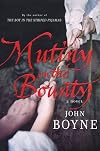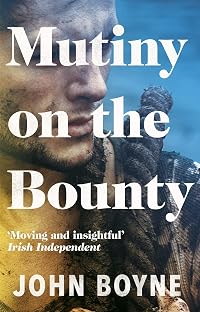
Mutiny on the Bounty
by John Boyne
On This Page
Description
Internationally bestselling author John Boyne has been praised as "one of the best and original of the new generation of Irish writers" by the Irish Examiner. With Mutiny, he's created an eye-opening story of life--and death--at sea. Fourteen-year-old pickpocket John Jacob Turnstile has just been caught red-handed and is on his way to prison when an offer is put to him---a ship has been refitted over the last few months and is about to set sail with an important mission. The boy who was show more expected to serve as the captain's personal valet has been injured and a replacement must be found immediately. Given the choice of prison or a life at sea, John soon finds himself on board, meeting the captain, just as the ship sets sail. The ship is the Bounty, the captain is William Bligh, and their destination is Tahiti. Their journey, however, will become one of the most infamous in naval history. Mutiny is the first novel to explore all the events relating to the Bounty's voyage, from the long passage across the ocean to their adventures on the island of Tahiti and the subsequent forty-eight-day expedition toward Timor. This vivid retelling of the notorious mutiny is packed with humor, violence, and historical detail, while presenting an intriguingly different portrait of Captain Bligh and Mr. Christian than has ever been presented before. show lessTags
Recommendations





























Member Recommendations
Member Reviews
From a fictional mutiny to perhaps the most famous of all mutinies - sadly underplayed by lazy writing. After reading The Absolutist and now this, I'm starting to doubt that John Boyne even bothers with research when writing historical fiction.
The facts of the famous mutiny, in which Lieutenant William Bligh and eighteen loyal crew were forced from the HMS Bounty in April 1789 and set adrift, are commandeered by Boyne's obnoxious narrator, an Oliver Twist style urchin who is made the captain's 'servant boy' rather than serve time for petty theft. John Jacob Turnstile - Boyne is so taken with his character's name that he regularly drops the full moniker into the narrative - is a good-looking youth, oddly well spoken for an orphan with no show more education, and Bligh is naturally taken with him. Instead of letting the captain speak for himself, which would have suited Boyne's vigorous defence of Bligh, we are subjected to the Turnip's rather modern take on events (he objects to slavery and can't understand his low ranking on the ship). The mutiny, and Captain Bligh's heroic efforts to sail his reduced crew to safety, are thereby reduced to a bildungsroman for a cheap copy of a Dickens street urchin (dressed up as a child prostitute in a molly house, because being an orphan just isn't dramatic enough).
The anachronisms distracted me from the Turnip's narrative, however, which I am actually grateful for in this instance. Considering that Boyne decided to bestow such an unsavoury childhood on his young protagonist, I am surprised that he couldn't be bothered to check the meaning of the slang term 'molly', which an eighteenth century man would have taken to mean 'an effeminate or homosexual male', not a young lady. Also, he has policemen - improbably concerned with raiding houses of ill-repute - in the late 1700s, a good thirty years before Robert Peel thought of them, and references to the polka and the foxtrot a century before those dances were popular.
Nitpicking aside, Boyne's dialogue is no better than his historical accuracy. Even presuming that Turnstile is recounting the mutiny from years later, where did the young 'molly' acquire his formal, educated speech, and why is his naval terminology so painfully inaccurate (C.S. Forester this is not)? Also, the pseudo-Dickens slang terms that Boyne peppers the narrative with - 'the scuts', 'every man-jack of us', 'gave me the motions' - become cliched by the end of the book. When Turnstile started throwing in phrases like 'sure as eggs is eggs' and 'the rest is history', I was ready to commit literary mutiny myself.
There is no denying that the mutiny on the Bounty is almost legendary, and for good reason, but Boyne does history - and Captain Bligh - no favours. He even ruins a good YA version of events by throwing in coarse language and sexual references. To get a better idea of what really happened, I would recommend reading the non-fiction sources that Boyne lists at the end of the book, because I'm not sure that the author did. show less
The facts of the famous mutiny, in which Lieutenant William Bligh and eighteen loyal crew were forced from the HMS Bounty in April 1789 and set adrift, are commandeered by Boyne's obnoxious narrator, an Oliver Twist style urchin who is made the captain's 'servant boy' rather than serve time for petty theft. John Jacob Turnstile - Boyne is so taken with his character's name that he regularly drops the full moniker into the narrative - is a good-looking youth, oddly well spoken for an orphan with no show more education, and Bligh is naturally taken with him. Instead of letting the captain speak for himself, which would have suited Boyne's vigorous defence of Bligh, we are subjected to the Turnip's rather modern take on events (he objects to slavery and can't understand his low ranking on the ship). The mutiny, and Captain Bligh's heroic efforts to sail his reduced crew to safety, are thereby reduced to a bildungsroman for a cheap copy of a Dickens street urchin (dressed up as a child prostitute in a molly house, because being an orphan just isn't dramatic enough).
The anachronisms distracted me from the Turnip's narrative, however, which I am actually grateful for in this instance. Considering that Boyne decided to bestow such an unsavoury childhood on his young protagonist, I am surprised that he couldn't be bothered to check the meaning of the slang term 'molly', which an eighteenth century man would have taken to mean 'an effeminate or homosexual male', not a young lady. Also, he has policemen - improbably concerned with raiding houses of ill-repute - in the late 1700s, a good thirty years before Robert Peel thought of them, and references to the polka and the foxtrot a century before those dances were popular.
Nitpicking aside, Boyne's dialogue is no better than his historical accuracy. Even presuming that Turnstile is recounting the mutiny from years later, where did the young 'molly' acquire his formal, educated speech, and why is his naval terminology so painfully inaccurate (C.S. Forester this is not)? Also, the pseudo-Dickens slang terms that Boyne peppers the narrative with - 'the scuts', 'every man-jack of us', 'gave me the motions' - become cliched by the end of the book. When Turnstile started throwing in phrases like 'sure as eggs is eggs' and 'the rest is history', I was ready to commit literary mutiny myself.
There is no denying that the mutiny on the Bounty is almost legendary, and for good reason, but Boyne does history - and Captain Bligh - no favours. He even ruins a good YA version of events by throwing in coarse language and sexual references. To get a better idea of what really happened, I would recommend reading the non-fiction sources that Boyne lists at the end of the book, because I'm not sure that the author did. show less
John Boyne has long been a favorite author of mine — in part because each book he writes is so distinctive in style and substance from his others. True with this one as well. A tension-filled adventure story from the start, MUTINY: A NOVEL OF THE BOUNTY recounts the story of the famous British ship and it's 1789 voyage to Tahiti to bring back breadfruit -- but with a completely new spin! Posing new questions like who were the heroes and who were the true villains?
I admit I find it particularly creative for a writer to take a story many of us are familiar with (i.e. the legend of King Arthur) and tackle it from a different angle. In this version, Boyne uses language that feels true to the 18th century time period, building a narrative show more around the first person accounting by John Jacob Turnstile, a fourteen-year-old self-aggrandizing pickpocket who becomes the personal servant to Captain William Bligh, rather than face a jail sentence. So the novel doubles as John's coming-of-age story where he struggles to find his rightful place as a newbie among the crew and ends up witnesses the unexpected drama of a mutiny.
Readers are introduced to the famous people so many of us have heard about. Captain Bligh and Fletcher Christian as well as other lesser known officers and members of the crew. Many on HMS Bounty carry secrets. Some have previous experience with this Captain. A few harbor personal rivalries.
It turns out to be a difficult journey from the start. Severe storms bring challenges. The crew is full of superstitions and John must endure a brutal rite of passage. Travel to Tahiti takes much longer than expected and requires a significant detour. So that when the ship finally arrives at their "island paradise”, everyone is desperate for a respite.
The mutiny and subsequent 48-day travail faced by those who do not support it is so filled with drama and tension I found I needed occasionally to take a break from reading. But I came to love John and several other characters and became fully vested in their fates. So much so that when MUTINY: A NOVEL OF THE BOUNTY ended, I felt truly sad to leave them all behind. show less
I admit I find it particularly creative for a writer to take a story many of us are familiar with (i.e. the legend of King Arthur) and tackle it from a different angle. In this version, Boyne uses language that feels true to the 18th century time period, building a narrative show more around the first person accounting by John Jacob Turnstile, a fourteen-year-old self-aggrandizing pickpocket who becomes the personal servant to Captain William Bligh, rather than face a jail sentence. So the novel doubles as John's coming-of-age story where he struggles to find his rightful place as a newbie among the crew and ends up witnesses the unexpected drama of a mutiny.
Readers are introduced to the famous people so many of us have heard about. Captain Bligh and Fletcher Christian as well as other lesser known officers and members of the crew. Many on HMS Bounty carry secrets. Some have previous experience with this Captain. A few harbor personal rivalries.
It turns out to be a difficult journey from the start. Severe storms bring challenges. The crew is full of superstitions and John must endure a brutal rite of passage. Travel to Tahiti takes much longer than expected and requires a significant detour. So that when the ship finally arrives at their "island paradise”, everyone is desperate for a respite.
The mutiny and subsequent 48-day travail faced by those who do not support it is so filled with drama and tension I found I needed occasionally to take a break from reading. But I came to love John and several other characters and became fully vested in their fates. So much so that when MUTINY: A NOVEL OF THE BOUNTY ended, I felt truly sad to leave them all behind. show less
John Boyne has long been a favorite author of mine — in part because each book he writes is so distinctive in style and substance from his others. True with this one as well. A tension-filled adventure story from the start, MUTINY: A NOVEL OF THE BOUNTY recounts the story of the famous British ship and it's 1789 voyage to Tahiti to bring back breadfruit -- but with a completely new spin! Posing new questions like who were the heroes and who were the true villains?
I admit I find it particularly creative for a writer to take a story many of us are familiar with (i.e. the legend of King Arthur) and tackle it from a different angle. In this version, Boyne uses language that feels true to the 18th century time period, building a narrative show more around the first person accounting by John Jacob Turnstile, a fourteen-year-old self-aggrandizing pickpocket who becomes the personal servant to Captain William Bligh, rather than face a jail sentence. So the novel doubles as John's coming-of-age story where he struggles to find his rightful place as a newbie among the crew and ends up witnesses the unexpected drama of a mutiny.
Readers are introduced to the famous people so many of us have heard about. Captain Bligh and Fletcher Christian as well as other lesser known officers and members of the crew. Many on HMS Bounty carry secrets. Some have previous experience with this Captain. A few harbor personal rivalries.
It turns out to be a difficult journey from the start. Severe storms bring challenges. The crew is full of superstitions and John must endure a brutal rite of passage. Travel to Tahiti takes much longer than expected and requires a significant detour. So that when the ship finally arrives at their "island paradise”, everyone is desperate for a respite.
The mutiny and subsequent 48-day travail faced by those who do not support it is so filled with drama and tension I found I needed occasionally to take a break from reading. But I came to love John and several other characters and became fully vested in their fates. So much so that when MUTINY: A NOVEL OF THE BOUNTY ended, I felt truly sad to leave them all behind. show less
I admit I find it particularly creative for a writer to take a story many of us are familiar with (i.e. the legend of King Arthur) and tackle it from a different angle. In this version, Boyne uses language that feels true to the 18th century time period, building a narrative show more around the first person accounting by John Jacob Turnstile, a fourteen-year-old self-aggrandizing pickpocket who becomes the personal servant to Captain William Bligh, rather than face a jail sentence. So the novel doubles as John's coming-of-age story where he struggles to find his rightful place as a newbie among the crew and ends up witnesses the unexpected drama of a mutiny.
Readers are introduced to the famous people so many of us have heard about. Captain Bligh and Fletcher Christian as well as other lesser known officers and members of the crew. Many on HMS Bounty carry secrets. Some have previous experience with this Captain. A few harbor personal rivalries.
It turns out to be a difficult journey from the start. Severe storms bring challenges. The crew is full of superstitions and John must endure a brutal rite of passage. Travel to Tahiti takes much longer than expected and requires a significant detour. So that when the ship finally arrives at their "island paradise”, everyone is desperate for a respite.
The mutiny and subsequent 48-day travail faced by those who do not support it is so filled with drama and tension I found I needed occasionally to take a break from reading. But I came to love John and several other characters and became fully vested in their fates. So much so that when MUTINY: A NOVEL OF THE BOUNTY ended, I felt truly sad to leave them all behind. show less
John Jacob Turnstile earns his living on the streets of Portsmouth as a petty thief. He has no real life, no real friends, employed in the services of Mr Lewis and used periodically to feed the sexual desires of propertied gentlemen. When the theft of a pocket watch leads to the arrest of young Master Turnstile it seems he is destined to spend a year incarcerated until an unexpected opportunity results in a change of fortune. John Turnstile is informed that if he joins the crew of the Bounty, on her mission to Otaheite, better known as Tahiti, he will on his return be a free man. On the Bounty he is of little importance his main role attending to the whims and desires of none other than Captain William Bligh.
What follows is a rollicking show more adventure as we sail the high seas in the company of a motley crew including the infamous Christian Fletcher. It of course comes as no surprise for me to tell you that a mutiny takes place and young Turnstile together with 18 crew members are set adrift in the Pacific ocean. Every page of John Boyne's extraordinary novel bristles with the taste and feel of what it was like to sail the high seas at the end of the 18th century. The crew faces the constant battering of inclement weather, the fear of pillaging pirates, and the threat of Scurvy, the disease of discovery, which ravaged both body and mind, and was caused by chronic vitamin C deficiency, brought on by lack of fresh fruit and vegetables. In the second part of the book when the mutiny takes places our survivors, under the remarkable leadership of Bligh, cling to life on a minuscule diet in the hope that they can replenish and refuel at the numerous Polynesian islands in the vicinity of Tahiti. This in turn leads to further turmoil when hostile inhabitants seem content on killing our brave sailors and cannibalizing their remains.
From the opening paragraph to the very satisfactory, poignant and just conclusion once again John Boyne has proved himself a master storyteller. Every page of his fictional account (but based on the known facts) sparkles with energy and a vibrancy that is so often missing in writing today. It is not only a boys own adventure but a beautiful coming of age story as John Turnstile uses opportunity offered to turn himself from a worthless street urchin into a man of some standing. Readers and admirers of Boyne will be delighted at this change in direction, if the art of a storyteller can be measured in his ability to create a narrative and compose a picture out of any situation then surely John Boyne has no equal. Wonderful colourful writing by one of my favourite authors and oh so highly recommended. show less
What follows is a rollicking show more adventure as we sail the high seas in the company of a motley crew including the infamous Christian Fletcher. It of course comes as no surprise for me to tell you that a mutiny takes place and young Turnstile together with 18 crew members are set adrift in the Pacific ocean. Every page of John Boyne's extraordinary novel bristles with the taste and feel of what it was like to sail the high seas at the end of the 18th century. The crew faces the constant battering of inclement weather, the fear of pillaging pirates, and the threat of Scurvy, the disease of discovery, which ravaged both body and mind, and was caused by chronic vitamin C deficiency, brought on by lack of fresh fruit and vegetables. In the second part of the book when the mutiny takes places our survivors, under the remarkable leadership of Bligh, cling to life on a minuscule diet in the hope that they can replenish and refuel at the numerous Polynesian islands in the vicinity of Tahiti. This in turn leads to further turmoil when hostile inhabitants seem content on killing our brave sailors and cannibalizing their remains.
From the opening paragraph to the very satisfactory, poignant and just conclusion once again John Boyne has proved himself a master storyteller. Every page of his fictional account (but based on the known facts) sparkles with energy and a vibrancy that is so often missing in writing today. It is not only a boys own adventure but a beautiful coming of age story as John Turnstile uses opportunity offered to turn himself from a worthless street urchin into a man of some standing. Readers and admirers of Boyne will be delighted at this change in direction, if the art of a storyteller can be measured in his ability to create a narrative and compose a picture out of any situation then surely John Boyne has no equal. Wonderful colourful writing by one of my favourite authors and oh so highly recommended. show less
A marvellously entertaining read. John Jacob Turnstile is a pickpocket in Portsmouth who, to avoid going to prison for a year, accepts a berth as Captain Bligh's servant aboard the HMS Bounty. The novel is Turnstile's account of his life on the voyage and on Otaheiti (Tahiti) and on the small launch on which he, Captain Bligh and the rest of those loyal to him are set adrift after the mutiny led by Fletcher Christian. Turnstile himself is fictional, but the other characters on board the ship all real and the events follow closely those recorded in the captain's logbook and other accounts. Bligh emerges as a largely sympathetic man, genuinely concerned for the welfare of his crew, if sometimes failing to understand them at an individual, show more human level. A great read. show less
A fascinating, fresh take on the historical mutiny aboard the HMS Bounty, this novel provides a more sympathetic portrayal (and possibly more true-to-life account) of Captain Bligh than the more sensational Hollywood narratives around the same incident. John Boyne's narrative style sets up a quick narrative pace that drives the reader ever forward into the mutiny and the aftermath. The reader is welcomed into the tale through the eyes of a fictional cabin boy, a narrative choice that really works in the story's favour. While not all the historical details are perfect, there is an impressive balance between accuracy and storytelling that makes the whole an enjoyable read; I'm sure I'll be revisiting this particular novel once again, in show more the (near) future. show less
 This review was written for LibraryThing Early Reviewers.
This was truly one of the best books I have ever read. Probably the number one reason it was was because of the language that John Boyne used to tell the story. It is told from the perspective of a 14 year old boy who is put on the Bounty as payment for petty crimes. And his "voice" is HILARIOUS and just so unique! I'm not sure if the author researched the time and certain word usage from then or if he invented such words as "scut" or "motions". But not just the WORDS also the PHRASING were incredible! !!! This book took me forever to read because I did not want it to end! I took a long break from reading it to stretch out the story for me. I, no doubt, will read it again and again. FANTASTIC!
Members
- Recently Added By
Lists

Llibres que he llegit el 2021
54 works; 1 member
Author Information

43+ Works 31,805 Members
Acclaimed Irish novelist John Boyne was born in Dublin, Ireland on April 30, 1971. He studied English Literature at Trinity College, Dublin and Creative Writing at the University of East Anglia. He has written dozens of short stories and many novels, including the New York Times bestseller The Boy in the Striped Pyjamas. An award-winning film show more adaptation of this work was released in 2008. In 2015 his title, A History of Lonelines made The New Zealand Best Seller List. (Bowker Author Biography) show less
Series
Belongs to Publisher Series
Empúries Narrativa (335)
Common Knowledge
- Canonical title*
- De scheepsjongen
- Original title
- The Mutiny on the Bounty
- Alternate titles
- Mutiny: A Novel of the Bounty
- Original publication date
- 2008
- People/Characters
- John Jacob Turnstile; William Bligh; Fletcher Christian; John Fryer; William Elphinstone; Peter Heywood (show all 8); Matthieu Zéla; Mr. Lewis
- Important places
- Portsmouth, Hampshire, England, UK; Tahiti; Timor
- Important events
- Mutiny on the Bounty (1789)
- Dedication
- For Con
- First words
- There was once a gentleman, a tall fellow with an air of superiority about him, who made it his business to come down to the marketplace in Portsmouth on the first Sunday of every month in order to replenish his library.
<... (show all)br> - Last words
- (Click to show. Warning: May contain spoilers.)But those days are past now. I must still look towards the future.
- Original language*
- Engels
- Disambiguation notice
- In English, this LT work is variously titled Mutiny on the Bounty, Mutiny: A Novel of the Bounty, and The King's Shilling: A Novel of the Bounty. Please distinguish this LT work by John Boyne from Nor... (show all)dhoff & Hall's work also titled Mutiny on the Bounty. Thank you
*Some information comes from Common Knowledge in other languages. Click "Edit" for more information.
Classifications
Statistics
- Members
- 560
- Popularity
- 52,924
- Reviews
- 42
- Rating
- (4.01)
- Languages
- 12 — Catalan, Danish, Dutch, English, Finnish, German, Italian, Portuguese (Portugal), Russian, Slovenian, Spanish, Swedish
- Media
- Paper, Ebook
- ISBNs
- 31
- ASINs
- 7