On This Page
Description
A young man searching for his origins is drawn from the Northern England countryside into the violent and corrupt London underworld of the late Regency.Tags
Recommendations

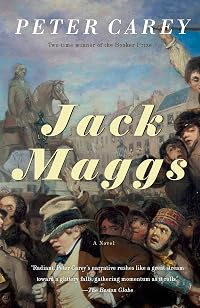
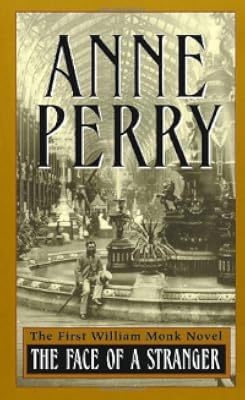
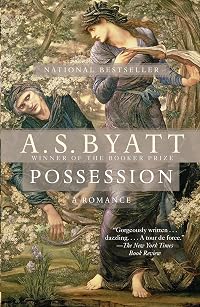
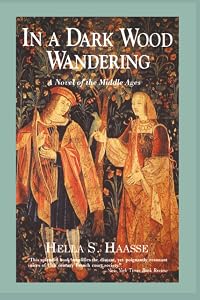





Member Recommendations

Limelite Another neo-Victorian complex mystery novel but set in New Zealand.
feeling.is.first Complex Victorian world-building. Mrs Quent is set in alternate reality, while Quincunx is set in Dickens' London.
Member Reviews
A young boy grows up with his mother in seclusion and hiding in a small 19th century English village. Who are they hiding from and why? Well, it takes a while to find out, and first their lives have to fall apart and they have to be propelled to a lie of grinding poverty in London before it becomes apparent that they are caught up in the gears of an appallingly complicated family history, full of secrets and mysteries and murders and betrayals and intrigue. They can't trust anyone, but they have precoius few friends, and everyone they meet seems to have hidden designs on them. There are no coincidences, a pointed conceit in a Dickensian pastiche, such that everything that occurs havng some bearing on a larger design becomes as much a show more contrivance as a plot propelled by conincidences, but who or what is doing the contriving? Even at the end, though, when it seems as though everything has been explained, here are still odd questions, gaps and ambiguities, enough to drive you barmy wondering about them, especially considering the sheer glut of information you have to go through to search for hints and clues. One of the truly great novels of huge, intricate and tightly wound mystery. It would make a sumptious audiobook, if someone had the gumption to produce one. show less
This book was too long by a million-ish pages. Still, you might enjoy it if you like the kind of story that relies heavily on the utter stupidity of its main characters, and where each fresh coincidence is more unbelievable than the last.
You will definitely savor these pages if you like a book where the main characters lose everything or have it taken from them, and then they lose the things they forgot they had in their pockets, and then the pockets themselves are taken. And when it seems they truly have nothing left, just when you think they have hit bottom, along comes yet another villain to proactively take from them any scraps they might have the potential to earn in the future. Every single terrible thing that can happen to them, show more does. Often, as I mentioned, because they are raging idiots.
Good news for those who love to be both bored and confused by their choice of fiction! The Quincunx is endlessly and needlessly complicated, pages and pages about the godforsaken codicil, the property entailed, the fee simple and the base-fee, etc etc. These concepts are discussed repeatedly and at length throughout the narrative and it is just as deadly boring as it sounds.
To further complicate matters the author has helpfully reused several of the names. There are more than one Harry (one of which is sometimes called Henry), several Johns, I'm not sure how many Jameses and at least two Thomases. Also, sometimes names are spelled differently for no point that I could see, for example Hougham and Huffam.
Speaking of names, 90% of the surnames were compound words and the other 10% were just bizarre.
Compound words: Leatherbarrow, Stringfellow, Acehand, Steplight, Twelvetrees, Bellringer, Beaglehole, Gildersleeve, Rookyard, Stillingfleet, Silverleaf.
Bizarre: Umphraville, Phumphred, Palphramond.
Anyway. I'm done with it. show less
You will definitely savor these pages if you like a book where the main characters lose everything or have it taken from them, and then they lose the things they forgot they had in their pockets, and then the pockets themselves are taken. And when it seems they truly have nothing left, just when you think they have hit bottom, along comes yet another villain to proactively take from them any scraps they might have the potential to earn in the future. Every single terrible thing that can happen to them, show more does. Often, as I mentioned, because they are raging idiots.
Good news for those who love to be both bored and confused by their choice of fiction! The Quincunx is endlessly and needlessly complicated, pages and pages about the godforsaken codicil, the property entailed, the fee simple and the base-fee, etc etc. These concepts are discussed repeatedly and at length throughout the narrative and it is just as deadly boring as it sounds.
To further complicate matters the author has helpfully reused several of the names. There are more than one Harry (one of which is sometimes called Henry), several Johns, I'm not sure how many Jameses and at least two Thomases. Also, sometimes names are spelled differently for no point that I could see, for example Hougham and Huffam.
Speaking of names, 90% of the surnames were compound words and the other 10% were just bizarre.
Compound words: Leatherbarrow, Stringfellow, Acehand, Steplight, Twelvetrees, Bellringer, Beaglehole, Gildersleeve, Rookyard, Stillingfleet, Silverleaf.
Bizarre: Umphraville, Phumphred, Palphramond.
Anyway. I'm done with it. show less
By most sane standards this is a ridiculous book. At least four times as long as the average modern novel, with a vast family-inheritance-saga plot that brings in just about every element of 19th century life that you remember from Dickens, Wilkie Collins, Henry Mayhew, Thackeray, Trollope, the Brontës, and many other English 19th-century writers (there's even a little echo of The prisoner of Zenda at one point...).
Not quite everything: the chapter in which Our Hero finds himself forced to work in a hellish Lancashire cotton mill seems to have been inadvertently missed out, and there's a mysterious absence of any serious discussion of religion. But we get shady lawyers, complex financial transactions, missing documents, elopements, show more murders, street crime, poverty, prostitution, burglary, body-snatching, "schools" and "lunatic asylums" that are nothing more than places to imprison inconvenient family-members, domestic service, enclosures, workhouses, stage-coaches, a public hanging, a tour of the London sewers, and much, much more.
There's even some entertaining nineteenth-century spelling to keep us amused, with (too) much play being made with sopha, lanthorn, visiter, shore (for sewer), and the like. And a few chapters in the central section are from the diary of a female narrator who can't spell at all...
So it's hardly surprising if, as Palliser complains in his 1992 afterword, this is a book that most readers just treat as a clever pastiche of the Victorian novel and some took as a satire on Mrs Thatcher's "Victorian values". (The action of the book takes place in the 1820s, so it's not really "Victorian" at all, but many of Dickens's and Collins's novels were set in the same pre-railway period.)
Palliser is simply too much the academic literary scholar, keen to use his expertise to tell us as much as he possibly can about the type of things that would have been going on in the minds of his nineteenth-century characters, and it all rather swamps his grand literary design for the book. We're more or less forced to notice that there's something going on with fivefold patterns (five parts, each divided into five books, each containing five chapters), and we're never quite as convinced as the narrator is that we've been given a complete solution to the mysteries of the plot, but there's just so much detail for us to keep track of that there's very little incentive to do what Palliser is apparently expecting the reader to do and work out alternative ways of making sense of the inter-relationships between the characters, different from the family-trees he helpfully scatters in our path.
The ending is a kind of clumsy compromise between our need for some sort of neat closure that would allow the narrator to stop work and the author's need to show that this is a book written in the late 20th century when no-one believes that literature has a place for fully-determined stories any more, but I doubt if many readers will follow the example of the apocryphal friend of the author who was so thrown off by the ambiguity in the last sentence that he went back to the beginning and started again. Life's too short! show less
Not quite everything: the chapter in which Our Hero finds himself forced to work in a hellish Lancashire cotton mill seems to have been inadvertently missed out, and there's a mysterious absence of any serious discussion of religion. But we get shady lawyers, complex financial transactions, missing documents, elopements, show more murders, street crime, poverty, prostitution, burglary, body-snatching, "schools" and "lunatic asylums" that are nothing more than places to imprison inconvenient family-members, domestic service, enclosures, workhouses, stage-coaches, a public hanging, a tour of the London sewers, and much, much more.
There's even some entertaining nineteenth-century spelling to keep us amused, with (too) much play being made with sopha, lanthorn, visiter, shore (for sewer), and the like. And a few chapters in the central section are from the diary of a female narrator who can't spell at all...
So it's hardly surprising if, as Palliser complains in his 1992 afterword, this is a book that most readers just treat as a clever pastiche of the Victorian novel and some took as a satire on Mrs Thatcher's "Victorian values". (The action of the book takes place in the 1820s, so it's not really "Victorian" at all, but many of Dickens's and Collins's novels were set in the same pre-railway period.)
Palliser is simply too much the academic literary scholar, keen to use his expertise to tell us as much as he possibly can about the type of things that would have been going on in the minds of his nineteenth-century characters, and it all rather swamps his grand literary design for the book. We're more or less forced to notice that there's something going on with fivefold patterns (five parts, each divided into five books, each containing five chapters), and we're never quite as convinced as the narrator is that we've been given a complete solution to the mysteries of the plot, but there's just so much detail for us to keep track of that there's very little incentive to do what Palliser is apparently expecting the reader to do and work out alternative ways of making sense of the inter-relationships between the characters, different from the family-trees he helpfully scatters in our path.
The ending is a kind of clumsy compromise between our need for some sort of neat closure that would allow the narrator to stop work and the author's need to show that this is a book written in the late 20th century when no-one believes that literature has a place for fully-determined stories any more, but I doubt if many readers will follow the example of the apocryphal friend of the author who was so thrown off by the ambiguity in the last sentence that he went back to the beginning and started again. Life's too short! show less
This read a bit as if someone had asked AI to write something akin to a Dickens novel, except that it was missing all the humour and the happy ending. There was only the one relentlessly depressing storyline with occasional chapters featuring 'Justice' or 'Power' or 'Equity'. There was a ridiculously complicated law case involving an intricate and unfathomable multigenerational family tree, and endless scenes of poverty, criminality, cruelty, addiction, violence, deception etc.. John's irritatingly daft mother spent her life concealing his identity from him, and had she not done so much of this could have been avoided. The coincidences and interconnectedness of all the characters was again on a different level to anything Dickens dreamt show more up and I found the whole thing exhausting.
Having said all that it was strangely compelling, even if I'm still not really sure who was related to who and how. show less
Having said all that it was strangely compelling, even if I'm still not really sure who was related to who and how. show less
The Quincunx is an enticing, entrancing recreation of a Victorian novel, written in such perfect period prose and holding so much that is typical of the Victorian novel that you might well believe that Charles Palliser had excavated it and not sat down to write late in the twentieth century.
I skated around it for quite some time, because it is such a very big book, and I read a couple of the author’s later, shorter works; but now that I have read this book I have to say that completely outclasses them.
The story begins with a young boy, named John, who lives with his mother, Mary, in an English village. They are not wealthy but they are not poor either, and so they are able to live quietly and quite comfortably. As he grows up John show more comes to realise that the way they live is not normal and that his mother is keeping secrets; that there must be reasons why she is so very protective of him, why he isn’t allowed to play with other children, why anyone who comes to their door is unwelcome.
When a relative he has never met dies – and after he has broken more than one of his mother’s rules – things go terribly wrong for Mary and John. They lose what small capital they had, Mary comes to believe that they are no longer safe in their home, and so mother and son set out for London.
Things go wrong again, and Mary does not know who they can trust; who is really her friend and who is in the employ of the man she believes to be her enemy?
The plot is much too elaborate to explain, but it spins around a simple scrap of paper: the codicil to a will written half a century earlier. The will and the codicil had implications for five families; they had been written for unhappy reasons in unhappy circumstances, and they had created greed, hatred, madness and murder in five generations. They affected John, but he didn’t know how, he didn’t who his father was, and he didn’t know who his friends and enemies were.
He did know that he was in danger, caught in a complicated conspiracy, and that he had to work out how to survive and claim the inheritance that he believed was his.
Every kind of character, every scenario, every setting, you might think of finding in a Victorian novel is to be found in this book.
Sometimes the plot lingers, but I found the details of day to day living and how practical problems were faced quite fascinating. At other times it rattles along, almost so quickly that I wished I might have spent a little more time with some places and people, though what happened next always captured my interest and didn’t allow me to miss the things that had gone by.
The plot is relentless, always focused on John’s story; mainly through his own first person account, broken only when he hears the stories of others and when an omniscient narrator steps from the shadows to show scenes that will affect John’s progress.
It’s construction is so elaborate and so clever.
The atmosphere is wonderful, and this really is the perfect book for dark winter evenings.
Imagine that Wilkie Collins and Charles Dickens sat down together with all of the time in the world to create a masterpiece, drawing on their own greatest works and the great works of their contemporaries, each writing to their strengths and reining in the other’s weaknesses, and trying things they has never tried before, to wonderful effect.
This feels a little like that.
There really is everything you could want in a Victorian novel, and I caught echoes of many beloved stories. And then there are things that feel a little more modern but work so well: a narrator who may not be wholly reliable, questions that are left unanswered, an ending that lets the reader draw their own conclusion, and a structure that slowly moves into the light ….
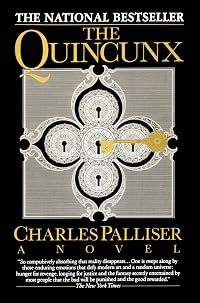
There are five related families over five generations, whose five crests form a quincunx, an arrangement of five objects with one in each corner of a square and one at the centre. The novel itself is divided into five parts, and each part is divided into five books and then five chapters.
There are so many small but significant details. I spotted some of them but I am sure that I missed others, and that this is a novel that would reveal much more on a second reading.
It has failings. John and Mary could both, for different reasons, be infuriating. Occasionally a character or a situation was compromised a little for the sake of the plot. The later chapters were less subtle than what had come before. There was at least one unanswered question that needed an answer: the question of John’s parentage.
But, as a whole, The Quincunx worked wonderfully well.
It is more a book for the head than a book for the heart.
And yet I loved that quite near the end I came to realise that it was also a coming of age story.
I read it much more quickly that I thought I would. I had to keep turning the pages. I was intrigued. I had to know. I couldn’t quite explain how all of the pieces of the puzzle fit together, but I have a good idea, and I think that it works.
I was completely caught up in the world of this book, I miss it now that it is over, and I can’t help wondering about the lives of many of the characters I met beyond the pages of the book. show less
I skated around it for quite some time, because it is such a very big book, and I read a couple of the author’s later, shorter works; but now that I have read this book I have to say that completely outclasses them.
The story begins with a young boy, named John, who lives with his mother, Mary, in an English village. They are not wealthy but they are not poor either, and so they are able to live quietly and quite comfortably. As he grows up John show more comes to realise that the way they live is not normal and that his mother is keeping secrets; that there must be reasons why she is so very protective of him, why he isn’t allowed to play with other children, why anyone who comes to their door is unwelcome.
When a relative he has never met dies – and after he has broken more than one of his mother’s rules – things go terribly wrong for Mary and John. They lose what small capital they had, Mary comes to believe that they are no longer safe in their home, and so mother and son set out for London.
Things go wrong again, and Mary does not know who they can trust; who is really her friend and who is in the employ of the man she believes to be her enemy?
The plot is much too elaborate to explain, but it spins around a simple scrap of paper: the codicil to a will written half a century earlier. The will and the codicil had implications for five families; they had been written for unhappy reasons in unhappy circumstances, and they had created greed, hatred, madness and murder in five generations. They affected John, but he didn’t know how, he didn’t who his father was, and he didn’t know who his friends and enemies were.
He did know that he was in danger, caught in a complicated conspiracy, and that he had to work out how to survive and claim the inheritance that he believed was his.
Every kind of character, every scenario, every setting, you might think of finding in a Victorian novel is to be found in this book.
Sometimes the plot lingers, but I found the details of day to day living and how practical problems were faced quite fascinating. At other times it rattles along, almost so quickly that I wished I might have spent a little more time with some places and people, though what happened next always captured my interest and didn’t allow me to miss the things that had gone by.
The plot is relentless, always focused on John’s story; mainly through his own first person account, broken only when he hears the stories of others and when an omniscient narrator steps from the shadows to show scenes that will affect John’s progress.
It’s construction is so elaborate and so clever.
The atmosphere is wonderful, and this really is the perfect book for dark winter evenings.
Imagine that Wilkie Collins and Charles Dickens sat down together with all of the time in the world to create a masterpiece, drawing on their own greatest works and the great works of their contemporaries, each writing to their strengths and reining in the other’s weaknesses, and trying things they has never tried before, to wonderful effect.
This feels a little like that.
There really is everything you could want in a Victorian novel, and I caught echoes of many beloved stories. And then there are things that feel a little more modern but work so well: a narrator who may not be wholly reliable, questions that are left unanswered, an ending that lets the reader draw their own conclusion, and a structure that slowly moves into the light ….
There are five related families over five generations, whose five crests form a quincunx, an arrangement of five objects with one in each corner of a square and one at the centre. The novel itself is divided into five parts, and each part is divided into five books and then five chapters.
There are so many small but significant details. I spotted some of them but I am sure that I missed others, and that this is a novel that would reveal much more on a second reading.
It has failings. John and Mary could both, for different reasons, be infuriating. Occasionally a character or a situation was compromised a little for the sake of the plot. The later chapters were less subtle than what had come before. There was at least one unanswered question that needed an answer: the question of John’s parentage.
But, as a whole, The Quincunx worked wonderfully well.
It is more a book for the head than a book for the heart.
And yet I loved that quite near the end I came to realise that it was also a coming of age story.
I read it much more quickly that I thought I would. I had to keep turning the pages. I was intrigued. I had to know. I couldn’t quite explain how all of the pieces of the puzzle fit together, but I have a good idea, and I think that it works.
I was completely caught up in the world of this book, I miss it now that it is over, and I can’t help wondering about the lives of many of the characters I met beyond the pages of the book. show less
I suppose we could regard Charles Palliser's Quincunx as final proof that for every genre or great genre master of fiction, however obscure or archaic, there is not only someone who will attempt a pastiche of it/him, but sometimes there is even one who is very, very good at it. Charles Palliser is one of these, an otaku's otaku in the realm of... the nineteenth century social novel?
I didn't know there could be such a thing. Did you?
For Quincunx* is a Dickensian pastiche of the very highest order, though it goes Dickens one better, or at least earlier, by setting itself in Britain's late Regency (and therefore pre-Victorian by a good bit) period. And perhaps it takes the Dickens to 11 at the very least, both in terms of legal/inheritance show more wrangling as plot driver and of risible degrees and numbers of coincidences at least in that Dickens' and Palliser's Londons have hilariously small populations.
And there is still more to keep the 21st century reader chuckling, for about halfway through, when a certain heraldry puzzle assumes paramount importance, the penny drops and one realizes she is in fact reading a high quality prose version of a hidden object game. All that is missing is the frustrating experience of "breaking" the cursor by mis-clicking on too many objects, but then again, that could be substituted for by our young hero's continually narrowly escaping yet another assassination attempt -- or only sort of escaping, continually forced as he is to more or less respawn as the penniless, near-helpless, delerious, paranoid, starving waif that he is for most of the novel.
And why is this so? Because, as I said, property inheritance and greed are the great drivers of the plot. An ancient francophone family (lots of glorious surnames feature in this story: Umphraville, Palphramond, Mompesson!) whose possession of a profitable estate dates back, apparently, to the time of William the Conqueror and whose bloodline includes Plantagenet ancestry, fell on hard times a few generations before our hero (John Mellamphy, he who answers to oh so many other names as he grows up) was born has been shadow-fighting over different versions of the patriarch's will in addition to publicly battling it out in the Court of Chancery (shades of Jarndyce and Jarndyce, eh wot?). Depending on what document finally surfaces and is approved, one family could be turned off the estate in favor of, well, several others.
The plot is intricate and small details matter; like in playing a hidden object game, we have to scrutinize every scene with care, somewhat hampered by our guide through all of this, John of the Many Surnames, from whom Secrets Have Been Kept and whose life is perpetually both endangered and protected by different interests, depending on which will from which they would benefit.
All this and all the Dickensian social justice hand-wringing you could ask for, as we spend time with body snatchers, dishonest bankers and lawyers, out-and-out bandit gangs, "down below men" who make their living salvaging coins and other valuables that have fallen into the sewers, starving Victorian garment workers, and, every once in a while, the gentry living high and betting too much on cards and horses. Like you do.
If that sounds like something you might enjoy, you'll enjoy the hell out of this book. I did, even though I snickered a lot. Hey, snickering is good.
*And I absolutely wound up reading this one now because of Aliette de Bodard, whose Obsidian and Blood Aztec godpunk trilogy employs the visual device and term of "quincunx" - a five-fold cross, more or less - and every time I came across the term, I remembered that my mother had presented me with a battered but still nice hardcover edition of Quincunx and it was still the substantial base of my small but formidable tower of dead tree TBR. Brains are funny old things. show less
I didn't know there could be such a thing. Did you?
For Quincunx* is a Dickensian pastiche of the very highest order, though it goes Dickens one better, or at least earlier, by setting itself in Britain's late Regency (and therefore pre-Victorian by a good bit) period. And perhaps it takes the Dickens to 11 at the very least, both in terms of legal/inheritance show more wrangling as plot driver and of risible degrees and numbers of coincidences at least in that Dickens' and Palliser's Londons have hilariously small populations.
And there is still more to keep the 21st century reader chuckling, for about halfway through, when a certain heraldry puzzle assumes paramount importance, the penny drops and one realizes she is in fact reading a high quality prose version of a hidden object game. All that is missing is the frustrating experience of "breaking" the cursor by mis-clicking on too many objects, but then again, that could be substituted for by our young hero's continually narrowly escaping yet another assassination attempt -- or only sort of escaping, continually forced as he is to more or less respawn as the penniless, near-helpless, delerious, paranoid, starving waif that he is for most of the novel.
And why is this so? Because, as I said, property inheritance and greed are the great drivers of the plot. An ancient francophone family (lots of glorious surnames feature in this story: Umphraville, Palphramond, Mompesson!) whose possession of a profitable estate dates back, apparently, to the time of William the Conqueror and whose bloodline includes Plantagenet ancestry, fell on hard times a few generations before our hero (John Mellamphy, he who answers to oh so many other names as he grows up) was born has been shadow-fighting over different versions of the patriarch's will in addition to publicly battling it out in the Court of Chancery (shades of Jarndyce and Jarndyce, eh wot?). Depending on what document finally surfaces and is approved, one family could be turned off the estate in favor of, well, several others.
The plot is intricate and small details matter; like in playing a hidden object game, we have to scrutinize every scene with care, somewhat hampered by our guide through all of this, John of the Many Surnames, from whom Secrets Have Been Kept and whose life is perpetually both endangered and protected by different interests, depending on which will from which they would benefit.
All this and all the Dickensian social justice hand-wringing you could ask for, as we spend time with body snatchers, dishonest bankers and lawyers, out-and-out bandit gangs, "down below men" who make their living salvaging coins and other valuables that have fallen into the sewers, starving Victorian garment workers, and, every once in a while, the gentry living high and betting too much on cards and horses. Like you do.
If that sounds like something you might enjoy, you'll enjoy the hell out of this book. I did, even though I snickered a lot. Hey, snickering is good.
*And I absolutely wound up reading this one now because of Aliette de Bodard, whose Obsidian and Blood Aztec godpunk trilogy employs the visual device and term of "quincunx" - a five-fold cross, more or less - and every time I came across the term, I remembered that my mother had presented me with a battered but still nice hardcover edition of Quincunx and it was still the substantial base of my small but formidable tower of dead tree TBR. Brains are funny old things. show less
The quincunx is an arrangement of five items in a square based on a cross that was used for several five-domed Byzantine churches. It's also a terribly important design in a novel of five parts by Charles Palliser that is absolutely riveting. Set in England during the early nineteenth century, it is narrated by a child whose age we are never told, even as he grows older. His name changes also as he realizes he has been hidden to protect his life, for he is the direct descendant of a wealthy landowner who left him everything in a will and a peculiar codicil, and the land will revert to others upon his death. Palliser's book makes a grand Dickensian sweep through the slums and ballrooms of Victorian England. John begins to piece together show more the puzzle, but only after he and his mother are manipulated and schemed out of everything they own Friends turn out to be enemies and ostensible enemies become friends in a topsy-turvy world.
Palliser did extensive research into the period, and intricate detail lends marvelously to the setting. And what an environment. A rigid class system prevented any kind of upward social mobility. Women were to be seen, not heard. They had no skills, were prevented from getting any, and when destitute, turned to prostitution as virtually their only means of survival. Greed and corruption were pervasive.
Intricate legal mechanisms were devised by rich landowners to deprive the poor of whatever little land they owned; more machinations made things worse by driving the price o flab or down. "Close towns" were created by buying up "freeholders," whose houses were then destroyed; only certain people were then allowed to live in the new cottages that were built. This meant the landowner did not have to "pay the paritch," a form of tax that was used to provide welfare for the completely indigent, of which there were many.
Some of the jobs the poor were forced into are graphically depicted. The "shore-hunters," for example, climbed down into the sewers at night during low tide, working their way through the labyrinth of tunnels underneath London to the spots where the sewers washed most of their detritus. This was picked through for whatever coins might have fallen down drain holes and been swept toward the river by the rain. It was filthy, dangerous (the tides were capricious and one did not dare to be caught underground at high tide) and not very rewarding. Often it was all there was. If a dead body was found, it was the custom not to strip it for anything valuable (like clothes), because after the body washed into the river it would be scavenged by those who eked out their living in such a manner. Stripping the body would be considered "robbing them of their trade."
John finally learns the secrets of the wills and codicils and the details of the murder that had haunted his family. Beware! Once begun, this book is difficult to put down. It will also make you want to dig out Dickens again. show less
Palliser did extensive research into the period, and intricate detail lends marvelously to the setting. And what an environment. A rigid class system prevented any kind of upward social mobility. Women were to be seen, not heard. They had no skills, were prevented from getting any, and when destitute, turned to prostitution as virtually their only means of survival. Greed and corruption were pervasive.
Intricate legal mechanisms were devised by rich landowners to deprive the poor of whatever little land they owned; more machinations made things worse by driving the price o flab or down. "Close towns" were created by buying up "freeholders," whose houses were then destroyed; only certain people were then allowed to live in the new cottages that were built. This meant the landowner did not have to "pay the paritch," a form of tax that was used to provide welfare for the completely indigent, of which there were many.
Some of the jobs the poor were forced into are graphically depicted. The "shore-hunters," for example, climbed down into the sewers at night during low tide, working their way through the labyrinth of tunnels underneath London to the spots where the sewers washed most of their detritus. This was picked through for whatever coins might have fallen down drain holes and been swept toward the river by the rain. It was filthy, dangerous (the tides were capricious and one did not dare to be caught underground at high tide) and not very rewarding. Often it was all there was. If a dead body was found, it was the custom not to strip it for anything valuable (like clothes), because after the body washed into the river it would be scavenged by those who eked out their living in such a manner. Stripping the body would be considered "robbing them of their trade."
John finally learns the secrets of the wills and codicils and the details of the murder that had haunted his family. Beware! Once begun, this book is difficult to put down. It will also make you want to dig out Dickens again. show less
Members
- Recently Added By
Published Reviews
ThingScore 100
'"The Quincunx" deserves the hoopla; it's an astonishing imitation, a Borgesian feat of sustained imaginative anachronism, the fictional equivalent of Colonial Williamsburg.'
added by bookfitz
"Quintuple the length of the ordinary novel, this extraordinary tour de force also has five times the ordinary allotment of adventure, action and aplomb."
added by bookfitz
"Palliser's first novel is an extraordinary achievement: a triple-decker (800-page) Victorian pastiche, obviously modeled on Bleak House, unfolding the staggeringly complex tale of young John Huffam's attempts to ward off ruin and death until he can solve multiple family mysteries."
added by bookfitz
Lists

Historical Fiction
889 works; 90 members

Favorite Long Books
330 works; 42 members

Crime and Mysteries to Read
746 works; 31 members

did I say that I didn't mean that (unreliable narrators)
34 works; 7 members

seedy victorian novels
16 works; 4 members

Jones & Newman: Best Horror Books Further Recommended Reading
577 works; 4 members

Books I Read Before The Invention Of The Internet.
144 works; 1 member
Author Information

12 Works 4,436 Members
Charles Palliser has taught modern literature and creative writing at universities in Glasgow, London, and the United States. Since 1990 he has been a fulltime writer. He lives in London.
Some Editions
Awards and Honors
Distinctions
Series

Work Relationships
Common Knowledge
- Canonical title
- The Quincunx
- Original title
- The Quincunx
- Alternate titles*
- De Quincunx : de erfenis van John Huffam
- Original publication date
- 1989
- People/Characters
- John Mellamphy; Mary Mellamphy; John Huffman; Eliza Huffman; Nicholas Clothier; Sir Perceval Mompesson (show all 7); Silas Clothier
- Important places
- England, UK; London, England, UK
- Epigraph
- Quid Quincunce speciosius, qui, in quamcunque partem spectaveris, rectus est? (Quintillian)
- Dedication
- For My Mother
(4th May 1919—22nd February 1989) - First words
- It must have been late autumn of that year, and probably it was towards dusk for the sake of being less conspicuous.
- Last words
- (Click to show. Warning: May contain spoilers.)At my last sight of her, she was still standing motionless holding her hands crossed in front of her in the centre of the square of trees beside the dead stump where Miss Lydia's lover had died by my grandfather's sword.
- Blurbers
- Ebert, Roger
- Original language
- English
- Disambiguation notice
- This is the omnibus of the 5 Quincunx books, do not combine single split books into it.
Amendment: Originally published as one volume in English language editions, this was subsequently published as five separate bo... (show all)oks in France and some other countries - The individual editions should not be combined with the single volume English editions, the English listing on Amazon with the subtitle 'The Inheritance of John Huffam' is for a combined edition and is not in fact 'part 1'; the same goes for the Dutch edition 'De Quincunx : de erfenis van John Huffam', which is a translation of the complete work.
*Some information comes from Common Knowledge in other languages. Click "Edit" for more information.
Classifications
Statistics
- Members
- 2,509
- Popularity
- 7,713
- Reviews
- 58
- Rating
- (4.09)
- Languages
- 9 — Dutch, English, Finnish, French, German, Japanese, Polish, Russian, Spanish
- Media
- Paper, Ebook
- ISBNs
- 32
- ASINs
- 15