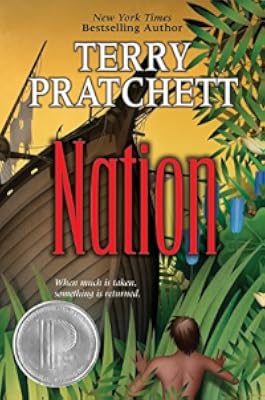
Nation
by Terry Pratchett
On This Page
Description
After a devastating tsunami destroys all that they have ever known, Mau, an island boy, and Daphne, an aristocratic English girl, together with a small band of refugees, set about rebuilding their community and all the things that are important in their lives.Tags
Recommendations


Member Recommendations



Member Reviews
I read somewhere, probably in A Stroke of the Keyboard, that Terry Pratchett considered this his best book, so it’s been on my to-read list for a while. The audiobook is read by the excellent Stephen Briggs, who captures Pratchett’s tone and humor perfectly.
I adored the Daphne and Mao, especially when they’re first trying to communicate, despite barriers of culture and language. There are inevitable misunderstandings (some of which made me laugh out loud), but these are trivial compared to the characters’ drive to form a connection and help each other survive.
Pratchett tackles imperialism, crises of faith, grief, coming of age and building community in this novel, accenting it all with his trademark humor and wordplay.
The show more result is fabulous, a must-read for fans and a good stand-alone for folks who want to try out his work. show less
I adored the Daphne and Mao, especially when they’re first trying to communicate, despite barriers of culture and language. There are inevitable misunderstandings (some of which made me laugh out loud), but these are trivial compared to the characters’ drive to form a connection and help each other survive.
Pratchett tackles imperialism, crises of faith, grief, coming of age and building community in this novel, accenting it all with his trademark humor and wordplay.
The show more result is fabulous, a must-read for fans and a good stand-alone for folks who want to try out his work. show less
This review contains spoilers relating to the ending of the book, as well as other sections of the story.
rough synopsis: In a world a half a turn away from this one, in a history that never was for a geography that is almost but not quite one I could squint and recognise, a major tsunami happens across an archipelago. Post-tsunami, one local boy and one passing-through colonial girl end up as the sole survivors on a (small) remote island. Interesting communication failures happen, more people drift in, politics happens, romance is implied, science is demonstrated to be not only important but not just in the possession of those who believe that they are better by dint of wearing more clothes (and possibly by belonging to a nation that show more claims more land and less understanding of the peoples within them).
I find it eternally fascinating how Pratchett takes what appears to be a single idea, and makes a novel out of it, while weaving in a myriad of other Important Ideas as if they weren't really there. In this book, the message that came through loud and clear was 'what is civilisation, and who gets to define it', with side orders of 'what are gods' and 'identity, what is it'. I think as a result of the main topic there ended up being far more unsympathetic or plain unlikeable characters than I was expecting, fully formed as they were, rather than the more caricatured unpleasant individuals of say, Ankh-Morpork. A further result was that while this is still a humorous book at times, the levity was smaller, more discrete, sometimes more forced than much of Pratchett's oeuvre.
The first chapter is a frustrating wall of text. I found it difficult to follow, with the first half requiring multiple readings to establish who was where, and in which direction they were going. And the last section (or rather the first section, merely the last to make any sense) only became clear when an event roughly 2/3 of the way through the book inspired me to go back and re-read, at which point it illuminated some of the background/empire building politics.
But from this unsteady foundation, stretched as it was geographically from England to the aforementioned remote archipelago, the story is drawn inexorably to a single important location - that of the Nation. This is the home of Mau, who is neither boy nor man, according to the ways of his people. And with the death of his people, Mau is the nation, a topic that is the trigger for much sole searching. He is also the focal character for more of Pratchett's pontification on the ways and wherefores of the Gods (as has been seen in other novels). And there is so much to explore here - the ideas of the ancestors as ghosts, of memories, of echoes that have been trapped rather than let free. The way in which Mau buries his people, allowing the God of Death to rule his body in order to do the job without completely fragmenting his sense of self. I find myself unable to poke at the ideas hard enough to get them to coallesce.
The other major character, who we meet later than Mau, is Daphne, a 'trouserman girl' who spends the entire story redefining herself repeatedly as she experiences and reimagines the world. This is made explicit in her first attempt to introduce herself, where she gives her chosen name, rather than that which was given to her. This is used as an interesting motif, where the use of her two names illuminations her internal conflict with respect to her identities. And as she redefines herself, she comes to understandings about the people that she is with, that she could not have done as the aristocratic child of the empire from the start of the story.
And yet, annoyingly, at the end Daphne defines the Nation--the people of the island--as civilised only by her colonising standards of scientific endeavour. It isn't that she doesn't recognise their current lifestyle as valid, but that who they had been, at some unremembered time, was somehow 'more', and thus that is what she identifies as valuable. Up to this point, the colonial invaders do not recognise the worth of the Nation and its people. This is characterised by the response that Daphne gives when her father asks "What is so special about this place?" and she tells not of the people, or their strength, their persistence, their survival, their existence, their right to self-determination but:
" 'There's a cave. It's got wonderful carvings in it. It's ancient. It may be more than a hundred thousand years old' ... "I think there are star maps on the ceiling...' "
Oddly, this is the first book I've read in a while that I've wanted to truly disect. I've done a half assed job so far - there are so many thoughts, scrambling in all directions. The contrast between the spirit of scientific enquiry of Mau and Daphne and the acceptance of the world of some of the other characters; the multiple variations on the destructive invaders theme explored both conceptually with the myth of the cannabalistic islanders from the north and the threefold invasions of nature, pirates and empire; the destructive ways of nature, contrasting the tsunami that makes Mau chief of the Nation with the virus that makes Daphne's father the king of the Empire; the insistence that magic is science unexplained coupled to truly inexplicable events of which an answer is suggested for one.
Recommended - yes. I want people to read it so that I can debate it with them. The characterisation, world-building, writing and plot are all good. I noticed nothing that I should warn for, which may be an indication of poor memory/perception rather than anything else. 7/10 show less
rough synopsis: In a world a half a turn away from this one, in a history that never was for a geography that is almost but not quite one I could squint and recognise, a major tsunami happens across an archipelago. Post-tsunami, one local boy and one passing-through colonial girl end up as the sole survivors on a (small) remote island. Interesting communication failures happen, more people drift in, politics happens, romance is implied, science is demonstrated to be not only important but not just in the possession of those who believe that they are better by dint of wearing more clothes (and possibly by belonging to a nation that show more claims more land and less understanding of the peoples within them).
I find it eternally fascinating how Pratchett takes what appears to be a single idea, and makes a novel out of it, while weaving in a myriad of other Important Ideas as if they weren't really there. In this book, the message that came through loud and clear was 'what is civilisation, and who gets to define it', with side orders of 'what are gods' and 'identity, what is it'. I think as a result of the main topic there ended up being far more unsympathetic or plain unlikeable characters than I was expecting, fully formed as they were, rather than the more caricatured unpleasant individuals of say, Ankh-Morpork. A further result was that while this is still a humorous book at times, the levity was smaller, more discrete, sometimes more forced than much of Pratchett's oeuvre.
The first chapter is a frustrating wall of text. I found it difficult to follow, with the first half requiring multiple readings to establish who was where, and in which direction they were going. And the last section (or rather the first section, merely the last to make any sense) only became clear when an event roughly 2/3 of the way through the book inspired me to go back and re-read, at which point it illuminated some of the background/empire building politics.
But from this unsteady foundation, stretched as it was geographically from England to the aforementioned remote archipelago, the story is drawn inexorably to a single important location - that of the Nation. This is the home of Mau, who is neither boy nor man, according to the ways of his people. And with the death of his people, Mau is the nation, a topic that is the trigger for much sole searching. He is also the focal character for more of Pratchett's pontification on the ways and wherefores of the Gods (as has been seen in other novels). And there is so much to explore here - the ideas of the ancestors as ghosts, of memories, of echoes that have been trapped rather than let free. The way in which Mau buries his people, allowing the God of Death to rule his body in order to do the job without completely fragmenting his sense of self. I find myself unable to poke at the ideas hard enough to get them to coallesce.
The other major character, who we meet later than Mau, is Daphne, a 'trouserman girl' who spends the entire story redefining herself repeatedly as she experiences and reimagines the world. This is made explicit in her first attempt to introduce herself, where she gives her chosen name, rather than that which was given to her. This is used as an interesting motif, where the use of her two names illuminations her internal conflict with respect to her identities. And as she redefines herself, she comes to understandings about the people that she is with, that she could not have done as the aristocratic child of the empire from the start of the story.
And yet, annoyingly, at the end Daphne defines the Nation--the people of the island--as civilised only by her colonising standards of scientific endeavour. It isn't that she doesn't recognise their current lifestyle as valid, but that who they had been, at some unremembered time, was somehow 'more', and thus that is what she identifies as valuable. Up to this point, the colonial invaders do not recognise the worth of the Nation and its people. This is characterised by the response that Daphne gives when her father asks "What is so special about this place?" and she tells not of the people, or their strength, their persistence, their survival, their existence, their right to self-determination but:
" 'There's a cave. It's got wonderful carvings in it. It's ancient. It may be more than a hundred thousand years old' ... "I think there are star maps on the ceiling...' "
Oddly, this is the first book I've read in a while that I've wanted to truly disect. I've done a half assed job so far - there are so many thoughts, scrambling in all directions. The contrast between the spirit of scientific enquiry of Mau and Daphne and the acceptance of the world of some of the other characters; the multiple variations on the destructive invaders theme explored both conceptually with the myth of the cannabalistic islanders from the north and the threefold invasions of nature, pirates and empire; the destructive ways of nature, contrasting the tsunami that makes Mau chief of the Nation with the virus that makes Daphne's father the king of the Empire; the insistence that magic is science unexplained coupled to truly inexplicable events of which an answer is suggested for one.
Recommended - yes. I want people to read it so that I can debate it with them. The characterisation, world-building, writing and plot are all good. I noticed nothing that I should warn for, which may be an indication of poor memory/perception rather than anything else. 7/10 show less
Terry Pratchett’s Nation is a thoughtful and moving novel about survival, belief, and how societies are formed. Mau, who believes he is the only survivor of his island after a tsunami, meets Daphne, an English girl shipwrecked on the same shore. Despite their very different backgrounds, they must work together to survive and rebuild.
Pratchett explores grief, faith, and cultural understanding with depth and sensitivity, balancing serious themes with his characteristic humor. The characters are well drawn, and the novel gently challenges tradition and the idea that any one culture has all the answers.
Overall, Nation is a powerful and memorable book that blends adventure, philosophy, and emotional depth.
Pratchett explores grief, faith, and cultural understanding with depth and sensitivity, balancing serious themes with his characteristic humor. The characters are well drawn, and the novel gently challenges tradition and the idea that any one culture has all the answers.
Overall, Nation is a powerful and memorable book that blends adventure, philosophy, and emotional depth.
Immediately upon finishing the e-book version of this, I turned to my wife and said, "You wanna go to B&N with me? I need to get this for Jack." Jack is my 14-year-old son.
This book does a great job of raising some fundamental questions (the existence of god, the "fairness" of what happens to us in our lives, what (if anything) makes one civilization better than another, and what does "better" mean). And it raises these questions in a non-pedantic way; they just grow out of the story. And while Pratchett does come down on the side of realism WRT the theological questions, he doesn't do so harshly, stridently, or disrespectfully.
Pratchett ends the book with some notes, the last of which is to encourage kids to think. What could be show more better in a YA novel?
[Audiobook Note: Stephen Briggs does his usual stellar job.] show less
This book does a great job of raising some fundamental questions (the existence of god, the "fairness" of what happens to us in our lives, what (if anything) makes one civilization better than another, and what does "better" mean). And it raises these questions in a non-pedantic way; they just grow out of the story. And while Pratchett does come down on the side of realism WRT the theological questions, he doesn't do so harshly, stridently, or disrespectfully.
Pratchett ends the book with some notes, the last of which is to encourage kids to think. What could be show more better in a YA novel?
[Audiobook Note: Stephen Briggs does his usual stellar job.] show less
Talented writer Terry Pratchett can take such diverse themes as faith, colonialism, origins of knowledge, racism, and feminism, roll them up together and place them in a story that’s so humorous and entertaining that readers hardly realize that real issues are being addressed. In Nation, a stand-alone novel, we first meet young Mau as he’s returning to his home island after having spent time alone on a neighboring coming-of-age island. But everything Mau has ever known has been swept from existence by a huge tidal wave and he’s left to fend for himself. Due to the tidal wave he’s deprived of achieving the traditional initiation into manhood, yet he must now take on all manner of tasks that only a boy of great maturity and show more stamina could withstand. Unbeknownst to Mau he is not totally alone. An English survey ship has run ashore on the island with its lone survivor, young and proper Ermintrude, who has decided henceforth to call herself Daphne. There are many wonderful scenes where Mau and Daphne begin to figure each other out, learning bits of language and attempting to understand imponderable actions. As more refugees alight on the island Mau, as default chief, and Daphne, as the budding scientist, midwife, surgeon, and beer-maker, are pushed to their limits. Along the way they question their faith, their customs and traditions, and their perception of both formal education and native intelligence. Foul bad guys, toothless hags, heroic hulks, and a squawking parrot round out a colorful cast of characters. Pratchett is a master at combining hilarious dialog with heartfelt moments. It’s like Lord of the Flies meets Monty Python. The Nation is delightful as well as thought-provoking. show less
My first Pratchett, and wonderful from start to finish. It's something of a book of manners, as two young people, each from a vastly different society, try to puzzle out the 'rules' of their respective cultures, and decide which are worth keeping and which are complete poppycock. For each of the main characters, it's also a coming of age tale, and Pratchett is very sensitive to the trials, fears, and foibles of young kids just reaching into their adult years.
I love the setting of the book - an island in a vast archipelago somewhere in the 'Pelagic Sea', in an alternate timeline from us, but which uses enough of our world history and the familiar names of many of our most famous scientists, that it couldn't have been set in Discworld. show more Which is fine - it doesn't need to be in Discworld. It stands wonderfully on its own two feet. I also like what he does with the alternate universe, changing it in a way that makes it relevant to his story, but also makes for an interesting lesson in the birth and promulgation of science across our species and the planet.
The image of the ship washed inland on the island, being slowly taken apart for useful parts, is also wonderful. And the appearance of pirates. And the knotty problem of how to milk a pig, and the constant guilty conscience about disappointing your grandmother, and the chorus of ghostly old men transmitting their 'rules' to Mao - so many wonderful things about this book that make it one of my favorites.
I've read this book and now listened to it on audio book read by the wonderful Stephen Briggs. show less
I love the setting of the book - an island in a vast archipelago somewhere in the 'Pelagic Sea', in an alternate timeline from us, but which uses enough of our world history and the familiar names of many of our most famous scientists, that it couldn't have been set in Discworld. show more Which is fine - it doesn't need to be in Discworld. It stands wonderfully on its own two feet. I also like what he does with the alternate universe, changing it in a way that makes it relevant to his story, but also makes for an interesting lesson in the birth and promulgation of science across our species and the planet.
The image of the ship washed inland on the island, being slowly taken apart for useful parts, is also wonderful. And the appearance of pirates. And the knotty problem of how to milk a pig, and the constant guilty conscience about disappointing your grandmother, and the chorus of ghostly old men transmitting their 'rules' to Mao - so many wonderful things about this book that make it one of my favorites.
I've read this book and now listened to it on audio book read by the wonderful Stephen Briggs. show less
A rather embarrassing confession: I wasn't the world's biggest fan of Terry Pratchett's writing--I always found it a little too clever. Despite this, my husband said I might like this one, and as usual, he was right. Mr. Pratchett's voice fits so well with the shape of the story and characters, and treats it all with his classic humor, and (somewhat surprisingly to me) great respect. It was pleasant to find, unexpectedly, so much heart in this story, and that the writing style fit it all so well. There were moments where the characters were experiencing something profound, sometimes terrible, and these moments were treated in fresh, emotional way that was incredibly effective. Then there were the wonderful commentaries on storytelling show more itself.
All the praise of the writing aside, the story itself is a wonderful adventure, internal and external, and the changes that the characters undergo is wonderful to see. I was concerned that there could be unintentional undertones of orientalism, but that too was waylaid at every turn--Mao and his people are so "civilized" by their own devices, and the thoughts and speeches as they are written are in a wonderful individual way--sure, it's all a bit sweet, but everyone in this world is. On top of this, who wouldn't love a strong Ghost Girl who chooses her own name, and is incredibly clever and kind, and in the end, always does the "right" thing.
I've come away from this book with a much greater love of Mr. Pratchett's writing, and look forward to reading more of his (thankfully extensive) works. show less
All the praise of the writing aside, the story itself is a wonderful adventure, internal and external, and the changes that the characters undergo is wonderful to see. I was concerned that there could be unintentional undertones of orientalism, but that too was waylaid at every turn--Mao and his people are so "civilized" by their own devices, and the thoughts and speeches as they are written are in a wonderful individual way--sure, it's all a bit sweet, but everyone in this world is. On top of this, who wouldn't love a strong Ghost Girl who chooses her own name, and is incredibly clever and kind, and in the end, always does the "right" thing.
I've come away from this book with a much greater love of Mr. Pratchett's writing, and look forward to reading more of his (thankfully extensive) works. show less
Members
- Recently Added By
Published Reviews
ThingScore 100
It's a complete departure for Pratchett and yet is recognizably him, on every page, writing with the same grace and wit we know from his other work. Highly recommended (and would make brilliant bedtime reading, too).
added by lampbane
Lists

Best Satire
188 works; 29 members

Carnegie Medal books I've read (shortlist and winners)
86 works; 17 members

Female Protagonist
1,056 works; 57 members

Dystopia
4 works; 1 member

Speculative Fiction to Read
706 works; 32 members

United Kingdom and Ireland
37 works; 1 member

Adventure and Intrigue
76 works; 2 members

Books Read in 2025
4,128 works; 98 members
Books We Couldn't Put Down
443 works; 197 members

Books Read in 2019
4,052 works; 110 members

KayStJ's to-read list
1,616 works; 11 members

Alphabetical Books
211 works; 3 members

Robinsonade Novels
55 works; 4 members

Puffin Books 70th anniversary handbook recommendations
537 works; 10 members

Books Read in 2014
2,343 works; 86 members

Best Survival Stories
97 works; 15 members

Books Set on Islands
190 works; 24 members

Five star books
1,767 works; 110 members
Talk Discussions
Past Discussions
A Thread to discuss _Nation_: Spoilers are present! in All Things Discworldian - The Guild of Pratchett Fans (December 2008)
Limited edition of Nation to be auctioned for charity... in All Things Discworldian - The Guild of Pratchett Fans (June 2008)
Author Information

422+ Works 580,968 Members
Terry Pratchett was on born April 28, 1948 in Beaconsfield, United Kingdom. He left school at the age of 17 to work on his local paper, the Bucks Free Press. While with the Press, he took the National Council for the Training of Journalists proficiency class. He also worked for the Western Daily Press and the Bath Chronicle. He produced a series show more of cartoons for the monthly journal, Psychic Researcher, describing the goings-on at the government's fictional paranormal research establishment, Warlock Hall. In 1980, he was appointed publicity officer for the Central Electricity Generating Board with responsibility for three nuclear power stations. His first novel, The Carpet People, was published in 1971. His first Discworld novel, The Colour of Magic, was published in 1983. He became a full-time author in 1987. He wrote more than 70 books during his lifetime including The Dark Side of the Sun, Strata, The Light Fantastic, Equal Rites, Mort, Sourcery, Truckers, Diggers, Wings, Dodger, Raising Steam, Dragons at Crumbling Castle: And Other Tales, and The Shephard's Crown. He was diagnosis with early onset Alzheimer's disease in 2007. He was knighted for services to literature in 2009 and received the World Fantasy award for life achievement in 2010. He died on March 12, 2015 at the age of 66. (Bowker Author Biography) show less
Some Editions
Awards and Honors
Awards
Distinctions
Series
Belongs to Publisher Series
Work Relationships
Is contained in
Has the adaptation
Common Knowledge
- Canonical title
- Nation
- Original title
- Nation
- Alternate titles
- Nación (España) (España)
- Original publication date
- 2008-09-11
- People/Characters
- Mau; Daphne; Pilu; Locaha
- Important places
- England, UK; Mothering Sunday Islands; Pacific Ocean
- Dedication
- For Lyn
- First words
- How Imo Made the World, in the Time When Things Were Otherwise and the Moon Was Different
Imo set out one day to catch some fish, but there was no sea. - Quotations
- It was like being in a Jane Austen novel, but one with far less clothing.
He's frightened of me, Mau thought. I haven't hit him or even raised my hand. I've just tried to make him think differently, and now he's scared. Of thinking. It's magic.
He'd missed dogs. Dogs added something that even people didn't, and one of the dogs was sitting by his feet, here in the darkness and the gentle rain. It wasn't bothered much about the rain or what might be out there on the u... (show all)nseen sea, but Mau was a warm body moving about in a sleeping world and might at any moment do something that called for running around and barking. Occasionally it looked up at him adoringly and made a slobbery gulping noise which possibly meant "Anything you say, boss!"
They saw that the perfect world is a journey, not a place. - Last words
- (Click to show. Warning: May contain spoilers.)The old man smiled, and believed.
- Blurbers
- Doctorow, Cory
- Original language
- English
Classifications
- Genres
- Fiction and Literature, Fantasy, Teen, Young Adult
- DDC/MDS
- 823.914 — Literature & rhetoric English & Old English literatures English fiction 1900- 1901-1999 1945-1999
- LCC
- PZ7 .P8865 .N — Language and Literature Fiction and juvenile belles lettres Fiction and juvenile belles lettres Juvenile belles lettres
- BISAC
Statistics
- Members
- 5,679
- Popularity
- 2,327
- Reviews
- 260
- Rating
- (4.12)
- Languages
- 11 — Czech, Dutch, English, Estonian, Finnish, French, German, Polish, Portuguese, Spanish, Turkish
- Media
- Paper, Audiobook, Ebook
- ISBNs
- 60
- ASINs
- 25