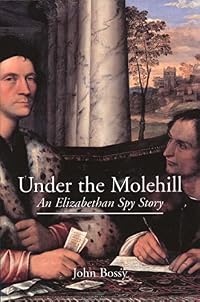
Under the Molehill: An Elizabethan Spy Story
by John Bossy
On This Page
Description
This absorbing account of Catholic and anti-Catholic plots and machinations at the English, French, and exiled Scottish courts in the latter part of the sixteenth century is a sequel to John Bossy's highly acclaimed Giordano Bruno and the Embassy Affair. It tells the story of an espionage operation in Elizabethan London that was designed to find out what side France would take in the hostilities between Protestant England and the Catholic powers of Europe. France was a Catholic country whose show more king was nonetheless hostile to Spanish and papal aggression, Bossy explains, but the king's sister-in-law, Mary Queen of Scots, in custody in England since 1568, was a magnet for Catholic activists, and the French ambassador in London, Michel de Castelnau, was of uncertain leanings. Bossy relates how Queen Elizabeth's Secretary of State, Sir Francis Walsingham, found a mole in Castelnau's household establishment, who passed information to someone in Walsingham's employ. Bossy discovers the identity of these persons, what items of intelligence were passed over, and what the English government decided to do with the information. He describes how individuals were arrested or fled, a political crisis occurred, an ambassador was expelled, deals were made. He concludes with a discussion of the authenticity of Elizabethan secret operations, arguing that they were not theatrical devices to prop up an unpopular regime but were a response to genuine threats of counter-revolution inspired by Catholic zeal. show lessTags
Recommendations















Member Recommendations

PuddinTame The fictional thriller Prophecy is based in part on John Bossy's two books about espionage against the French.
Member Reviews
https://nwhyte.livejournal.com/3241194.html
The late great John Bossy was a family friend, and my sister's godfather; his best book is still Christianity in the West, 1400-1700, but towards the end of his career he achieved a remarkable coup of winning both the Wolfson History Prize and the Crime Writers Association Gold Dagger for Non-Fiction for Giordano Bruno and the Embassy Affair, which examined the connections between the Renaissance philosopher and the murky world of espionage in Elizabethan London. This short, dense book concerns one particular wrinkle of the wider story of which Giordano Bruno was also part - identifying the individual who at a crucial moment stole the French ambassador's correspondence and passed it to the show more agents of Queen Elizabeth.
I came to this soon after reading the story of Alexander Wilson, and it is salutary to reflect on how much intelligence-gathering had changed across the centuries. What we can see of the Elizabethan world is based very much on the transmission of written records; the nascent bureaucracy of the state required hard copies, as it were. Obviously the whispered conversations do not survive, but Bossy feels pretty confident that by putting all the pieces together - and allowing for various mis-dating of key documents over time - he is able to give us a picture of what was happening in and around the French embassy in London in the 1580s, and who it was that exposed the ambassador's secrets.
Having said that, this is a book where the trees are more important than the forest, and I'd have liked a few more signposts along the way to remind us of why the story is important. It's all there, but one has to dig for it a bit, and I think the book needs to be taken as a close sequel to Giordano Bruno and the Embassy Affair, which I read a very long time ago. show less
The late great John Bossy was a family friend, and my sister's godfather; his best book is still Christianity in the West, 1400-1700, but towards the end of his career he achieved a remarkable coup of winning both the Wolfson History Prize and the Crime Writers Association Gold Dagger for Non-Fiction for Giordano Bruno and the Embassy Affair, which examined the connections between the Renaissance philosopher and the murky world of espionage in Elizabethan London. This short, dense book concerns one particular wrinkle of the wider story of which Giordano Bruno was also part - identifying the individual who at a crucial moment stole the French ambassador's correspondence and passed it to the show more agents of Queen Elizabeth.
I came to this soon after reading the story of Alexander Wilson, and it is salutary to reflect on how much intelligence-gathering had changed across the centuries. What we can see of the Elizabethan world is based very much on the transmission of written records; the nascent bureaucracy of the state required hard copies, as it were. Obviously the whispered conversations do not survive, but Bossy feels pretty confident that by putting all the pieces together - and allowing for various mis-dating of key documents over time - he is able to give us a picture of what was happening in and around the French embassy in London in the 1580s, and who it was that exposed the ambassador's secrets.
Having said that, this is a book where the trees are more important than the forest, and I'd have liked a few more signposts along the way to remind us of why the story is important. It's all there, but one has to dig for it a bit, and I think the book needs to be taken as a close sequel to Giordano Bruno and the Embassy Affair, which I read a very long time ago. show less
Like Bossy's earlier work, a bit too dense to be readable and too speculative to be interesting. But I very much like how Bossy lays out his intellectual process for the reader, at the very least, and his revisitations of earlier conclusions.
Ratings
Members
- Recently Added By
Author Information

11+ Works 517 Members
John Bossy is emeritus professor of history at the University of York.
Some Editions
Work Relationships
Is a (non-series) sequel to
Common Knowledge
- Original publication date
- 2001
- People/Characters
- Jean Arnault (secretary of Michel de Castelnau); Guillaume de l'Aubespine, baron de Châteauneuf; Thomas Baldwin (servant of Mary's guardian the Earl of Shrewsbury); Giordano Bruno; Michel de Castelnau, Sieur de la Mauvissiere; Girault de la Chassaigne (butler of Michel de Castelnau) (show all 26); Claude de Courcelles (secretary of Michel de Castelnau); William Cecil, 1st Baron Burghley; Archibald Douglas; Robert Dudley, 1st Earl of Leicester; Elizabeth I, Queen of England; Henri Fagot (presumably pseudonymous chaplain of Michel de Castelnau, possibly a pseudonym of Giordano Bruno); Laurent Feron (clerk of Michel de Castelnau); William Fowler (Scottish ex-minister); William Herle (servant of William Cecil, intelligencer, later ambassador); Henry Howard, 1st Earl of Northampton (friend of Castelnau); Mary, Queen of Scots; Bernardino de Mendoza (Spanish ambassador to Elizabeth, 1578 - 1584); Thomas Morgan (servant of Mary, Queen of Scots living in Paris); Charles Paget; William Parry (executed 1585); Sir Philip Sidney; Sir Edward Stafford (English ambassador in France, 1583 - 1589); Francis Throckmorton; Sir Francis Walsingham; Walter Williams
- Important places
- London, England, UK
- Dedication
- For Pete and Miggy,
with love - First words
- Some years ago I published Giordano Bruno and the Embassy Affair, a book which claimed disentangle part of a spying operation in Elizabethan London; to identify a principal figure in the story, known under the alias, p... (show all)ossibly comic, of 'Henri Fagot', as the philosopher named in the title; and to attempt the writing of the life of the hero which was required if the identification were correct. (Introduction)
When Walsingham died in London on April 1590 he took many of his secrets with him. (Chapter 1) - Last words
- (Click to show. Warning: May contain spoilers.)I do hope Walsingham laughed, but I hope he laughed kindly, as he should have done.
- Disambiguation notice
- Sequel to: Giordano Bruno and the embassy affair. Robert Shephard on H-Net thinks that it would be better described... (show all) as a supplement, since it covers different aspects of the same events.
Classifications
- Genres
- History, Nonfiction, General Nonfiction, Religion & Spirituality, Biography & Memoir
- DDC/MDS
- 942.055 — History & geography History of Europe England and Wales England 1485-1603, Tudors 1558-1603, Elizabeth I
- LCC
- DA356 .B675 — History of Europe, Asia, Africa and Oceania Great Britain History of Great Britain England History By period Modern, 1485- Tudors, 1485-1603 Elizabeth I, 1558-1603. Elizabethan age
- BISAC
Statistics
- Members
- 75
- Popularity
- 418,860
- Reviews
- 2
- Rating
- (3.29)
- Languages
- English
- Media
- Paper
- ISBNs
- 2