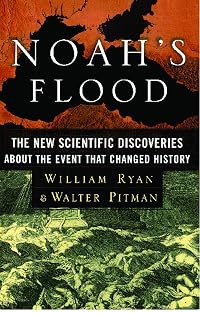
Noah's Flood: The New Scientific Discoveries About The Event That Changed History
by William B. F. Ryan (Author), Walter Pitman
On This Page
Description
For thousands of years, the legend of a great flood has endured in the biblical story of Noah and in such Middle Eastern myths as the epic of Gilgamesh. Few believed that such a catastrophic deluge had actually occurred. But now geophysicists have discovered an event that changed history, a sensational flood 7,600 years ago in what is today the Black Sea. Using sound waves and coring devices to probe the sea floor, they discovered clear evidence that this inland body of water had once been a show more vast freshwater lake lying hundreds of feet below the level of the world's rising oceans. The authors explore the archaeological, genetic, and linguistic evidence suggesting that the flood rapidly created a human diaspora that spread as far as Western Europe, Central Asia, China, Egypt, and the Persian Gulf. They suggest that the Black Sea People could well have been the mysterious proto-Sumerians, who developed the first great civilization in Mesopotamia, the source of our own. show lessTags
Recommendations









Member Reviews
Let's take a look at the historical evidence to find where the Great Flood took place.
That's the concept that William Ryan and Walter Pitman came up with some years ago, and through dedicated research, oceonographic mapping and discovery, and some luck, along with scientists unwittingly on similar paths through the ages, they have announced their findings here, in this book. Part scientific investigation, part historical detective work, in Noah's Flood Pitman and Ryan find the actual physical evidence that could explain one of the oldest stories in existence, and why that story seems to be so prevalent in societies across the globe.
Definitely a good read, if a little dry at points, but worth it if you, like me, are on the search for the show more potential truth behind the fiction of our ancestors. I read this as part of my World History foray into my Read Your Library project, and I highly recommend it. show less
That's the concept that William Ryan and Walter Pitman came up with some years ago, and through dedicated research, oceonographic mapping and discovery, and some luck, along with scientists unwittingly on similar paths through the ages, they have announced their findings here, in this book. Part scientific investigation, part historical detective work, in Noah's Flood Pitman and Ryan find the actual physical evidence that could explain one of the oldest stories in existence, and why that story seems to be so prevalent in societies across the globe.
Definitely a good read, if a little dry at points, but worth it if you, like me, are on the search for the show more potential truth behind the fiction of our ancestors. I read this as part of my World History foray into my Read Your Library project, and I highly recommend it. show less
2022 book #8. 1999. During the last ice age the Black Sea was a large fresh water lake. When the Mediterranean crashed back in the prehistoric peoples living there scattered giving rise to various flood myths like Noah's Ark. That's the theory. Interesting read.
“We need not try to make history out of legend, but we ought to assume that beneath much that is artificial or incredible there lurks something of fact.” –C. Leonard Wooley, 1934
With this quote, the authors set the tone for the story of their exploration of the Black Sea basin. 7,500 years ago, their research determined, rising sea levels on the Mediterranean broke through a barricade and plunged into the Black Sea with a force 400 times greater than that of Niagara Falls, its thundering sound carrying at least 60 miles. Could this event have spawned the flood legends we read of in so many cultures, including the Hebrew story of Noah and the Ark? “The details given in the inscriptions describing the Flood leave no doubt that show more both the Bible and the Babylonian story describe the same event, and the Flood becomes the starting point for the modern world in both histories.” Could it be that people driven from their villages spread advances in agriculture and irrigation throughout Mesopotamia?
Because of the impact these flood stories have had on various cultures for so long, this is a fascinating topic for me. For the most part, the research of Ryan and Pitman has been well-received, and the general theory (if not all the details) deserves to be treated seriously. More recent research validates that a sudden flood event may indeed have occurred as suggested, though perhaps not at the magnitude described in Ryan and Pitman’s hypothesis.
The writing is interesting, and it reads like a scientific detective story. This isn’t a new book; it’s now thirteen years old, and you can pick it up used at Amazon for pennies. show less
With this quote, the authors set the tone for the story of their exploration of the Black Sea basin. 7,500 years ago, their research determined, rising sea levels on the Mediterranean broke through a barricade and plunged into the Black Sea with a force 400 times greater than that of Niagara Falls, its thundering sound carrying at least 60 miles. Could this event have spawned the flood legends we read of in so many cultures, including the Hebrew story of Noah and the Ark? “The details given in the inscriptions describing the Flood leave no doubt that show more both the Bible and the Babylonian story describe the same event, and the Flood becomes the starting point for the modern world in both histories.” Could it be that people driven from their villages spread advances in agriculture and irrigation throughout Mesopotamia?
Because of the impact these flood stories have had on various cultures for so long, this is a fascinating topic for me. For the most part, the research of Ryan and Pitman has been well-received, and the general theory (if not all the details) deserves to be treated seriously. More recent research validates that a sudden flood event may indeed have occurred as suggested, though perhaps not at the magnitude described in Ryan and Pitman’s hypothesis.
The writing is interesting, and it reads like a scientific detective story. This isn’t a new book; it’s now thirteen years old, and you can pick it up used at Amazon for pennies. show less
A neat theory, but one that has nothing to do with Noah's flood. For instance, the relatively slow inflow of water into the Euxine basin, spectacular though it might be, would have engendered legends of running away from the flood to high mountains (the source of the Deucalion and Megaron myths perhaps?), not of a boat building flash flood. But the addition of "Noah" to the title probably netted them thousands of bucks.
This book provided an interesting and very probable take on things. A little dry but worth the read.
The new scientific discoveries about the event that changed history.
Ratings
Members
- Recently Added By
Lists

Geology - Disaster/Epic Change
8 works; 3 members
Author Information


1 Work 639 Members
Some Editions
Common Knowledge
- Original publication date
- 1998
- People/Characters
- Gilgamesh; Noah; Henry Creswicke Rawlinson
- Important places
- Anatolia; Babylon; Black Sea; Bosporus; Euphrates River; Mediterranean Sea (show all 7); Mesopotamia
- Important events
- The Flood (Genesis 6-9)
- Epigraph
- The paths going up and down rom forests of cedars
all mourn you: the weeping does not end day or night.
The meadows weep, they mourn you like your mother.
The bear, the hyena, the tiger, the deer,... (show all) the lion,
the wild bull, the ibex—all the animals of the plain cry for you.
The river Ulay, on whose banks we walked, laments you
We travelled its banks. The pure stream bewails you
where we filled our waterbag.
GILGAMESH, tablet viii, column i
(Gardner and Maier, 1985) - Dedication
- Sean Ryan Hunter
6/4/1972—8/22/1995 - First words
- PROLOGUE
Witnesses
Paddling desperately toward land with his whole torso bent in effort, the voyager is astonished to see a forest rising beneath his raft. - Last words
- (Click to show. Warning: May contain spoilers.)Nur-Aya finishes with the last lines of the timeless story, reciting words that announce not only an end but a beginning.
I shall sing of the flood to all people:
Listen! - Blurbers
- Heller, Amanda; Morrison, Philip; Morrison, Phyllis; Ellis, Richard
Classifications
- Genres
- Anthropology, History, Nonfiction, Science & Nature, General Nonfiction, Religion & Spirituality
- DDC/MDS
- 930.2 — History & geography History of ancient world (to ca. 499) Ancient History: China, Egypt, Rome, Greece
- LCC
- BS658 .R93 — Philosophy, Psychology and Religion The Bible The Bible Works about the Bible Bible and science
- BISAC
Statistics
- Members
- 647
- Popularity
- 44,867
- Reviews
- 6
- Rating
- (3.57)
- Languages
- Danish, English, German, Spanish
- Media
- Paper
- ISBNs
- 8
- ASINs
- 3