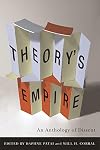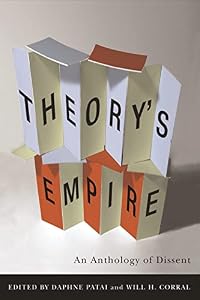
Theory's Empire: An Anthology of Dissent
by Daphne Patai, Will H. Corral (Editor)
On This Page
Description
Not too long ago, literary theorists were writing about the death of the novel and the death of the author; today many are talking about the death of Theory. Theory, as the many theoretical ism's (among them postcolonialism, postmodernism, and New Historicism) are now known, once seemed so exciting but has become ossified and insular. This iconoclastic collection is an excellent companion to current anthologies of literary theory, which have embraced an uncritical stance toward Theory and show more its practitioners. Written by nearly fifty prominent scholars, the essays in Theory's Empire question the ideas, catchphrases, and excesses that have let Theory congeal into a predictable orthodoxy. More than just a critique, however, this collection provides readers with effective tools to redeem the study of literature, restore reason to our intellectual life, and redefine the role and place of Theory in the academy. show lessTags
Recommendations








Member Reviews
OK, OK so this can't really be a 'review' as such, yet -- because this volume is still in the mails, on its way to me, as of this writing. But I am excited to read this, since I spent a good part of the 1980s swaddled in "that incomprehensible French stuff" as I worked toward a Ph.D. in Dramatic Art. All sorts of thoughts occur to me: the *utility* of obfuscation (the illusion of profundity) ... the often-missed 'playfulness' of someone like Derrida (I insist it's there, even what crumbs of it remain in translation are evidence of this ... I think he was aware all along that he was performing, and having a laugh at the expense of many).
My attitude towards some of this material has surely changed since I was in a situation where dealing show more with it was de rigeur, and it is interesting (to me, anyway) to compare the situation re: certain types of 'theory' having a stranglehold on literature departments that is ... perhaps? ... functionally equivalent to the stranglehold string theory has had in many physics departments (especially since one of the more infamous blemishes on the shining surface of the Theory Machine was its adherents' frequent, complete misunderstandings of scientific concepts, which misunderstandings did not, of course, prevent them from writing about said concepts). show less
My attitude towards some of this material has surely changed since I was in a situation where dealing show more with it was de rigeur, and it is interesting (to me, anyway) to compare the situation re: certain types of 'theory' having a stranglehold on literature departments that is ... perhaps? ... functionally equivalent to the stranglehold string theory has had in many physics departments (especially since one of the more infamous blemishes on the shining surface of the Theory Machine was its adherents' frequent, complete misunderstandings of scientific concepts, which misunderstandings did not, of course, prevent them from writing about said concepts). show less
There seem to be two kinds of literary criticism, the kind found in Western university departments that is concerned with "deconstructing" literary texts through a race/ gender/ post-imperialist/ queer lens, and the other kind on book review websites such as Amazon, dealing with popular titles like, "The Hunger Games", "Twilight", Harry Potter and the Deathly Hallows" or "Pride and Prejudice".
The first kind specially selects books that lend themselves to race/ gender/ post-imperialist/ queer analysis and the second kind selects books that deal with love, morality, good and evil, heroism, cowardice, duty and mostly male/ female relationships.
There is no doubt about which type of reading the public prefers, but as this excellent book show more makes clear Western university literature departments are really engaged in a cult like political project rather than anything resembling genuine literary criticism.
The various authors show the totalitarian nature of the race/ gender/ post-imperialist/ queer (RGIQ) project which functions in a similar way to other totalitarian projects such as Islamic Fundamentalism or Marxism in taking for granted their monopoly on the truth and ruthlessly suppressing dissent.
The reader can also see the roots of the RGIQ project in the Frankfurt School with its explicit aim of destroying the foundations of Western society. Probably most of the reviewers of Amazon's top 25 books are not aware ot the Frankfurt School but leftist university academics will be quite familiar with Adorno, Marcuse and their other heroes from the 1960's.
A necessary and worthwhile book explaining what is really going on within the RGIQ Political Correctness movement, and yes, literary criticism is just another agitprop tool to further their aims. show less
The first kind specially selects books that lend themselves to race/ gender/ post-imperialist/ queer analysis and the second kind selects books that deal with love, morality, good and evil, heroism, cowardice, duty and mostly male/ female relationships.
There is no doubt about which type of reading the public prefers, but as this excellent book show more makes clear Western university literature departments are really engaged in a cult like political project rather than anything resembling genuine literary criticism.
The various authors show the totalitarian nature of the race/ gender/ post-imperialist/ queer (RGIQ) project which functions in a similar way to other totalitarian projects such as Islamic Fundamentalism or Marxism in taking for granted their monopoly on the truth and ruthlessly suppressing dissent.
The reader can also see the roots of the RGIQ project in the Frankfurt School with its explicit aim of destroying the foundations of Western society. Probably most of the reviewers of Amazon's top 25 books are not aware ot the Frankfurt School but leftist university academics will be quite familiar with Adorno, Marcuse and their other heroes from the 1960's.
A necessary and worthwhile book explaining what is really going on within the RGIQ Political Correctness movement, and yes, literary criticism is just another agitprop tool to further their aims. show less
Ratings
Members
- Recently Added By
Lists

Literary Theory and Criticism: What Happens and Why
37 works; 5 members
Author Information
8 Works 378 Members
Daphne Patai is Professor in the Department of Spanish and Portuguese and the University of Massachusetts Amherst.
All Editions
Common Knowledge
- Blurbers
- Denby, David; Vargas Llosa, Mario; Pavel, Thomas; Lefkowitz, Mary; Erickson, Jon
Classifications
- Genres
- Literature Studies and Criticism, Nonfiction, Fiction and Literature, Philosophy
- DDC/MDS
- 801.95 — Literature & rhetoric Literature, rhetoric & criticism Philosophy and theory Nature and character Literary theory and criticism
- LCC
- PN81 .T445 — Language and Literature Literature (General) Literature (General) Criticism
- BISAC
Statistics
- Members
- 104
- Popularity
- 310,155
- Reviews
- 2
- Rating
- (3.86)
- Languages
- English
- Media
- Paper, Ebook
- ISBNs
- 3
- ASINs
- 1