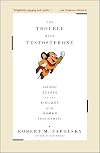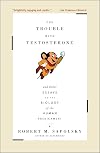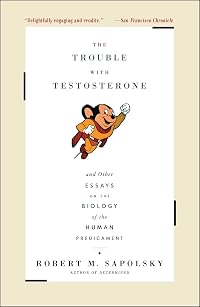
The Trouble With Testosterone: And Other Essays On The Biology Of The Human Predicament
by Robert M. Sapolsky
On This Page
Description
In this collection of erudite essays on science, the world and our relation to both, behavioural biologist Robert K. Sapolsky interprets the peculiar drives and intrinsic needs of that most exotic species - homo sapiens.Tags
Recommendations






Member Reviews
A gloriously readable, insightful and thought-provoking look at a number of different facets of the human condition, especially as displayed by our primate cousins. (No, really.)
Made up of a series of short essays (with copious lists for further reading at the end of each chapter), this is a better introduction to Sapolsky’s writing then the much denser (but equally fascinating) Why Zebras Don’t Get Ulcers. His writing style is somewhere between Oliver Sacks/Robert Winston and VS Ramachandran, with the accessibility and enthusiasm of the former meeting the erudition of the latter. He knows his stuff, but (something I particularly like) doesn’t pretend that he has the final word on any of these questions.
His area of particular show more expertise is neuroendocrinology – looking at how the chemical makeup of our bodies (mostly our brains) determines (or at least strongly predisposes) … well, pretty much everything, and not just physical health. Dominance and social relations; moods, emotions; creativity, thought, personality; the onset of developmental stages; even the relationships between compulsion and religious teachings. His early training in biological anthropology means that he is often able to bring in fascinating examples of how similar conditions and behaviours arise in primates, and how those similarities (and differences) can point to new lines of research and questioning for humans. If that sounds dry and technical, I can assure you his writing is anything but. Psychology, neurology, health studies, history, anthropology … it’s a brilliant synthesis of all of these disciplines, and then some.
It's funny, intelligent, very approachable, extremely well researched, and brilliantly well written. It will challenge some ideas you’ve never thought to question, and provide you with a whole sheaf of new questions to ponder. Strongly recommended. show less
Made up of a series of short essays (with copious lists for further reading at the end of each chapter), this is a better introduction to Sapolsky’s writing then the much denser (but equally fascinating) Why Zebras Don’t Get Ulcers. His writing style is somewhere between Oliver Sacks/Robert Winston and VS Ramachandran, with the accessibility and enthusiasm of the former meeting the erudition of the latter. He knows his stuff, but (something I particularly like) doesn’t pretend that he has the final word on any of these questions.
His area of particular show more expertise is neuroendocrinology – looking at how the chemical makeup of our bodies (mostly our brains) determines (or at least strongly predisposes) … well, pretty much everything, and not just physical health. Dominance and social relations; moods, emotions; creativity, thought, personality; the onset of developmental stages; even the relationships between compulsion and religious teachings. His early training in biological anthropology means that he is often able to bring in fascinating examples of how similar conditions and behaviours arise in primates, and how those similarities (and differences) can point to new lines of research and questioning for humans. If that sounds dry and technical, I can assure you his writing is anything but. Psychology, neurology, health studies, history, anthropology … it’s a brilliant synthesis of all of these disciplines, and then some.
It's funny, intelligent, very approachable, extremely well researched, and brilliantly well written. It will challenge some ideas you’ve never thought to question, and provide you with a whole sheaf of new questions to ponder. Strongly recommended. show less
Robert M. Sapolsky is a biologist and neuroscientist who's spent much of his career studying stress in our relatives the baboons, something that unquestionably has things to tell us about ourselves. In this collection of essays, he talks a little about some of that work, and also about things like how hormones affect our aggression levels, whether animals might use plants to medicate themselves, ways in which aspects of personality can be linked to brain conditions like temporal lobe epilepsy, and even a controversial essay about possible interactions between mental illnesses and the evolution of religion.
Interesting topics, all, and I've really liked the other two books by Sapolsky that I've read (A Primate's Memoir and Why Zebras show more Don't Get Ulcers), but I have to say that I didn't find this collection nearly as satisfying as I'd hoped. Most of the essays feel rather slight to me, and do rather too much mixing personal speculations with actual scientific findings, often in ways where the difference isn't nearly as clear as it should be. Not that what's in here isn't worth reading or thinking about. But I'd say a lot of it should be taken with a grain of salt, and none of it does more than scratch the surface of any particular topic. Also worth noting is that since this was originally published in 1997, it's definitely a bit dated -- in the references it makes, for sure, and probably also in the science.
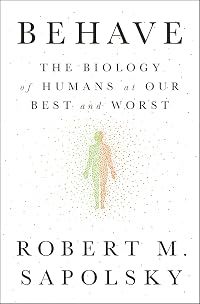
I recently picked up a copy of Sapolsky's new book Behave: The Biology of Humans at Our Best and Worst, and I'm hoping he comes back to some of these topics in it. I have the feeling maybe he's just better when writing at length than in short pieces. show less
Interesting topics, all, and I've really liked the other two books by Sapolsky that I've read (A Primate's Memoir and Why Zebras show more Don't Get Ulcers), but I have to say that I didn't find this collection nearly as satisfying as I'd hoped. Most of the essays feel rather slight to me, and do rather too much mixing personal speculations with actual scientific findings, often in ways where the difference isn't nearly as clear as it should be. Not that what's in here isn't worth reading or thinking about. But I'd say a lot of it should be taken with a grain of salt, and none of it does more than scratch the surface of any particular topic. Also worth noting is that since this was originally published in 1997, it's definitely a bit dated -- in the references it makes, for sure, and probably also in the science.
I recently picked up a copy of Sapolsky's new book Behave: The Biology of Humans at Our Best and Worst, and I'm hoping he comes back to some of these topics in it. I have the feeling maybe he's just better when writing at length than in short pieces. show less
The Trouble with Testosterone by Robert Sapolsky (book review)
Well, I'm a Sapolsky fan now after reading "The Trouble with Testosterone." His style of writing reminds me of Natalie Angiers (The Beauty of the Beastly & Woman, an Intimate Geography)
It's funny that I read it just after 'The Songlines" which has some of man's innate wanderlust as the heart of the story.
As a mother with a young son my heart just ached for male 273 (a baboon)
He was badly mauled and, in a poignant act, crawled for miles to return to his former home troop to die near his mother.
In the chapter 'Circling the Blanket for God' I just had to stop reading periodically to wipe the tears of laughter out of my eyes. He presents the (not new) argument that religion, show more schizophrenia and OCD are all related.
Put succinctly, it is not usually considered to be a sign of robust mental health to hear voices in burning bushes. Or to report that you've spent the night wrestling with an angel, or that someone who had died has risen and conversed with you.
He has a diagram of Rice Krispy treats and shows how it is innate human nature to want to always leave a straight line on the treats left in the pan. This really tickled me. I’ve always known it as ‘cake straightening’. No one can leave a jagged line of cake in a sheet cake pan. YOU JUST HAVE TO EAT cake until there is a straight line left.
For schizophrenics, it’s not a matter of trees and forests. Instead it’s habitually seeing only the bark.
This guy sure makes science accessible. show less
Well, I'm a Sapolsky fan now after reading "The Trouble with Testosterone." His style of writing reminds me of Natalie Angiers (The Beauty of the Beastly & Woman, an Intimate Geography)
It's funny that I read it just after 'The Songlines" which has some of man's innate wanderlust as the heart of the story.
As a mother with a young son my heart just ached for male 273 (a baboon)
He was badly mauled and, in a poignant act, crawled for miles to return to his former home troop to die near his mother.
In the chapter 'Circling the Blanket for God' I just had to stop reading periodically to wipe the tears of laughter out of my eyes. He presents the (not new) argument that religion, show more schizophrenia and OCD are all related.
Put succinctly, it is not usually considered to be a sign of robust mental health to hear voices in burning bushes. Or to report that you've spent the night wrestling with an angel, or that someone who had died has risen and conversed with you.
He has a diagram of Rice Krispy treats and shows how it is innate human nature to want to always leave a straight line on the treats left in the pan. This really tickled me. I’ve always known it as ‘cake straightening’. No one can leave a jagged line of cake in a sheet cake pan. YOU JUST HAVE TO EAT cake until there is a straight line left.
For schizophrenics, it’s not a matter of trees and forests. Instead it’s habitually seeing only the bark.
This guy sure makes science accessible. show less
Robert Sapolsky is a Professor of Biological Sciences, and Professor of Neurology and Neurological Sciences, and by courtesy, Neurosurgery, at Stanford University, and his main focus is studying primates and how us humans relate to them. This is a collection of well-written, candid, humorous and interesting essays about the biology of human culture and behavior, the evolution of biology, and the social and political implications of these biological findings. Each essay contains interesting information (and some personal anecdotes) on the brain, behavior, biology, and environment. The book is easily understood by the non-scientist but not simplified so much that the scientists will want to rip their hair out. Each essay is concluded with show more a reference section for those who want more detailed information on that specific subject. The book is only slightly dated, as research has progressed and new information has emerged on certain subjects since its publication, but the vast majority is still valid.
My favourite story is probably “Junk Food Monkeys” in which Sapolsky relates the adventures of a troop of baboons in Kenya who stumble upon a tourist garbage dump. The essay on the relationship between schizotypal behaviour, OCD and religion (shamanism and institutionalized religions) is also very interesting. show less
My favourite story is probably “Junk Food Monkeys” in which Sapolsky relates the adventures of a troop of baboons in Kenya who stumble upon a tourist garbage dump. The essay on the relationship between schizotypal behaviour, OCD and religion (shamanism and institutionalized religions) is also very interesting. show less
Ratings
Members
- Recently Added By
Lists

The r/AskScience Reading List
159 works; 3 members

The Venus Project Recommended Books - Contemporary sources
53 works; 2 members
Author Information

55+ Works 7,251 Members
Robert M. Sapolsky is a Professor of Biology & Neurology at Stanford & a Research Associate with the Institute of Primate Research, National Museums of Kenya. He is the author of "The Trouble with Testosterone" & "Why Zebras Don't Get Ulcers", both Los Angeles Times Book Award finalists. A regular contributor to Discover & The Sciences & a show more recipient of a MacArthur Foundation genius grant, Sapolsky lives in San Francisco, California. (Bowker Author Biography) show less
Awards and Honors
Awards
Notable Lists
Work Relationships
Contains
Common Knowledge
- Original title
- The Trouble With Testosterone: And Other Essays On The Biology Of The Human Predicament
- Alternate titles
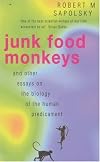
- Junk Food Monkeys: And Other Essays on the Biology of the Human Predicament
- Original publication date
- 1997-04-14
- Dedication
- For my mother who, a long time ago, read to me
Classifications
Statistics
- Members
- 465
- Popularity
- 65,605
- Reviews
- 4
- Rating
- (4.09)
- Languages
- English, Polish
- Media
- Paper, Ebook
- ISBNs
- 6
- ASINs
- 2