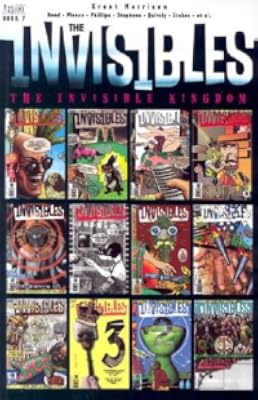
The Invisibles, Vol. 7: The Invisible Kingdom
by Grant Morrison
The Invisibles Vol.3 (Collections and Selections — Complete 12 Issues), The Invisibles (Collections and Selections — TPB Vol 3 issues 12-01)
On This Page
Description
For countless millennia the world has been subjected to an all-encompassing apocalyptic conspiracy. Through clandestine movements, a sinister secret organization has been creating a hypnotic state of conformity and control through their manipulation of the government, business, and entertainment industry. But from the shadows, a subversive group of anarchists called the Invisibles have opposed their plot and looked to create self-awareness and freedom through disobedience. Now with the fate show more of all mankind hanging in the balance, the secret freedom fighting cult make their final rebellious stand in the war of control versus chaos. show lessTags
Recommendations





Member Recommendations
Sandwich76 Super graphic serial killer novel, almost to the point of high camp. I think you'll enjoy it.
Member Reviews
I remember being largely confused by the finale of The Invisibles when I read it for the first time as a teenager. I enjoyed it more this time around, not least because I read it shortly after the preceding six volumes. It hangs together better and makes more sense with the rest of the series in recent memory. Consequently I'm adding a fifth star, which applies both to this volume and the series as a whole.
There are cast changes in [b:The Invisibles, Vol. 7: The Invisible Kingdom|22394|The Invisibles, Vol. 7 The Invisible Kingdom|Grant Morrison|https://i.gr-assets.com/images/S/compressed.photo.goodreads.com/books/1309400639l/22394._SX50_.jpg|23420]. Ragged Robin and Boy have left; Helga is introduced. When I was a teenager I thought show more she was the coolest character ever. She studies alien languages, frightens everyone around her, and always wears black. As an adult I still think she's awesome. Jolly Roger also comes into her own - I love her Eurythmics eyepatch look. Division X rock up: a set of psychics cosplaying a 1970s cop show. I appreciated them more this time around, by paying attention to their adoption of these pastiche genre identities rather than taking them literally.
To be honest, as a teenager I couldn't make sense of the ending, although it fascinated me as much as the rest of the series. Many elements from the preceding volumes collide: UFOs! Interdimensional monster royalty! The Wicker Man! The millennium! Deprogramming evil Sir Miles! De Sade, who has invented a renewable energy source from orgasms! The King in Yellow! Orlando the skin-wearing demon! The Harlequinade! Solar flares! Etc. Twenty years later I can parse it all a bit better.
The overall point I inferred is that reality is a dialectical process.Dane eats the king-archon who was intended to possess him; Jon O' Dreams is both Invisible and Adversary. Dane walks through the mirror to find the same conflict playing out as in our reality: the archons/the machine vs freedom/self-knowledge. There is no ultimate victory for either side. Reality is, it seems, composed of their dynamic. Initiation never ends as there is always more to understand.
The word-as-thing-itself drug Key 23 returns and is, I think, a microcosm of another theme of the series. Helga doses herself with it at one point to better understand how words make reality. At various points characters ask whether The Invisibles is a novel, a game, or some other fictional narrative. The final line is, I think, perfect in its multiple meanings: 'Our sentence is up.' That said, I do not know what the supercontext is and am unsure whether I'm meant to.
Notwithstanding the definitive final line, the story-telling is as non-linear as ever. Events orbit around the climactic scene in Westminster Abbey, which is made more disorientating by multiple contrasting art styles. The epistolary sections with Edith (in which she meets De Sade) are dilatory yet fascinating. Once again Fanny is a mistress of disguise and teams up with Dane - they make a great duo. During the denouement King Mob gets shot but doesn't die. Jolly Roger gets shot and does die - her corpse is shown on page 257 - then Dane comments that, "Nobody died. Nobody ever dies. We just have to make sure that the maggot turns into a fly." I still do not understand or appreciate that particular choice. It's cute that Boy has a child called Robin, though. Ragged Robin emerging from a timehole (??) is enigmatic yet striking. More prosaically, the millennium references are fun, including disparaging commentary on the Dome and posters mimicking Ministry of Sound.
I'm very glad I reread The Invisibles. It is both interesting as a flashback to the turn of the century and for its ongoing relevance. Thanks to ubiquitous connectivity, we live in a more unstable and disputed reality than ever. This line was particularly cutting to read in 2022: "We didn't have MeMes when I was little. Personalities, we called them." Ouch. The series plays with narrative, identity, and meaning in original and memorably weird ways. It's also just cool as fuck. I thought so as a teenager and was pleased to find my younger self wasn't mistaken. A lot of heavy existential stuff is delivered via kinetic action scenes, stunningly vivid splash pages, and compelling characters wearing stylish outfits. The series definitely shaped my taste in fiction and teenage daydreams. Thank you, Grant Morrison, for making me that bit weirder. show less
There are cast changes in [b:The Invisibles, Vol. 7: The Invisible Kingdom|22394|The Invisibles, Vol. 7 The Invisible Kingdom|Grant Morrison|https://i.gr-assets.com/images/S/compressed.photo.goodreads.com/books/1309400639l/22394._SX50_.jpg|23420]. Ragged Robin and Boy have left; Helga is introduced. When I was a teenager I thought show more she was the coolest character ever. She studies alien languages, frightens everyone around her, and always wears black. As an adult I still think she's awesome. Jolly Roger also comes into her own - I love her Eurythmics eyepatch look. Division X rock up: a set of psychics cosplaying a 1970s cop show. I appreciated them more this time around, by paying attention to their adoption of these pastiche genre identities rather than taking them literally.
To be honest, as a teenager I couldn't make sense of the ending, although it fascinated me as much as the rest of the series. Many elements from the preceding volumes collide: UFOs! Interdimensional monster royalty! The Wicker Man! The millennium! Deprogramming evil Sir Miles! De Sade, who has invented a renewable energy source from orgasms! The King in Yellow! Orlando the skin-wearing demon! The Harlequinade! Solar flares! Etc. Twenty years later I can parse it all a bit better.
The overall point I inferred is that reality is a dialectical process.
The word-as-thing-itself drug Key 23 returns and is, I think, a microcosm of another theme of the series. Helga doses herself with it at one point to better understand how words make reality. At various points characters ask whether The Invisibles is a novel, a game, or some other fictional narrative. The final line is, I think, perfect in its multiple meanings: 'Our sentence is up.' That said, I do not know what the supercontext is and am unsure whether I'm meant to.
Notwithstanding the definitive final line, the story-telling is as non-linear as ever. Events orbit around the climactic scene in Westminster Abbey, which is made more disorientating by multiple contrasting art styles. The epistolary sections with Edith (in which she meets De Sade) are dilatory yet fascinating. Once again Fanny is a mistress of disguise and teams up with Dane - they make a great duo. During the denouement King Mob gets shot but doesn't die. Jolly Roger gets shot and does die - her corpse is shown on page 257 - then Dane comments that, "Nobody died. Nobody ever dies. We just have to make sure that the maggot turns into a fly." I still do not understand or appreciate that particular choice. It's cute that Boy has a child called Robin, though. Ragged Robin emerging from a timehole (??) is enigmatic yet striking. More prosaically, the millennium references are fun, including disparaging commentary on the Dome and posters mimicking Ministry of Sound.
I'm very glad I reread The Invisibles. It is both interesting as a flashback to the turn of the century and for its ongoing relevance. Thanks to ubiquitous connectivity, we live in a more unstable and disputed reality than ever. This line was particularly cutting to read in 2022: "We didn't have MeMes when I was little. Personalities, we called them." Ouch. The series plays with narrative, identity, and meaning in original and memorably weird ways. It's also just cool as fuck. I thought so as a teenager and was pleased to find my younger self wasn't mistaken. A lot of heavy existential stuff is delivered via kinetic action scenes, stunningly vivid splash pages, and compelling characters wearing stylish outfits. The series definitely shaped my taste in fiction and teenage daydreams. Thank you, Grant Morrison, for making me that bit weirder. show less
This trade paper volume collects all twelve issues of the third and final Invisibles series. New characters are introduced, and the boundaries between the various conspiracies motivating the action become ever more porous as the eschaton is immanentized.
The closing series of the comic--especially its last issues--suffers from a surfeit of artists. It gets to the point where a single illustrator rarely has contributed more than two or three pages in sequence. In some cases, a shift of artistic style seems to be deliberately communicating a shift of perspective, but these seem to be the minority, and the visual idiolects are so divergent that the reader must struggle to identify characters and settings in panel after panel.
Once in a show more while, I would pause and try to bring "beginner's mind" to bear on the dialogue of the book (especially the pronouncements of "expert" protagonists like King Mob and Helga), and I found that it was mostly sesquipedalian gibberish. For better or for worse, though, it's the sort of gibberish that my conditioned mind understands and enjoys.
These comic books were originally issued in 1999 and 2000, and they are very much a product of their time. No one could or would write this sort of thing today. Even though the essential fears expressed here remain in force, our political context has rather dampened and shifted the corresponding hopes. Another book from the same period that has dated similarly is Hakim Bey's Millennium. I would contrast Morrsion's more concentrated and coherent effort in The Filth, which addresses many similar themes. show less
The closing series of the comic--especially its last issues--suffers from a surfeit of artists. It gets to the point where a single illustrator rarely has contributed more than two or three pages in sequence. In some cases, a shift of artistic style seems to be deliberately communicating a shift of perspective, but these seem to be the minority, and the visual idiolects are so divergent that the reader must struggle to identify characters and settings in panel after panel.
Once in a show more while, I would pause and try to bring "beginner's mind" to bear on the dialogue of the book (especially the pronouncements of "expert" protagonists like King Mob and Helga), and I found that it was mostly sesquipedalian gibberish. For better or for worse, though, it's the sort of gibberish that my conditioned mind understands and enjoys.
These comic books were originally issued in 1999 and 2000, and they are very much a product of their time. No one could or would write this sort of thing today. Even though the essential fears expressed here remain in force, our political context has rather dampened and shifted the corresponding hopes. Another book from the same period that has dated similarly is Hakim Bey's Millennium. I would contrast Morrsion's more concentrated and coherent effort in The Filth, which addresses many similar themes. show less
It's been a long journey. Morrison has kept me vaguely interested enough that I haven't dropped him entirely, but I more than recognize why this series turned me off of him for months before I discovered WE3.
It didn't help that the final series is numbered in reverse and that I ended up reading the last three comics as the first three; I'd thought for a moment that Morrison's experimental plotting had reached some sort of frenzied climax where empty symbols had completely taken over any sense of meaning.
This error was a bit confusing at first, but had the added effect of revealing to me part of why Morrison comes off so flat to me. Morrison's story works like a drug trip; indeed, he utilizes several real-life trips as direct inspiration show more for this and others of his comics. The semi-random firings of neurons brought on by sleep and (hallucinogenic) drugs creates an overlay of sensory and symbolic experience which becomes the medium for our understanding.
The same might be said of any story, except that in Morrison's particular reading habits, he culls his symbols and sensory experiences not from the recognizeable or even the metaphorical, but from the theoretical or even the paranoid. His reality then has no focus, and exists in an interchangeable, dreamlike state; and like a dream, the thing which interconnects it is a continuous narrative.
One might ask if this has to be a problem, but in Morrison's case, he does not let it be a scattered dream but instead constantly tries to coalesce it into some holistic truth. It is unfortunate that one cannot build a holistic truth out of and unrelated scree. Mankind will always try to see patterns, even when they aren't there. We cannot understand or replicate the random, and never understand that the coincidence is something that must happen.
The real problem with the story, which sets Morrison apart from both Moore and Gaiman is that he's come to believe in his own bullshit. This story is too close to home for him, and beyond basing it on his own philosophies, he comes to believe that the whole work is a magic spell that is controlling his life. Now, maybe it is and maybe it isn't, but the end result is that Morrison stops working to make the thing coherent because he believes it is already.
Belief in the quality of a work or idea is the worst thing that can happen to an author. Without a constant doubt as to the quality or coherence of the message, the constant inflow of unchecked ideas turns into nothing more than a distracting white noise around the plot. The 2012 date for apocalypse quoted by Morrison comes from a completely innacurate source that actually doesn't match the Mayan calendar at all.
Morrison wraps it all up with something that looks but does not feel like a climax. Though he sets up all the evil empires, double agents, monomythic battle against evil, magic items, and monsters, he spends too much of his dialogue trying to explain this or that 5th-dimensional crystal to actually describe the cosmological conflict itself.
That being said, it's new and interesting enough, and did inspire me to think more about physical exploration and catharsis. The art gets better as the series closes up, though the latter books are a bit annoying sometimes in that they switch from one artist to the next for scenes.
I finished the thing. It taught me a lot of things not to do as a writer and helped me to recognize why some of Morrison's stories work so very well and why others are just empty and confused. I'll have to make sure that if I ever write my dream project, near and dear to my heart, that I have a very smart and very honest friend read it first and let me know if I should just keep the hubristic nonsense to myself. show less
It didn't help that the final series is numbered in reverse and that I ended up reading the last three comics as the first three; I'd thought for a moment that Morrison's experimental plotting had reached some sort of frenzied climax where empty symbols had completely taken over any sense of meaning.
This error was a bit confusing at first, but had the added effect of revealing to me part of why Morrison comes off so flat to me. Morrison's story works like a drug trip; indeed, he utilizes several real-life trips as direct inspiration show more for this and others of his comics. The semi-random firings of neurons brought on by sleep and (hallucinogenic) drugs creates an overlay of sensory and symbolic experience which becomes the medium for our understanding.
The same might be said of any story, except that in Morrison's particular reading habits, he culls his symbols and sensory experiences not from the recognizeable or even the metaphorical, but from the theoretical or even the paranoid. His reality then has no focus, and exists in an interchangeable, dreamlike state; and like a dream, the thing which interconnects it is a continuous narrative.
One might ask if this has to be a problem, but in Morrison's case, he does not let it be a scattered dream but instead constantly tries to coalesce it into some holistic truth. It is unfortunate that one cannot build a holistic truth out of and unrelated scree. Mankind will always try to see patterns, even when they aren't there. We cannot understand or replicate the random, and never understand that the coincidence is something that must happen.
The real problem with the story, which sets Morrison apart from both Moore and Gaiman is that he's come to believe in his own bullshit. This story is too close to home for him, and beyond basing it on his own philosophies, he comes to believe that the whole work is a magic spell that is controlling his life. Now, maybe it is and maybe it isn't, but the end result is that Morrison stops working to make the thing coherent because he believes it is already.
Belief in the quality of a work or idea is the worst thing that can happen to an author. Without a constant doubt as to the quality or coherence of the message, the constant inflow of unchecked ideas turns into nothing more than a distracting white noise around the plot. The 2012 date for apocalypse quoted by Morrison comes from a completely innacurate source that actually doesn't match the Mayan calendar at all.
Morrison wraps it all up with something that looks but does not feel like a climax. Though he sets up all the evil empires, double agents, monomythic battle against evil, magic items, and monsters, he spends too much of his dialogue trying to explain this or that 5th-dimensional crystal to actually describe the cosmological conflict itself.
That being said, it's new and interesting enough, and did inspire me to think more about physical exploration and catharsis. The art gets better as the series closes up, though the latter books are a bit annoying sometimes in that they switch from one artist to the next for scenes.
I finished the thing. It taught me a lot of things not to do as a writer and helped me to recognize why some of Morrison's stories work so very well and why others are just empty and confused. I'll have to make sure that if I ever write my dream project, near and dear to my heart, that I have a very smart and very honest friend read it first and let me know if I should just keep the hubristic nonsense to myself. show less
I picked up most of the Invisibles collections last year, but felt like it was losing focus towards the end. I put off buying this, the final installment, for months, and alas! the world ends not with a bang but a whimper.
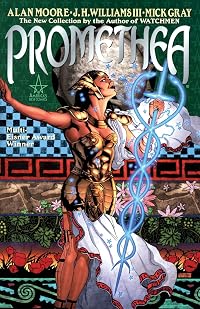
I like Morrison's work in general, and I'm a big fan of the long form, such as Sandman, Promethea, or Cerebus; but the Invisibles doesn't so much end as merely stop.
Still, some folks love this, so I'm going to look into the Disinformation Guide to the Invisibles to see if I've missed something major.
I like Morrison's work in general, and I'm a big fan of the long form, such as Sandman, Promethea, or Cerebus; but the Invisibles doesn't so much end as merely stop.
Still, some folks love this, so I'm going to look into the Disinformation Guide to the Invisibles to see if I've missed something major.
Hm.
This volume takes place in the future, and strangely, doesn't focus on the main characters of King Mob's Invisible cell, but rather on Division X for most of it. I didn't mind the switch to Division X - especially as it followed up on a few of the earlier storylines (Monster of Glamis, Orlando, John O'Dreams, etc.) but the art style entirely distracted me.
I wasn't crazy about the artwork of this album - the style just didn't speak to me, and somewhat pulled my focus away from the storyline entire. Unlike the earlier volumes, I found this one rather dense and left the story not entirely certain I understood it.
Dickensian, indeed, it did go full-circle in a rather nice way. The Time Machine plot, the earlier abduction plot, Sir Miles, show more all of it came to a rather firm conclusion. I didn't dislike this volume, per se, but it left me with questions.
I think I'll head over to Barbelith and give this some heavy thinking... show less
This volume takes place in the future, and strangely, doesn't focus on the main characters of King Mob's Invisible cell, but rather on Division X for most of it. I didn't mind the switch to Division X - especially as it followed up on a few of the earlier storylines (Monster of Glamis, Orlando, John O'Dreams, etc.) but the art style entirely distracted me.
I wasn't crazy about the artwork of this album - the style just didn't speak to me, and somewhat pulled my focus away from the storyline entire. Unlike the earlier volumes, I found this one rather dense and left the story not entirely certain I understood it.
Dickensian, indeed, it did go full-circle in a rather nice way. The Time Machine plot, the earlier abduction plot, Sir Miles, show more all of it came to a rather firm conclusion. I didn't dislike this volume, per se, but it left me with questions.
I think I'll head over to Barbelith and give this some heavy thinking... show less
The first few volumes of this series was intriguing and playful. It reminded me of a fusion of some of Philip K. Dick work and the Illuminatus trilogy.
On the other hand as the series went on it got more disorganized and less and less interesting characters emerged. At some point I was just reading hoping to get to the ending and now I wish I hadn't. The ending itself was disappointing on many levels. Towards the end only one or two characters got introduced that I even cared to find more about. The actual ending felt more like they couldn't decide on an ending and just went for vagueness. Not even cool vagueness. Eh.
The series no longer has the humor or zaniness of Illuminatus nor none of the weirdness or fascinating characters of Dick. show more I can't figure out where it happened, but know I wish I had stopped reading somewhere after the ending of the story arches of Lord Fanny & Boy. show less
On the other hand as the series went on it got more disorganized and less and less interesting characters emerged. At some point I was just reading hoping to get to the ending and now I wish I hadn't. The ending itself was disappointing on many levels. Towards the end only one or two characters got introduced that I even cared to find more about. The actual ending felt more like they couldn't decide on an ending and just went for vagueness. Not even cool vagueness. Eh.
The series no longer has the humor or zaniness of Illuminatus nor none of the weirdness or fascinating characters of Dick. show more I can't figure out where it happened, but know I wish I had stopped reading somewhere after the ending of the story arches of Lord Fanny & Boy. show less
I just read this backwards and didn't even know. What the hell, man? But it is pure dead style and the newest invisible is a linguist to boot.
Members
- Recently Added By
Lists

Drawn Out: The 50 Best Non-Superhero Graphic Novels
175 works; 8 members
Author Information

All Editions
Series

The Invisibles Vol.3
12 works (Collections and Selections — Complete 12 Issues)

The Invisibles
65 works (Collections and Selections — TPB Vol 3 issues 12-01)
Belongs to Publisher Series
Work Relationships
Contains
Has as a study
Common Knowledge
- Canonical title
- The Invisibles, Vol. 7: The Invisible Kingdom
- Original title
- The Invisibles, Vol. 7: The Invisible Kingdom
- Alternate titles
- The Invisibles: The Invisible Kingdom
- People/Characters
- King Mob; Ragged Robin; Lord Fanny; Jack Frost
- Last words
- (Click to show. Warning: May contain spoilers.)Our sentence is up.
Classifications
- Genre
- Graphic Novels & Comics
- DDC/MDS
- 741.5973 — Arts & recreation Drawing & decorative arts Drawing Comic books, graphic novels, fotonovelas, cartoons, caricatures, comic strips History, geographic treatment, biography North American United States (General)
- LCC
- PN6728 .I58 .M68 — Language and Literature Literature (General) Literature (General) Collections of general literature Comic books, strips, etc.
- BISAC
Statistics
- Members
- 538
- Popularity
- 55,391
- Reviews
- 8
- Rating
- (3.90)
- Languages
- English
- Media
- Paper, Ebook
- ISBNs
- 3
- ASINs
- 1