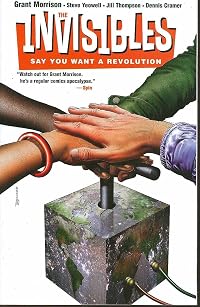
The Invisibles, Vol. 1: Say You Want a Revolution
by Grant Morrison (Writer)
The Invisibles Vol.1 (Collections and Selections — 1-8), The Invisibles (Collections and Selections — TPB Vol 1 issues 01-08)
On This Page
Description
Throughout history, a secret society called the Invisibles, who count among their number Lord Byron and Percy Shelley, work against the forces of order that seek to repress humanity's growth. In this first collection, the Invisibles' latest recruit, a teenage lout from the streets of London, must survive a bizarre, mind-altering training course before being projected into the past to help enlist the Marquis de Sade.Tags
Recommendations

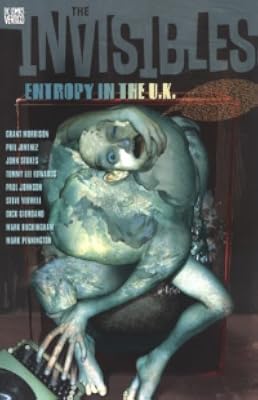
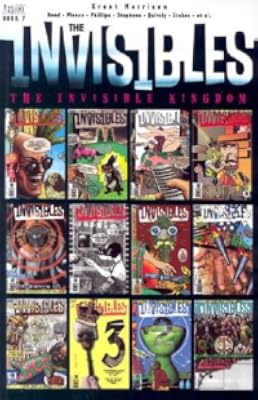
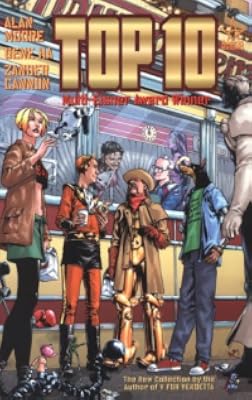
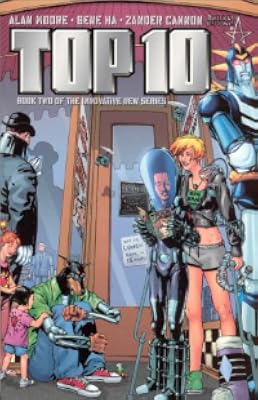
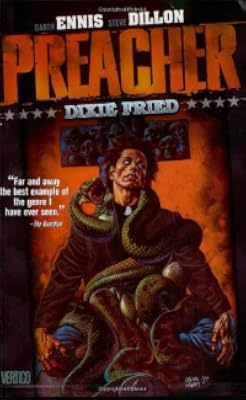

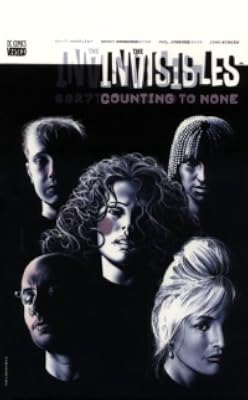





Member Recommendations
Member Reviews
The first couple issues of this, with Jack Frost's awakening guided by Tom o'Bedlam, are as good this time around--exhilarating, erudite, phantasmagorical-as they ever felt: not only the psychedelia, but the human stuff--the gently hungry way Tom's age looks at Jack's youth; the way, at 36, I can't any longer elide over the fact that Jack is kind of a prick and a half but at the same time recognize exactly how much the wild life in him is worth--taking neither thing any longer for granted (I am the parent of a toddler). The other Invisibles, as they pose and pout their way on in, are a bit too self-conscious a badass crew of mystic rebels to impress quite as much as they did (in this case age attenuates that beauty--perhaps because they show more are grown humans and Jack is just a kid? But that's not an attitude I'd endorse. Hm.) But I know that they are gonna get cool character dev and secrets revealed and trust that I'll love 'em as much as I ever did--all except one: King Mob has aged poorly (worse than the drag queen!), so clearly an authorial avatar and feminist bro (which in the world of the Inviz means of course also a open-the-doors-of-perception bro, a wisdom-of-the-East bro, all those things). But that kind of depreciation is only to be expected in a work whose beating heart is so totally of its times, and the main reason I didn't enjoy this as much as I did a decade ago is, to be honest, that it's full of ugly graphic violence, swaggering in oh-so-pleased with itself. Literature should break the ice within, certainly, and the bits like where Orlando cuts off Jack's finger while he's in his trance ("Such a small piece of you ...") certainly might be justified in terms of the affective yields; but then other parts, like where Orlando, uh ... skins the guy out getting ice cream for his kids and then comes home and nails the dog to the door and dismembers the kids and pops one of their heads onto the end of the lamppost and rapes and disembowels the guy's wife while wearing his skin, all rendered with a clever but filthy visual economy (literally all we see of the wife is a single breast, entrails, and bloodied thighs, reducing her neatly to a collection of brutalized parts; all we see of the one kid is the severed head, the part that smiled and sparkled)--no. Done with it. I'm not so hoary that I can't just about remember how this kind of gore once seemed kind of admirably punk, anti-hypocrisy, to say nothing of an almost irresistible card to play to say EVIL EVIL EVIL, and so I don't blame the creators--but in this world we have today, those conditions are long gone, and we're all intimately familiar with how brutalizing and pornographic this kind of thing is (ironically, undercutting the original impact of its use and replacing it with an uglier). So that's unpleasant, but The Invisibles is of its times--and still wonderful in so many ways. show less
I've decided it's time to re-read The Invisibles, which I was obsessed with as a teenager in the early '00s. I read the whole thing out of chronological order based on library reservation timescales and have no memory of what the hell happened at the end. So it'll be interesting to see if I still love it and what I notice twenty years later. My teenage self adored how weird and metatextual it is, different to anything I'd read before.
The first volume follows Dane McGowan, a delinquent Liverpool teenage boy from a deprived background. He is recruited by the Invisibles, a small cell of resistance fighters. He has no idea what is going on and neither does the reader, so this volume works better as an introduction than I remembered. (I show more didn't realise because I initially read it after at least four other volumes.) Characters from different time periods who become more significant later pop up here and there, plus the two key characteristics of the antagonists are established. They are i) interdimensional monsters, ii) Tories. For the first half of the book an enigmatic tramp named Tom O'Bedlam mentors Dane while the two live on the streets of London(s). O'Bedlam introduces Dane to magic and alternate realities. This feels relatively slow in comparison with later events, while setting up several main characters and much strangeness to come.
In the second half, the plot gets going and there are some fantastic time travel sequences. How could I have forgotten that the Invisibles visit the height of the Terror to recruit the Marquis de Sade? I only recalled De Sade turning up later, so this was a lovely surprise. Byron, Shelley, and Mary Shelley also appear, discussing utopia. Given that at the age of 16 I was already fascinated by the French Revolution and utopian thought, is it any wonder I got into this series. There's also a fair amount of creepy supernatural shit, brutal violence, and BDSM (hardly surprising, given De Sade's presence).
Definitely still five stars two decades later. Although the art hasn't hit its stride yet, the plot and tone are fully compelling from the start. I have a real dilemma about what genre tags to use for this series, though. It deliberately mixes sci-fi, horror, supernatural, and fantasy elements and borrows from a huge range of literary, historical, mythological, and spiritual sources. What the hell, let's say sci-fi and supernatural even though there is so much more going on than that. show less
The first volume follows Dane McGowan, a delinquent Liverpool teenage boy from a deprived background. He is recruited by the Invisibles, a small cell of resistance fighters. He has no idea what is going on and neither does the reader, so this volume works better as an introduction than I remembered. (I show more didn't realise because I initially read it after at least four other volumes.) Characters from different time periods who become more significant later pop up here and there, plus the two key characteristics of the antagonists are established. They are i) interdimensional monsters, ii) Tories. For the first half of the book an enigmatic tramp named Tom O'Bedlam mentors Dane while the two live on the streets of London(s). O'Bedlam introduces Dane to magic and alternate realities. This feels relatively slow in comparison with later events, while setting up several main characters and much strangeness to come.
In the second half, the plot gets going and there are some fantastic time travel sequences. How could I have forgotten that the Invisibles visit the height of the Terror to recruit the Marquis de Sade? I only recalled De Sade turning up later, so this was a lovely surprise. Byron, Shelley, and Mary Shelley also appear, discussing utopia. Given that at the age of 16 I was already fascinated by the French Revolution and utopian thought, is it any wonder I got into this series. There's also a fair amount of creepy supernatural shit, brutal violence, and BDSM (hardly surprising, given De Sade's presence).
Definitely still five stars two decades later. Although the art hasn't hit its stride yet, the plot and tone are fully compelling from the start. I have a real dilemma about what genre tags to use for this series, though. It deliberately mixes sci-fi, horror, supernatural, and fantasy elements and borrows from a huge range of literary, historical, mythological, and spiritual sources. What the hell, let's say sci-fi and supernatural even though there is so much more going on than that. show less
This was a little disappointing as the first volume in a series widely touted as innovative. Of course, looking at something in 2010 is not going to be the same as looking at in 1994 when it was first published but it does not stand the test of time in the way that the Sandman series of Neil Gaiman or the work of Alan Moore has done.
Morrison is not stupid. He plays well with the tropes of Chaos Magick (never mentioned but central to the thinking behind the book) and with the psychogeography of London.
He is well within an English tradition of mixing magic and public culture, one that has been a highly fertile source for American popular culture and whose literary output comprises such luminaries as Ackroyd, Sinclair and, most recently, show more with 'Kraken', China Mieville.
But the graphics are conventional and Morrison himself can be wordy. He stretches things out a bit on occasions so that you end up asking 'where's the beef?'. No graphic novel should ever permit the stifling of a yawn as one does while listening to the self-indulgent wittering of 'Old Tom'. It also leaps around too much with an odd rhythm - too much meandering in one part and too much jump-cutting in another.
I would like to think that this was some deliberate strategy to mimic Chaos Magick theory but, if so, it fails. Chaos Magick does not work through external but through internal narrative. Here, you never get the chance to sustain an engagement that will shift your mental gear into new paradigms - you are, too often, being preached at, the exact antithesis of the Chaos mentality.
So much good work has been done around the idea of a second magical and sinister London under the skin of the one that we see (if we are resident) every day that this one seems pale in retrospect. This first volume is a violent and post-modern concoction that owes a great deal to the spirit of Foucault - a sort of creative version of those near-contemporaneous graphic accounts of philosophy provided as cribs by Icon Books and others.
The unfairness of this review is the unfairness of over fifteen years of shelf life. There are striking images and ideas but there is something adolescent and gratuitous about it ... a text to show how Vertigo managed to open up new themes and ideas for the generation born in the 1970s, much different from Alan Moore's own embedment in that same dystopian decade, but not one that truly 'enlightens'. show less
Morrison is not stupid. He plays well with the tropes of Chaos Magick (never mentioned but central to the thinking behind the book) and with the psychogeography of London.
He is well within an English tradition of mixing magic and public culture, one that has been a highly fertile source for American popular culture and whose literary output comprises such luminaries as Ackroyd, Sinclair and, most recently, show more with 'Kraken', China Mieville.
But the graphics are conventional and Morrison himself can be wordy. He stretches things out a bit on occasions so that you end up asking 'where's the beef?'. No graphic novel should ever permit the stifling of a yawn as one does while listening to the self-indulgent wittering of 'Old Tom'. It also leaps around too much with an odd rhythm - too much meandering in one part and too much jump-cutting in another.
I would like to think that this was some deliberate strategy to mimic Chaos Magick theory but, if so, it fails. Chaos Magick does not work through external but through internal narrative. Here, you never get the chance to sustain an engagement that will shift your mental gear into new paradigms - you are, too often, being preached at, the exact antithesis of the Chaos mentality.
So much good work has been done around the idea of a second magical and sinister London under the skin of the one that we see (if we are resident) every day that this one seems pale in retrospect. This first volume is a violent and post-modern concoction that owes a great deal to the spirit of Foucault - a sort of creative version of those near-contemporaneous graphic accounts of philosophy provided as cribs by Icon Books and others.
The unfairness of this review is the unfairness of over fifteen years of shelf life. There are striking images and ideas but there is something adolescent and gratuitous about it ... a text to show how Vertigo managed to open up new themes and ideas for the generation born in the 1970s, much different from Alan Moore's own embedment in that same dystopian decade, but not one that truly 'enlightens'. show less
Well, here we go then. The first volume of what's largely considered a classic graphic novel series, and my introduction to [a:Grant Morrison|12732|Grant Morrison|http://photo.goodreads.com/authors/1311378308p2/12732.jpg]. What an introduction!
This volume includes, among other things, John Lennon as a deity, the Marquise de Sade as political force to be reckoned with in the future, Shelley, St. Germaine, and about anything else you can possibly imagine. What if every conspiracy theory you've ever heard were true? Well, in this series, it is. What a lot of fun!
I've heard [a:Grant Morrison|12732|Grant Morrison|http://photo.goodreads.com/authors/1311378308p2/12732.jpg] criticized as being too dense, and I can see why some would feel that show more way. To me, his historical rants and philosophical ravings are part of the appeal of the comic.
So far, I'm not quite enjoying this as much as I did Transmetropolitan but I still have high hopes for the series. show less
This volume includes, among other things, John Lennon as a deity, the Marquise de Sade as political force to be reckoned with in the future, Shelley, St. Germaine, and about anything else you can possibly imagine. What if every conspiracy theory you've ever heard were true? Well, in this series, it is. What a lot of fun!
I've heard [a:Grant Morrison|12732|Grant Morrison|http://photo.goodreads.com/authors/1311378308p2/12732.jpg] criticized as being too dense, and I can see why some would feel that show more way. To me, his historical rants and philosophical ravings are part of the appeal of the comic.
So far, I'm not quite enjoying this as much as I did Transmetropolitan but I still have high hopes for the series. show less
Wow, those pamphlet comics were long in the old days!
I almost read this back in the day. I loved Morrison's Animal Man run - and Zenith, and St Swithin's Day - but got a little put off by the psychedelia, automatic writing and channeling of higher powers that came in with Doom Patrol. Coming back to The Invisibles I see why I passed on it, but still have a slight regret that I did.
I'm surprised how much Sandman there is in it. The densely written, historical sections in particular definitely feel like a reaction to Gaiman's comics.
I enjoyed this first volume, although there is little genuine plot - it's essentially a lot of set up, mostly vehicled through a vivacious delinquent, rude and raw, as he is nurtured by various unlikely show more shamen, fighting the forces of order and constraint (a few similarities to Stone Junction on that score). show less
I almost read this back in the day. I loved Morrison's Animal Man run - and Zenith, and St Swithin's Day - but got a little put off by the psychedelia, automatic writing and channeling of higher powers that came in with Doom Patrol. Coming back to The Invisibles I see why I passed on it, but still have a slight regret that I did.
I'm surprised how much Sandman there is in it. The densely written, historical sections in particular definitely feel like a reaction to Gaiman's comics.
I enjoyed this first volume, although there is little genuine plot - it's essentially a lot of set up, mostly vehicled through a vivacious delinquent, rude and raw, as he is nurtured by various unlikely show more shamen, fighting the forces of order and constraint (a few similarities to Stone Junction on that score). show less
Rating and review are for the series.
The sort of non-conformist stuff that sounds amazing when you're 17. Bright, brash, vulgar, lacking in nuance. I'm pretty sure Dane is a stand-in for the target audience: young, wanting more in life than conformity and an office job but not knowing where to find it, waiting to have his mind blown by the Invisibles' philosophy of radical freedom. (it's no wonder, then, that everyone keeps talking about how special he is, despite everyone else seeming just as special, and having read the whole series I still doubt he has the buddha nature, but anyway...) And the first volume in particular is written to be confusing because both Dane and the reader are out of their depth, thrown into something totally show more new (and maybe also to make the author sound clever)--though having read the series twice now, it does actually hold together, scenes are pulled from much later in the story but there's a reason they're in both places.
This series touches a lot of subjects, some with less care than one might like. The mentions of buddhism and hinduism have a lot of the 60s orientalism, and I'm not sure vudu was very accurately represented, though I suppose it's a step forward that it's neither evil nor all about the zombies here. And much as I love Fanny, she could lead to some mistaken stereotypes in the young and impressionable--though again, it's a step forward that she's there at all. And I certainly wouldn't want an alleged rapist and child molester designing a sexual utopia.
But despite it's flaws, I still might have given the series four stars: many other people have tried to do the every-conspiracy-is-real storyline, or the creatures-from-beyond-space-and-time-that-we-can't-even-conceptualize storyline, but most do it very badly, but this, as mentioned above, for the most part hangs together--that is, until you get to the end. Now one would expect a certain amount of falling apart at the end of a series like this, as what the creators are attempting to represent is by definition something that is impossible to conceive of in ordinary space and time, but it's like the author completely lost interest in the series about 3 or 4 issues from the end of the last volume.The well-fleshed-out characters start dropping from the storyline and are replaced by other characters that the reader has no time to get to know--some don't even have names. Plot lines are introduced, then dropped without tying into anything. 13 years, more than all the time the series has taken to that point, fly by with apparently nothing happening. I suppose it might have needed an eighth or even ninth volume to do it justice, but having read all that one wants a better payoff than this series delivers. show less
The sort of non-conformist stuff that sounds amazing when you're 17. Bright, brash, vulgar, lacking in nuance. I'm pretty sure Dane is a stand-in for the target audience: young, wanting more in life than conformity and an office job but not knowing where to find it, waiting to have his mind blown by the Invisibles' philosophy of radical freedom. (it's no wonder, then, that everyone keeps talking about how special he is, despite everyone else seeming just as special, and having read the whole series I still doubt he has the buddha nature, but anyway...) And the first volume in particular is written to be confusing because both Dane and the reader are out of their depth, thrown into something totally show more new (and maybe also to make the author sound clever)--though having read the series twice now, it does actually hold together, scenes are pulled from much later in the story but there's a reason they're in both places.
This series touches a lot of subjects, some with less care than one might like. The mentions of buddhism and hinduism have a lot of the 60s orientalism, and I'm not sure vudu was very accurately represented, though I suppose it's a step forward that it's neither evil nor all about the zombies here. And much as I love Fanny, she could lead to some mistaken stereotypes in the young and impressionable--though again, it's a step forward that she's there at all. And I certainly wouldn't want an alleged rapist and child molester designing a sexual utopia.
But despite it's flaws, I still might have given the series four stars: many other people have tried to do the every-conspiracy-is-real storyline, or the creatures-from-beyond-space-and-time-that-we-can't-even-conceptualize storyline, but most do it very badly, but this, as mentioned above, for the most part hangs together--that is, until you get to the end. Now one would expect a certain amount of falling apart at the end of a series like this, as what the creators are attempting to represent is by definition something that is impossible to conceive of in ordinary space and time, but it's like the author completely lost interest in the series about 3 or 4 issues from the end of the last volume.
I can neither laud nor condemn Morrison's Invisibles comic on the basis of this first trade volume. I appreciate the content, and it's easy to see how it was ahead of the curve later occupied by The Matrix and its derivatives. Even by the end of this book, the plot was still sprawling to the point of incoherence, though. I never learned to care much for the protagonists, although the villains are plenty distasteful. The four-color art is adequate to the story, but rarely impressive in its own right.
The physical production of this reprint book is dismal. The paper is cheap and flimsy, and the glue-bound cover fell off entirely after a single reading. And the list price is $19.95? Good grief. For that price, I'd rather borrow the show more subsequent volumes from the public library. But they aren't there, nor are they likely to be, given the extreme graphic violence in sections of this book. show less
The physical production of this reprint book is dismal. The paper is cheap and flimsy, and the glue-bound cover fell off entirely after a single reading. And the list price is $19.95? Good grief. For that price, I'd rather borrow the show more subsequent volumes from the public library. But they aren't there, nor are they likely to be, given the extreme graphic violence in sections of this book. show less
Members
- Recently Added By
Lists

Drawn Out: The 50 Best Non-Superhero Graphic Novels
175 works; 8 members

Books Read in 2016
4,666 works; 199 members

Reading Glasses Podcast
410 works; 3 members
Author Information

All Editions
Some Editions
Series

The Invisibles Vol.1
25 works (Collections and Selections — 1-8)

The Invisibles
65 works (Collections and Selections — TPB Vol 1 issues 01-08)
Belongs to Publisher Series
Work Relationships
Contains
Was inspired by
Has as a study
Common Knowledge
- Canonical title
- The Invisibles, Vol. 1: Say You Want a Revolution
- Original title
- The Invisibles, Vol. 1: Say You Want a Revolution
- Alternate titles
- The Invisibles: Say You Want a Revolution
- People/Characters
- King Mob; Ragged Robin; Lord Fanny; Jack Frost; Boy; Lord Byron (show all 8); Percy Bysshe Shelley; Donatien Alphonse-François, Marquis de Sade
- Important places
- London, England, UK; Paris, France; San Francisco, California, USA
- Important events
- French Revolution
- First words
- And so we return and begin again.
Classifications
- Genre
- Graphic Novels & Comics
- DDC/MDS
- 741.5973 — Arts & recreation Drawing & decorative arts Drawing Comic books, graphic novels, fotonovelas, cartoons, caricatures, comic strips History, geographic treatment, biography North American United States (General)
- LCC
- PN6728 .I58 .M67 — Language and Literature Literature (General) Literature (General) Collections of general literature Comic books, strips, etc.
- BISAC
Statistics
- Members
- 1,271
- Popularity
- 19,273
- Reviews
- 29
- Rating
- (3.76)
- Languages
- 5 — English, French, German, Japanese, Portuguese (Portugal)
- Media
- Paper, Ebook
- ISBNs
- 7
- ASINs
- 7