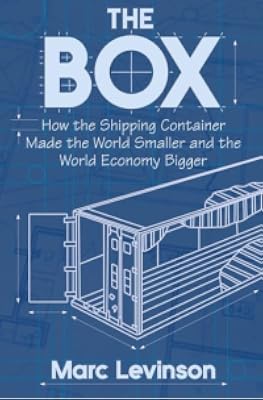
The Box: How the Shipping Container Made the World Smaller and the World Economy Bigger
by Marc Levinson
On This Page
Description
In April 1956, a refitted oil tanker carried fifty-eight shipping containers from Newark to Houston. From that modest beginning, container shipping developed into a huge industry that made the boom in global trade possible. The Box tells the dramatic story of the container's creation, the decade of struggle before it was widely adopted, and the sweeping economic consequences of the sharp fall in transportation costs that containerization brought about. But the container didn't just happen. show more Its adoption required huge sums of money, both from private investors and from ports that aspired to be on the leading edge of a new technology. It required years of high-stakes bargaining with two of the titans of organized labor, Harry Bridges and Teddy Gleason, as well as delicate negotiations on standards that made it possible for almost any container to travel on any truck or train or ship. Ultimately, it took McLean's success in supplying U.S. forces in Vietnam to persuade the world of the container's potential. Drawing on previously neglected sources, economist Marc Levinson shows how the container transformed economic geography, devastating traditional ports such as New York and London and fueling the growth of previously obscure ones, such as Oakland. By making shipping so cheap that industry could locate factories far from its customers, the container paved the way for Asia to become the world's workshop and brought consumers a previously unimaginable variety of low-cost products from around the globe. Published in hardcover on the fiftieth anniversary of the first container voyage, this is the first comprehensive history of the shipping container. Now with a new chapter, The Box tells the dramatic story of how the drive and imagination of an iconoclastic entrepreneur turned containerization from an impractical idea into a phenomenon that transformed economic geography, slashed transportation costs, and made the boom in global trade possible. show lessTags
Recommendations





























Member Recommendations


alco261 The Box gives you the history of the evolution of the box and Box Boats gives you a technical/financial/general history of the first 50 years of the container industry.

szarka Although about very different industries, The Box and The Fabric of Civilization both mine the fascinating intersection of history, economics, technology, and business.
Member Reviews
In economic theory, standardization goes hand in hand with division of labor; Adam Smith's pin factory wouldn't have worked nearly so well without a single pin size. Examples of useful standards are everywhere: the metric system, TCP/IP packets, DIN slots, shoe sizes... some are driven by physical needs, others are arbitrary, but when they were decided, all created winners and losers. Few international standards have created more winners and losers than the shipping container, one of the most important standards of the 20th century, and Marc Levinson transforms what could have been a deadly boring trudge through ISO meeting minutes into a fairly interesting, if somewhat disjointed account of the irresistible force of containerization show more and the not-quite immovable objects of shipping lines, railroads, trucking companies, labor unions, and port authorities trying to hang onto obsolete shares of the inefficient pre-containerization transport landscape. Before The Box, shipping was a torturously slow, expensive, loss- and theft-prone venture dominated by industry cartels and longshoreman's unions, each more concerned with protecting their own high profits and wages than facilitating commerce. Enter self-made transport tycoon Malcom McLean, whose business savvy and early embrace of the container allowed him to exert vast commercial, industrial, and military influence on the country even while remaining fairly obscure. Seemingly minor decisions, like what kind of clasp should be used to seal the container, or how many sizes there should be, had billion-dollar consequences, to say nothing of the shifting flows of wealth from San Fransisco, New York, and London to Oakland, East Rutherford, and Felixstowe. I really liked how Levinson avoided casting anyone in the story as a hero or villain; economics isn't a simple morality play of noble innovators versus evil protectionists, and it's easy to forget that while containerization has created thousands of companies and millions of jobs, there were still costs for the businesses, people, and cities who couldn't adapt, that we measure in empty warehouses, vacant lots, and rusting pylons. Consumer surplus in the form of lower transaction costs does not always create new jobs. I just wish there had been more graphs to clarify the extremely data-rich narrative, which also jumps around in time almost constantly, making it tough to tell exactly what's going on. What a fascinating story of one of the most under-appreciated shapes in the world. show less
A brilliant look at how logistics standardization in the form of containers has revolutionized the transportation business and the modern world. Levinson is an amazing guide to the strange lost world a few decades past where prices were administered, competition regulated, and cozy cartels ruled. Ports were harbours of inefficiency and dens of thieves. Hayek's dedication to the socialists of all parties rings true when rhetorics advocated free markets and practice stifled competition.
Having learned to squeeze money out of the trucking business, one man, Malcom McLean, saw the opportunity to profit from the mess and improve efficiency. In acts of daring, financial acumen and brinkmanship, McLean established a container shipping business. show more Just as in any revolution, he himself was overtaken by history. One of the joys of Levinson's book is that he shows changes to be both evolutionary and revolutionary - with plenty of evolutionary dead ends (McLean's non-standard 35 ft. container), ship scale arms races and booms and busts. The container changed the whole transportation infrastructure - making and breaking communities. Levinson tells the story of the Port Authority of New York on the East Coast, Oakland and Seattle on the West Coast and glimpses at Rotterdam and Singapore. The 278 page book is over much too soon and there remain many stories to be told, eg I would have liked to read a chapter about the IT revolution of warehouse and shipping management as well as a pointer to GPS and tracking systems. Curiously for a personalized economic history, the book features not a single illustration. show less
Having learned to squeeze money out of the trucking business, one man, Malcom McLean, saw the opportunity to profit from the mess and improve efficiency. In acts of daring, financial acumen and brinkmanship, McLean established a container shipping business. show more Just as in any revolution, he himself was overtaken by history. One of the joys of Levinson's book is that he shows changes to be both evolutionary and revolutionary - with plenty of evolutionary dead ends (McLean's non-standard 35 ft. container), ship scale arms races and booms and busts. The container changed the whole transportation infrastructure - making and breaking communities. Levinson tells the story of the Port Authority of New York on the East Coast, Oakland and Seattle on the West Coast and glimpses at Rotterdam and Singapore. The 278 page book is over much too soon and there remain many stories to be told, eg I would have liked to read a chapter about the IT revolution of warehouse and shipping management as well as a pointer to GPS and tracking systems. Curiously for a personalized economic history, the book features not a single illustration. show less
The Box deserves all of its accolades. The shipping container is one of the least romantic objects imaginable, a 40' by 8' by 8' steel and wood box full of, well, everything and anything. The basic idea behind containerization is that it takes about the same amount of time to move a box, no matter the size, and putting everything in one box enables goods to move from ship to train to truck at minimum cost, accelerating commerce everywhere. But while the idea seems simple, it took decades to make it a reality.
Levinson gets at both the creation and destruction in this account. The creation primarily follows Malcom McLean, a North Carolina trucking magnate who's relentless desire to cut costs and boldness to steer away from the way things show more were done created the first workable modern container system, using a pair of World War 2 vintage converted tankers. McLean was a lonely visionary at first, with other shipping lines taking decades to see the benefits of containers, even at 400% improvements in cost per ton of cargo moved. Containerization necessarily required massive capital investments in new ships and specialized loading gear, harmonization of international and cross-sector regulations across a multiple cartels, and new shipping practices from customers. A major turning point was the use of containers to ease a crisis in military logistics during the Vietnam War. With McLean's expenses covered by the Department of Defense, everything shipped back from Japan was pure profit. We've all benefited from reliability and cheapness of container shipped materials and goods.
But there was also plenty of destruction. Longshoremen unions were hit hardest. Longshoremen loaded and unloaded ships in a manner that their medieval predecessors would have understood, muscling goods between dock and hold only slightly aided by advances like the pallet, forklift, and powered crane. Being a longshoreman was a dangerous trade, injury rates were substantially higher than for other manual labor, but the tens of thousands of longshoremen were a unique community. They were also heavily involved with organized crime, pilferage, and while I'm generally on board with a "fuck all the bosses" stance, deliberate inefficiency in work just barely short of sabotage. Containers required far fewer men than break-bulk loading, and it kicked the foundations out from under longshoremen.
A second set of victims were traditional port cities, primarily New York and London. With 19th century infrastructure and labor practices, these cities were unable to adapt to containers. When shipping had been a substantial cost, factories were close to markets and docks. New intermodal models meant that factories could chase efficiencies worldwide, leading to the lost decades for both cities in the 1970s as they shifted from industry to finance, and rippling Rust Belts as factories and jobs moved from America and Europe to Asia. Ports able to make bold bets on new technologies flourished, like Newark, Rotterdam, Singapore, and Dubai, while others failed based on the harsh economic logic of new integrated supply chains.
Malcom McLean himself hit some of the destruction. He made further bold bets into very fast ships that sunk his company when the 1973 oil embargo drove fuel costs up. A second bet on large round-the-world service hit the opposite problem when oil prices crashed. He was still a rich man, but he never again achieved that flashing acme of success.
This is a detailed, extensive history. Where there are gaps, such as on good pricing data for shipping over time, Levinson makes the case that such data is probably unrecoverable, due to shifting exchange rates, complex per-cargo rates, and under the table kickbacks to major shippers. show less
Levinson gets at both the creation and destruction in this account. The creation primarily follows Malcom McLean, a North Carolina trucking magnate who's relentless desire to cut costs and boldness to steer away from the way things show more were done created the first workable modern container system, using a pair of World War 2 vintage converted tankers. McLean was a lonely visionary at first, with other shipping lines taking decades to see the benefits of containers, even at 400% improvements in cost per ton of cargo moved. Containerization necessarily required massive capital investments in new ships and specialized loading gear, harmonization of international and cross-sector regulations across a multiple cartels, and new shipping practices from customers. A major turning point was the use of containers to ease a crisis in military logistics during the Vietnam War. With McLean's expenses covered by the Department of Defense, everything shipped back from Japan was pure profit. We've all benefited from reliability and cheapness of container shipped materials and goods.
But there was also plenty of destruction. Longshoremen unions were hit hardest. Longshoremen loaded and unloaded ships in a manner that their medieval predecessors would have understood, muscling goods between dock and hold only slightly aided by advances like the pallet, forklift, and powered crane. Being a longshoreman was a dangerous trade, injury rates were substantially higher than for other manual labor, but the tens of thousands of longshoremen were a unique community. They were also heavily involved with organized crime, pilferage, and while I'm generally on board with a "fuck all the bosses" stance, deliberate inefficiency in work just barely short of sabotage. Containers required far fewer men than break-bulk loading, and it kicked the foundations out from under longshoremen.
A second set of victims were traditional port cities, primarily New York and London. With 19th century infrastructure and labor practices, these cities were unable to adapt to containers. When shipping had been a substantial cost, factories were close to markets and docks. New intermodal models meant that factories could chase efficiencies worldwide, leading to the lost decades for both cities in the 1970s as they shifted from industry to finance, and rippling Rust Belts as factories and jobs moved from America and Europe to Asia. Ports able to make bold bets on new technologies flourished, like Newark, Rotterdam, Singapore, and Dubai, while others failed based on the harsh economic logic of new integrated supply chains.
Malcom McLean himself hit some of the destruction. He made further bold bets into very fast ships that sunk his company when the 1973 oil embargo drove fuel costs up. A second bet on large round-the-world service hit the opposite problem when oil prices crashed. He was still a rich man, but he never again achieved that flashing acme of success.
This is a detailed, extensive history. Where there are gaps, such as on good pricing data for shipping over time, Levinson makes the case that such data is probably unrecoverable, due to shifting exchange rates, complex per-cargo rates, and under the table kickbacks to major shippers. show less
Call this an examination of how the right innovation at the right time can have a catalytic impact, as a cadre of determined businessman (most notably one Malcom McLean of the United States) sought to wring profits from a stagnant industry and helped to unleash a revolution. The question is unanswerable whether the box begot globalization or whether globalization would have called forth some comparable innovation, but it is certainly now the symbol of the global world economic order. If Levinson does nothing else he reminds one of the deep inefficiencies represented by the world of manually-loaded tramp steamers, the stagnant communities that served the industry, and the out-date regulations that constrained trade. While one can show more denounce the spirit of deregulation now run rampant, it's good to be reminded that this spirit had real justification a generation ago. The question that Levinson can't answer is whether this revolution has so refined itself that it is now set for its own unforeseen systemic failure. show less
On seeing this book my wife exclaimed “I can’t believe you bought a book about shipping containers!” - which, translated, meant “I can believe you bought a book about shipping containers, and I still wonder daily how it is that we ended up together.” The reason I bought it, of course, is that it sounded like a fascinating and very readable history of the development of container shipping, and the effect this has had on the global economy. Thankfully I was right - it is both fascinating and very readable.
The central thesis is that container shipping - while not in itself a particularly mind-blowing idea - was a necessary precondition for globalisation. The rise of containerised freight brought dramatic increases in efficiency show more and incredible decreases in cost, but it did a lot more than just change the cost of shipping something from point A to point B. Containerisation resulted in a standard unit of bulk freight, and the means of seamlessly transitioning freight between different modes of transportation. With this system in place it becomes possible for a shipper to specify the destination of a container and not have to worry too much about how it gets there. As hard as it is for many of us to imagine these days, this was not always the case.
Much of the book deals with the challenges faced in making containerisation a reality. Despite being a simple idea, there was enormous resistance to begin with. Obstacles included overbearing government regulation on freight of all types, the total dominance of international shipping cartels, and the degree to which labour unions consisting of tens of thousands of dockworkers controlled ports around the world.
However, container shipping turned out to be a transformative technology - with effects far in excess of those predicted by the people who fought to make it a reality. Once the idea was embraced it took force with astonishing rapidity, transforming the waterfronts and economies of many cities around the world and destroying tens of thousands of waterfront labour jobs in the process.
The most important effects had little to do with shipping itself - it turned out that containerised freight provided a massive increase in flexibility, enabling brand new approaches to production and leading to boom in global trade.
The only thing the book is missing is a chapter on the use being made now of containers for purposes other than freight - for example as a means of deploying self-contained datacenters, or as a basic structural element for low-cost modular architecture.
I really enjoyed this book, and found it an excellent treatment of a subject that - let’s be honest - sounds slightly dull. Much of the story focuses on Malcom McLean - a US trucker whose intuitive grasp of the freight business lead him to create the first dedicated container shipping service. This focus helps give the book a biographical narrative which ties it all together very well, and while the book goes into much more detail about circumstances in the US it manages to avoid the trap of pretending that the rest of the world doesn’t exist.
Heartily recommended! show less
The central thesis is that container shipping - while not in itself a particularly mind-blowing idea - was a necessary precondition for globalisation. The rise of containerised freight brought dramatic increases in efficiency show more and incredible decreases in cost, but it did a lot more than just change the cost of shipping something from point A to point B. Containerisation resulted in a standard unit of bulk freight, and the means of seamlessly transitioning freight between different modes of transportation. With this system in place it becomes possible for a shipper to specify the destination of a container and not have to worry too much about how it gets there. As hard as it is for many of us to imagine these days, this was not always the case.
Much of the book deals with the challenges faced in making containerisation a reality. Despite being a simple idea, there was enormous resistance to begin with. Obstacles included overbearing government regulation on freight of all types, the total dominance of international shipping cartels, and the degree to which labour unions consisting of tens of thousands of dockworkers controlled ports around the world.
However, container shipping turned out to be a transformative technology - with effects far in excess of those predicted by the people who fought to make it a reality. Once the idea was embraced it took force with astonishing rapidity, transforming the waterfronts and economies of many cities around the world and destroying tens of thousands of waterfront labour jobs in the process.
The most important effects had little to do with shipping itself - it turned out that containerised freight provided a massive increase in flexibility, enabling brand new approaches to production and leading to boom in global trade.
The only thing the book is missing is a chapter on the use being made now of containers for purposes other than freight - for example as a means of deploying self-contained datacenters, or as a basic structural element for low-cost modular architecture.
I really enjoyed this book, and found it an excellent treatment of a subject that - let’s be honest - sounds slightly dull. Much of the story focuses on Malcom McLean - a US trucker whose intuitive grasp of the freight business lead him to create the first dedicated container shipping service. This focus helps give the book a biographical narrative which ties it all together very well, and while the book goes into much more detail about circumstances in the US it manages to avoid the trap of pretending that the rest of the world doesn’t exist.
Heartily recommended! show less
FYI, 58% of this book is the book, the rest is notes, bibliography, and index. I checked it out from my library, yay libraries!
Although the author goes into the kind of detail my brain will never retain, and although I did skim and even skip several chapters because of that, I did get the sort of overall understanding I was looking for, so that's a win. I'd thought the process from breakbulk shipping to streamlining in large containers was less fraught than it turned out to have been. Well, humans will human; we want prosperity, but we get in each other's and our own way more often than not.
Although the author goes into the kind of detail my brain will never retain, and although I did skim and even skip several chapters because of that, I did get the sort of overall understanding I was looking for, so that's a win. I'd thought the process from breakbulk shipping to streamlining in large containers was less fraught than it turned out to have been. Well, humans will human; we want prosperity, but we get in each other's and our own way more often than not.
It takes a lot to take a subject such as a shipping container and make it interesting. Beyond the birth of shipping containers in their various forms and functions; the author weaves together economic, political and labor relations throughout. The impact on port cities, particularly their populations/manufacturing, and how some were able to ride the wave of this emerging technology is fascinating. So too was the evolution of ships and the drive toward standardization to create flow.
Members
- Recently Added By
Author Information

12 Works 1,601 Members
Marc Levinson is the author of several books, including The Box: How the Shipping Container Made the World Smaller and the World Economy Bigger (Princeton). He was finance and economics editor at The Economist and a senior fellow at the Council on Foreign Relations.
Some Editions
Awards and Honors
Awards
Notable Lists
Common Knowledge
- Original publication date
- 2006
- Dedication
- To Aaron, Rebecca, and Deborah
- First words
- On April 26, 1956, a crane lifted fifty-eight aluminum truck bodies aboard an aging tanker ship moored in Newark, New Jersey.
- Quotations
- Malcom McLean's persistence in pushing containerization was vital to the U.S. war effort in Vietnam. Without it, America's ability to prosecute a large-scale war halfway around the world would have been severely limited. The ... (show all)U.S. military would have experienced extreme difficulty feeding, housing, and supplying the 540,000 soldiers, sailors, marines, and air force personnel who were in Vietnam by the start of 1969. Continual headlines about theft, supply shortages, and massive waste woiuld have caused domestic support for the war to erode even faster than it did. Containerization enabled the United States to sustain a well-fed and well-equipped force through years of combat in places that would otherwise have been beyond the reach of U.S. military might.
- Last words
- (Click to show. Warning: May contain spoilers.)If they ever come about, these enormously costly ships and ports will create yet more economies of scale, making it still cheaper and easier to move goods around the globe.
- Original language
- English
Classifications
- Genres
- Economics, Nonfiction, Business, History, General Nonfiction
- DDC/MDS
- 387.5442 — Society, government, & culture Commerce, communications & transportation regulations Water, air, space transportation Maritime History
- LCC
- TA1215 .L47 — Technology Engineering Civil engineering (General). Engineering (General). Civil engineering (General) Transportation engineering
- BISAC
Statistics
- Members
- 1,110
- Popularity
- 22,906
- Reviews
- 32
- Rating
- (3.90)
- Languages
- English, French, Italian
- Media
- Paper, Audiobook, Ebook
- ISBNs
- 9
- ASINs
- 7