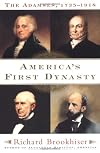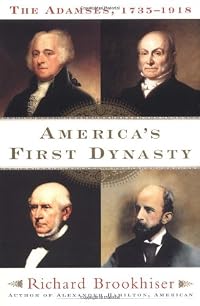
America's First Dynasty: The Adamses, 1735–1918
by Richard Brookhiser
On This Page
Description
"In America's First Dynasty, Brookhiser tells the story of America's longest and still greatest dynasty - the Adamses, the only family in our history to play a leading role in American affairs for nearly two centuries. From John, the self-made, tough-minded lawyer who rose to the highest office in the government he helped create; to John Quincy, the child prodigy who grew up amid foreign royalty, followed his father to the White House, and later reinvented himself as a champion of liberty in show more Congress; to politician and writer Charles Francis, the only well-balanced Adams; to Henry, brilliant scholar and journalist - the Adamses achieved longer-lasting greatness than any other American family."--Jacket. show lessTags
Recommendations









Member Reviews
While this is not his first book, nor his first biography of important American politicians, it is decidedly written differently. In a New Englander matter-of-fact tone, with a smattering of don't-take-my-word-for-it and a texture of this-is-the-way-it-was, Mr. Brookhiser writes with an authority from a standpoint of emotional detachment.
Perhaps, realizing Richard Brookhiser was the editor of a premier conservative magazine, he remained arm's length away from the antithesis of the contemporary Bush Dynasty. Brookhiser pulled countless punches; authoring a book that fellow conservatives might label "benign" and liberals would undoubtedly attach as biased.
Rather than a prosy, pseudo-novel styled biography, Brookhiser remains clinical in show more his approach and spares the reader from delving into unauthorized biography muckraking. For instance he writes: "John Randolph, his power long lost to opium, alcohol, and irresponsibility, but his tongue still bright and gleaming, attacked [Henry] Clay with sparkling malice.... The secretary of state [Clay] challenged him [Randolph] to a duel. Both men missed twice and shook hands." (pg 94) While literarily elegant, he refrains from unnecessary elaboration.
As the perennial disagreement goes, the party name at the genesis of the Democrat Party can be a plethora of monikers; however Brookhiser insists on calling it the Republican Party [First Generation], opting to forgo a more clear delineation between the modern Republican Party and that of the Anti-Federalists. I merely mention this aspect of the book to illustrate his non-partisanship and sticking to historical facts, rather than retooling four Adamses lives to disparage a party.
Incorporating four men's biographies into one work, not a lot of depth is expected. But delightfully, the quartet of men spanning generations from pre-Revolutionary War to the start of World War I is surprisingly comprehensive. I especially enjoyed the sections on the lesser known Adamses, Charles Francis and Henry. show less
Perhaps, realizing Richard Brookhiser was the editor of a premier conservative magazine, he remained arm's length away from the antithesis of the contemporary Bush Dynasty. Brookhiser pulled countless punches; authoring a book that fellow conservatives might label "benign" and liberals would undoubtedly attach as biased.
Rather than a prosy, pseudo-novel styled biography, Brookhiser remains clinical in show more his approach and spares the reader from delving into unauthorized biography muckraking. For instance he writes: "John Randolph, his power long lost to opium, alcohol, and irresponsibility, but his tongue still bright and gleaming, attacked [Henry] Clay with sparkling malice.... The secretary of state [Clay] challenged him [Randolph] to a duel. Both men missed twice and shook hands." (pg 94) While literarily elegant, he refrains from unnecessary elaboration.
As the perennial disagreement goes, the party name at the genesis of the Democrat Party can be a plethora of monikers; however Brookhiser insists on calling it the Republican Party [First Generation], opting to forgo a more clear delineation between the modern Republican Party and that of the Anti-Federalists. I merely mention this aspect of the book to illustrate his non-partisanship and sticking to historical facts, rather than retooling four Adamses lives to disparage a party.
Incorporating four men's biographies into one work, not a lot of depth is expected. But delightfully, the quartet of men spanning generations from pre-Revolutionary War to the start of World War I is surprisingly comprehensive. I especially enjoyed the sections on the lesser known Adamses, Charles Francis and Henry. show less
America's First Dynasty takes a different approach to the lives of the Founders than that used by Brookhiser in his biographies of Washington, Hamilton, Madison and Gouveneur Morris. Most obviously it covers the lives of four generations of the Adams family from the birth of John Adams in 1735 through the death of Henry Adams in 1918 while World War I was still being fought. The scope of the book consists of brief biographies of John Adams, John Quincy Adams, Charles Francis Adams and lastly Henry Adams.
In a sense Brookhiser is documenting the birth, development and gradual decline in the political prominence of the Adams dynasty from the founder who led the fight in Congress to declare independence, and who served in a diplomatic show more capacity on behalf of the new republic in France, the Netherlands and England. Adams was Washington's Vice-President for both terms, won the election of 1796 and became the first incumbent to lose the Presidency.
His son, John Quincy Adams, served as a diplomat in Holland, Prussia and Russia, was elected President in 1824 and like his father was defeated as an incumbent when he lost to Andrew Jackson in 1828. He served in the House of Representatives elected as a Federalist from Massachusetts but by 1808 he had defected to the Republicans having been alienated by Federalist leadership's increasing secessionist bent. He became associated with what came to be known as National Republicanism and in the aftermath of the election and reelection of Jackson became a "Conscience" Whig as opposed to "Cotton" Whig, the term Conscience Whig indicating an unwillingness to accommodate the institution of slavery.
John Quincy's son Charles Francis Adams is less well know than his immediate antecedents, but played an important role as Ambassador to Great Britain during the American Civil War and was instrumental in keeping the British from allying herself to the Confederacy. He accompanied his father to Russia at the tender age of two during John Quincy's service as ambassador. Having managed to finish his undergraduate degree at Harvard mainly at the insistence of his father, Adams married and undertook the study of law. He supported Martin VanBuren during his first run at the Presidency buit grew disillusioned over VanBuren's accommodation of the slave states. Adams ran for the Massachusetts House of Representatives as a Whig and served three years in the House and two more in the state Senate. In 1843 he presented a petition to the Massachusetts House with 63,000 signatures asking that the state decline to assist in the return of fugitive slaves. Charles also opposed the annexation of Texas alleging that it was a pretext for the expansion of slavery. He left the legislature in 1845 and founded a newspaper, The Daily Whig, dedicated to boosting the anti-slavery cause within the Whig Party. Also, in the mid-1840's he rejected an overture to run for office from the Native American Party.
In 1848 he was selected as VanBuren's running mate for the presidential ticket of the Free Soil Party an amalgam of the anti-slavery Liberty party, the Conscience Whigs and a faction of the New York Democratic party called the Barnburners who were opposed to the expansion of slavery. They received only 10% if the popular vote and failed to carry a state but they finished second in New York pushing the Democrats down to third place thereby helping Zachary Taylor to carry the state and win the election for the Whigs. Ten years later the Whigs had been eclipsed by a new political party, the Republicans, and Charles Francis was elected to Congress from Massachusetts as a candidate of the new party.
Following Lincoln's inauguration in 1861 Adams was appointed minister to England at the urging of William Seward , thus becoming the third member of the Adams family to serve in that capacity. Adams was a prospective candidate for the Republican presidential nomination in 1876 following Grant's second term. But he was rejected in favor of Horace Greeley and devoted himself to publishing a twelve volume edition of John Quincy Adams's diaries.
Charles's son, Henry Adams, made a career as a journalist, novelist, historian and auto-biographer. He is probably best remembered for "The Education of Henry Adams", "Democracy", a novel that holds the politics and politicians of Washington, DC up to an unflattering light, his highly regarded 'Mont Saint Michel and Chartres" and his history of the United States covering the administrations of Jefferson and Madison.
Henry determined to create a chronicle of the events of his time, that is the descent of the United States into Civil War following the election of Lincoln. He wrote articles for the Boston Daily Advertiser and generated more candid quotes in a series of letters to his brother Charles Francis . Brookhiser provides this sample excerpt: "President [Buchanan] divides his time between crying and praying; the Cabinet has resigned or else is occupied in committing treason. Some of them have done both.". Buchanan comes off pretty good in comparison with Adams's assessment of Stephen A. Douglas - "...a brute...gross, vulgar, demagogic; a drunkard; ruined as a politician; ruined as a private man; over head and ears...in debt; with no mental or literary resources; without a future; with a past worse than none at all....On the whole I'd rather not be Mrs. Douglas".
In 1861 Henry accompanied his father to London acting as his private secretary, a role he had just filled during his father's congressional term. Henry returned to the States and moved to Washington in 1868 resuming his journalism career. Eventually he was hired by Harvard to teach medieval history, a subject in which he professed no knowledge at all, and also to edit the North American Review, the most prestigious intellectual journal in America.
Following the war Henry took up residence in Washington, D.C. in a home on Lafayette Square. He became close friends with John Hay, formerly Lincoln's secretary who eventually became Secretary of State. He was in and out of politics in the period commencing with Grant's presidency through the assassination of McKinley, although his participation was always from outside as an influencer, most notably as a supporter of Cuban independence. He traveled widely in Europe and the US following the suicide of his wife Marian in 1885. He was booked aboard the Titanic in 1912 but switched to another ship.
Whether they were motivated by noblesse oblige, a sense of public obligation, the Puritan drive to demonstrate their inclusion among the elect, or the ancient goal of achieving everlasting fame, if not glory, these members of the Adams dynasty were all gifted, remarkable servants of the public weal according to their best lights. Brookhiser does justice to their virtues and vices and as always writes with a graceful style that is a pleasure to read. show less
In a sense Brookhiser is documenting the birth, development and gradual decline in the political prominence of the Adams dynasty from the founder who led the fight in Congress to declare independence, and who served in a diplomatic show more capacity on behalf of the new republic in France, the Netherlands and England. Adams was Washington's Vice-President for both terms, won the election of 1796 and became the first incumbent to lose the Presidency.
His son, John Quincy Adams, served as a diplomat in Holland, Prussia and Russia, was elected President in 1824 and like his father was defeated as an incumbent when he lost to Andrew Jackson in 1828. He served in the House of Representatives elected as a Federalist from Massachusetts but by 1808 he had defected to the Republicans having been alienated by Federalist leadership's increasing secessionist bent. He became associated with what came to be known as National Republicanism and in the aftermath of the election and reelection of Jackson became a "Conscience" Whig as opposed to "Cotton" Whig, the term Conscience Whig indicating an unwillingness to accommodate the institution of slavery.
John Quincy's son Charles Francis Adams is less well know than his immediate antecedents, but played an important role as Ambassador to Great Britain during the American Civil War and was instrumental in keeping the British from allying herself to the Confederacy. He accompanied his father to Russia at the tender age of two during John Quincy's service as ambassador. Having managed to finish his undergraduate degree at Harvard mainly at the insistence of his father, Adams married and undertook the study of law. He supported Martin VanBuren during his first run at the Presidency buit grew disillusioned over VanBuren's accommodation of the slave states. Adams ran for the Massachusetts House of Representatives as a Whig and served three years in the House and two more in the state Senate. In 1843 he presented a petition to the Massachusetts House with 63,000 signatures asking that the state decline to assist in the return of fugitive slaves. Charles also opposed the annexation of Texas alleging that it was a pretext for the expansion of slavery. He left the legislature in 1845 and founded a newspaper, The Daily Whig, dedicated to boosting the anti-slavery cause within the Whig Party. Also, in the mid-1840's he rejected an overture to run for office from the Native American Party.
In 1848 he was selected as VanBuren's running mate for the presidential ticket of the Free Soil Party an amalgam of the anti-slavery Liberty party, the Conscience Whigs and a faction of the New York Democratic party called the Barnburners who were opposed to the expansion of slavery. They received only 10% if the popular vote and failed to carry a state but they finished second in New York pushing the Democrats down to third place thereby helping Zachary Taylor to carry the state and win the election for the Whigs. Ten years later the Whigs had been eclipsed by a new political party, the Republicans, and Charles Francis was elected to Congress from Massachusetts as a candidate of the new party.
Following Lincoln's inauguration in 1861 Adams was appointed minister to England at the urging of William Seward , thus becoming the third member of the Adams family to serve in that capacity. Adams was a prospective candidate for the Republican presidential nomination in 1876 following Grant's second term. But he was rejected in favor of Horace Greeley and devoted himself to publishing a twelve volume edition of John Quincy Adams's diaries.
Charles's son, Henry Adams, made a career as a journalist, novelist, historian and auto-biographer. He is probably best remembered for "The Education of Henry Adams", "Democracy", a novel that holds the politics and politicians of Washington, DC up to an unflattering light, his highly regarded 'Mont Saint Michel and Chartres" and his history of the United States covering the administrations of Jefferson and Madison.
Henry determined to create a chronicle of the events of his time, that is the descent of the United States into Civil War following the election of Lincoln. He wrote articles for the Boston Daily Advertiser and generated more candid quotes in a series of letters to his brother Charles Francis . Brookhiser provides this sample excerpt: "President [Buchanan] divides his time between crying and praying; the Cabinet has resigned or else is occupied in committing treason. Some of them have done both.". Buchanan comes off pretty good in comparison with Adams's assessment of Stephen A. Douglas - "...a brute...gross, vulgar, demagogic; a drunkard; ruined as a politician; ruined as a private man; over head and ears...in debt; with no mental or literary resources; without a future; with a past worse than none at all....On the whole I'd rather not be Mrs. Douglas".
In 1861 Henry accompanied his father to London acting as his private secretary, a role he had just filled during his father's congressional term. Henry returned to the States and moved to Washington in 1868 resuming his journalism career. Eventually he was hired by Harvard to teach medieval history, a subject in which he professed no knowledge at all, and also to edit the North American Review, the most prestigious intellectual journal in America.
Following the war Henry took up residence in Washington, D.C. in a home on Lafayette Square. He became close friends with John Hay, formerly Lincoln's secretary who eventually became Secretary of State. He was in and out of politics in the period commencing with Grant's presidency through the assassination of McKinley, although his participation was always from outside as an influencer, most notably as a supporter of Cuban independence. He traveled widely in Europe and the US following the suicide of his wife Marian in 1885. He was booked aboard the Titanic in 1912 but switched to another ship.
Whether they were motivated by noblesse oblige, a sense of public obligation, the Puritan drive to demonstrate their inclusion among the elect, or the ancient goal of achieving everlasting fame, if not glory, these members of the Adams dynasty were all gifted, remarkable servants of the public weal according to their best lights. Brookhiser does justice to their virtues and vices and as always writes with a graceful style that is a pleasure to read. show less
Richard Brookhiser has written biographies of Presidents Madison and Washington, revolutionary statesmen Hamilton and Gouvernor Morris, and most recently a book on Lincoln, but my favorite of his biographies that I have read is America's First Dynasty: The Adamses, 1735-1918. The dates alone, spanning three centuries, suggest the significance of this family on the history of the United States.
The first two of the dynasty, John and his son John Quincy both became President. The father was one of the leaders of the American Revolution while the son was both President and, later, member of the House of Representatives from Massachusetts. John's grandson Charles Francis also had a brilliant political career that included a term as Minister show more to England in the Lincoln Administration. The fourth Adams of this dynasty, John's great grandson Henry Adams, found his greatness in literature both as an academic historian and with the publication of his autobiography, The Education of Henry Adams, a classic that is read to this day.
Their story begins with John Adams, a self-taught lawyer who rode horseback to meet clients, and ends with Henry Adams in France as World War I begins and he returns to Washington, D. C. This is a well told overview of a family dynasty that more than any other helped make the United States the great nation it is today. show less
The first two of the dynasty, John and his son John Quincy both became President. The father was one of the leaders of the American Revolution while the son was both President and, later, member of the House of Representatives from Massachusetts. John's grandson Charles Francis also had a brilliant political career that included a term as Minister show more to England in the Lincoln Administration. The fourth Adams of this dynasty, John's great grandson Henry Adams, found his greatness in literature both as an academic historian and with the publication of his autobiography, The Education of Henry Adams, a classic that is read to this day.
Their story begins with John Adams, a self-taught lawyer who rode horseback to meet clients, and ends with Henry Adams in France as World War I begins and he returns to Washington, D. C. This is a well told overview of a family dynasty that more than any other helped make the United States the great nation it is today. show less
An excellent discussion of the Adams generations.
Interesting
There are a number of books on "dynasty" first familes. Nagel has written more on the Adams family in Adams Women and Descent from Glory. There are an increasing number of books on the Bushes, not all flattering.
Ratings
Members
- Recently Added By
Author Information

21+ Works 3,778 Members
Richard Brookhiser is a Senior Editor at The National Review and a New York Observer columnist. He contributes to such publications as American Heritage and The New York Times. He lives in New York City
Common Knowledge
- Canonical title
- America's First Dynasty: The Adamses, 1735–1918
- Original publication date
- 2009
- People/Characters
- Abigail Adams; Abigail Adams Smith (daughter of John Adams and Abigail Adams); Abigail Brooks Adams (Mrs. Charles Francis Adams); Brooks Adams; Charles Adams; Charles Francis Adams (show all 217); Charles Francis Adams, Jr.; Clover Adams; Elihu Adams; George Washington Adams; Henry Adams; Henry Adams (a Puritan ancestor of John Adams); John Adams, Sr. (father of John Adams); John Adams; John Adams II; John Quincy Adams; John Quincy Adams II; Joseph Adams (name of great-grandfather and grandfather of John Adams); Louisa Catherine Johnson Adams; Peter Adams; Samuel Adams; Thomas Boylston Adams; Albert (Prince Consort); Alexander I (Emperor of Russia); George Berkeley; James G. Blaine; Henry St. John (1st Viscount Bolingbroke); Simón Bolívar; Napoleon Bonaparte; James Buchanan; Aaron Burr; George Cabot; James A. Garfield; Elizabeth Cameron; George Canning; Joseph Cartwright; Lewis Cass; Catherine the Great (Empress of Russia); Edward Chalfant; Charles VII (King of France); Samuel Chase; George Rogers Clark; Henry Clay; William Collins; Thomas Conway; John Singleton Copley; Abel Rathbone Corbin; William Crawford; Jack Custis; Francis Dana; Richard Henry Dana; Enrico Davila; Silas Deane; John Dickinson; Stephen A. Douglas; John Dryden; James Duane; Martin Duberman; T. S. Eliot; Ralph Waldo Emerson; Ferdinand VI (King of Spain); John Ferling; Hamilton Fish; Jim Fisk; John Fitch; Benjamin Franklin; Rodney Frelinghuysen; Robert Fulton; Woldemar Galitzin; Albert Gallatin; Joseph Galloway; Giuseppe Garibaldi; William Lloyd Garrison; George II, King of Great Britain and Ireland; George III, King of the United Kingdom; Elbridge Gerry; Edward Gibbon; Stephen Girard; William Ewart Gladstone; Albert Gore, Sr.; Jay Gould; Julia Dent Grant; Ulysses S. Grant; Horace Greeley; Alexander Hamilton; John Hancock; Zoltan Haraszti; Benjamin Harrison (father of William Henry Harrison); William Henry Harrison; Clara Louise Stone Hay; John Hay; Anne-Catherine de Ligniville (Madame Helvétius); Sally Hemings; Patrick Henry; Philip Hone; William Dean Howells; Thomas Hutchinson; Andrew Jackson; Rachel Jackson; Henry James; William James; John Jay; Thomas Jefferson; Andrew Johnson; John F. Kennedy; Clarence King; Rufus King; Rudyard Kipling; Alexander Knox; Etienne de la Boetie; Marquis de Lafayette; Arthur Lee; Richard Henry Lee; Meriwether Lewis; Abraham Lincoln; Mary Todd Lincoln; Robert Livingston; John Locke; Henry Wadsworth Longfellow; Louis XVI (King of France); Charles Lyell; Thomas Lynch; Abbé de Mably; Thomas Babington Macaulay; Niccolò Machiavelli; William Maclay; James Madison; John Marshall (4th Chief Justice of the United States); James McHenry; William Miller; John Milton; Molière; James Monroe; William Morgan; Gouverneur Morris; Napoleon III; Marchamont Nedham; Thomas Nelson; Nietzsche, Friedrich Wilhelm, 1844-1900; Don Luis de Onis; James Otis, Jr.; Thomas Paine; Henry John Temple (3rd Viscount Palmerston); Charles Wilson Peale; Rembrandt Peale; William Pepperell; Timothy Pickering; Zebulon Montgomery Pike, Jr.; William Pitt the Younger; William Plumer; James Knox Polk; Ezra Pound; Joseph Priestley; Sam Quincy; John Randolph; Paul Revere; Caesar Rodney; Charles Rollins; Eleanor Roosevelt; Franklin Delano Roosevelt; Theodore Roosevelt; Benjamin Rush; Jonathan Russell; John Russell (1st Earl of Russell); Augustus Saint-Gaudens; Ernest Samuels; José San Martin; Arthur Schlesinger Jr.; Carl Schurz; William Henry Seward; Peter Shaw; John Sherman; Roger Sherman; Adam Smith; William Smith; James Smithson; Elizabeth Cady Stanton; Richard Stockton; Benjamin Stoddert; Joseph Story; George Templeton Strong; Gilbert Stuart; Charles Sumner; Lewis Tappan; John Taylor; Zachary Taylor; Henry David Thoreau; Louisa Hooper Thoron; Alexis de Tocqueville; John Trumbull; Nat Turner; John Tyler; Cornelius Vanderbilt; Marquis de Vauban; Charles Gravier (Comte de Vergennes); Victoria (Queen of the United Kingdom); Gore Vidal; Voltaire "François-Marie Arouet", 1694-1778; William Walker; Joseph Warren; Mercy Otis Warren; George Washington; Daniel Webster; Thurlow Weed; Edith Wharton; Horace White; George Whitefield; John Winthrop; Robert Winthrop; Thomas Lindall Winthrop; William Wirt; Oliver Wolcott; James Abram Garfield; William McKinley; Wolfang Amadeus Mozart; Ludwig Van Beethoven; Esther, Queen of Persia
- Important places
- Washington, D.C., USA; Boston, Massachusetts, USA; Braintree, Massachusetts, USA; Sri Lanka; China; Cuba (show all 20); Florida, USA; France; Germany; Guam; Hawai'i, USA; Italy; Kansas, USA; Mexico; Missouri, USA; New Orleans, Louisiana, USA; Nicaragua; Pennsylvania, USA; Philadelphia, Pennsylvania, USA; The Philippines
- Important events
- War of the Austrian Succession (1740 | 1748); Treaty of Aix-la-Chapelle (1748); French and Indian War; Continental Congress (1774 | 1789); American Revolution (1775 | 1783); Battle of Bunker Hill (1775-06-17) (show all 28); Declaration of Independence approved (1776); Battle of Trenton (1776-12-26); Battle of Princeton (1777); Constitutional Convention (1787); French Revolution (1789 | 1799); War of 1812 (1812 | 1815); Treaty of Ghent (1814-12-24); Missouri Compromise (1820); Greek War of Independence (1821 | 1830); Mexican-American War (1846 | 1848); Kansas-Nebraska Act (1854); American Civil War; Battle of Antietam (1862-09-17); Emancipation Proclamation; Gettysburg Campaign; Battle of Gettysburg; Gettysburg Address; Battle of the Wilderness (1864-05-05 | 1865-05-07); Spanish-American War (1898); Russo-Japanese War (1904-02-10 | 1905-09-05); Sinking of the Titanic (1912-04-14 | 1912-04-15); World War I (1914 | 1918)
- Dedication
- For William F. Buckley, Jr.
Classifications
- Genres
- History, Nonfiction, Biography & Memoir, General Nonfiction
- DDC/MDS
- 973.4 — History & geography History of North America United States Constitutional period (1789-1809)
- LCC
- E322.1 .B76 — History of the United States United States Revolution to the Civil War, 1775/1783-1861 By period 1789-1809. Constitutional period John Adams' administration, 1797-1801
- BISAC
Statistics
- Members
- 367
- Popularity
- 85,241
- Reviews
- 6
- Rating
- (3.48)
- Languages
- English
- Media
- Paper, Audiobook, Ebook
- ISBNs
- 5
- ASINs
- 5