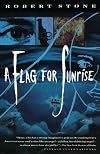
A Flag for Sunrise
by Robert Stone
On This Page
Description
A Flag for Sunrise is a novel of Americans drawn into the maelstrom of Tecan, a small Central American country on the brink of revolution. At a mission on the coast a priest is lapsing into alcoholic mysticism, while a young American nun is veering towards commitment to the cause. In a bar in Brooklyn, Frank Holliwell is lunching with an old CIA friend who is begging for a favor. On the Tex-Mex border, Pablo, a Coast Guard deserter, loco on speed, is about to take a job carrying mysterious show more contraband to Tecan. As these lives converge, as this small, crowded world erupts, the novel builds to an electrifying climax. show lessTags
Recommendations













Member Reviews
This looks at first like a straightforwardly political novel, a fictionalized version of the hideous behavior of U.S. allies in Central America in the 1980s, as witnessed by a well-meaning Yankee academic, a speed-freak sailor on a smuggling boat, and a pair of Catholic missionaries out of Graham Greene. It's not. It sketches in enough of that to feel real, but only just enough; the civil war is represented by a couple of murders, a couple of betrayals, big plans whose outcomes we never find out. Stone trusts that you know the rest from the real world.
The heart of the book is all interior to the characters, who are all desperate people in some way but not really in the service of any cause, and they're all memorable. The least show more interesting to me are the two who are the most familiar as Stone characters go-- bitter alcoholic smart-asses-- although in this book their verbal flourishes aren't just stylish fireworks, but have some pretty direct consequences. But the nun and the sailor are amazing: the most clear-headed and sympathetic character Stone has written so far, and then the opposite of that. What happens with each of them is predictable, but not the way they get there.
The ending is chaotic in a way that I don't think entirely works, but still very moving. There's a scene about a page long that's the half-conscious thoughts of someone who's being horribly killed, and there's just about no description of what's happening, but it's one of the scariest and saddest things I've ever read. show less
The heart of the book is all interior to the characters, who are all desperate people in some way but not really in the service of any cause, and they're all memorable. The least show more interesting to me are the two who are the most familiar as Stone characters go-- bitter alcoholic smart-asses-- although in this book their verbal flourishes aren't just stylish fireworks, but have some pretty direct consequences. But the nun and the sailor are amazing: the most clear-headed and sympathetic character Stone has written so far, and then the opposite of that. What happens with each of them is predictable, but not the way they get there.
The ending is chaotic in a way that I don't think entirely works, but still very moving. There's a scene about a page long that's the half-conscious thoughts of someone who's being horribly killed, and there's just about no description of what's happening, but it's one of the scariest and saddest things I've ever read. show less
You might call "A Flag for Sunrise" Robert Stone's Central American novel. In it we follow a troubled anthropologist, a coast guard crewman who's jumped ship, a gang of smugglers, a nun who's lost her faith, and and a dying priest on a series of tropical adventures, most of which end very badly. Though it's not named, the background suggests the El Salvadorean civil war. You might also say that "A Flag for Sunrise" is just Robert Stone: sparkling economical prose that's equally indebted to dime novels and mid-century Amercian literary fiction, amoral characters whose words can't be trusted and, everywhere, the specter of the Vietnam War, a never-ending debacle that seems to have sucked the morality of everyone who experienced it. show more Readers who feel that they have to like the characters they read about are advised to avoid this one, as well as Stone's other stuff. In "A Flag for Sunrise" he is, as always, fascinated by the yawning gulf that separates his characters statements and their darker motives. It isn't pleasant to see the optimistic language of the sixties gets turned on its head here and become mere window dressing for self-seeking hustlers, but Stone's writing is, as always, a joy to read, both kinetic and addled, beautiful and unsettling.
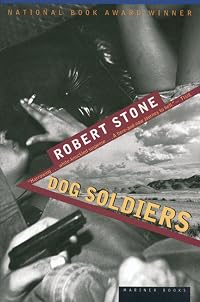
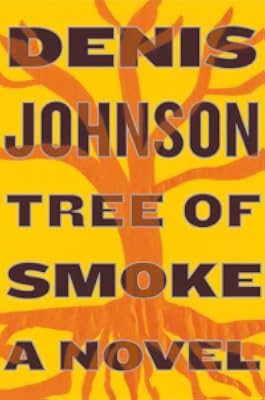
"A Flag for Sunrise" is also a much looser, more diffuse book than Stone's award-winning "Dog Soldiers," and while he brings each of these characters' narratives to a satisfactory conclusion, I rather missed that earlier book's considerable narrative drive. "Sunrise" reminded me a bit of Denis Johnson's "Tree of Smoke," a novel that danced around the dark center of the Vietnam conflict while never really threatening to plunge into it. It's a long, dense read but I also feel that the author glosses over a couple of subjects that deserved his full attention. I never felt that I really grasped the American nun's motivations for lending her support to a coming Marxist insurgency, for example. And, while it goes without saying, those looking for an accurate or sympathetic portrait of the Caribbean and its people will not find it here. This novel can be justly criticized for using this part of the world as a seedy backdrop, much as a James Bond film would, though I don't think its author would be too interested in contesting this particular objection. Still, "A Flag for Sunrise" is, by most metrics, a success, a compelling portrait of some who hover over the void and a few others who have already abandoned themselves to it. show less
"A Flag for Sunrise" is also a much looser, more diffuse book than Stone's award-winning "Dog Soldiers," and while he brings each of these characters' narratives to a satisfactory conclusion, I rather missed that earlier book's considerable narrative drive. "Sunrise" reminded me a bit of Denis Johnson's "Tree of Smoke," a novel that danced around the dark center of the Vietnam conflict while never really threatening to plunge into it. It's a long, dense read but I also feel that the author glosses over a couple of subjects that deserved his full attention. I never felt that I really grasped the American nun's motivations for lending her support to a coming Marxist insurgency, for example. And, while it goes without saying, those looking for an accurate or sympathetic portrait of the Caribbean and its people will not find it here. This novel can be justly criticized for using this part of the world as a seedy backdrop, much as a James Bond film would, though I don't think its author would be too interested in contesting this particular objection. Still, "A Flag for Sunrise" is, by most metrics, a success, a compelling portrait of some who hover over the void and a few others who have already abandoned themselves to it. show less
From teaching this book several times and turning it inside out analytically my esteem for this book has grown and deepened. It's a highly allusive text that repays study. I've come to believe that the mysticism of Meister Eckhart is the key to unlocking the novel's symbolic riches. But the main story line is gripping enough for those who don't have the inclination to go further. The title comes from an Emily Dickinson poem ("A Wife - at Daybreak I shall be").
A big, masterful story leading up to a failed revolution in a fictional Central American country called Tecan. The book is also a product of the 1970s - messy, full of mysticism, greed, drugs (of course) and American wrongdoing. Stone follows three Americans and their long, winding path and various levels of involvement in government overthrow – from wrong-place-wrong-time to very involved yet clueless.
An alcoholic anthropologist who compromised himself by doing some work for the CIA in Vietnam and can't forget it, a dangerous Coast Guard deserter hooked on speed, and an altruistic nun who gets too involved in trying to save the country. There are also a ridiculous arms-dealing couple, a priest overcome by hopelessness, and a vicious show more Tecan military man who has it in for the nun. There’s a lot going on in the story and none of it really turns out good for anyone. show less
An alcoholic anthropologist who compromised himself by doing some work for the CIA in Vietnam and can't forget it, a dangerous Coast Guard deserter hooked on speed, and an altruistic nun who gets too involved in trying to save the country. There are also a ridiculous arms-dealing couple, a priest overcome by hopelessness, and a vicious show more Tecan military man who has it in for the nun. There’s a lot going on in the story and none of it really turns out good for anyone. show less
This political novel from the 1970s mixes political revolution, crime, some mystery, violence, psychology, philosophy, and theology in dense, beautiful writing. The author's descriptions of emotion and place have depth and power. He explores the psychology of his main characters in detail. The novel will be appreciated by those who have a somewhat leftist view of US-Central American political happenings in the 1970s. It is not the author's aim to promote any one political view over another: he is cynical about everyone and nihilist in his approach to ultimate values.
Readers should know they will gain little insight into the lives of Central American characters. The author's main dealings are with American expatriates, almost as types: show more the missionary, the spy, embassy official, the criminal, and so on. The lives of local citizens are not much explored. Moreover the expatriate characters are all mad, drunk, drugged up, or otherwise deranged, which only reinforces any prejudices that Americans have of Central or Latin American society and politics as hopelessly and impenetrably irrational.
In what is otherwise a well-paced and gripping novel, I found the many pages of ranting dialogues and interior monologues to be tedious at times. show less
Readers should know they will gain little insight into the lives of Central American characters. The author's main dealings are with American expatriates, almost as types: show more the missionary, the spy, embassy official, the criminal, and so on. The lives of local citizens are not much explored. Moreover the expatriate characters are all mad, drunk, drugged up, or otherwise deranged, which only reinforces any prejudices that Americans have of Central or Latin American society and politics as hopelessly and impenetrably irrational.
In what is otherwise a well-paced and gripping novel, I found the many pages of ranting dialogues and interior monologues to be tedious at times. show less
Ratings
Members
- Recently Added By
Lists

The Guardian's 1000 Novels Everyone Must Read
1,005 works; 547 members

National Book Award Finalists - Fiction
377 works; 12 members

Pulitzer Prize for Fiction - Finalists
88 works; 9 members
TML 200 Best Books 1950-1999
202 works; 10 members

Pen/Faulkner Winners and Finalists
178 works; 9 members
Read These Too
458 works; 9 members

Central America
14 works; 1 member

Harold Bloom - The Western Canon: D. The Chaotic Age
833 works; 24 members

The Modern Library (The Two Hundred Best Novels....
202 works; 1 member
Author Information

26+ Works 5,151 Members
Robert Stone was born in Brooklyn, New York on August 21, 1937. His parents never married and his father was not part of his life. His mother had schizophrenia and was frequently hospitalized. From the ages of 6 to 10, he lived in an orphanage run by the Marist brothers. In 1954, he dropped out of high school and joined the Navy, where he earned show more his high school equivalency diploma. In the 1960's, he briefly attended New York University, worked as a copy boy for the New York Daily News, and attended the Wallace Stegner writing workshop at Standford University. His first novel, A Hall of Mirrors, won a William Faulkner Foundation award for best first novel of 1967 and was adapted into a movie entitled WUSA starring Paul Newman. His other books include Children of Light, Outerbridge Reach, Damascus Gate, Bear and His Daughter, Fun with Problems, Bay of Souls, and Death of the Black-Haired Girl. He also wrote a memoir entitled Prime Green: Remembering the Sixties. He won numerous awards including the National Book Award in 1975 for Dog Soldier, which was adapted into a movie entitled Who'll Stop the Rain starring Nick Nolte and Tuesday Weld, and a PEN/Faulkner Award for A Flag for Sunrise. He died of chronic obstructive pulmonary disease on January 10, 2015 at the age of 77. (Bowker Author Biography) show less
Some Editions
Awards and Honors
Awards
Distinctions
Series
Belongs to Publisher Series
rororo (12416)
Work Relationships
Common Knowledge
- Original title
- A Flag for Sunrise
- Original publication date
- 1981
- People/Characters
- Frank Holliwell; Sister Justin Feeney; Father Egan; Pablo Tabor
- Important places
- Tecan
Classifications
Statistics
- Members
- 599
- Popularity
- 48,811
- Reviews
- 5
- Rating
- (3.74)
- Languages
- 6 — Danish, English, Finnish, German, Spanish, Swedish
- Media
- Paper, Audiobook, Ebook
- ISBNs
- 23
- ASINs
- 9