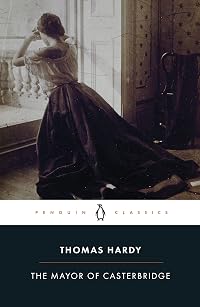
The Mayor of Casterbridge
by Thomas Hardy
On This Page
Description
Regarded as a towering figure in nineteenth-century British literature, Thomas Hardy ranks among the most acclaimed of the Victorian realists. Though he achieved more popular success for works such as Far From the Madding Crowd and Tess of the d'Urbervilles, most critics now see The Mayor of Casterbridge as Harding's crowning accomplishment. This novel traces the ascension of Michael Henchard from a hardscrabble manual laborer to a pillar of his community. But will the shameful secret that show more haunts him come to light and undermine his new-found prominence?. show less
Tags
Recommendations










Member Recommendations
ncgraham Both stories of men who commit public crimes ... and yet the outcomes are very different.
50

Member Reviews
I devoured Hardy as a teenager, but approached this book with some foreboding. I feared I would find it slow-going. It wasn't. I loved from the first Hardy's evocation of the Dorset countryside, its rural and urban landscape. Hardy specialises in telling us about lives which do not go well, and the story of the brooding, moody self-made Michael Henshaw, Mayor of Casterbridge is no exception. Although I was more convinced by his male characters than the female, I was drawn into the lives of the principal protagonists. It was obvious things would not end in a good way, but I was involved in the narrative, and in the detailed picture of a way of life already on its way out, a rural throw-back. This is a powerful and sympathetic study of a show more deeply flawed character, and the milieu in which he spent his life. show less
Mayor of Casterbridge is the wickedly funny and deeply affecting account of the train wreck that is Michael Henchard's life. Much of the humor comes from the Greek chorus like interludes in which some the the local lower class give their take on the doings if their "betters." Yet, this a tragedy of character. Henchard just can't seem not to hoist himself on every possible one of his petards, sometimes taking a somewhat innocent victim such as Lucetta with him. His combative sense of inferiority constantly eggs him into rivalry with both those seem such as Farfrae and unseen such as the sailor Newsome, Elizabeth Jane's father. His need to control and own people and things ultimately leaves him alone. All if the major characters are show more sympathetically drawn, finely shaded and colorful. The setting is splendidly golden. The honey hues of the stone, the grains, the sunlight wash over the story at times affecting a healing balm. The ancient ruins of Casterbridge underpin themes of wrongheaded malignant rivalry over vaunting pride, and plain old spitefulness as old as Hector and Achilles, Oedipus...you get the idea. Indeed, Henchard is a deeply flawed hero in the classical mode. There is never a dull moment in the Hardy's masterful treatment of his subject. This is just plain old good stuff. Fun, dramatic. cringe worthy, fascinating storytelling at its best. show less
Oh Mr. Hardy - canst thou ever forgive me for doubting thee?
The book is finished. My heart is sore. In my grief I can't bear to put it back on the bookshelf yet. Let it stay beside me on the bedside cabinet just a little while longer.
How wrong was I in my original assessment of Hardy's prose. I wept whilst reading this book. WEPT! Real tears! And not just once either.
Hardy initially cut to the chase with alarming alacrity, and it almost put me off continuing as I felt he had divulged the plot before I was engrossed enough to care much for the characters. More fool me. That was merely the tip of the iceberg, for the tale that developed was to have more twists and turns than a doorknob.
And the characterisation - oh, like nothing I've show more read before. Mr. Henchard was the most unpleasant of protagonists - harsh, proud, stubborn, jealous, cold, pompous - yet the whole way through the novel I was rooting for him, willing him on, desperately hoping he'll say the right thing here, do the right thing there. In the same way that my husband's wayward driving compels me to pump an imaginary brake as a passenger, so too Henchard's repeated mistakes had me constantly silently screaming "Stop! Look out! Take care!".
I'm now 5 books into my 50 book target. How I fear the 45 others shall now pale by comparison. show less
The book is finished. My heart is sore. In my grief I can't bear to put it back on the bookshelf yet. Let it stay beside me on the bedside cabinet just a little while longer.
How wrong was I in my original assessment of Hardy's prose. I wept whilst reading this book. WEPT! Real tears! And not just once either.
Hardy initially cut to the chase with alarming alacrity, and it almost put me off continuing as I felt he had divulged the plot before I was engrossed enough to care much for the characters. More fool me. That was merely the tip of the iceberg, for the tale that developed was to have more twists and turns than a doorknob.
And the characterisation - oh, like nothing I've show more read before. Mr. Henchard was the most unpleasant of protagonists - harsh, proud, stubborn, jealous, cold, pompous - yet the whole way through the novel I was rooting for him, willing him on, desperately hoping he'll say the right thing here, do the right thing there. In the same way that my husband's wayward driving compels me to pump an imaginary brake as a passenger, so too Henchard's repeated mistakes had me constantly silently screaming "Stop! Look out! Take care!".
I'm now 5 books into my 50 book target. How I fear the 45 others shall now pale by comparison. show less
My first ever visit to Dorchester prompted me to read my first ever Thomas Hardy novel - very few other writers are so closely associated with a specific town or city; the fictional town in this novel's title is based very closely on Dorset's county town. I loved this novel, and will certainly be reading more Hardy. The plot is simple yet at the same time captivating and timeless. Michael Henchard, an itinerant farm labourer, while drunk one day sells his wife and baby daughter to a sailor at a fair. He wakes up sober and immediately regrets his choice, forswearing alcohol for 21 years and going off to search for them, but it is too late. The ramifications of this moment of madness ring throughout the years and affect Henchard's life show more and those of his family and others. This is a story about fortune's wheel and how it can bring one man up and cast another man down. Marvellous stuff, full of colourful incident and some quirky minor characters. show less
In a fit of drunken anger, Michael Henchard sells his wife and baby daughter for five guineas at a country fair. Over the course of the following years, he manages to establish himself as a respected and prosperous pillar of the community of Casterbridge, but behind his success there always lurk the shameful secret of his past and a personality prone to self-destructive pride and temper. Hardy's powerful and sympathetic study of the heroic but deeply flawed Henchard is also an intensely dramatic work, tragically played out against the vivid backdrop of a close-knit Dorsetshire town.
I don't read much Hardy, on the basis that he is too depressing, but I really enjoyed this one, despite it still being fairly sad. Henchard, the Mayor of Casterbridge (for part of the novel at least), is his own worst enemy, but Hardy makes us sympathize with him despite his many and appalling faults - after all, he kept Abel Whittle's poor mother in coals all winter. There were flashes of humour throughout and the description of the constables trying to track down the perpetrators of the 'skimmington ride' was hilarious. The writing was reasonably easy to understand, and the Casterbridge setting (where everyone in the town is more or less co-dependant on everyone else) was strong.
If Thomas Hardy's Wessex region was a real place the British government would probably have to nuke it as nothing but misery seems to go on there, as recounted in [b: Tess of the d'Urbervilles|32261|Tess of the D'Urbervilles|Thomas Hardy|https://d.gr-assets.com/books/1358921541s/32261.jpg|3331021], [b: Jude the Obscure|50798|Jude the Obscure|Thomas Hardy|https://d.gr-assets.com/books/1389403264s/50798.jpg|41342119], [b: The Return of the Native|32650|The Return of the Native |Thomas Hardy|https://d.gr-assets.com/books/1403182613s/32650.jpg|3140534] and other bleak-fests (I am excluding [b: Far from the Madding Crowd|31463|Far from the Madding Crowd |Thomas Hardy|https://d.gr-assets.com/books/1388279695s/31463.jpg|914540] here because I show more find it quite cheerful by his melancholic standard (only a few tissue papers required instead of a whole box of Kleenex). The Mayor of Casterbridge is Hardy at least wonderfully mirthless best. A sign reading “Abandon all hope, ye who enter here” would do just as well for the border of Wessex as Dante’s gate of hell.
The Mayor of Casterbridge, subtitled “The Life and Death of a Man of Character” is the story of Michael Henchard the (sometime) eponymous mayor of the town of Casterbridge. A bad tempered man with incredible mood swings who specializes in making very poor decisions. He starts off in fine form with selling his wife and child to an unknown sailor for the bargain basement price of five guineas (better known today as a fiver or GBP 5) while inebriated (pissed out of his mind in fact). After losing his wife for the price of a Big Mac he somehow manages to get his act together and works his way up in the world from a lowly hay-trusser to becoming a successful merchant and the town’s mayor (some suspension of disbelief is required here). After almost twenty years his poor sold wife shows up in town and reconciles with him, all seem to be going well until the fecal matter hits the fan. Seriously if they had electrical fans in Wessex I would stay well away from them as fecal matters would always make a beeline for these things, and spanners are always thrown into the works.
Most of Henchard’s troubles are of his own making but the universe also seems to have it in for him as his bad decisions are always compounded by misfortunes. Henchard is Thomas Hardy’s most interesting protagonist, bad tempered, cynical, violent and pessimistic, yet energetic, well-meaning (sometime), and honorable (usually); but don’t make him angry, you wouldn’t like him when he’s angry. He is often despicable yet oddly sympathetic and I could not help but wish things will work out well for him, but his worst stroke of luck is probably to find himself in a Thomas Hardy novel so that is not going to happen.
This is the fourth Hardy novel I have read and it is definitely my favorite. I am a sucker for tales of redemption or at least contrition and I felt an unmanly lump in throat several times towards the end of this book. Hardy was a master at creating complex and vivid characters, his prose is always a thing of wonder. However, it is always best not to become too attached to his characters as he usually put them all through the grinder and make sausages out of them. In his defence he does not do it out of malice but to illustrate the pitfalls and vicissitudes of life. If only people would be more open and honest with each other, if only they do not let secrets fester in their lives. Henchard’s step daughter Elizabeth-Jane is a good example of this, she survives being in a Hardy novel relatively unscathed* by virtue of her humbleness, honestly and resilience. For example:
“So she viewed with an approach to equanimity the now cancelled days when Donald had been her undeclared lover, and wondered what unwished-for thing Heaven might send her in place of him.”
Attagirl! Likewise Henchard’s unintentional antagonist and rival Donald Farfrae who is always kind and forgiving.
The Mayor of Casterbridge is a beautiful and moving novel in spite of its bleakness. There is always something you can take away from a Hardy novel, usually about your interrelationship with people around you. Now I’m going watch some cartoons…
* Though it was touch and go for a while when she is attacked by a crazed bull (!).
______________________________________
Audio book credit:
I "read" the free audiobook version from Librivox, beautifully read by Bruce Pirie. Thank you sir! show less
The Mayor of Casterbridge, subtitled “The Life and Death of a Man of Character” is the story of Michael Henchard the (sometime) eponymous mayor of the town of Casterbridge. A bad tempered man with incredible mood swings who specializes in making very poor decisions. He starts off in fine form with selling his wife and child to an unknown sailor for the bargain basement price of five guineas (better known today as a fiver or GBP 5) while inebriated (pissed out of his mind in fact). After losing his wife for the price of a Big Mac he somehow manages to get his act together and works his way up in the world from a lowly hay-trusser to becoming a successful merchant and the town’s mayor (some suspension of disbelief is required here). After almost twenty years his poor sold wife shows up in town and reconciles with him, all seem to be going well until the fecal matter hits the fan. Seriously if they had electrical fans in Wessex I would stay well away from them as fecal matters would always make a beeline for these things, and spanners are always thrown into the works.
Most of Henchard’s troubles are of his own making but the universe also seems to have it in for him as his bad decisions are always compounded by misfortunes. Henchard is Thomas Hardy’s most interesting protagonist, bad tempered, cynical, violent and pessimistic, yet energetic, well-meaning (sometime), and honorable (usually); but don’t make him angry, you wouldn’t like him when he’s angry. He is often despicable yet oddly sympathetic and I could not help but wish things will work out well for him, but his worst stroke of luck is probably to find himself in a Thomas Hardy novel so that is not going to happen.
This is the fourth Hardy novel I have read and it is definitely my favorite. I am a sucker for tales of redemption or at least contrition and I felt an unmanly lump in throat several times towards the end of this book. Hardy was a master at creating complex and vivid characters, his prose is always a thing of wonder. However, it is always best not to become too attached to his characters as he usually put them all through the grinder and make sausages out of them. In his defence he does not do it out of malice but to illustrate the pitfalls and vicissitudes of life. If only people would be more open and honest with each other, if only they do not let secrets fester in their lives. Henchard’s step daughter Elizabeth-Jane is a good example of this, she survives being in a Hardy novel relatively unscathed* by virtue of her humbleness, honestly and resilience. For example:
“So she viewed with an approach to equanimity the now cancelled days when Donald had been her undeclared lover, and wondered what unwished-for thing Heaven might send her in place of him.”
Attagirl! Likewise Henchard’s unintentional antagonist and rival Donald Farfrae who is always kind and forgiving.
The Mayor of Casterbridge is a beautiful and moving novel in spite of its bleakness. There is always something you can take away from a Hardy novel, usually about your interrelationship with people around you. Now I’m going watch some cartoons…
* Though it was touch and go for a while when she is attacked by a crazed bull (!).
______________________________________
Audio book credit:
I "read" the free audiobook version from Librivox, beautifully read by Bruce Pirie. Thank you sir! show less
Members
- Recently Added By
Lists

The Guardian's 1000 Novels Everyone Must Read
1,005 works; 548 members

1001 Books You Must Read Before You Die
1,448 works; 1,136 members
BBC Big Read
191 works; 45 members

Favourite 19th century fiction
257 works; 62 members
Best of British Literature
226 works; 41 members

Recommend the 20 best books you've read in the last five years
2,168 works; 607 members

The Top Ten: Writers Pick Their Favorite Books
240 works; 31 members

Literature About Social Class
134 works; 19 members

Unread books
1,063 works; 87 members
Books I've Read More Than Once
602 works; 49 members

Harold Bloom - The Western Canon: D. The Chaotic Age
833 works; 24 members

Western World's Greatest Books - Project Gutenberg
295 works; 15 members

Books You Read During High School (For School)
301 works; 53 members

Global Reads: Books Set in the United Kingdom and Ireland
109 works; 5 members

19th Century
190 works; 16 members

Newark Public Library's 1904 List of a Thousand of the Best Novels
95 works; 5 members

1964 College Preparatory Reading List
202 works; 8 members
Folio Society
831 works; 50 members

Best family sagas
244 works; 34 members
Out of Copyright
244 works; 14 members

Dysfunctional Families
133 works; 7 members

Best Antiheroes and Antiheroines
119 works; 7 members

100 World Classics
99 works; 15 members
Victorian Period
113 works; 10 members

Books on my Kindle
162 works; 3 members
Novels featuring Fathers
56 works; 7 members
Books Set in Small Towns and Villages
278 works; 16 members

Books I've read
87 works; 2 members

University literature
145 works; 5 members

1880s
14 works; 2 members
Trinity College Booklist (1951): Class Ten, English Literature
358 works; 5 members

Books Read in 2022
5,226 works; 115 members

Books Read in 2004
212 works; 7 members

Fate vs. Free Will
63 works; 8 members

Tagged 19th Century
104 works; 7 members

Greatest Books, allegedly
484 works; 9 members

AP Lit
363 works; 6 members
New Lifetime Reading Plan by Fadiman and Major
225 works; 5 members

Books Read in 2006
424 works; 8 members

Recommended Reading : 600 Classics Reviewed, Editors of Salem Press, 2015
634 works; 6 members

DigitalDreamDoor top 300
300 works; 4 members
Read in 2006
140 works; 1 member
School Made Us Read It
380 works; 196 members

.
396 works; 1 member

Books Read in 2025
4,128 works; 98 members

Take Four Books
130 works; 1 member
Author Information

476+ Works 85,026 Members
Thomas Hardy was born on June 2, 1840, in Higher Bockhampton, England. The eldest child of Thomas and Jemima, Hardy studied Latin, French, and architecture in school. He also became an avid reader. Upon graduation, Hardy traveled to London to work as an architect's assistant under the guidance of Arthur Bloomfield. He also began writing poetry. show more How I Built Myself a House, Hardy's first professional article, was published in 1865. Two years later, while still working in the architecture field, Hardy wrote the unpublished novel The Poor Man and the Lady. During the next five years, Hardy penned Desperate Remedies, Under the Greenwood Tree, and A Pair of Blue Eyes. In 1873, Hardy decided it was time to relinquish his architecture career and concentrate on writing full-time. In September 1874, his first book as a full-time author, Far from the Madding Crowd, appeared serially. After publishing more than two dozen novels, one of the last being Tess of the d'Urbervilles, Hardy returned to writing poetry--his first love. Hardy's volumes of poetry include Poems of the Past and Present, The Dynasts: Part One, Two, and Three, Time's Laughingstocks, and The Famous Tragedy of the Queen of Cornwall. From 1833 until his death, Hardy lived in Dorchester, England. His house, Max Gate, was designed by Hardy, who also supervised its construction. Hardy died on January 11, 1928. His ashes are buried in Poet's Corner at Westminster Abbey. (Bowker Author Biography) show less
Some Editions
Awards and Honors
Notable Lists
BBC's Big Read (115)
Greatest Books algorithm (339)
Series
Belongs to Publisher Series
Macmillan Papermac (P58)
Forumbiblioteket (23)
Prisma Klassieken (19)
Penguin English Library, 2012 series (2012-07)
Reader's Enrichment Series (RE 310)
The Pocket Library (PL-52)
Penguin Clothbound Classics (2018)
Airmont Classics (63)
Signet Classics (CP 536)
Modern Library (17)
Work Relationships
Is contained in
The Collected Novels: Volume I (Modern Library: Far from the Madding Crowd ∙ The Return of the Native ∙ The Mayor of Casterbridge) by Thomas Hardy
Far from the Madding Crowd / The Mayor of Casterbridge / Tess of the d'Urbervilles / Wessex Tales / The Woodlanders (Omnibus) by Thomas Hardy
Far From the Madding Crowd / Jude the Obscure / The Mayor of Casterbridge / The Return of the Native / Tess of the d'Urbervilles (Five Novels) by Thomas Hardy
Works of Thomas Hardy. (200 Works) The Return of the Native, Desperate Remedies, Tess of the d'Urbervilles, Jude the Obscure & more (Mobi Collected Works) by Thomas Hardy
Far from the Madding Crowd / Jude the Obscure / The Mayor of Casterbridge / The Return of the Native / Tess of the d'Urbervilles / The Woodlanders (The Wessex Novels) by Thomas Hardy
The Thomas Hardy Collection: Far from the Madding Crowd / The Mayor of Casterbridge / Tess of the D'Urbervilles by Thomas Hardy
Far from the Madding Crowd / The Mayor of Casterbridge / The Return of the Native / Tess of the D'Urbervilles / The Trumpet Major / Under the Greenwood Tree (6 Wessex novels) by Thomas Hardy
The Mayor of Casterbridge, Far From the Madding Crowd, Tess of the D'Urbervilles, Plus Cliffs Notes on Mayor of Casterbridge by Thomas Hardy
Has the adaptation
Is abridged in
Has as a reference guide/companion
Has as a study
Has as a commentary on the text
Has as a student's study guide
Common Knowledge
- Canonical title
- The Mayor of Casterbridge
- Original title
- The Life and Death of The Mayor of Casterbridge
- Alternate titles
- The Life and Death of The Mayor of Casterbridge : The Story of a Man of Character
- Original publication date
- 1886
- People/Characters
- Michael Henchard; Donald Farfrae; Susan Henchard (Newson); Elizabeth-Jane Newson; Lucetta Templeman; Jopp (show all 7); Richard Newson
- Important places
- Wendon-Priors, Upper Wessex, England, UK; Dorset, England, UK; Casterbridge, Wessex, England, UK
- Related movies
- The Mayor of Casterbridge (2003 | IMDb); The Mayor of Casterbridge (1978 | IMDb); The Claim (2000 | IMDb)
- First words
- One evening of late summer, before the nineteenth century had reached one-third of its span, a young man and woman, the latter carrying a child, were approaching the large village of Weydon-Priors, in Upper Wessex, on foot.
- Last words
- (Click to show. Warning: May contain spoilers.)And in being forced to class herself among the fortunate she did not cease to wonder at the persistence of the unforeseen, when the one to whom such unbroken tranquility had been accorded in the adult stage was she whose youth had seemed to teach that happiness was but the occasional episode in a general drama of pain.
- Original language
- English
- Canonical DDC/MDS
- 823.8
- Canonical LCC
- PR4750
Classifications
Statistics
- Members
- 9,224
- Popularity
- 1,160
- Reviews
- 126
- Rating
- (3.91)
- Languages
- 20 — Bulgarian, Catalan, Chinese, Czech, Danish, Dutch, English, Estonian, Finnish, French, German, Greek, Hungarian, Italian, Norwegian (Bokmål), Portuguese, Russian, Spanish, Swedish, Turkish
- Media
- Paper, Audiobook, Ebook
- ISBNs
- 394
- UPCs
- 2
- ASINs
- 262