On This Page
Description
David B. spent an idyllic early childhood in a small town near Orléans, France, but the family's life changed abruptly when his big brother Jean-Christophe was struck with epilepsy at age eleven. In search of a cure, their parents dragged the family to acupuncturists and magnetic therapists, to mediums and macrobiotic communes, but every new cure ended in disappointment. Angry at his brother for "abandoning" him and at all the quacks who offered them false hope, the author learned to cope show more by drawing fantastically elaborate battle scenes, creating images that provide a window into his interior life, as well as reliving his grandfathers' experiences in both World Wars through flashbacks. An honest and horrifying portrait of the disease and of the pain and fear it sowed in the family, this graphic autobiography is also a moving depiction of one family's intricate history.--From publisher description. show lessTags
Recommendations










Member Recommendations
Member Reviews
This is a dark slog of a memoir as the author describes the huge impact his older brother's epilepsy had on the family. As their parents pursue all manner of esoteric philosophies, treatments and diets to find relief for Jean-Christophe, Pierre-Francois (David B.) draws and writes stories to find escape, if not understanding, from his brother's condition. I found it slow going after awhile, and quite weighty, but also gained a sense of the lifelong frustration and emotional challenge this family faced. Rant: Readers of a certain age and older will be pained by David B.'s small, tight lettering.
Probably the strangest and most memorable approach to autobiographical comics I've seen, this is a story about the author, his older brother and younger sister and parents, and how they were affected by the brother's incurable epilepsy. David B. tells it and tells it, using everything at his disposal: childhood obsessions and dream images, long tangents about every other branch of the family, the history of macrobiotics and spiritualism, his present-day family's reaction to the ongoing book... every digression adding a new recurring piece to the visual language of the story. There are virtually no "scenes" of action spanning more than one panel, and much more narration than dialogue, so for a while you may feel like you're just seeing show more separate illustrations of a fragmented text, but it flows and builds effortlessly. I read somewhere that the artist described this approach as "personal mythology", but it's not just about David's own strange inner life; it's about the way all children develop their own mythology, and then succeed or fail in using it for other things as they grow up.
Kim Thompson's translation is good as usual, even though I wish there had been some way to use more of the original title, which is an evocative pun. show less
Kim Thompson's translation is good as usual, even though I wish there had been some way to use more of the original title, which is an evocative pun. show less
Epileptic is a graphic memoir, in which David B describes the childhood he spent with an older brother suffering from epilepsy. His parents try to cure his brother with all the traditional methods available, which are pretty limited in the 1970's, and begin experimenting with more unconventional, alternative options. David is introduced to many different forms of spirituality, mysticism, and occultism, but none of them seem to work, and so instead of curing him David and his parents have to come to terms with the illness and learn to live with the symptoms.
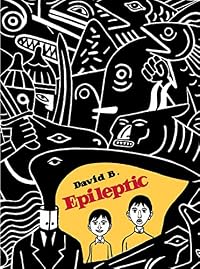
What is loved most about Epileptic was the eccentric nature of the drawings. David B doesn't draw in a literal way, but characterizes what is happening in peculiar and wonderfully show more zany way. Though the story is a memoir, people are sometimes represented as animals, events are dramatized with disproportionate drawings, and his brother's illness manifests on the pages as a monster snaking around the page. Though his story is important, it was the stylized representation on the pages that really shines, and is the main reason I would recommend this. show less
What is loved most about Epileptic was the eccentric nature of the drawings. David B doesn't draw in a literal way, but characterizes what is happening in peculiar and wonderfully show more zany way. Though the story is a memoir, people are sometimes represented as animals, events are dramatized with disproportionate drawings, and his brother's illness manifests on the pages as a monster snaking around the page. Though his story is important, it was the stylized representation on the pages that really shines, and is the main reason I would recommend this. show less
REVIEW OF EPILEPTIC DAVID B for librarything.com
David B.'s exploration of how a family member copes with epilepsy dives deep into the world of having an older sibling with the illness. Epileptic is a profound graphic novel in which the younger of two brothers narrates his life experience with unremitting candor. In this sense, 'graphic' refers both to the book's content as well as to its illustrated format. Before I present my review, I ask the reader to be very sensitive to the fact that Epileptic was copyrighted almost two decades ago (2005) when many victims and loved ones had starkly different life experiences than many, if not most, of their contemporary counterparts. The subject character suffers daily seizures during broad parts show more of his life which will naturally affect his cognitive life experience to a much greater degree than that of very many modern victims, the beneficiaries of far more effective second- and third-generation anticonvulsant medications. The likely difference in medical experiences is particularly assured if we assume that the author's outlook will have arisen deep in the 1990's. Cautious sensitivity becomes increasingly required as the illustrations of the sick brother distort him in a negative way as the book progresses. Some of the distortion has realism to it, however uncomfortable such realism might be.
The book is extraordinary in how many issues it brings up. The author tackles prejudice of violence; fear of surgery; non-medicinal seizure control; psychosomatic pitfalls in behavior; and many others. The author quickly calls attention to how readily people might stigmatize victims. Even as a graphic novel it wields more intellectual impact than ordinary texts might do.
The 2nd half of the book requires the most sensitivity to the time of publication as I've mentioned above. More and more, Jean-Christophe behaves in an agitated, antisocial manner. At the same time, his artistic portrayal becomes darker and larger than life. In illustrating his brother's resentful image of him, the author visually portrays him as a veritable monster in his brother's mind. The imagery discomforts a reader for its stigmatizing visuals, and for this reason the fact that it reveals the brother's psychological state is critical to bear in mind. The book, in fact, is more of a treatise on the healthy sibling than on the ill one.
So as not to be a spoiler, I will not detail the end of the book other than to say it is one of the most creative endings that I have seen in literature. It's not at all majestic, heroic, damning, or name your extreme. Rather it is creative and as profound as a miserable, humiliating disease permits. Epileptic is essential to a complete library of anyone with interests in the topic. show less
David B.'s exploration of how a family member copes with epilepsy dives deep into the world of having an older sibling with the illness. Epileptic is a profound graphic novel in which the younger of two brothers narrates his life experience with unremitting candor. In this sense, 'graphic' refers both to the book's content as well as to its illustrated format. Before I present my review, I ask the reader to be very sensitive to the fact that Epileptic was copyrighted almost two decades ago (2005) when many victims and loved ones had starkly different life experiences than many, if not most, of their contemporary counterparts. The subject character suffers daily seizures during broad parts show more of his life which will naturally affect his cognitive life experience to a much greater degree than that of very many modern victims, the beneficiaries of far more effective second- and third-generation anticonvulsant medications. The likely difference in medical experiences is particularly assured if we assume that the author's outlook will have arisen deep in the 1990's. Cautious sensitivity becomes increasingly required as the illustrations of the sick brother distort him in a negative way as the book progresses. Some of the distortion has realism to it, however uncomfortable such realism might be.
The book is extraordinary in how many issues it brings up. The author tackles prejudice of violence; fear of surgery; non-medicinal seizure control; psychosomatic pitfalls in behavior; and many others. The author quickly calls attention to how readily people might stigmatize victims. Even as a graphic novel it wields more intellectual impact than ordinary texts might do.
The 2nd half of the book requires the most sensitivity to the time of publication as I've mentioned above. More and more, Jean-Christophe behaves in an agitated, antisocial manner. At the same time, his artistic portrayal becomes darker and larger than life. In illustrating his brother's resentful image of him, the author visually portrays him as a veritable monster in his brother's mind. The imagery discomforts a reader for its stigmatizing visuals, and for this reason the fact that it reveals the brother's psychological state is critical to bear in mind. The book, in fact, is more of a treatise on the healthy sibling than on the ill one.
So as not to be a spoiler, I will not detail the end of the book other than to say it is one of the most creative endings that I have seen in literature. It's not at all majestic, heroic, damning, or name your extreme. Rather it is creative and as profound as a miserable, humiliating disease permits. Epileptic is essential to a complete library of anyone with interests in the topic. show less
People who think graphic novels aren't serious novels are probably also in the same category as those who haven't read novels like Epileptic by David B. (birthname: Pierre-François Bouchard) Though it is very different in context than Marjane Satrapi's Persepolis, it is no less vivid and piercingly autobiographical. This novel focuses on the author's own story of himself as a little boy growing up in France in the 1960s with a brother who is an epileptic and all the various alternative medicines and struggles the family is put through...it's mixed with any typical coming of age fascinations but overlying it is the themes of wonder and despair. There's an incredible insight into the way they are treated and a sense of deep show more questioning...where does the seizure take his older brother..does he do it on purpose? The guilt, the anger, the sadness all combine in alarming honesty that makes this book a must read for anyone trying to come to terms with disability and its pervasive impact.
The writing is fantastic but the story is truly enriched by the author's own drawings of his family, the legions of historical battle scenes boys typically get caught up in, and all of those who wish to in some way heal his brother. Best of all are the author's darkside imaginary confidants who he relies on in his loneliness while searching for answers as well as his very imaginative dreams that seem to often plague him and bring up more questions.
In any case, if you've always been a little curious about the graphic novel but don't like all of the stuff about superheros (I'll take those too personally depending on my mood) then I'd highly recommend this one. Very challenging with so much emotional depth you'll likely only be able to read a bit at a time..though, I suppose the better to savor it. show less
The writing is fantastic but the story is truly enriched by the author's own drawings of his family, the legions of historical battle scenes boys typically get caught up in, and all of those who wish to in some way heal his brother. Best of all are the author's darkside imaginary confidants who he relies on in his loneliness while searching for answers as well as his very imaginative dreams that seem to often plague him and bring up more questions.
In any case, if you've always been a little curious about the graphic novel but don't like all of the stuff about superheros (I'll take those too personally depending on my mood) then I'd highly recommend this one. Very challenging with so much emotional depth you'll likely only be able to read a bit at a time..though, I suppose the better to savor it. show less
This is David B's open and raw account of his family's life as they search for a cure for his brother's severe epilepsy. David B leaves in all up for examination - his family's ancestry, the various cures the family seeks out, obsessions each family member develops, the frustrations all of them have and the toll that all of this takes on everyone.
There are times where David B's level of disclosure can seem uncomfortable. Worse yet, much of the alternative medication in our pill-driven society can seem downright cruel until you realize nearly every pharmacological treatment for his brother ends up in complete failure. Then it becomes a story about a family willing to take any weapon up against a cruel tormentor, no matter how slim the show more chances of success. Even so, he presents this story honestly, showing the toll that a fight with no real end will take on all participants involved.
As an illustrator, David B's work is reminiscent of intricate wood-cuttings where one can get lost in the details for hours. The depictions of the seizures and the onset of depression are an accomplishment unto themselves, and well worth a look through the book. Each of the backgrounds contains characters and spirit guides that serve he and his siblings well in their active fantasy life.
Highly recommended. show less
There are times where David B's level of disclosure can seem uncomfortable. Worse yet, much of the alternative medication in our pill-driven society can seem downright cruel until you realize nearly every pharmacological treatment for his brother ends up in complete failure. Then it becomes a story about a family willing to take any weapon up against a cruel tormentor, no matter how slim the show more chances of success. Even so, he presents this story honestly, showing the toll that a fight with no real end will take on all participants involved.
As an illustrator, David B's work is reminiscent of intricate wood-cuttings where one can get lost in the details for hours. The depictions of the seizures and the onset of depression are an accomplishment unto themselves, and well worth a look through the book. Each of the backgrounds contains characters and spirit guides that serve he and his siblings well in their active fantasy life.
Highly recommended. show less
This book is a work of art. This definitely ranks highly among my favorite memoir/autobiographies and graphic novels/memoirs. David B. is French, and his illustrations and framing are quite different than the American graphic novelists I've read.
Members
- Recently Added By
Published Reviews
ThingScore 94
Illness may be of dubious use as metaphor, as Susan Sontag famously argued, but it's an even unlikelier theme for a comic book. By both origin and reputation, comics (or graphic novels, as one is now more or less obliged to call them) are the ultimate vessel of nerdy wish-fulfillment: blocky, oversaturated fantasy pieces in which everyday schmoes acquire superhuman powers and wreak righteous show more vengeance on their villainous tormentors. show less
added by stephmo
David B's autobiographical Epileptic [368pp, Jonathan Cape, £16.99], on the other hand, is a staggeringly original work of real power. Its creator developed his cartooning style as a way to cope with his brother's debilitating illness. In his childhood bedroom, with Bach on the stereo, he would pour all his fear, aggression, sympathy and detachment into intricate comic strips.
added by stephmo
A book with a title like Epileptic does not raise high expectations: will it be an account of suffering nobly borne, or a worthy medical treatise perhaps? Not a bit of it, this memoir is a graphics extravaganza spread over 361 pages, bursting with energy and wild imaginings, a comic tour de force that is as emotionally gut-wrenching as it is visually stunning.
added by stephmo
Lists

Recommended Comics / Graphic Novels
595 works; 122 members

Read This Next
120 works; 3 members

Books Read in 2014
2,341 works; 86 members

The Guardian's 1000 Novels Everyone Must Read
1,005 works; 549 members

Drawn Out: The 50 Best Non-Superhero Graphic Novels
175 works; 8 members

Adult Books for YA Readers
194 works; 6 members
Best Graphic Novel Nonfiction
199 works; 101 members

el
1,139 works; 1 member
Author Information

88+ Works 2,672 Members
Awards and Honors
Awards
Distinctions
Series

Belongs to Publisher Series
Common Knowledge
- Canonical title
- Epileptic
- Original title
- L'Ascension du Haut Mal
- Original publication date
- 2005; 1996-2003: Original French Edition (6 volumes) (6 volumes)
- People/Characters
- Pierre-François Beauchard (David B.); Jean-Christophe Beauchard; Florence Beauchard
- Important places
- Orléans, Loiret, Centre-Val de Loire, France; Olivet, Centre-Val de Loire, France; Paris, Île-de-France, France
- First words
- 1994. I'm in the bathroom, at my parents' house in Olivet.
- Last words
- (Click to show. Warning: May contain spoilers.)I figured that at some point...my face would be yours.
- Blurbers
- Sacco, Joe; Paul Collins; Abel, Jessica; Lutes, Jason
- Disambiguation notice
- Please do not combine partial editions with the full edition of Epileptic. Partial volumes are not the same as an omnibus volume and are their own work. Please keep in mind that the French version comes in six volume... (show all)s, where other language versions come in a two volume set when combining Volumes 1 and Volumes 2 together.
Classifications
- Genre
- Graphic Novels & Comics
- DDC/MDS
- 741.5944 — Arts & recreation Drawing & decorative arts Drawing and drawings Comic books, graphic novels, fotonovelas, cartoons, caricatures, comic strips History, geographic treatment, biography European France & Monaco
- LCC
- PN6747 .B2213 — Language and Literature Literature (General) Literature (General) Collections of general literature Comic books, strips, etc.
- BISAC
Statistics
- Members
- 1,307
- Popularity
- 18,373
- Reviews
- 24
- Rating
- (3.96)
- Languages
- 12 — Danish, Dutch, English, Finnish, French, German, Indonesian, Norwegian (Bokmål), Norwegian, Portuguese, Spanish, Swedish
- Media
- Paper, Ebook
- ISBNs
- 19
- ASINs
- 4