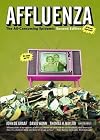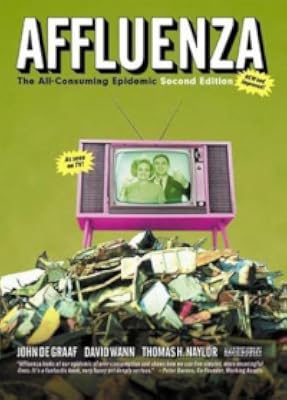
Affluenza: The All-Consuming Epidemic
by John de Graaf, Thomas H Naylor (Author), David Wann (Author)
On This Page
Description
"A fascinating look at one of the greatest social maladies of our time: overconsumption and materialism. Hosted by National Public Radio's Scott Simon, the program explores both the comical and sobering aspects of our consumerism and its enormous impact on families, communities and the environment. With the help of historians and archival film, Affluenza reveals the forces that have dramatically transformed us from a nation that prizes thriftiness - with strong beliefs in 'plain living and show more high thinking' - into the ultimate consumer society"--Container. show lessTags
Recommendations









Member Recommendations

Member Reviews
Given all the plaudits Affluenza has received, I found it to be a surprisingly bad book.
I suppose its authorial team is to be given credit for 'consciousness raising' -- but they're awful writers. We get plenty o' platitudes -- plus bromides! Shrill, hectoring denunciations of American lifestyles plus the biggest selection of 'noble savage' references you'll find outside Rousseau. Did you know that people in every country, in every time in history, except maybe for some dead white guy countries sometimes, have understood the secret to life and happiness -- except Americans?
Look, I'm all for confronting affluenza. I agree with the book's ultimate premise, i.e. that buying things doesn't lead to guaranteed happiness or give life show more ultimate meaning. But the treatment here is so stupifyingly shallow and inane reading it made we want to go out and burn down some redwoods. Tell me you can read passages like this one and not feel the same way:
"Simple things to save the Earth? Sure, let's do as many as we can, because they reduce impacts, stimulate better design, and save money . . . . But while we're at it, let's not forget a few other details that need to be taken care of by the week after next: redesigning the American economy and many of its products, and recycling the American mindset." (p. 202)
Have you ever read more inappropriately breezy, vapid prose? And don't think there's any depth behind these sweeping pronouncements: the best you'll get is lots of calls for government regulations and cheesy environmentalist claptrap. The authors suggest that we confront the anomie of postmodern consumerist culture by advocating, over and over and yet over again, that it's nice to 'get back in touch with nature'.
Affluenza is a serious topic, but this is not a serious book. show less
I suppose its authorial team is to be given credit for 'consciousness raising' -- but they're awful writers. We get plenty o' platitudes -- plus bromides! Shrill, hectoring denunciations of American lifestyles plus the biggest selection of 'noble savage' references you'll find outside Rousseau. Did you know that people in every country, in every time in history, except maybe for some dead white guy countries sometimes, have understood the secret to life and happiness -- except Americans?
Look, I'm all for confronting affluenza. I agree with the book's ultimate premise, i.e. that buying things doesn't lead to guaranteed happiness or give life show more ultimate meaning. But the treatment here is so stupifyingly shallow and inane reading it made we want to go out and burn down some redwoods. Tell me you can read passages like this one and not feel the same way:
"Simple things to save the Earth? Sure, let's do as many as we can, because they reduce impacts, stimulate better design, and save money . . . . But while we're at it, let's not forget a few other details that need to be taken care of by the week after next: redesigning the American economy and many of its products, and recycling the American mindset." (p. 202)
Have you ever read more inappropriately breezy, vapid prose? And don't think there's any depth behind these sweeping pronouncements: the best you'll get is lots of calls for government regulations and cheesy environmentalist claptrap. The authors suggest that we confront the anomie of postmodern consumerist culture by advocating, over and over and yet over again, that it's nice to 'get back in touch with nature'.
Affluenza is a serious topic, but this is not a serious book. show less
It's good to know that I'm doing at least some things right, though I know I could do more. Reading this book only reaffirmed my beliefs about the state of over-consumption in America and increasingly, in the world. Written tongue-in-cheek as an exposé of the disease of affluenza, the authors discuss the disorder's symptoms, causes, and treatments.
I always seem to read these types of books after the predictions have come true. For example, take the credit crash of fall 2008. For anyone in government or business who said the state of credit in America was fine and were surprised by the catastrophe, this book is but one exhibit in a litany of books, articles, and documentaries that surmised a crash would be the inevitable conclusion. It show more makes me wonder what the authors of Affluenza would have written had they had the chance to see what happened under the Bush administration. I imagine it would have gone from concerned and distressed to appalled and disgusted.
For me the highlight was part two: causes of affluenza. It was wonderful to hear Marx again and incongruous that as a society we still fail to heed his advice. Again and again throughout history we are shown the errors of our ways yet still make the same mistakes. And now with the rest of the world watching and imitating us, we're taking everyone down the primrose path. Hopefully this time, we will have learned some lessons. It's not just the economy that is at stake if we don't - it's our environment, our health, our families, and our self-worth. show less
I always seem to read these types of books after the predictions have come true. For example, take the credit crash of fall 2008. For anyone in government or business who said the state of credit in America was fine and were surprised by the catastrophe, this book is but one exhibit in a litany of books, articles, and documentaries that surmised a crash would be the inevitable conclusion. It show more makes me wonder what the authors of Affluenza would have written had they had the chance to see what happened under the Bush administration. I imagine it would have gone from concerned and distressed to appalled and disgusted.
For me the highlight was part two: causes of affluenza. It was wonderful to hear Marx again and incongruous that as a society we still fail to heed his advice. Again and again throughout history we are shown the errors of our ways yet still make the same mistakes. And now with the rest of the world watching and imitating us, we're taking everyone down the primrose path. Hopefully this time, we will have learned some lessons. It's not just the economy that is at stake if we don't - it's our environment, our health, our families, and our self-worth. show less
It’s more than a book … it’s a disease. Affluenza is a largely modern disease when people are consumed with the idea of consuming. Does this sound like anyone you know?
The book was written around November 2000 and is still very true today. Fun, witty, and filled with illustrations from Pulitzer Prize Winner, David Horsey, this book takes aim at our growing culture of consumerism. Nowadays, we just have so much stuff … or is it junk?
The book divides into three parts: symptoms, causes, and treatments. In short, the symptoms include things like emptiness, stress, and feeling like not having enough time. Feeling bloated and sluggish are also prevalent symptoms. There is little test in the book to take to see how much affluenza you show more have.
Jokingly, the authors blame Adam and Eve’s Original Sin as the root of affluenza. There are anecdotes of a company like Kellogg that at one point had a standard six hour workday (do any of you know anyone who works only six hours a day?) and the beginnings of the credit card industry. It’s strange in light of all the advances in technology that we were supposed to save us time; we collectively have even less time.
So is there a cure? Yes, one can choose to downshift to a smaller household or just have a smaller environmental footprint. The things most important to us can probably not be bought at your local mall. Goodness knows we have all tried. show less
The book was written around November 2000 and is still very true today. Fun, witty, and filled with illustrations from Pulitzer Prize Winner, David Horsey, this book takes aim at our growing culture of consumerism. Nowadays, we just have so much stuff … or is it junk?
The book divides into three parts: symptoms, causes, and treatments. In short, the symptoms include things like emptiness, stress, and feeling like not having enough time. Feeling bloated and sluggish are also prevalent symptoms. There is little test in the book to take to see how much affluenza you show more have.
Jokingly, the authors blame Adam and Eve’s Original Sin as the root of affluenza. There are anecdotes of a company like Kellogg that at one point had a standard six hour workday (do any of you know anyone who works only six hours a day?) and the beginnings of the credit card industry. It’s strange in light of all the advances in technology that we were supposed to save us time; we collectively have even less time.
So is there a cure? Yes, one can choose to downshift to a smaller household or just have a smaller environmental footprint. The things most important to us can probably not be bought at your local mall. Goodness knows we have all tried. show less
Affluenza: The All-Consuming Epidemic tackles — in excruciating detail — the “painful, contagious, socially transmitted condition of overload, debt, anxiety, and waste resulting from the dogged pursuit of more.” In other words, the authors take on the American way of life; their metaphor-based argument — constructed largely from news clippings, sound bytes and anecdotal evidence — is that the all-consuming pursuit of material things in this country leads to everything from, at best, stress, bankruptcy, divorce, gridlock and chronic dissatisfaction, to, at worst, poor city planning (sprawl), the breakdown of families and communities, resource-exhaustion and environmental devastation. Love the book or hate it, much of it will show more ring true. — Jeanie Straub show less
Everyone in America should read this book.
The authors compare our level of consumption to a disease, hence the title. At first I thought it was just a gimmick, but now I believe our over-consumption truly is a disease that we need to treat and eventually cure.
Bankruptcies and foreclosures are happening at a higher rate than ever before. Our expectations for the size of our houses and cars grow and grow and grow with no signs of slowing down. Just about every moderate- to large-sized city in the country has traffic problems. And too many of the vehicles on the road are disgustingly fuel-inefficient. We work too much and spend too little time with our families and friends. Our kids go to school and are bombarded by ads in the halls, in show more their classrooms, and in their textbooks. (Not to mention the advertising and marketing that bombards them outside of school.) More and more, cities throughout America are starting to look eerily identical because big chains are replacing locally owned, unique businesses. We use too much paper, too much oil, too much of everything. I could go on and on.
Before I read this book, I would find myself in despair about the state of our country and all these issues, not knowing how to go about trying to fix them. But this book showed me how all these problems are related in a fundamental way and that they are all symptoms of our over-consumption.
The book has a quiz you can take to determine your level of infection, and it has suggestions for both individual and community changes we can make to combat this disturbing disease.
Here's just one of the many parts of the book that opened my eyes:
"Normal is getting dressed in clothes that you buy for work, driving through traffic in a car that you are still paying for, in order to get to the job that you need so you can pay for the clothes, car and the house that you leave empty all day in order to afford to live in it." show less
The authors compare our level of consumption to a disease, hence the title. At first I thought it was just a gimmick, but now I believe our over-consumption truly is a disease that we need to treat and eventually cure.
Bankruptcies and foreclosures are happening at a higher rate than ever before. Our expectations for the size of our houses and cars grow and grow and grow with no signs of slowing down. Just about every moderate- to large-sized city in the country has traffic problems. And too many of the vehicles on the road are disgustingly fuel-inefficient. We work too much and spend too little time with our families and friends. Our kids go to school and are bombarded by ads in the halls, in show more their classrooms, and in their textbooks. (Not to mention the advertising and marketing that bombards them outside of school.) More and more, cities throughout America are starting to look eerily identical because big chains are replacing locally owned, unique businesses. We use too much paper, too much oil, too much of everything. I could go on and on.
Before I read this book, I would find myself in despair about the state of our country and all these issues, not knowing how to go about trying to fix them. But this book showed me how all these problems are related in a fundamental way and that they are all symptoms of our over-consumption.
The book has a quiz you can take to determine your level of infection, and it has suggestions for both individual and community changes we can make to combat this disturbing disease.
Here's just one of the many parts of the book that opened my eyes:
"Normal is getting dressed in clothes that you buy for work, driving through traffic in a car that you are still paying for, in order to get to the job that you need so you can pay for the clothes, car and the house that you leave empty all day in order to afford to live in it." show less
Originally a one hour special on PBS about overconsumption in the 1990s, the book Affluenza expands on what the show had to say on the subject. The first two sections section of the book covers how American society shifted over to a consumer society from a more frugal and saving society. The shift came from post-World War II prosperity, the growth of suburbia, continued influence of advertising, and other factors, leading to now, with people having very large houses, storage units, working longer and longer hours with less vacations, and continuing declines in reported quality of life. Part three covers ways to shift one's life from this high focus on stuff back to focusing on community and family and the world around us. Given the show more recent economic collapses, I think more Americans would benefit from reading and applying the techniques in this book.
I do have one disagreement with a statement in the book. One of the suggestions made for less consumption of meat, because of cattle using up so much grain and water in their raising. First, when cows are fed properly on the food they are designed to eat (grass, NOT grain, cows get sick on grain), they actually enhance overall quality of both the meat produced and the land on which they graze. Secondly, the implication in this statement that people can eat the grain is questionable, since there are so many people with gluten issues as is, and that a heavily grain based diet is potentially one of the big causes for so much chronic illness in Americans.
I do think Americans eat too much food, period. Not simply meat. Among our collective affluenza, "we" are obsessed with the idea of getting the highest volume of food for the least amount of cost. Never mind the quality of the food, or how the animals are treated, or how much fertilizer needs to be dumped on fallow land because it's being overtaxes by monocultures.
Otherwise, I highly recommend the book. In fact I think it's close to necessary reading. show less
I do have one disagreement with a statement in the book. One of the suggestions made for less consumption of meat, because of cattle using up so much grain and water in their raising. First, when cows are fed properly on the food they are designed to eat (grass, NOT grain, cows get sick on grain), they actually enhance overall quality of both the meat produced and the land on which they graze. Secondly, the implication in this statement that people can eat the grain is questionable, since there are so many people with gluten issues as is, and that a heavily grain based diet is potentially one of the big causes for so much chronic illness in Americans.
I do think Americans eat too much food, period. Not simply meat. Among our collective affluenza, "we" are obsessed with the idea of getting the highest volume of food for the least amount of cost. Never mind the quality of the food, or how the animals are treated, or how much fertilizer needs to be dumped on fallow land because it's being overtaxes by monocultures.
Otherwise, I highly recommend the book. In fact I think it's close to necessary reading. show less
I’m not sure why I enjoyed this (slightly) more than The Paradox of Choice that I also recently finished. They both deal with essentially the same issue – we gringos are surrounded by, and thus seduced into acquiring too much junk and the resulting depression from debt and/or the process of wading through endless options harshes our buzz. Perhaps Affluenza’s cartoon illustration inclusions are better? Maybe it’s the goofy “As seen on PBS” cover graphic? At the very least, my favorite/most dismal baseball team finally won a game so my mood is slightly elevated recently.
Here the authors interview and grab quotes, studies, and anecdotes from a wide ranging cast of characters to illuminate how the typical US citizen’s show more priorities have become most skewed within a society that is increasingly defined by the GDP metric. Tidbits from economists, suburbanites, New Agers, the “Good Book,” and marketing experts cast illumination on the dreadful plague we (or at least some) experience as the forty hour work week and easily procured credit. Written ten years back, it’s simultaneously dated in certain aspects (access to network TV used to be free?) yet even more relevant in others. I didn’t necessarily find it a “page-turner” but it’s short enough to quickly get through and the diversity of topical areas prevent staleness.
Ooh, I figured out why I prefer this one to Schwartz’s effort. On the final page they mention architecture – something about how we should build for a thousand years instead erecting disposable trash such as the ubiquitous eight year Wal-Mart. Of the many dozens of NOT-architecture-specific, non-fiction books I’ve recently encountered, this is the only one that even acknowledges the existence of my chosen profession; something of an unexpected shout-out to a mostly forgotten profession on life-support. Good read! show less
Here the authors interview and grab quotes, studies, and anecdotes from a wide ranging cast of characters to illuminate how the typical US citizen’s show more priorities have become most skewed within a society that is increasingly defined by the GDP metric. Tidbits from economists, suburbanites, New Agers, the “Good Book,” and marketing experts cast illumination on the dreadful plague we (or at least some) experience as the forty hour work week and easily procured credit. Written ten years back, it’s simultaneously dated in certain aspects (access to network TV used to be free?) yet even more relevant in others. I didn’t necessarily find it a “page-turner” but it’s short enough to quickly get through and the diversity of topical areas prevent staleness.
Ooh, I figured out why I prefer this one to Schwartz’s effort. On the final page they mention architecture – something about how we should build for a thousand years instead erecting disposable trash such as the ubiquitous eight year Wal-Mart. Of the many dozens of NOT-architecture-specific, non-fiction books I’ve recently encountered, this is the only one that even acknowledges the existence of my chosen profession; something of an unexpected shout-out to a mostly forgotten profession on life-support. Good read! show less
Members
- Recently Added By
Lists

LT picks: Blue Books
197 works; 39 members
Author Information

12+ Works 1,211 Members

Some Editions
Work Relationships
Common Knowledge
- Canonical title
- Affluenza: The All-Consuming Epidemic
- Original publication date
- 2001
- Dedication
- In memory of
David Ross Brower
(1912-200)
a giant of 20th Century thought and action on behalf
of the earth. He hoped that one day
We may see that progress is not the
Accelerating speed with whi... (show all)ch we multiply
And subdue the Earth, nor the growing number
Of things we possess and cling to.
It is a way along which to search for truth,
To find serenity and love and reverence for life,
To be part of an enduring harmony...
And in memory of
Donella Meadows
(1941-2001)
Scientist and sheep farmer, she pointed us all
in the direction of a more sustainable society. - First words
- Let's put it bluntly: we can't grow on like this.... Never before has so much meant so little to so many.
- Blurbers
- Barnes, Peter; Brower, David R.; Hawken, Paul; Bradley, Bill; Hayes, Denis; Robin, Vicki
- Canonical DDC/MDS
- 306.0973
- Canonical LCC
- HN60
Classifications
- Genres
- Sociology, Economics, Nonfiction, General Nonfiction, Business
- DDC/MDS
- 306.0973 — Society, government, & culture Social sciences, sociology & anthropology Social Behavior - Dating, Marriage, Divorce Social history North America United States
- LCC
- HN60 — Social sciences Social history and conditions. Social problems. Social reform Social history and conditions. Social problems. By region or country
- BISAC
Statistics
- Members
- 964
- Popularity
- 27,390
- Reviews
- 20
- Rating
- (3.83)
- Languages
- English, French, German
- Media
- Paper, Ebook
- ISBNs
- 10
- UPCs
- 1
- ASINs
- 4