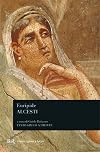
Alcestis
by Euripides
On This Page
Description
No detailed description available for "Alcestis".Tags
Recommendations



















Member Reviews
I can now understand why they call this a problem play: for most of the play it is a tragedy but suddenly, at the end, everything turns out all right. One commentary I have read on this raises the question of whether it is a masterpiece or a train wreck. What we need to remember though is that this would have been one of the seven plays of Euripides that were selected to be preserved (and I say this because unlike the other two classic playwrights, he have a whole volume of Euripidean plays that came down to us along with the seven masterpieces).
However it is the myth sitting behind this play that we need to consider, and it seems that Euripides actually added nothing to the myth, and the resurrection of Alcestis at the conclusion of show more the play is something that existed in the original myth. The story was that Alcestis was an incredibly beautiful woman (surprise, surprise) and her father held a contest to see who would be the most worthy suitor - Admentus won the contest. With regards to Admentus, he had helped Apollo by taking care of the god after he had been kicked out of Olympus, and Apollo rewarded Admentus by helping him complete the task to win over Alcestis' father.
However, after the marriage, Admentus did not make the required sacrifice and was to die, but once again Apollo intervened and saved his life by making the furies drunk. The catch was that somebody had to die in Admentus' place. This is a little different than what I gathered from the play, and that was that for helping Apollo, Admentus was given the gift of a longer life, but there was a sting in the tail, and that was that somebody else had to willing give up their life. Admentus' parents basically told him to bugger off, but Alcestis, his wife, stepped in as the sacrifice, much to Ademntus' horror.
The play begins with Alcestis dying, and this happens pretty quickly. However, while Admentus and his household is in mourning, Heracles rocks up on his way to Thrace to complete one of his tasks. Now, hospitality is very, very important to the Greeks, and despite his mourning, Heracles is welcomed into the house and given guest quarters, however he is not told what is happening. Heracles finds out after speaking to a servant, and in appreciation for Admentus opening up his house, he goes and defeats death and brings Alcestis back to life.
Now, here is another instance of resurrection in Greek mythology. Here we have Heracles defeating death to bring someone back to life, however this differs from Christian mythology in that a second person steps in to overturn death, even though he is the son of Zeus. This is more like Jesus bringing Lazerus back to life as opposed to Christ returning from the dead. However we do see glimpses here of the concept of the son of God defeating death.
Admentus is truly a tragic character, probably one of the most tragic of the Greek heroes that I have read, though I note that it is Euripides that seems to use this the best. However, it does not end badly for Admentus, and his tragic flaw: his desire for a long life; does not truly bite him. In a way it causes division within his family, such as with the death of Alcestis and the fact that he drives away his father. Admentus is a truly selfish individual - what right does he have demanding the life of his father-in-law so that he might live longer. It does not work like that, and it seems that Euripides is in agreement.
This play is about death, pure and simple, and how death destroys relationships. We also get a glimpse into the mind of Admentus, as he mourns over the death of his wife. We see that despite his longer life it is no longer a life worth living and in fact he no longer wants to spend any time where he will be reminded of Alcestis' sacrifice. I guess the main reason he mourns so hard is not the futility and meaninglessness of death (as some Christians might suggest) but rather because the death came about through his own selfish desire to live longer.
Yet he does not learn from this, and in fact he is rewarded for his selfishness. Okay, it is clear that the reward comes not from his own failings as a human being, but rather because despite his grief and mourning (though I doubt a psychologist would suggest that this is the natural grief process) he still fulfilled his duty towards his guest. Also, despite his lying to Heracles, Heracles still saw fit to reward him for his hospitality. Still, those last five pages where Alcestis returns from the dead, despite her no longer having a voice in the play, just does not seem to sit right. show less
However it is the myth sitting behind this play that we need to consider, and it seems that Euripides actually added nothing to the myth, and the resurrection of Alcestis at the conclusion of show more the play is something that existed in the original myth. The story was that Alcestis was an incredibly beautiful woman (surprise, surprise) and her father held a contest to see who would be the most worthy suitor - Admentus won the contest. With regards to Admentus, he had helped Apollo by taking care of the god after he had been kicked out of Olympus, and Apollo rewarded Admentus by helping him complete the task to win over Alcestis' father.
However, after the marriage, Admentus did not make the required sacrifice and was to die, but once again Apollo intervened and saved his life by making the furies drunk. The catch was that somebody had to die in Admentus' place. This is a little different than what I gathered from the play, and that was that for helping Apollo, Admentus was given the gift of a longer life, but there was a sting in the tail, and that was that somebody else had to willing give up their life. Admentus' parents basically told him to bugger off, but Alcestis, his wife, stepped in as the sacrifice, much to Ademntus' horror.
The play begins with Alcestis dying, and this happens pretty quickly. However, while Admentus and his household is in mourning, Heracles rocks up on his way to Thrace to complete one of his tasks. Now, hospitality is very, very important to the Greeks, and despite his mourning, Heracles is welcomed into the house and given guest quarters, however he is not told what is happening. Heracles finds out after speaking to a servant, and in appreciation for Admentus opening up his house, he goes and defeats death and brings Alcestis back to life.
Now, here is another instance of resurrection in Greek mythology. Here we have Heracles defeating death to bring someone back to life, however this differs from Christian mythology in that a second person steps in to overturn death, even though he is the son of Zeus. This is more like Jesus bringing Lazerus back to life as opposed to Christ returning from the dead. However we do see glimpses here of the concept of the son of God defeating death.
Admentus is truly a tragic character, probably one of the most tragic of the Greek heroes that I have read, though I note that it is Euripides that seems to use this the best. However, it does not end badly for Admentus, and his tragic flaw: his desire for a long life; does not truly bite him. In a way it causes division within his family, such as with the death of Alcestis and the fact that he drives away his father. Admentus is a truly selfish individual - what right does he have demanding the life of his father-in-law so that he might live longer. It does not work like that, and it seems that Euripides is in agreement.
This play is about death, pure and simple, and how death destroys relationships. We also get a glimpse into the mind of Admentus, as he mourns over the death of his wife. We see that despite his longer life it is no longer a life worth living and in fact he no longer wants to spend any time where he will be reminded of Alcestis' sacrifice. I guess the main reason he mourns so hard is not the futility and meaninglessness of death (as some Christians might suggest) but rather because the death came about through his own selfish desire to live longer.
Yet he does not learn from this, and in fact he is rewarded for his selfishness. Okay, it is clear that the reward comes not from his own failings as a human being, but rather because despite his grief and mourning (though I doubt a psychologist would suggest that this is the natural grief process) he still fulfilled his duty towards his guest. Also, despite his lying to Heracles, Heracles still saw fit to reward him for his hospitality. Still, those last five pages where Alcestis returns from the dead, despite her no longer having a voice in the play, just does not seem to sit right. show less
What a delightful play! Murray's notes and introduction are refreshing and enlightening, and the verse form he gives the work is enjoyable and at times inspired. Perceptive fellow, Euripides! Brilliant character study; a very thoughtful work.
One of my favorite Greek plays, precisely because it is not a tragedy. I do not buy the theory that we are supposed to be skeptical of the rescue of Alcestis.
Alcestis, en su lecho de muerte, pide que a cambio Admeto nunca se case de nuevo, que no la olvide ni ponga a sus hijos una resentida madrastra. Admeto se muestra conforme, y promete llevar una vida de solemnidad en su honor, absteniéndose de la alegría que era parte integral de su casa. Entonces, muere Alcestis.
Justo entonces, Heracles, viejo amigo de Admeto, llega a palacio sin tener idea de lo ocurrido. Sería contrario a todos los modales rechazar a un huésped,3 así que el rey decide no abrumarlo con las tristes noticias e instruye a los criados para que den la bienvenida a Heracles y se callen. Heracles se emborracha y empieza a importunar a los criados, que amaban a su reina y están amargados por no poder llorarla show more adecuadamente. Al final, uno de ellos salta y le dice lo que ha ocurrido.
Heracles está terriblemente incómodo por su comportamiento, y, durante los sacrificios funerarios que se hacen ante la tumba de Alcestis, decide enfrentarse con la Muerte.
Cuando regresa, trae consigo una mujer con velo y dice a Admeto que es una nueva esposa. Después de muchas discusiones, fuerza a Admeto a tomar la mano de ella; cuando alza el velo, encuentra que parece ser, en realidad, Alcestis, de regreso de la muerte. Heracles ha luchado contra la Muerte y la ha forzado a devolvérsela. Alcestis no podrá hablar durante tres días, después de los cuales quedará purificada y totalmente vuelta a la vida. show less
Justo entonces, Heracles, viejo amigo de Admeto, llega a palacio sin tener idea de lo ocurrido. Sería contrario a todos los modales rechazar a un huésped,3 así que el rey decide no abrumarlo con las tristes noticias e instruye a los criados para que den la bienvenida a Heracles y se callen. Heracles se emborracha y empieza a importunar a los criados, que amaban a su reina y están amargados por no poder llorarla show more adecuadamente. Al final, uno de ellos salta y le dice lo que ha ocurrido.
Heracles está terriblemente incómodo por su comportamiento, y, durante los sacrificios funerarios que se hacen ante la tumba de Alcestis, decide enfrentarse con la Muerte.
Cuando regresa, trae consigo una mujer con velo y dice a Admeto que es una nueva esposa. Después de muchas discusiones, fuerza a Admeto a tomar la mano de ella; cuando alza el velo, encuentra que parece ser, en realidad, Alcestis, de regreso de la muerte. Heracles ha luchado contra la Muerte y la ha forzado a devolvérsela. Alcestis no podrá hablar durante tres días, después de los cuales quedará purificada y totalmente vuelta a la vida. show less
This was better than many of the other Greek plays I've read.
Uma das mais belas tragédias da mitologia grega, escrita belamente por Eurípides. Confirmou seu título, aliás, de o mais trágico dos poetas.
*i did not read this exact translation, but this story by Euripides
Admetus was not a great dude and definitely shouldn’t have deserved to be saved by his wife tbh
Admetus was not a great dude and definitely shouldn’t have deserved to be saved by his wife tbh
Members
- Recently Added By
Lists

Harold Bloom - The Western Canon: A. The Theocratic Age
97 works; 13 members

Favourite Books
1,817 works; 316 members

100 Books to Read in a Lifetime (That Are Older Than 200 Years)
415 works; 173 members

Favourite Greek Books
97 works; 1 member

Books Read in 2017
4,249 works; 130 members

Top Five Books of 2020
982 works; 348 members

Greatest Books, allegedly
484 works; 9 members

Mustich's 1000 Books to Read Before You Die: A Life Changing List
1,001 works; 19 members

New Lifetime Reading Plan by Fadiman and Major
225 works; 5 members

My Play Collection
769 works; 3 members

Next Plays / 2025
352 works; 1 member

euripides ranked
23 works; 1 member
Author Information

1,343+ Works 34,113 Members
Euripides was born in Attica, Greece probably in 480 B.C. He was the youngest of the three principal fifth-century tragic poets. In his youth he cultivated gymnastic pursuits and studied philosophy and rhetoric. Soon after he received recognition for a play that he had written, Euripides left Athens for the court of Archelaus, king of Macedonia. show more Fragments of about fifty-five plays survive. Among his best-known plays are Alcestis, Medea and Philoctetes, Electra, Iphigenia in Tauris, The Trojan Women, and Iphigenia in Aulis Iphigenia. He died in Athens in 406 B.C. (Bowker Author Biography) show less
Some Editions
Awards and Honors
Awards
Notable Lists
Series
Belongs to Publisher Series
Work Relationships
Is contained in
5 Plays: Bacchae / Heracles / Children of Heracles / Phoenician Women / Suppliant Women by Euripides
Great Books of The Western World: Aeschylus, Sophocles, Euripides, Aristophanes by Robert Maynard Hutchins (indirect)
10 Plays: Alcestis / Andromache / Children of Heracles / Helen / Hippolytus / Ion / Medea / Rhesus / Suppliant Women / Trojan Women by Euripides
11 Plays: Alcestis / Andromache / Children of Heracles / Electra / Hecuba / Helen / Heracles / Hippolytus / Medea / Suppliant Women / Trojan Women by Euripide
9 Plays: Alcestis / Andromache / Bacchae / Children of Heracles / Electra / Hecuba / Helen / Heracles / Hyppolytus by Euripides
World Drama, Volume 1: Ancient Greece, Rome, India, China, Japan, Medieval Europe, and England by Barrett H. Clark
Inspired
Has as a student's study guide
Common Knowledge
Classifications
- Genres
- Fiction and Literature, Poetry
- DDC/MDS
- 882.01 — Literature & rhetoric Classical & modern Greek literatures Classical Greek dramatic poetry and drama standard subdivisions; collections; history, description, critical appraisal; Specific periods Ancient period to ca. 499
- LCC
- PA3975 .A5 .A7 — Language and Literature Greek language and literature. Latin language and literature Greek literature Individual authors Euripedes
- BISAC
Statistics
- Members
- 858
- Popularity
- 31,707
- Reviews
- 19
- Rating
- (3.57)
- Languages
- 14 — Catalan, Danish, Dutch, English, French, German, Greek (Ancient), Greek, Italian, Latin, Norwegian (Bokmål), Russian, Spanish, Swedish
- Media
- Paper, Ebook
- ISBNs
- 68
- ASINs
- 25