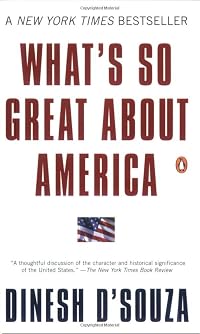
What's So Great About America
by Dinesh D'Souza
On This Page
Description
America is under attack as never before-not only from terrorists, but from people who provide a rationale for terrorism. Bestselling author Dinesh D'Souza takes on all of America's critics and proves them wrong as perhaps only a writer with an immigrant's understanding of this country can. D'Souza presents his case for intelligent patriotism based on an understanding of what really makes America unique in the world. Among other issues, he confronts the hallmarks of criticism of the American show more way -our history of slavery, colonialism and materialism. His thought provoking essay is simply presented. He defends not an idealized America, But America as it really is, and measures America not against utopia, but against the rest of the world. "This book brings a new personal tone to D'Souza's always sharp handling of ideas. There are at least two "bests" in the book: the best argument t against racial reparations. Then there's the powerful account of D'Souza's own enchantment with the America he encountered when he first came here as an immigrant from India. My Favorite D'Souza book. Read it!". Shelby Steele, author of The Content of Our Character.. show less
Tags
Recommendations











Member Reviews
This was one of the most powerful and fascinating books I've read in a long time. There was good representation of both sides of the argument and I learned so much about why other countries and religions hate America, terrorism, and immigration. I'm generally not interested in books about government, politics, foreign policy, economics, etc. but I couldn't put this down and will probably read again but much slower with a highlighter. There were passages that just floored me as they got me thinking and my brain working. This should be required reading for everyone. I totally get it now.
Dinesh D'Souza, who immigrated to America from India, has had great success in this country. He is both a bestselling author and a former White House policy analyst and he wants to tell the world exactly What's So Great About America. And please note that there is no question mark at the end of his book's title.
If Dinesh D'Souza or his publisher were concerned with being politically correct, this book would never have seen the light of day. D'Souza is not interested in defending an idealized version of America. Rather, he describes the real America, both the good and the bad, and reminds American citizens that they should be proud of themselves and their country despite the peevish criticism that the United States receives from others show more who blame them and their country for everything that goes wrong in the world. Not surprisingly, America's harsh critics conveniently only tell one side of the story and never give the United States credit for any of the good things that happen around the world.
Fair warning: what follows makes no attempt at being politically correct. It is D'Souza's blunt criticism of the "blame America first" crowd, and the Muslim world, in particular.
D'Souza makes four main points in What's So Great About America:
1. Much of the world hates the United States and her citizens.
2. There is really not much that America can do about being hated because it comes with the territory.
3. Modern American and Western society truly is the best that the world has to offer.
4. Islamic society is striking out at the West in order to mask its own humiliating failures.
The "blame America first" bunch, according to D'Souza is made up of three elements: leftist intellectuals largely located in Europe and the Third World, American multiculturalists who want us to believe that all cultures are equal, and Islamic fundamentalists. He contends that criticism from the intellectuals is largely a result of childish jealousy resulting from the fact that Europe's power and influence is a shadow of what it was a few decades ago. The unhappiness of Third World intellectuals is even more easily explained by the observation that, if they admitted how good America really is, they would at the same time be forced to also admit how bad their own countries are.
American multiculturalists are another story. Their multiculturalism is largely based on simple anti-Americanism and a desire to apologize to the rest of the world for all that America does today or has ever done in the past. In their view, all cultures are equal, regardless of the fact that some primitive societies have accomplished little or nothing even up to the present day and others, such as Islamic society, have taken a giant step backward in the last three centuries.
In D'Souza's view, it is Islamic fundamentalists who have the most legitimate reason for hating America because America is a strong threat to the Islamic world. But this threat does not come from either the American military or from America's solid support for Israel. It is the very idea of what America stands for that is such a threat to the Islamic way of life. The American way of life is one in which each citizen is free to shape his own life in ways that are entirely inner-directed and in which the government has no say. This concept is likely to win the hearts and minds of Muslims exposed to it and that threatens not only those in charge of Islamic society but the very sacredness of the Muslim home. Radical Islam sees this as the greatest threat that the Muslim world has faced since the days of Mohamed himself.
For that reason, Islamic fundamentalist leadership wants to stop the spread of American ideals at any cost but, even if America agreed to cooperate with them, we do not have the power necessary to keep our ideals and our culture from crossing the borders of the Muslim world. We live in an age in which the flow of information, thanks largely to television, movies and the internet, takes on a life of its own. That flow is simply unstoppable.
Muslim fundamentalists recognize that nothing about their culture appeals to outsiders and that it has no chance of expanding outside its given region. In fact, as D'Souza points out, the opposite is happening and it is the West that is making inroads into Muslim society. They know, too, that they have no real chance to conquer the West and bin Laden-style terrorism is a desperate attempt to strike out at a culture they both loathe and greatly fear. Unfortunately for both sides, this means that the West will have to continue to respond with force as long as radical Islam insists that death and destruction are to be its only exports other than an ever diminishing supply of crude oil.
Those who have grown weary of an endless repetition of the same short list of what is so wrong about America will welcome D'Souza's analysis of, and counterargument to, the main points thrown out most often by America's harshest critics. At the very least, this book will arm those who love this country with a framework for defending it and for regaining the pride that Americans should feel for how truly great a country America really is.
Rated at: 4.0 show less
If Dinesh D'Souza or his publisher were concerned with being politically correct, this book would never have seen the light of day. D'Souza is not interested in defending an idealized version of America. Rather, he describes the real America, both the good and the bad, and reminds American citizens that they should be proud of themselves and their country despite the peevish criticism that the United States receives from others show more who blame them and their country for everything that goes wrong in the world. Not surprisingly, America's harsh critics conveniently only tell one side of the story and never give the United States credit for any of the good things that happen around the world.
Fair warning: what follows makes no attempt at being politically correct. It is D'Souza's blunt criticism of the "blame America first" crowd, and the Muslim world, in particular.
D'Souza makes four main points in What's So Great About America:
1. Much of the world hates the United States and her citizens.
2. There is really not much that America can do about being hated because it comes with the territory.
3. Modern American and Western society truly is the best that the world has to offer.
4. Islamic society is striking out at the West in order to mask its own humiliating failures.
The "blame America first" bunch, according to D'Souza is made up of three elements: leftist intellectuals largely located in Europe and the Third World, American multiculturalists who want us to believe that all cultures are equal, and Islamic fundamentalists. He contends that criticism from the intellectuals is largely a result of childish jealousy resulting from the fact that Europe's power and influence is a shadow of what it was a few decades ago. The unhappiness of Third World intellectuals is even more easily explained by the observation that, if they admitted how good America really is, they would at the same time be forced to also admit how bad their own countries are.
American multiculturalists are another story. Their multiculturalism is largely based on simple anti-Americanism and a desire to apologize to the rest of the world for all that America does today or has ever done in the past. In their view, all cultures are equal, regardless of the fact that some primitive societies have accomplished little or nothing even up to the present day and others, such as Islamic society, have taken a giant step backward in the last three centuries.
In D'Souza's view, it is Islamic fundamentalists who have the most legitimate reason for hating America because America is a strong threat to the Islamic world. But this threat does not come from either the American military or from America's solid support for Israel. It is the very idea of what America stands for that is such a threat to the Islamic way of life. The American way of life is one in which each citizen is free to shape his own life in ways that are entirely inner-directed and in which the government has no say. This concept is likely to win the hearts and minds of Muslims exposed to it and that threatens not only those in charge of Islamic society but the very sacredness of the Muslim home. Radical Islam sees this as the greatest threat that the Muslim world has faced since the days of Mohamed himself.
For that reason, Islamic fundamentalist leadership wants to stop the spread of American ideals at any cost but, even if America agreed to cooperate with them, we do not have the power necessary to keep our ideals and our culture from crossing the borders of the Muslim world. We live in an age in which the flow of information, thanks largely to television, movies and the internet, takes on a life of its own. That flow is simply unstoppable.
Muslim fundamentalists recognize that nothing about their culture appeals to outsiders and that it has no chance of expanding outside its given region. In fact, as D'Souza points out, the opposite is happening and it is the West that is making inroads into Muslim society. They know, too, that they have no real chance to conquer the West and bin Laden-style terrorism is a desperate attempt to strike out at a culture they both loathe and greatly fear. Unfortunately for both sides, this means that the West will have to continue to respond with force as long as radical Islam insists that death and destruction are to be its only exports other than an ever diminishing supply of crude oil.
Those who have grown weary of an endless repetition of the same short list of what is so wrong about America will welcome D'Souza's analysis of, and counterargument to, the main points thrown out most often by America's harshest critics. At the very least, this book will arm those who love this country with a framework for defending it and for regaining the pride that Americans should feel for how truly great a country America really is.
Rated at: 4.0 show less
A Truly fascinating and insightful rebuttal to the constant cry from the left of how terrible this wonderful country is. And from a recent immigrant no less. D'Souza clearly, and concisely takes apart the lefts denigrations one by one till we are left with a country we are proud of.
Not too bad but not exciting and seemed drag in places
Signed copy
Ratings
Members
- Recently Added By
Author Information

51+ Works 6,100 Members
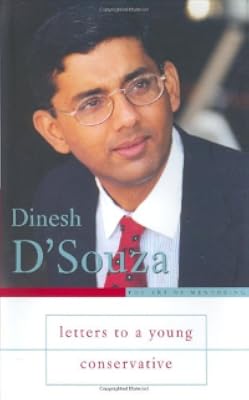
Dinesh D'Souza was born on April 25, 1961 in Mumbai, Maharashtra, India. He came to the U.S. in 1978 and attended Union High School in Patagonia, Arizona. He went on to Dartmouth College, where he graduated Phi Beta Kappa in English in 1983. While attending Dartmouth, he became the editor of a conservative monthly called The Prospect. The paper show more ignited controversy during D'Souza's editorship by criticizing the College's affirmative action policies. He also became known as a writer for the Dartmouth Review which was subsidized by several right-wing organizations. After Dartmouth he moved to Washington, D.C. where he was an editor of Policy Review, an influential conservative journal. In 1988 he left the magazine on to serve as an advisor in Ronald Regan's White House. He joined the American Enterprise Institute in 1989 where he was the institute's John M. Olin fellow. He has appeared on several news shows as a political commentator such as: CNN, Glen Beck, and ABC's Nightline. D'Souza's first book, Lliberal Education was published in 1991. Since then, he has written numerous bestselling political commentaries, including: America: Imagine a World Without Her, Obama's America: Unmaking the American Dream, Letters to a Young Conservative, The End of Racism, and The Big Lie: Exposing the Nazi Roots of the American Left. D'Souza's title's, Hilary's America and Death of a Nation, made the New York Times Bestseller List. (Bowker Author Biography) show less
Awards and Honors
Distinctions
Common Knowledge
- Important places
- USA
Classifications
Statistics
- Members
- 548
- Popularity
- 54,464
- Reviews
- 5
- Rating
- (3.65)
- Languages
- English, French
- Media
- Paper, Audiobook, Ebook
- ISBNs
- 10
- ASINs
- 5