Catching Fire: How Cooking Made Us Human
by Richard Wrangham
On This Page
Description
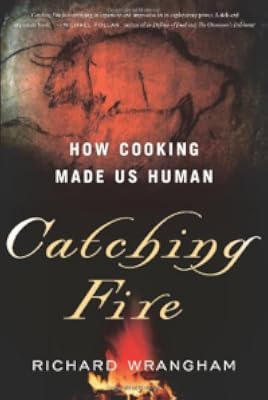
In this stunningly original book, renowned primatologist Richard Wrangham argues that "cooking" created the human race. At the heart of "Catching Fire" lies an explosive new idea: The habit of eating cooked rather than raw food permitted the digestive tract to shrink and the human brain to grow, helped structure human society, and created the male-female division of labor.Tags
Recommendations







Member Reviews
Catching fire is a gem with many interesting ideas about the influence of cooked food on human behavior. Its main flaw is that the author's plausible hypothesis that eating nutritious cooked food was the main trigger to human development (big brains, small guts) currently lacks any evidence to support it. A great theory in search of confirmation. Unfortunately, it will be difficult to find remains of fireplaces and cooked food of homo habilis two million years ago.
The book is filled with interesting observations about food, especially cooked food, and human behavior. Man the cooking ape is a great concept. Food, and especially man's hunger for cooked food, joins sex as one of evolution's driving forces. Highly recommended (hopefully, show more his hypothesis can soon be falsified or confirmed.). show less
The book is filled with interesting observations about food, especially cooked food, and human behavior. Man the cooking ape is a great concept. Food, and especially man's hunger for cooked food, joins sex as one of evolution's driving forces. Highly recommended (hopefully, show more his hypothesis can soon be falsified or confirmed.). show less
Plenty of food for thought (ha) and very well written to be readable yet scientifically persuasive. Found it a bit depressing when he talked about how women became slaves to the cooker (or fire) as they needed someone stronger to help them prevent their food being stolen. The housewife was born.
As I live in an area that is perhaps the world capital of raw food veganism, the contrarian in me just had to read How Cooking Made Us Human. [disclaimer: I'm naturally a quasi-vegetarian, although I eat plenty of fish, eggs & poultry] Wrangham's thesis is a fairly simple one: it's not "man" the hunter but rather "man" the fire-tender and cook who best explains the change from australopithecine (habiline)to human (homo erectus). As cooking increases the amount of energy our bodies obtain from food, less energy has to be expended in chewing and digesting raw foods, which allows us to have smaller intestines than our ancestors the great apes and frees up energy for our larger brains. ("Cooked food is better than raw food because life is show more mostly concerned with energy. So from an evolutionary perspective, if cooking causes a loss of vitamins or creates a few long-term toxic compounds, the effect is relatively unimportant compared to the impact of more calories.") Wrangham posits a secondary claim that is both intriguing and more debatable. He proposes cooking as the technical invention that "made possible one of the most distinctive features of human society: the modern form of the sexual division of labor." He goes on to say that while men have historically engaged in cooking when alone or for ceremonial purposes, domestic cooking has been an almost exclusively female activity. And it is to the dominant male's need to secure his source of cooked food and the physically "smaller and weaker" female's need for a "food guard" that we can attribute the advent of patriarchy. Thus, in the author's view, the advent of patriarchy dates not from the invention of agriculture roughly 10,000 years ago, but rather much earlier, at the very beginnings of our species. I find this argument a bit reductive as it fails to explain how human females came to be "smaller and weaker" in the first place. If sexual selection prompts humans of both sexes to choose the most evolutionarily fit and healthy members of the opposite sex for reproduction and if size and strength are accurate indicators of such fitness and health, then it would make sense that females would choose larger and stronger males as mates and that over time, size differences between the sexes would increase. However, wouldn't males also choose larger and stronger females as more reproductively fit with the result of equalizing size and strength between the genders? That said, I can't help finding some amusement in the author's statement that "females feed males to reward them for behaving well." How Cooking Made Us Human presents a strong argument for cooked food as THE cultural innovation that resulted in humans, while leaving some questions unanswered regarding the advent of patriarchy with its division of labor and attribution of social power and status according to gender. show less
This book offers a compelling case for the idea that cooking is the main reason why we evolved from australopithecines to Homo erectus and then to Homo sapiens. It challenges at several points the mainstream notion that meat-eating was a keystone of (at least some parts of) this evolution, for having comparatively limited explanatory power. Besides the anatomical changes it uses cooking to explain some things I wouldn't have expected, such as marriage and the sexual division of labor.
I thought the point was generally well-argued and at the same time the book provided enough interesting bits to keep a wide audience interested. There are plenty of anecdotes (favorite example: the author adds tough leaves to a raw goat meat meal to test show more that they make chewing easier), and many references to actual studies in the endnotes for the true nerds.
It has a problem that might be unavoidable in this kind of pop-sci book: there's always a lot of uncertainty in modern science (especially in something with as little archeological evidence as fire), but, because the author wants to make their case as persuasive as possible, diverging points tend to be omitted or minimized. As a result, it's sometimes hard to know what's well established and what's controversial. For example, a core point in the book (why is the human brain so unusually large?) relies on the expensive tissue hypothesis. The author does note that it's a hypothesis, but there's no exploration of why it's still one, or how accepted it is in the field. show less
I thought the point was generally well-argued and at the same time the book provided enough interesting bits to keep a wide audience interested. There are plenty of anecdotes (favorite example: the author adds tough leaves to a raw goat meat meal to test show more that they make chewing easier), and many references to actual studies in the endnotes for the true nerds.
It has a problem that might be unavoidable in this kind of pop-sci book: there's always a lot of uncertainty in modern science (especially in something with as little archeological evidence as fire), but, because the author wants to make their case as persuasive as possible, diverging points tend to be omitted or minimized. As a result, it's sometimes hard to know what's well established and what's controversial. For example, a core point in the book (why is the human brain so unusually large?) relies on the expensive tissue hypothesis. The author does note that it's a hypothesis, but there's no exploration of why it's still one, or how accepted it is in the field. show less
A rather narrow focus, but Wrangham does a great job of telling the story and methodically laying out the arguments.
Intuitively Wrangham's thesis makes a lot of sense, and he does a decent job laying out research that supports his thesis. I suspect that it's not quite that simple, but I found persuasive his account of the nutritional benefits of cooking. His relation of this to evolutionary time is a bit sketchy, but seems plausible.
A lot of male blurbers extolled this as utterly fresh; I daresay that had it been written by a woman it would have been outright ignored rather than so fulsomely praised. See, e.g., Sarah Blaffer Hrdy, whose similar re-conceptions of 'what makes us human' continue to get relatively short shrift in the usual evolutionary psych circles. Given the primacy of gendered labor divisions in Wrangham's thinking, I have to wonder show more what an explicitly feminist scholar might make of it. One can't help but think, for instance, that since (in Wrangham's thinking) cooking led to these gendered labor divisions, is sexism what 'makes us human'? I think the root causes of gendered labor divisions are probably more complex than that, as are the things that 'make us human'.
Recommended for an interesting, quick read and a fresh take on human evolution. show less
A lot of male blurbers extolled this as utterly fresh; I daresay that had it been written by a woman it would have been outright ignored rather than so fulsomely praised. See, e.g., Sarah Blaffer Hrdy, whose similar re-conceptions of 'what makes us human' continue to get relatively short shrift in the usual evolutionary psych circles. Given the primacy of gendered labor divisions in Wrangham's thinking, I have to wonder show more what an explicitly feminist scholar might make of it. One can't help but think, for instance, that since (in Wrangham's thinking) cooking led to these gendered labor divisions, is sexism what 'makes us human'? I think the root causes of gendered labor divisions are probably more complex than that, as are the things that 'make us human'.
Recommended for an interesting, quick read and a fresh take on human evolution. show less
Wrangham's premise is fascinating: he believes that cooking food is not merely a side-effect of human evolution, but a necessary condition for it -- only when our ancestors learned to cook, were they able to process enough calories to support our energy-hungry brains. Further, he says, the domestication of fire allowed early pre-humans to safely descend from the trees, and encouraged social behavior.
Wrangham's writing is highly accessible, and he uses evidence from a wide range of fields to support his thesis: nutrition, anthropology, archeology, etc. He doesn't over-labor his ideas, either -- it takes only around 200 pages from the first page to the endnotes.
Wrangham's writing is highly accessible, and he uses evidence from a wide range of fields to support his thesis: nutrition, anthropology, archeology, etc. He doesn't over-labor his ideas, either -- it takes only around 200 pages from the first page to the endnotes.
Members
- Recently Added By
Published Reviews
ThingScore 100
More of a discussion than a review, but some review commentary: In “Catching Fire” he has delivered a rare thing: a slim book — the text itself is a mere 207 pages — that contains serious science yet is related in direct, no-nonsense prose. It is toothsome, skillfully prepared brain food.
added by lquilter
Lists

Read These Too
458 works; 9 members

Reading list
170 works; 1 member

The Joe Rogan Experience Library
254 works; 3 members

Mind Expanding Books by hackerkid
581 works; 8 members

Books Cited in Blueprint by Nicholas Christakis
261 works; 1 member
Author Information

7+ Works 1,577 Members
Richard Wrangham is the Ruth Moore Professor of Biological Anthropology at Harvard University. He is coauthor of Demonic Males, and has been featured on NPR and in the Boston Globe, New Scientist, and Scientific American. he lives in Cambridge, Massachusetts.
Some Editions
Awards and Honors
Common Knowledge
- Canonical title*
- L'intelligenza del fuoco. L'invenzione della cottura e l'evoluzione dell'uomo
- Original title
- Catching Fire: How Cooking Made Us Human
- Original publication date
- 2009
- Epigraph
- [Fire] provides us warmth on cold nights; it is the means by which they prepare their food, for they eat nothing save a few fruits ... the Andamanese believe it is the possession of fire that makes human beings what they are ... (show all)and distinguishes them from animals. -- A. R. Radcliffe-Brown, The Andaman Islanders: A Study in Social Anthropology (epigraph to introduction, p.1)
- First words
- The question is old: Where do we come from?
- Quotations
- Although the australopithecines were far different from us, in the big scheme of things they lived not so long ago. Imagine going to a sporting event with sixty thousand seats around the stadium. You arrive early with your gr... (show all)andmother, and the two of you take the first seats. Next to your grandmother sits her grandmother, your great-great-grandmother. The stadium fills with the ghosts of preceding grandmothers. An hour later the seat next to you is occupied by the last to sit down, the ancestor of you all. ... She is your ancestor and an australopithecine, hardly a companion your grandmother can be expected to enjoy. She grabs an overhead beam and swings away over the crowd to steal some peanuts from a vendor. (Introduction, pp. 2-3)
- Last words
- (Click to show. Warning: May contain spoilers.)We must find ways to make our ancient dependence on cooked food healthier.
- Blurbers
- Pollan, Michael; Pinker, Steven; Aiello, Leslie C.; Symons, Michael; Humphrey, Nicholas; Trivers, Robert (show all 12); Ridley, Matt; Raichlen, Steven; Haber, Barbara; Pilbeam, David; Foley, Robert; Fernandez-Armesto, Felipe
- Original language
- English
*Some information comes from Common Knowledge in other languages. Click "Edit" for more information.
Classifications
- Genres
- Anthropology, Science & Nature, Nonfiction, General Nonfiction, Food & Cooking, History
- DDC/MDS
- 394.12 — Society, government, & culture Customs, etiquette & folklore General customs Eating, drinking, using drugs Eating and drinking
- LCC
- GN799 .F6 .W73 — Geography, Anthropology and Recreation Anthropology Anthropology Prehistoric archaeology
- BISAC
Statistics
- Members
- 982
- Popularity
- 26,873
- Reviews
- 32
- Rating
- (3.86)
- Languages
- 10 — Dutch, English, Finnish, German, Greek, Italian, Polish, Portuguese, Russian, Spanish
- Media
- Paper, Audiobook, Ebook
- ISBNs
- 20
- UPCs
- 1
- ASINs
- 16