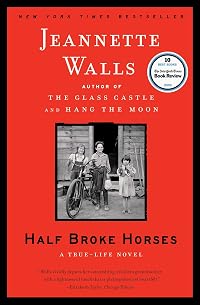
Half Broke Horses
by Jeannette Walls
On This Page
Description
A true-life novel about Lily Casey Smith (the author's grandmother) who at age six helped her father break horses, at age fifteen left home to teach in a frontier town, and later as a wife and mother runs a vast ranch in Arizona where she survived tornadoes, droughts, floods, the Great Depression, and the most heartbreaking personal tragedy--but despite a life of hardscrabble drudgery still remains a woman of indomitable spirit.Tags
Recommendations



Member Recommendations
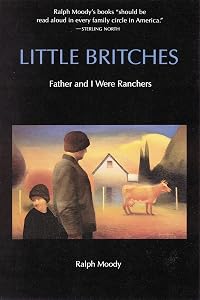
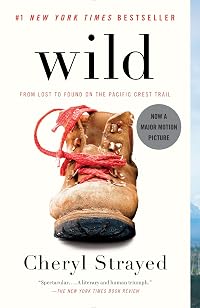
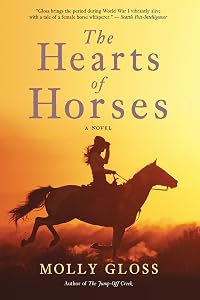
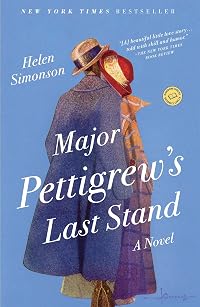
SunnySD If you enjoyed Jeannette Walls' tale of her grandmother's adventures, but wish it had been nonfiction, Wilkin's journey across country with her four-footed companions will be right up your alley.
11
Member Reviews
The book begins with a flood. Literally, on the first page a flash flood threatens the lives of three young children in Texas. From that second on the book completely hooked me. This addictive read is a “real life novel” from the author of The Glass Castle (which I loved). Her first book chronicled her own unconventional childhood. This book tells her grandma Lily’s story.
It’s a “novel” because she allows Lily’s voice to tell the story and doesn’t question the amazing stories that have been passed down orally in her family. The style is perfect and I think it would have felt stilted and forced if written in any other way. Lily is a spitfire and led one hell of a life. It’s rare for me to feel so completely sucked in show more to a nonfiction book. I had a hard time putting it down, because there was no end to the trials Lily faced. Her life reads like a movie.
Whenever she decided she wanted something, she just rolled up her sleeves and made it happen. She didn’t shy away from hard work, but she also never became complacent in her life and settled for what she had. Her strong personality was off-putting to many people in her life, but that never stopped her. She stood her ground regardless of public opinion. She was determined, brave and a fierce advocate for her children.
“I realized that you can get so used to certain luxuries that you start to think they’re necessities, but when you have to forgo them, you come to see that you don’t need them after all.”
If you’ve already read The Glass Castle (definitely not a necessary thing to do before reading this) you’ll be interested to learn more about the author’s mother Rosemary. This book explains her upbringing, which sheds a lot of light on why she turned out like she did. It’s not a perfect book, but I loved it. So whether you’re interested in learning more about their family or just want a great story, read this!
The book is packed with too many great one-liners to mention, but here are a few of my favorites…
"The only difference between a traitor and a patriot is your perspective."
“If you want to be reminded of the love of the Lord, Mom always said, just watch the sunrise. And if you want to be reminded of the wrath of the Lord, Dad said, watch a tornado.”
“Some times after I finished a particularly good book, I had the urge to get the library card, find out who else had read the book, and track them down to talk about it.” show less
It’s a “novel” because she allows Lily’s voice to tell the story and doesn’t question the amazing stories that have been passed down orally in her family. The style is perfect and I think it would have felt stilted and forced if written in any other way. Lily is a spitfire and led one hell of a life. It’s rare for me to feel so completely sucked in show more to a nonfiction book. I had a hard time putting it down, because there was no end to the trials Lily faced. Her life reads like a movie.
Whenever she decided she wanted something, she just rolled up her sleeves and made it happen. She didn’t shy away from hard work, but she also never became complacent in her life and settled for what she had. Her strong personality was off-putting to many people in her life, but that never stopped her. She stood her ground regardless of public opinion. She was determined, brave and a fierce advocate for her children.
“I realized that you can get so used to certain luxuries that you start to think they’re necessities, but when you have to forgo them, you come to see that you don’t need them after all.”
If you’ve already read The Glass Castle (definitely not a necessary thing to do before reading this) you’ll be interested to learn more about the author’s mother Rosemary. This book explains her upbringing, which sheds a lot of light on why she turned out like she did. It’s not a perfect book, but I loved it. So whether you’re interested in learning more about their family or just want a great story, read this!
The book is packed with too many great one-liners to mention, but here are a few of my favorites…
"The only difference between a traitor and a patriot is your perspective."
“If you want to be reminded of the love of the Lord, Mom always said, just watch the sunrise. And if you want to be reminded of the wrath of the Lord, Dad said, watch a tornado.”
“Some times after I finished a particularly good book, I had the urge to get the library card, find out who else had read the book, and track them down to talk about it.” show less
Loved loved loved it. I'm a simple gal--I want a good story, told in an interesting voice, with at least one likable character. Bonus points for not trying to make me cry. This book, told in the first person, was full of great characters, dialog was always good and believable, and even events that were actually pretty tragic were told in that no-nonsense voice rather than milking them for drama. yay!
I've seen this described as Little House for adults, and that has some validity. I'd say there's a better connection with Caddie Woodlawn. Lily Casey is who I wish I was. Had the book been wholly fiction, it might have seemed a bit thin, but she's such a dynamic character that I'd likely have enjoyed it just the same.
Review Haiku:
Hearse full show more of schoolkids?
It's just their bus, don't worry
No dead kids! It's safe. show less
I've seen this described as Little House for adults, and that has some validity. I'd say there's a better connection with Caddie Woodlawn. Lily Casey is who I wish I was. Had the book been wholly fiction, it might have seemed a bit thin, but she's such a dynamic character that I'd likely have enjoyed it just the same.
Review Haiku:
Hearse full show more of schoolkids?
It's just their bus, don't worry
No dead kids! It's safe. show less
I am so glad I picked this up at the library. I loved Jeanette Walls' book [The Glass Castle]. She is a wonderful storyteller. The subject of this novel is her maternal grandmother, Lily Casey Smith. What a woman! Although I am certain there is the usual memoir-ish embellishment of the character, Walls said that many of the stories were confirmed by a variety of sources. She called it a novel because she didn’t hear the stories first hand and did use fictional happenings to connect the events for a smoother presentation. It is a quick read and fun to learn about 1930's and 40's culture in the US Western states. The majority of the book takes place on ranches in Arizona and reveals a strong-headed woman with an equally strong, but more show more mellow husband playing out their dreams together. The word persistence echoes throughout the narrative and leaves the reader inspired and satisfied with a well-told tale. This could be considered a prequel to The Glass Castle, which Walls wrote first. It is fun to get to know the back story of the mother and father portrayed in the Glass Castle, but I don’t think it matters what order you read the books as each stands very well on its own. show less
I remember reading years back Jeannette Walls' first book, her memoir, GLASS CASTLE, and enjoying it greatly. It was a huge bestseller, and, I think, a movie too. HALF BROKE HORSES is neither a memoir nor a biography. Instead it's a novel based on the life of her grandmother, Lily Casey Smith, born at the turn of the last century, who grew up wild on western ranches in Texas and Arizona, where her father, half crippled, and with a speech impediment, carved a life out of training carriage horses. Lily loved horses, but she also loved learning, and got a teaching certificate at a young age and taught in tiny one-room schools, often clashing with administrators and moving on. Her story continues through the Great Depression and prohibition show more years. After one ill-fated early marriage (he was already married, with kids) in Chicago, in Arizona she marries a man twenty years older, has a couple of kids, goes back to college, helps her husband run a business, then a ranch, sells a little hooch on the side to make ends meet (and carries a gun), teaches some more, learns to drive - and to fly - moves to the city, then back to the country. Sends her kids off to boarding school. Watches her kids grow up and marry. I mean this is a woman's whole LIFE, and there's a LOT going on here. Remember I said I loved Walls' first book? Well ditto this one. Jeannette Walls is one helluva story teller. My highest recommendation.
- Tim Bazzett, author of the memoir, BOOKLOVER show less
- Tim Bazzett, author of the memoir, BOOKLOVER show less
What a wonderful life! Lily Casey grew up in the Southwest during the early 1900s. She was raised on various hard-scrabble homesteads and being a fast learner, she quickly grasped ranching, breaking horses and basic farming. Her natural smarts and love of books, led her to a teaching career, which included locking horns with the creepy head of a Polygamist sect. She also raced horses, played a mean hand of poker, dabbled in bootlegging, flew airplanes and drove a western taxi, which was a converted hearse. This is called a true-life novel and the author Jeanette Walls, who penned the acclaimed memoir The Glass Castle, based this story on her maternal grandmother. It’s crisply and vividly written. This brief dialogue captures Lily’s show more grit. She is taking a couple New York ladies to the Grand Canyon, in the “taxi”, when Lily rolls the car. No one is hurt but the ladies are understandably upset:
“Youse almost got us kilt!”
And Lily’s reply- “All that’s happened to you is that you’ve had the lace knocked off your panties. Instead of carrying on, you should be thanking me, because my driving skills just saved all your necks. You ride, you got to know how to fall, and you drive, you got to know how to crash.” show less
“Youse almost got us kilt!”
And Lily’s reply- “All that’s happened to you is that you’ve had the lace knocked off your panties. Instead of carrying on, you should be thanking me, because my driving skills just saved all your necks. You ride, you got to know how to fall, and you drive, you got to know how to crash.” show less
This was a Christmas present, and I knew Walls' name from several friends having recommended The Glass Castle (though I still haven't gotten around to reading that one yet).
Walls' grandmother, Lily Casey Smith, was more of a character than any writer could make up. (Details, though, did have to be fabricated out of necessity; thus the fiction and non-fiction shelf labels.) The book has a strong, distinctive voice: Smith was tough as nails, unsentimental, and opinionated. Walls does a nice job communicating Smith's flaws, especially in parenting, without having the character come out and admit to being wrong.
But Smith's flaws aren't nearly as important to the story as her gumption and the gumption of her family members. It's that show more wild-headed acumen of hers - and the situations it gets her into and out of - that makes this an irresistible read. show less
Walls' grandmother, Lily Casey Smith, was more of a character than any writer could make up. (Details, though, did have to be fabricated out of necessity; thus the fiction and non-fiction shelf labels.) The book has a strong, distinctive voice: Smith was tough as nails, unsentimental, and opinionated. Walls does a nice job communicating Smith's flaws, especially in parenting, without having the character come out and admit to being wrong.
But Smith's flaws aren't nearly as important to the story as her gumption and the gumption of her family members. It's that show more wild-headed acumen of hers - and the situations it gets her into and out of - that makes this an irresistible read. show less
I remember reading Jeannette Walls memoir, The Glass Castle, teary-eyed at the life she and her siblings led at the hands of her alcoholic father and totally useless mother, fending for themselves because the parents who could provide for them chose not to. Walls new book, Half-Broke Horses, described as a true-life novel, tells the story of Walls’ grandmother, a gritty, tenacious, unsentimental, harsh woman. There were no tears here just many thoughts of “Who would do that?” or “Who would let their child do that?”
We meet Lily Casey when she is ten years old and she and her brother and sister climb a tree to escape the suddenly raging flood waters, and hang on up there through the night until they are able to climb down and show more return home where their parents’ prayers have been answered by their safe return. Her mother tries to take the credit for their survival because she prayed all night but Lily will have none of it:
“The way I saw it, I was the one who’d saved us all, not Mom and not some guardian angel. No one was up in that cottonwood tree except the three of us. I started explaining how I’d gotten us to the cottonwood tree in time, figuring out how to switch places when our arms got tired and keeping Buster and Helen awake through the long night by quizzing them.”
And so begins the tale of Lily Casey’s life, filled with one dramatic rescue after another; one daring escapade only to be topped by the next one; a continual line of spineless characters, put in their place by the overbearing Lily. You soon begin to realize that, in her opinion, she’s good at anything and everything she tries. And try she does, because living in the southwest desert of the United States in the 1930’s and 40’s was a true pioneer experience. This is the West when the West was still rough: we follow Lily as she is allowed by her parents to take on responsibilities usually reserved for adults such as, breaking horses, bartering with a store owner over the price of eggs, gelding horses (yikes!), and other incidents that prepare her for what turns out to be her initiation into adulthood at the age of 15: she is hired as an itinerant teacher for a school 500 miles away and the only way to get there is on her horse. It takes four weeks, which Lily takes in stride since Dad supplies her with a pearl-handled six shooter.
From there the book goes on to explore Lily’s life as a young teacher, her brief time in Chicago, her marriage to Jim Smith and the birth of her children and her experiences as a mother. Towards the end of the book, her daughter Rosemary is highlighted as is the man she marries, Rex Walls. The author lets us know that Lily predicted the life that Rosemary ended up living which was brought to life in Jeannette Walls’ memoir. Through it all, Lily’s tenacity and strong-willed spirit shines through and although I really didn’t like this character much, I had to admire her grit, perseverance and fortitude. The author is just such a great storyteller that it is easy to ignore Lily’s less desirable characteristics and just be carried along by the narrative. Along the way you meet many, many other eccentric, quirky characters. Highly recommended. show less
We meet Lily Casey when she is ten years old and she and her brother and sister climb a tree to escape the suddenly raging flood waters, and hang on up there through the night until they are able to climb down and show more return home where their parents’ prayers have been answered by their safe return. Her mother tries to take the credit for their survival because she prayed all night but Lily will have none of it:
“The way I saw it, I was the one who’d saved us all, not Mom and not some guardian angel. No one was up in that cottonwood tree except the three of us. I started explaining how I’d gotten us to the cottonwood tree in time, figuring out how to switch places when our arms got tired and keeping Buster and Helen awake through the long night by quizzing them.”
And so begins the tale of Lily Casey’s life, filled with one dramatic rescue after another; one daring escapade only to be topped by the next one; a continual line of spineless characters, put in their place by the overbearing Lily. You soon begin to realize that, in her opinion, she’s good at anything and everything she tries. And try she does, because living in the southwest desert of the United States in the 1930’s and 40’s was a true pioneer experience. This is the West when the West was still rough: we follow Lily as she is allowed by her parents to take on responsibilities usually reserved for adults such as, breaking horses, bartering with a store owner over the price of eggs, gelding horses (yikes!), and other incidents that prepare her for what turns out to be her initiation into adulthood at the age of 15: she is hired as an itinerant teacher for a school 500 miles away and the only way to get there is on her horse. It takes four weeks, which Lily takes in stride since Dad supplies her with a pearl-handled six shooter.
From there the book goes on to explore Lily’s life as a young teacher, her brief time in Chicago, her marriage to Jim Smith and the birth of her children and her experiences as a mother. Towards the end of the book, her daughter Rosemary is highlighted as is the man she marries, Rex Walls. The author lets us know that Lily predicted the life that Rosemary ended up living which was brought to life in Jeannette Walls’ memoir. Through it all, Lily’s tenacity and strong-willed spirit shines through and although I really didn’t like this character much, I had to admire her grit, perseverance and fortitude. The author is just such a great storyteller that it is easy to ignore Lily’s less desirable characteristics and just be carried along by the narrative. Along the way you meet many, many other eccentric, quirky characters. Highly recommended. show less
Members
- Recently Added By
Published Reviews
ThingScore 75
The pert style of “Half Broke Horses” is much more repetitive and grating than the more spontaneous-sounding voice Ms. Walls used to describe her own life.
But the author comes from a family that knew how to lure horses using grain, not rope. And she has inherited a version of that skill. So she has managed to make her second book almost as inviting as her first, even though its upright show more heroine is never as startling as Ms. Walls’s parents were. show less
But the author comes from a family that knew how to lure horses using grain, not rope. And she has inherited a version of that skill. So she has managed to make her second book almost as inviting as her first, even though its upright show more heroine is never as startling as Ms. Walls’s parents were. show less
added by Shortride
Lists

Favorite books I've read
7 works; 4 members

Best books read in 2011
200 works; 51 members

Carole's List
445 works; 13 members

Books Read in 2010
631 works; 11 members

Best Family Stories
241 works; 22 members

Fictional Biographies
17 works; 3 members

Biggest Disappointments
606 works; 168 members
Animals in the Title
498 works; 11 members

To Read
617 works; 7 members
Literary Travelogue of the United States Challenge
133 works; 6 members

Tagged Great Depression
23 works; 3 members

Five star books
1,767 works; 110 members

Indie Next Picks
196 works; 4 members
Deena's Favorites--How Many have you read?
102 works; 3 members
Talk Discussions
Past Discussions
Half Broke Horses in Westerns by Women (May 2010)
Author Information

12+ Works 31,873 Members
Jeannette Walls was born in Phoenix, Arizona on April 21, 1960. She graduated from Barnard College and was a journalist in New York City for twenty years. Her books include a memoir entitled The Glass Castle and several novels including Half Broke Horses and The Silver Star. (Bowker Author Biography)
Awards and Honors
Awards
Series
Belongs to Publisher Series
Reclams Universal-Bibliothek (19866)
Work Relationships
Is contained in
Is abridged in
Reader's Digest Select Editions 2010 v03 #309: Winter Garden / The Poacher's Son / A Thread So Thin / Half Broke Horses by Reader's Digest
Common Knowledge
- Original publication date
- 2009-10-06
- People/Characters
- Lily Casey; Buster Casey; Helen Casey; Adam Casey; Sister Albertina; "Big Jim" Smith (show all 17); Billy the Kid; Minnie Hanagan; Ted Conover; Orville Stubbs; Rosemary Smith Walls; Blackie Camel; Fidel Hanna; Clarice Pearl; Marion Finch; Rex Walls; Jeannette Walls
- Important places
- Texas, USA; Red Lake, Arizona, USA
- Epigraph
- It was the great north wind that made the Vikings.
—Old Norwegian saying - Dedication
- This book is dedicated
to all teachers,
and especially to
Rose Mary Walls,
Phyllis Owens, and
Esther Fuchs
And in memory of
Jeannette Bivens and
Lily Casey Smith - First words
- Those old cows knew trouble was coming before we did.
- Quotations
- I never met a kid I couldn't teach. Every kid was good at something, and the trick was to find out what it was, then use it to teach him everything else.
- Last words
- (Click to show. Warning: May contain spoilers.)I had a few thing to teach those kids, and there wasn't a soul alive who could stop me.
Classifications
Statistics
- Members
- 5,262
- Popularity
- 2,589
- Reviews
- 242
- Rating
- (3.97)
- Languages
- 6 — Chinese, Danish, English, French, German, Spanish
- Media
- Paper, Audiobook, Ebook
- ISBNs
- 53
- ASINs
- 26
