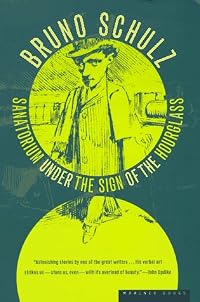
Sanatorium Under the Sign of the Hourglass
by Bruno Schulz
On This Page
Description
This is the second and final work of Bruno Schulz, the acclaimed Polish writer killed by the Nazis during World War II. In the words of Isaac Bashevis Singer, "What he did in his short life was enough to make him one of the most remarkable writers who ever lived." Weaving myth, fantasy, and reality, Sanatorium Under the Sign of the Hourglass, is, to quote Schulz, "an attempt at eliciting the history of a certain family . . . by a search for the mythical sense, the essential core of that show more history." show lessTags
Recommendations






















Member Reviews
Bruno Schulz was a writer of crepuscular fantasy who sometimes feels like a kinder Ligotti. He got no kindness out of life in the end, being deliberately murdered by a Gestapo officer (Schulz was a Polish Jew) on his way back to the Drohobycz Ghetto in 1942.
This particular novella is, like all his work, hard to get a fix on. The writer takes a train to a sanatorium where his father sits literally, it would seem, in a state between life and death and he too finds himself in transit eventually, also in a state that might be somewhere between the two.
This is not a story from which you should expect any firmness or clarity. It has all the quality of a lucid dream. Indeed, I cannot think of any writer as good as Schulz in reproducing dream show more states. I suspect that for many readers its imagery will prey on the mind for a while after finishing the tale.
What it means is less certain. Perhaps the point is that, as pure literature, there is no point in trying to find any meaning or perhaps there are multiple layers of meaning as one might find in a dream. My suspicion is that the meaning lies in the lack of coherent meaning.
The imaginative skill of Schulz is impressive if only for the restraint he shows in not trying to hint at meaning. It is a story to let flow over you and be a little disturbed by. It does seem to be about death and loss in some way - there is a grieving in this story which is more than just sadness. show less
This particular novella is, like all his work, hard to get a fix on. The writer takes a train to a sanatorium where his father sits literally, it would seem, in a state between life and death and he too finds himself in transit eventually, also in a state that might be somewhere between the two.
This is not a story from which you should expect any firmness or clarity. It has all the quality of a lucid dream. Indeed, I cannot think of any writer as good as Schulz in reproducing dream show more states. I suspect that for many readers its imagery will prey on the mind for a while after finishing the tale.
What it means is less certain. Perhaps the point is that, as pure literature, there is no point in trying to find any meaning or perhaps there are multiple layers of meaning as one might find in a dream. My suspicion is that the meaning lies in the lack of coherent meaning.
The imaginative skill of Schulz is impressive if only for the restraint he shows in not trying to hint at meaning. It is a story to let flow over you and be a little disturbed by. It does seem to be about death and loss in some way - there is a grieving in this story which is more than just sadness. show less
As a whole, I did not find this to be quite as strong as Schulz's first collection, The Street of Crocodiles. The main issue holding back that half star in my rating was the longest story, "Spring," which did not resonate with me. Though it had its moments, overall the premise was too fanciful in a way that kept losing my interest (sorry I can't be more specific than that). However, the remainder of the collection was more in line with what I love about Schulz: dreamy prose highly tuned into nature and the passage of time, peppered with quirky humor and an exquisite pathos. Loosely arranged as a movement through the seasons, both literally and metaphorically, the collection pairs well with Street of Crocodiles, and in fact the two were show more combined with a few of his uncollected stories into a later Penguin edition, which also includes Schulz's original drawings, providing a wondrous enhancement of his fictional universe. Highly recommended. show less
It might be fair to say that this is the weaker of Schulz' two collections; that is, it is not 100% consistently mind-blowing. Perhaps only 90-98%. Schuz' prose has the quality of being downright intoxicating. His tales all deal with his family and life in his hometown, but the incandescent profusion of language and imagery reveals the transcendent behind the ordinary.
The first three stories feature an obsession with texts, starting with The Book of the story by that name, in which the Authentic is regenerated, and finishing with the strange season of "Spring," in which a stamp album holds the secrets to the Hapsburg dynasty and a youthful love triangle.
In the title story, the narrator visits his father at a convalescent home, where show more death is kept at bay through entrechment in the past. As the not-days progress, he soon learns that he is living in recycled time.
"The Old Age Pensioner" and "Father's Last Escape" are haunting portrayals of the metamorphosis of old age and its approach to the final transmutation of death.
Schulz wrote like no one else, and his fantasies of the everyday are worth getting lost in. show less
The first three stories feature an obsession with texts, starting with The Book of the story by that name, in which the Authentic is regenerated, and finishing with the strange season of "Spring," in which a stamp album holds the secrets to the Hapsburg dynasty and a youthful love triangle.
In the title story, the narrator visits his father at a convalescent home, where show more death is kept at bay through entrechment in the past. As the not-days progress, he soon learns that he is living in recycled time.
"The Old Age Pensioner" and "Father's Last Escape" are haunting portrayals of the metamorphosis of old age and its approach to the final transmutation of death.
Schulz wrote like no one else, and his fantasies of the everyday are worth getting lost in. show less
"Now at last one can understand the great and sad machinery of spring. Ah, how it thrives on stories, on events, on chronicles, on destinies! Everything we have ever read, all the stories we have heard and those we have never heard before but have been dreaming since childhood — here and nowhere else is their home and their motherland. Where would writers find their ideas, how would they muster the courage for invention, had they not been aware of these reserves, this frozen capital, these funds salted away in the underworld?"
It looks like Schulz thought of 'The Well of Lost Plots' before Fforde. This is a collection of short stories by the author of The Street of Crocodiles and was written in the Thirties. Patchier than Crocodiles, show more but it has some good stories featuring the father. In various stories he : goes mad, turns into an invertebrate, turns into a door lintel, and joins the Fire Brigade. Schulz weaves fantastical stories from the mundane and ordinary. Events, people, buildings, even the seasons become living things; nights are alive, and the line between existence and non-existence can be crossed and re-crossed. Schulz was a one-off. show less
It looks like Schulz thought of 'The Well of Lost Plots' before Fforde. This is a collection of short stories by the author of The Street of Crocodiles and was written in the Thirties. Patchier than Crocodiles, show more but it has some good stories featuring the father. In various stories he : goes mad, turns into an invertebrate, turns into a door lintel, and joins the Fire Brigade. Schulz weaves fantastical stories from the mundane and ordinary. Events, people, buildings, even the seasons become living things; nights are alive, and the line between existence and non-existence can be crossed and re-crossed. Schulz was a one-off. show less
I read this book, which I've owned since the 70s, for the Reading Globally group read on Poland. It's difficult for me to know what to say about Schulz. His writing is often surreal and fantastical, and at the same time he very deeply observes the natural biological and meteorological world around him, and invests these elements with such power that the natural world almost is more of a character than the people. His writing is also very dense, almost claustrophobic in places, and he has a desolate view of the world. Nonetheless, I found some of the stories quite remarkable, including the title story, "Spring," "A Second Fall," and "Dead Season." My edition is also enlivened with sketches by the author to accompany some of the stories
As I couldn't remember this book at all, I reread it and now I get it why I forgot it so completely. It's beautiful - it's a bit like reading a very long and mysterious poem in prose, but it was a book about nothing. There are some eccentric members of family, some strange neighbours, some more or less important objects, some half-cooked love story, a bit of magic - all this mixed togethed and served in a wonderful poem-prose. I've just finished reading it and I already don't remember most of it.
Definitely not for me and I'm not going to read this book ever again.
Definitely not for me and I'm not going to read this book ever again.
Not until I was more than halfway through the book did its power begin to exert itself, which might simply mean that the stories (and they are stories, which I hadn't realized at first, since the old edition I was reading seemed to present it as a novel with titled chapters) are arranged best last, or that one needs to adjust to the apparently dilatory and whimsical nature of the writing. The story "Loneliness," which is translated also as "Solitude" -- not at all the same thing! -- deserves five stars, as may the last story, though that one is perhaps too evidently influenced by Kafka, whom Schulz admired immensely.
So taken with the stories, eventually, was I that I now have them in another translation along with the Street of show more Crocodiles story collection and other writings in a single volume, at GoodReads here:
http://www.goodreads.com/book/show/1485379.Sanatorium_Under_the_Sign_of_the_Hour...
All of this seems to have been put on this site:
http://www.schulzian.net/index.htm
by a different translator, though the actual book is nice and the translator for all is listed as Celina Wieniewska, whose translation I found invisible yet attractive.
In summary, Bruno Schulz bears persisting and taking your time. show less
So taken with the stories, eventually, was I that I now have them in another translation along with the Street of show more Crocodiles story collection and other writings in a single volume, at GoodReads here:
http://www.goodreads.com/book/show/1485379.Sanatorium_Under_the_Sign_of_the_Hour...
All of this seems to have been put on this site:
http://www.schulzian.net/index.htm
by a different translator, though the actual book is nice and the translator for all is listed as Celina Wieniewska, whose translation I found invisible yet attractive.
In summary, Bruno Schulz bears persisting and taking your time. show less
Members
- Recently Added By
Lists

Harold Bloom - The Western Canon: D. The Chaotic Age
833 works; 24 members
Author Information

46+ Works 3,925 Members
Some Editions
Awards and Honors
Awards
Notable Lists
Series
Belongs to Publisher Series
Work Relationships
Is contained in
Contains
Has the adaptation
Is abridged in
Common Knowledge
- Canonical title
- Sanatorium Under the Sign of the Hourglass
- Original title
- Sanatorium pod klepsydrą
- Original publication date
- 1937 (original Polish publication) (original Polish publication); 1978 (first American publication) (first American publication)
- Important places
- Poland
- Epigraph*
- Voor Jozefina Szelinska
- First words
- I am simply calling it The Book without any epithets or qualifications, and in this sobriety there is a shade of helplessness, a silent capitulation before the vastness of the transcendental, for no word, no allusion, can ade... (show all)quately suggest the shiver of fear, the presentiment of a thing without name that exceeds all our capacity for wonder.
- Quotations
- For, under the imaginary table that separates me from my readers, don't we secretly clasp each other's hands?
- Original language
- Polish
- Disambiguation notice
- Translation of: Sanatorium pod klepsydra
*Some information comes from Common Knowledge in other languages. Click "Edit" for more information.
Classifications
- Genres
- General Fiction, Fiction and Literature
- DDC/MDS
- 891.8537 — Literature & rhetoric Asian Literature East Indo-European and Celtic literatures West and South Slavic languages (Bulgarian, Slovene, Polish, Czech, Slovak, Serbo-Croatian, and Macedonian) Polish Polish fiction 1919–1989
- LCC
- PG7158 .S294 — Language and Literature Slavic languages and literatures. Baltic languages. Albanian language Slavic. Baltic. Albanian Slavic Polish
- BISAC
Statistics
- Members
- 696
- Popularity
- 40,774
- Reviews
- 12
- Rating
- (4.34)
- Languages
- 12 — Danish, Dutch, English, Estonian, French, German, Lithuanian, Polish, Portuguese (Portugal), Russian, Spanish, Swedish
- Media
- Paper, Ebook
- ISBNs
- 27
- UPCs
- 1