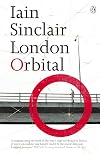
London Orbital
by Iain Sinclair
On This Page
Description
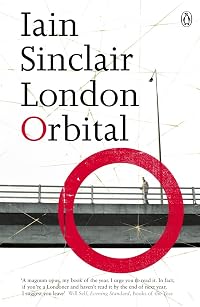
In this volume Iain Sinclair sets out to map the vast stretch of urban settlement outside London bounded by the M25. His long journeys - from the Lea Valley to Uxbridge, from Staines to South Mimms - are flanked by the black clouds of smoke from burning carcasses as the foot and mouth panic takes hold. Here he uncovers a history of forgotten villages, suburban utopias and hellish asylums, now transformed into upmarket housing, all the while walking a disappearing landscape, as the show more countryside is engulfed by commerce. show lessTags
Recommendations















Member Recommendations




Member Reviews
What a discovery. if anybody had told me that a book could make we want to explore the M25, I would have thought they were mad. But this book did. Sinclair, on the surface seems to be cynicism personified, but this book is imbued with an affection and love for the sub-ordinary found in the secret and not-so-secret places surrounding London. Very funny, full of information and insight, a real pleasure to read.
Paperback. Pub Date: 2003 Pages: 592 Publisher: Penguin A illiant the Voyage of Discovery into the deeply unfashionable fringes of London. 'It is not often that one reads a book and is convinced that it's an instant classic but I 'm sure that London Orbital will be read 50 years from now. This account of his walk around the M25 is on one level a journey into the heart of darkness. that terrain of golf courses. retail parks and industrial estates which is Blair's itain. It's a fascinating snapshot of who we are. lit by Sinclair's vivid prose. and on another level a warning that the mythological England of village greens and cycling aunts has been buried under the rush of a million radial tyres' - JG Ballard. Observer.Contents : show more Prejudices declare; soothing the seething - up the Lea Valley with Bill Drummond (and the Unabomber); Paradise Gardens - Waltham Abbey to Shenley; Col... show less
Iain Sinclair's extended anti-Millenium Dome ramble should certainly be recognised as an imaginative form of protest march. Disguised as a grumpy old man complaining about a younger generation's flawed vision of the future he sets forth to exorcise his temper by circling London in close proximity to its orbital belt of the M25 motorway.
He hops from suburban asylum to industrial edgeland with equal enthusiasm. In close keeping with his adopted character he condemns the vast out of town shopping centres and the manufactured estates of new ticky-tacky houses. And in the end as a final self-sacrificing gesture he trecks from the fringe, through his beloved but bespoiled Hackney, to a riverside viewing point to cast his furious but becalmed show more eyes on the object of his anti-worship. show less
He hops from suburban asylum to industrial edgeland with equal enthusiasm. In close keeping with his adopted character he condemns the vast out of town shopping centres and the manufactured estates of new ticky-tacky houses. And in the end as a final self-sacrificing gesture he trecks from the fringe, through his beloved but bespoiled Hackney, to a riverside viewing point to cast his furious but becalmed show more eyes on the object of his anti-worship. show less
★★★★.5
The M25 is a roadway that circles around London and it is generally considered to be a road to nowhere. Sinclair decides that he will walk the M25 (or paths next to the M25) through various neighborhoods and passing abandoned buildings, closed mental institutions, polluted neighborhoods, beautiful gardens and estates, and much more. Multiple "characters" accompany the author as he makes the walk around the entire circuit.
This was a fascinating book for me but it is clearly not for everyone. Despite the fact that it took me months to finish this book, I really enjoyed it. I have no idea why it is on the list. It's not a novel. It's non-fiction and reads like a series of footnotes with some narrative thread loosely show more connecting the various threads. This typically is not the sort of book I would enjoy but I tackled the book as a journey. I printed out maps of the M25 and surrounding neighborhoods and I read slowly looking up pictures of all the locations. I used to live in England up until age 12. We lived in Surrey and Sinclair described many towns I knew and I loved the amount of detail provided. Reading the book in this way over the course of months, made it an enjoyable and fascinating read. I think it will be a more enjoyable book for people who are either from London or have spent significant time in London and surrounding areas.
The best way for me to describe this book is to liken it to a museum guided tour where you go from one point to the next with a group of people and stop at various locations to learn a little about each destination point and while on the way you chat with your neighbors about a variety of topics. And the sheer number of literary references are fun to read. show less
The M25 is a roadway that circles around London and it is generally considered to be a road to nowhere. Sinclair decides that he will walk the M25 (or paths next to the M25) through various neighborhoods and passing abandoned buildings, closed mental institutions, polluted neighborhoods, beautiful gardens and estates, and much more. Multiple "characters" accompany the author as he makes the walk around the entire circuit.
This was a fascinating book for me but it is clearly not for everyone. Despite the fact that it took me months to finish this book, I really enjoyed it. I have no idea why it is on the list. It's not a novel. It's non-fiction and reads like a series of footnotes with some narrative thread loosely show more connecting the various threads. This typically is not the sort of book I would enjoy but I tackled the book as a journey. I printed out maps of the M25 and surrounding neighborhoods and I read slowly looking up pictures of all the locations. I used to live in England up until age 12. We lived in Surrey and Sinclair described many towns I knew and I loved the amount of detail provided. Reading the book in this way over the course of months, made it an enjoyable and fascinating read. I think it will be a more enjoyable book for people who are either from London or have spent significant time in London and surrounding areas.
The best way for me to describe this book is to liken it to a museum guided tour where you go from one point to the next with a group of people and stop at various locations to learn a little about each destination point and while on the way you chat with your neighbors about a variety of topics. And the sheer number of literary references are fun to read. show less
I feel a bit cheating writing a review when I didn't make a huge dent in this book (out of 500+ pages, I made it up to 87). But, damnit, I read 87 pages, that has to count for something.
One day, Iain Sinclair and some of his friends decide to walk the London Orbital, the M25, which circles London and divides it into the city and the not-city. I even remember getting lost on it once, many years ago! But this is an exercise in "psychogeography", not a travelogue or a history.
I've been giving this a try on-and-off for a few months now. But I think I might have to give up hope of actually finishing it. I'm finding it half fascinating, half frustrating. I like the writing style (reminiscent of the newspaper headlines he so admires, it is show more short and punchy in the extreme), I like the idea, I like finding out these interesting things about a London I certainly know very little about.
But my deity, a bigger bunch of wankers I have never met. Sinclair and his friends are the sort of people who, if you met them in the pub, you might be tempted to kill if only they hadn't lulled you to sleep with their arrogance and artsy-fartsy wankery.
I mean, one of them buried 100,000 pounds in his fields. As art. Now, I often leap to the defence of modern art, but this one just pissed me off. What a waste of money, when the world is full of poverty. Hell, not even the world, London itself. And the most annoying thing? I'm sure if this mate of Sinclair knew I was pissed off at him, he'd be chuffed, because outrage is probably part of the response he's searching for.
I may return to this at a later stage (but don't hold your breath waiting). As I said above, I did like quite a bit of it: it's a very dense read, where you have to pay attention to each word; and the content was really rather fascinating, with such an unusual view of modern London, unlike anything I'd ever read before. Maybe this just isn't the time for me, and in a year or two I'll be up for it. Then again, maybe not. show less
One day, Iain Sinclair and some of his friends decide to walk the London Orbital, the M25, which circles London and divides it into the city and the not-city. I even remember getting lost on it once, many years ago! But this is an exercise in "psychogeography", not a travelogue or a history.
I've been giving this a try on-and-off for a few months now. But I think I might have to give up hope of actually finishing it. I'm finding it half fascinating, half frustrating. I like the writing style (reminiscent of the newspaper headlines he so admires, it is show more short and punchy in the extreme), I like the idea, I like finding out these interesting things about a London I certainly know very little about.
But my deity, a bigger bunch of wankers I have never met. Sinclair and his friends are the sort of people who, if you met them in the pub, you might be tempted to kill if only they hadn't lulled you to sleep with their arrogance and artsy-fartsy wankery.
I mean, one of them buried 100,000 pounds in his fields. As art. Now, I often leap to the defence of modern art, but this one just pissed me off. What a waste of money, when the world is full of poverty. Hell, not even the world, London itself. And the most annoying thing? I'm sure if this mate of Sinclair knew I was pissed off at him, he'd be chuffed, because outrage is probably part of the response he's searching for.
I may return to this at a later stage (but don't hold your breath waiting). As I said above, I did like quite a bit of it: it's a very dense read, where you have to pay attention to each word; and the content was really rather fascinating, with such an unusual view of modern London, unlike anything I'd ever read before. Maybe this just isn't the time for me, and in a year or two I'll be up for it. Then again, maybe not. show less
It was kinda fun joining the author and his friends walking around London on the M25 and environs. But there's a lot of digressions and references that a lot of readers might not get or get tired of. The place I'm writing from Edmonton, also has a ring road ( The Anthony Henday) and lot of the issues of the M25 could also be applied here. But generally I think it's magnificent being able to get to places faster and avoid traffic lights. Except during rush hour. I liked the history that the author presents on his walk and the lay of the land he manages to convey.
Tremendous. The narrative arced as a measure of validation for all the bookish types minding themselves on the margins. I cannot praise this book enough. London Orbital remains anecdotal and poetic. It has a charm and understatement. Consider the blurbs from Will Self and Russell Brand. There is a grit and presence here.
Members
- Recently Added By
Published Reviews
... with its incessant detours and constant diversions into the socio-political, architectural, or artistic implications of the terrain, it can hardly be called a travel narrative.
So, what is it?
Somewhere around South Mimms, Sinclair himself dubs the journey a fugue, "transient mental illness. Madness as a voyage." Psychological fugue. Characterized by a loss of awareness of self in show more combination with a flight from one's home. Sinclair revels in his mad fugue. "You didn't walk to forget, you walked to forget the walk." The payoff lay "in the heightened experience of present-tense actuality." In American: Zen and the Art of Walking around London. show less
So, what is it?
Somewhere around South Mimms, Sinclair himself dubs the journey a fugue, "transient mental illness. Madness as a voyage." Psychological fugue. Characterized by a loss of awareness of self in show more combination with a flight from one's home. Sinclair revels in his mad fugue. "You didn't walk to forget, you walked to forget the walk." The payoff lay "in the heightened experience of present-tense actuality." In American: Zen and the Art of Walking around London. show less
added by John_Vaughan
Lists

Best Literary Walks
35 works; 7 members

Novels with a city or town in the title
61 works; 1 member

02
28 works; 1 member

To read
37 works; 1 member

World Book Club (BBC World Service)
212 works; 1 member
Author Information

87+ Works 4,643 Members
Iain Sinclair is a professional theatre director and dramaturge based in Sydney, Australia. He is a graduate of both The Royal Academy of Dramatic Art (RADA) and King's College London. His works includes Our Town and Blood Wedding for the Sydney Theatre Company, as well as The Seed for Company B. Belvoir.
Some Editions
Awards and Honors
Common Knowledge
- Canonical title
- London Orbital
- Original publication date
- 2002
- Important places
- London, England, UK; Lea Valley
- Epigraph
- ...for tho' eclipses of thought are to me a living inhumement and equal to the dread throes of suffocation, turning the valley of vision into a fen of scorpions and stripes and agonies, yet I protest, and glory in it for the ... (show all)sake of its evidence, of the strength of spirit that when inspir'd for art I am quite insensible to cold, hunger and bodily fatigue...
Samuel Palmer (letter to George Richmond)
K Hodges (London W8): 'What was your worst moment on TV?'
Jeremy Paxman: 'Interviewing a man under the impression that he was a schizophrenic in care in the community when in fact he was an engineer who'd come to talk abou... (show all)t the M25.'
'Independent' (29 September 1999) - Dedication
- For Renchi, and for Kevin Jackson, shadows on the road
- First words
- It started with the Dome, the Millennium Dome. An urge to walk away from the Teflon meteorite on Bugsby's Marshes. A white thing had been dropped in the mud of the Greenwich peninsual. The ripples had to stop somewhere.
- Quotations
- London sky described:
'This was one of those London days when the light was no light, a grey hood. Trapped inside a gigantic light-bulb' (p9)
'The day is a London ordinary, pylon-punctured cloud base. Grey duvet... (show all) flopping overhead' (p48)
'Light is troubled, unnatural. The scarlet scream of the furniture warehouse fights with the graded slate-greys of the road, the river and the sky' (60)
'An off-highway day, sky like porridge. My colour shots, Drummond slouching, hands in pockets, are soft: grey road, grey sky.' (108)
'The sky, this morning, is dull and anxious; a dirty scum of cloud into which lamp standards twist their necks, in a feeding frenzy.' (233) - Blurbers
- Self, Will; Lanchester, John; Moore, Rowan; Ballard, J G; Royle, Nicholas; Lezard, Nicholas
Classifications
- Genres
- Nonfiction, Travel, General Nonfiction
- DDC/MDS
- 388 — Society, government, & culture Commerce, communications & transportation regulations Transportation
- LCC
- DA684.25 .S562 — History of Europe, Asia, Africa and Oceania Great Britain History of Great Britain England Local history and description London
- BISAC
Statistics
- Members
- 671
- Popularity
- 43,004
- Reviews
- 12
- Rating
- (3.69)
- Languages
- English, French, Italian
- Media
- Paper, Audiobook, Ebook
- ISBNs
- 8
- ASINs
- 4