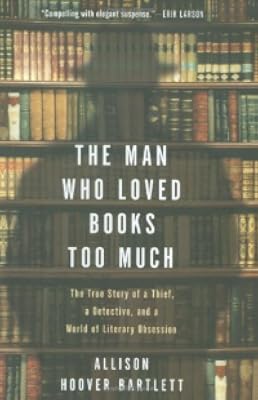
The Man Who Loved Books Too Much: The True Story of a Thief, a Detective, and a World of Literary Obsession
by Allison Hoover Bartlett 
On This Page
Description
In the tradition of The Orchid Thief, a compelling narrative set within the strange and genteel world of rare-book collecting: the true story of an infamous book thief, his victims, and the man determined to catch him.Rare-book theft is even more widespread than fine-art theft. Most thieves, of course, steal for profit. John Charles Gilkey steals purely for the love of books. In an attempt to understand him better, journalist Allison Hoover Bartlett plunged herself into the world of book show more lust and discovered just how dangerous it can be.
John Gilkey is an obsessed, unrepentant book thief who has stolen hundreds of thousands of dollars worth of rare books from book fairs, stores, and libraries around the country. Ken Sanders is the self-appointed "bibliodick" (book dealer with a penchant for detective work) driven to catch him. Bartlett befriended both outlandish characters and found herself caught in the middle of efforts to recover hidden treasure. With a mixture of suspense, insight, and humor, she has woven this entertaining cat-and-mouse chase into a narrative that not only reveals exactly how Gilkey pulled off his dirtiest crimes, where he stashed the loot, and how Sanders ultimately caught him but also explores the romance of books, the lure to collect them, and the temptation to steal them. Immersing the reader in a rich, wide world of literary obsession, Bartlett looks at the history of book passion, collection, and theft through the ages, to examine the craving that makes some people willing to stop at nothing to possess the books they love.
. show less
Tags
Recommendations






Member Recommendations




Member Reviews
This is the perfect true crime book for me - all the intrigue without any blood or gore or violence. It's about a man who stole rare books but rarely (sorry, no pun intended) sold them because he just wanted to own them, which made it rather difficult for book sellers and the police to track him down. Of course, it's a lot deeper than that and author/journalist Bartlett managed to delve into not only his method, but also into the psychology of the criminal mind of a book thief. And of a true *collector*. John Gilkey, the thief, was unrepentant and even while spending time in jail, was already plotting his next move.
I also loved the historic references and insights Bartlett provided throughout to give texture and context to the story. show more And, let's be honest, the whole thing appealed to the book lover in me. I don't collect rare books (because of the obvious expense) but if you walked into my house, you would definitely know I collect books. Difference is, I don't steal them! ;-) show less
I also loved the historic references and insights Bartlett provided throughout to give texture and context to the story. show more And, let's be honest, the whole thing appealed to the book lover in me. I don't collect rare books (because of the obvious expense) but if you walked into my house, you would definitely know I collect books. Difference is, I don't steal them! ;-) show less
There are many kinds of book collectors. Some collect a particular author or subject matter, some incunables and others modern first editions. Most are rational, law-abiding citizens. But sometimes the urge to collect becomes an obsession, as with Sir Thomas Phillipps' desire to own a copy of every book in the world. (I highly recommend A.N.L. Munby's Portrait of an Obsession, a distillation by Nicolas Barker of the five volumes of Phillipps Studies.) And sometimes, as with John Gilkey, the subject of Ms. Bartlett's book, it causes the collector to turn to crime.
Gilkey was (is?) a book thief. He seems to have wanted books, not for their content, but to have them, to possess them as physical objects, and as a signifier of taste. But, not show more having the money to build his collection, he took the view that he had a right to have a collection and that, if book sellers charged more than he could afford, he could simply take them. He gathered, often through retail jobs, credit card information, and used this to purchase books.
Bartlett juxtaposes Gilkey's story with that of Ken Sanders, a book seller and one-time chair of the Antiquarian Booksellers' Association of America security committee, who became as obsessed with hunting down Gilkey as Gilkey was with hunting down books to steal.
Bartlett conducted extensive interviews with both, and one of the most interesting aspects of this book is the way its writing caused the author to become a bit obsessed herself, not so much with books, though she feels a bit of temptation herself, but with the story. She goes with Gilkey, during a time when he was not locked up, to a store from which he had stolen in the past. He reveals to her certain information, and she struggles over whether to pass it on, knowing that, if she does so, he might close his mouth to her and affect her ability to write her book.
There are those who, looking at my double-shelved bookcases, and the piles of books on my floor and most flat surfaces in my apartment, would call me a woman who loves books too much. I feel what Bartlett terms the "sensory enticement" of books, enjoy the feel of a heavy paper with deckle edge, the smell of a leather binding, the heft of a volume in my hand. But I cannot fathom stealing a book, however tempted, and would say, with the medieval scribe, that a book thief should have "his name be erased from the book of the living and not be recorded among the Blessed".
The book is well-written and well-researched (though I noted a couple of errors in legal procedure, these are minor in relation to the book as a whole), and is sure to please all who love books, detective stories, and the psychology of obsession.
UPDATE (7/7/11): ACK! He's at it again! show less
Gilkey was (is?) a book thief. He seems to have wanted books, not for their content, but to have them, to possess them as physical objects, and as a signifier of taste. But, not show more having the money to build his collection, he took the view that he had a right to have a collection and that, if book sellers charged more than he could afford, he could simply take them. He gathered, often through retail jobs, credit card information, and used this to purchase books.
Bartlett juxtaposes Gilkey's story with that of Ken Sanders, a book seller and one-time chair of the Antiquarian Booksellers' Association of America security committee, who became as obsessed with hunting down Gilkey as Gilkey was with hunting down books to steal.
Bartlett conducted extensive interviews with both, and one of the most interesting aspects of this book is the way its writing caused the author to become a bit obsessed herself, not so much with books, though she feels a bit of temptation herself, but with the story. She goes with Gilkey, during a time when he was not locked up, to a store from which he had stolen in the past. He reveals to her certain information, and she struggles over whether to pass it on, knowing that, if she does so, he might close his mouth to her and affect her ability to write her book.
There are those who, looking at my double-shelved bookcases, and the piles of books on my floor and most flat surfaces in my apartment, would call me a woman who loves books too much. I feel what Bartlett terms the "sensory enticement" of books, enjoy the feel of a heavy paper with deckle edge, the smell of a leather binding, the heft of a volume in my hand. But I cannot fathom stealing a book, however tempted, and would say, with the medieval scribe, that a book thief should have "his name be erased from the book of the living and not be recorded among the Blessed".
The book is well-written and well-researched (though I noted a couple of errors in legal procedure, these are minor in relation to the book as a whole), and is sure to please all who love books, detective stories, and the psychology of obsession.
UPDATE (7/7/11): ACK! He's at it again! show less
Anyone who has made their way to LibraryThing is almost certainly fascinated by books. As members of that clan, LTers will find much to enjoy -- and be provoked by -- in "The Man Who Loved Books Too Much."
Author Allison Hoover Bartlett delves into the book stealing crime spree, and the mind, of thief and con man John Gilkey. She interviewed Gilkey on multiple occasions over the course of several years. And she entered the world of rare book collectors and dealers to research her reporting.
Bartlett takes a somewhat unexpected approach in her book. She examines how she influences Gilkey and how she comes perilously close to unwanted complicity in his actions. (It's a tenet of physics often ignored by nonfiction writers and journalists: show more no one can observe a phenomenon without changing it.) Gilkey starts to live through the book she will write -- offering possible endings for his character that will aggrandize him and bring the respect and recognition he craves.
Watching Bartlett struggle with this is fascinating. Are her rationalizations more valid than Gilkeys? Is she as obsessed with collecting her story as he is with "collecting" books? Bartlett exonerates herself. Readers will feel unsettled and will need to come to their own conclusions. Including their own conclusions about what they would have done in Barlett's place -- and their complicity in enjoying the tale. show less
Author Allison Hoover Bartlett delves into the book stealing crime spree, and the mind, of thief and con man John Gilkey. She interviewed Gilkey on multiple occasions over the course of several years. And she entered the world of rare book collectors and dealers to research her reporting.
Bartlett takes a somewhat unexpected approach in her book. She examines how she influences Gilkey and how she comes perilously close to unwanted complicity in his actions. (It's a tenet of physics often ignored by nonfiction writers and journalists: show more no one can observe a phenomenon without changing it.) Gilkey starts to live through the book she will write -- offering possible endings for his character that will aggrandize him and bring the respect and recognition he craves.
Watching Bartlett struggle with this is fascinating. Are her rationalizations more valid than Gilkeys? Is she as obsessed with collecting her story as he is with "collecting" books? Bartlett exonerates herself. Readers will feel unsettled and will need to come to their own conclusions. Including their own conclusions about what they would have done in Barlett's place -- and their complicity in enjoying the tale. show less
A fascinating and disturbing book. The author follows John Gilkey through the labyrinth of his reasoning, listening while he justifies in his own mind his relentless thieving of rare and precious books. The author delves into what lies beneath a normal collector's passion, and the driving sense of entitlement that sparks Gilkey's thefts.
She does acknowledge the difference between the dedicated, even obsessive love of most collectors and the warped logic of Gilkey's thought processes - but it seems sometimes that she blurs the line. So, too, she occasionally blurs the line between observing Gilkey and contributing to his ego trips. She even accompanied him as he strolls around a rare book store showing her how he cases the security, and show more how he identifies the prime book selections. It made me a bit uncomfortable.
But the overall impression I take from this book concerns the widespread brotherhood/sisterhood of book lovers to which I belong. (English really needs more gender-neutral nouns) Bartlett writes movingly of the deep almost visceral anger of one of the store owners that Gilkey ripped off - and the deep hurt that the loss of a rare book causes another. A really good book for bibliophiles. Oh, and by the way, Gilkey is on the loose again. show less
She does acknowledge the difference between the dedicated, even obsessive love of most collectors and the warped logic of Gilkey's thought processes - but it seems sometimes that she blurs the line. So, too, she occasionally blurs the line between observing Gilkey and contributing to his ego trips. She even accompanied him as he strolls around a rare book store showing her how he cases the security, and show more how he identifies the prime book selections. It made me a bit uncomfortable.
But the overall impression I take from this book concerns the widespread brotherhood/sisterhood of book lovers to which I belong. (English really needs more gender-neutral nouns) Bartlett writes movingly of the deep almost visceral anger of one of the store owners that Gilkey ripped off - and the deep hurt that the loss of a rare book causes another. A really good book for bibliophiles. Oh, and by the way, Gilkey is on the loose again. show less
This true story is about a book thief named John Gilkey and a rare book dealer named Ken Sanders who is determined to stop him. Set in the intriguing world of rare books, The Man Who Loved Books Too Much explores the power of possession. For John Gilkey ownership of books carries an identity of intelligence and class. Rather than work to pay for the books he wants to own, he makes fraudulent purchases and generally acquires rare books any way he can. Ken Sanders becomes obsessed with stopping Gilkey in order to protect his trade from such a prolific rare book thief. Sanders and other book sellers who are victims of Gilkey take the loss of beloved books very personally and band together to bring him to justice.
Allison Hoover Bartlett show more finds herself wanting to understand how Gilkey could risk his freedom in order to stock his book collection. Through detailed interviews with Gilkey she begins to discover a man who has an unusual set of ethics and a strong desire to create his ideal self-identity. Along the way the author is herself drawn into some ethical dilemmas. As she spends more and more time with Gilkey and he begins to reveal details not yet known to the police investigators, the author's role becomes unclear. Is she merely collecting stories, or is she influencing them?
One of the reasons that I enjoyed this book was that there was a lot of variety to it. It contained crime mystery, an introduction to the rare book trade and stories of historical book collectors. Another aspect I particularly liked was the interesting and timely themes. The author delved into Gilkey's ethical theories and psychological motivations. The fine line between loving books and obsessively collecting them at any cost was an interesting question that was raised in The Man Who Loved Books Too Much. The desirability of books as objects in and of themselves regardless of the content printed within is still alive and strong today even with the popularity of electronic books. Allison Hoover Bartlett's writing was charming, as were her descriptions of various rare book stores and the people that frequent them. show less
Allison Hoover Bartlett show more finds herself wanting to understand how Gilkey could risk his freedom in order to stock his book collection. Through detailed interviews with Gilkey she begins to discover a man who has an unusual set of ethics and a strong desire to create his ideal self-identity. Along the way the author is herself drawn into some ethical dilemmas. As she spends more and more time with Gilkey and he begins to reveal details not yet known to the police investigators, the author's role becomes unclear. Is she merely collecting stories, or is she influencing them?
One of the reasons that I enjoyed this book was that there was a lot of variety to it. It contained crime mystery, an introduction to the rare book trade and stories of historical book collectors. Another aspect I particularly liked was the interesting and timely themes. The author delved into Gilkey's ethical theories and psychological motivations. The fine line between loving books and obsessively collecting them at any cost was an interesting question that was raised in The Man Who Loved Books Too Much. The desirability of books as objects in and of themselves regardless of the content printed within is still alive and strong today even with the popularity of electronic books. Allison Hoover Bartlett's writing was charming, as were her descriptions of various rare book stores and the people that frequent them. show less
Allison Hoover Bartlett has turned her 2006 San Francisco Magazine article "The Man Who Loved Books Too Much" into a book by the same name (Riverhead, 2009). The subject is John Charles Gilkey, longtime book thief and crook-of-all-trades, who has stolen (and most likely continues to steal) from book dealers and libraries around the world. Bartlett widens her scope to encompass those who've sought to put a stop to Gilkey's thieving ways, most notably book dealer Ken Sanders. And she includes herself in the story, becoming a part of the Gilkey saga in ways I suspect she never anticipated when she began the research for what would become this book.
In many ways similar to Miles Harvey's superb The Island of Lost Maps (which treats map thief show more Gilbert Bland), The Man Who Loved Books Too Much is dissimilar in one crucial respect: the thief talked. Bartlett met with Gilkey multiple times over a two-year period, and was able to add his perspective to her work. That perspective adds much to the work, even though it quickly becomes clear that Gilkey's playing Bartlett the same way he'd played every employer, book dealer, and librarian he's had dealings with.
Gilkey's willingness not only to talk with Bartlett but also to boast about his crimes even directly in the faces of his victims is quite stunning. He and Bartlett even go so far as to visit Brick Row Book Shop, where owner John Crichton (who's lost books to Gilkey in the past) recognizes Gilkey and is forced to look on as the thief, his reporter in tow, browses his stock and complains loudly about the practices of book dealers.
Gilkey stole, at least at first, almost exclusively from book dealers. From his conversations with Bartlett, she gathered that this seemed to be because he felt that because he loved books, he ought to be able to have whichever ones he wanted: "for Gilkey," she writes, "'fairness' seemed to be a synonym for 'satisfaction': if he is satisfied, all is deemed fair; if not, it isn't" (p. 50). Because he wanted the books, he said, he ought to be able to get them, and if he could get them for free, all the better. By stealing credit card receipts and calling in orders using the snagged numbers, or passing bad checks, Gilkey accumulated thousands of books from shops up and down the West Coast. Bartlett writes that he seemed to have no concept of the fact that what he was doing was wrong - he didn't seem to think that stealing from dealers could possibly be inappropriate (although, as she notes, he did seem careful not to use words like 'steal,' 'prison,' or 'theft'. "Instead, he 'got' books and has been 'away' for 'doing that.'").
Naturally, things progressed, and even during the course of reporting for the book, Bartlett learned that Gilkey had begun stealing maps and other rare materials from libraries: on p. 181, she writes that she asked the thief "'Have you ever taken a book from the library?' ... Gilkey looked incredulous. 'No,' he said. 'That would be stealing.' I had no idea what to say." By p. 240, he's admitted to stealing dust jackets and cutting maps out of library books. "So much for not stealing from the library," Bartlett notes. This wasn't the only crime Gilkey confessed to Bartlett, but she writes that it was the first one that made her question whether she ought to inform someone. And here's where she ran off the rails, as far as I'm concerned.
Bartlett writes that she consulted several lawyer friends, as well as her literary agent's attorney, about whether she had an obligation to inform the authorities of Gilkey's crimes. They told her she had no legal obligation. Bartlett: "But what about ethical responsibility? The difference between the two was as blurry as my role, which had shifted from observer to participant in Gilkey's story. Did I owe this information to dealers, who had been so helpful with my research? But if I notified them of these thefts, wouldn't Gilkey keep all future and possibly more significant thefts from me? ... I found myself teetering between selfishness and benevolence: either reveal the secrets Gilkey had shared with me, probably losing access to him and possibly sending him to jail, or keep them to myself and be unjust to his victims. I tried to reassure myself that such consequences were not directly my responsibility." Two months later, Bartlett says, she called the FBI and talked to Art Crime Team head Bonnie Magness-Gardiner, who explained the circumstances in which federal agencies would get involved with book crimes. Asked directly "You'd tell me if the the book thief had stolen anything, right?" Bartlett said she would, but failed to inform Magness-Gardiner of several unprosecuted thefts (plus credit card fraud) she knew of ... justifying this, she said, with the fact that she later determined that the statute of limitations had passed (p. 241-42).
While whatever library crimes Gilkey confessed to Bartlett probably weren't federal offenses, for her to slough off the responsibility of reporting them so easily and carelessly is absolutely reprehensible, and to have literally lied to the FBI about thefts of which she was aware is pretty rotten as well. She ought to be ashamed of herself.
Bartlett chronicles Gilkey's run from both his perspective and from the viewpoints of those he victimized and those who sought to catch him. Her interview with still furious (and justifiably so) dealer Lane Heldfond is one of the most interesting parts of the book, and her profile of Gilkey pursuer Ken Sanders is mostly fair and appropriately-drawn. She pads the narratives with tales of past bibliomaniacs (many of which are straight from Basbanes' A Gentle Madness), and with material from some recent works on collecting. She tries to present Gilkey as someone interested in books and literature, and it's clear that he is that, but at heart he is also a con man and a thief, pure and simple. He likes getting things for free (travel, hotels, food, as well as books), and he feels no remorse in getting away with illegal activities. Bartlett also adds some revealing information (which again points to the notion that she was getting far too chummy with her subject, I think); he starts telling her that he's thinking up "a grand finale," a way to obtain all 100 books from the Modern Library's list of the 100 Best Novels of the 20th century. He's a showman, an attention-seeker, an incorrigible thief. That he happens to like books doesn't make him any more likeable, it makes him that much more dangerous to all of us to sell, protect, collect and love them.
This is a well-written book, that tells a good story. Kudos to Bartlett for getting Gilkey to talk. But reading about his lies, his crimes, his manipulations of those around him just made my skin crawl. He deserves to be in prison for the rest of his life.
As Bartlett notes in the afterword, Gilkey couldn't be stopped: just before the book went to press, he stole a book from a Canadian dealer. I'm sure it's not the last time.
http://philobiblos.blogspot.com/2009/10/book-review-man-who-loved-books-too.html show less
In many ways similar to Miles Harvey's superb The Island of Lost Maps (which treats map thief show more Gilbert Bland), The Man Who Loved Books Too Much is dissimilar in one crucial respect: the thief talked. Bartlett met with Gilkey multiple times over a two-year period, and was able to add his perspective to her work. That perspective adds much to the work, even though it quickly becomes clear that Gilkey's playing Bartlett the same way he'd played every employer, book dealer, and librarian he's had dealings with.
Gilkey's willingness not only to talk with Bartlett but also to boast about his crimes even directly in the faces of his victims is quite stunning. He and Bartlett even go so far as to visit Brick Row Book Shop, where owner John Crichton (who's lost books to Gilkey in the past) recognizes Gilkey and is forced to look on as the thief, his reporter in tow, browses his stock and complains loudly about the practices of book dealers.
Gilkey stole, at least at first, almost exclusively from book dealers. From his conversations with Bartlett, she gathered that this seemed to be because he felt that because he loved books, he ought to be able to have whichever ones he wanted: "for Gilkey," she writes, "'fairness' seemed to be a synonym for 'satisfaction': if he is satisfied, all is deemed fair; if not, it isn't" (p. 50). Because he wanted the books, he said, he ought to be able to get them, and if he could get them for free, all the better. By stealing credit card receipts and calling in orders using the snagged numbers, or passing bad checks, Gilkey accumulated thousands of books from shops up and down the West Coast. Bartlett writes that he seemed to have no concept of the fact that what he was doing was wrong - he didn't seem to think that stealing from dealers could possibly be inappropriate (although, as she notes, he did seem careful not to use words like 'steal,' 'prison,' or 'theft'. "Instead, he 'got' books and has been 'away' for 'doing that.'").
Naturally, things progressed, and even during the course of reporting for the book, Bartlett learned that Gilkey had begun stealing maps and other rare materials from libraries: on p. 181, she writes that she asked the thief "'Have you ever taken a book from the library?' ... Gilkey looked incredulous. 'No,' he said. 'That would be stealing.' I had no idea what to say." By p. 240, he's admitted to stealing dust jackets and cutting maps out of library books. "So much for not stealing from the library," Bartlett notes. This wasn't the only crime Gilkey confessed to Bartlett, but she writes that it was the first one that made her question whether she ought to inform someone. And here's where she ran off the rails, as far as I'm concerned.
Bartlett writes that she consulted several lawyer friends, as well as her literary agent's attorney, about whether she had an obligation to inform the authorities of Gilkey's crimes. They told her she had no legal obligation. Bartlett: "But what about ethical responsibility? The difference between the two was as blurry as my role, which had shifted from observer to participant in Gilkey's story. Did I owe this information to dealers, who had been so helpful with my research? But if I notified them of these thefts, wouldn't Gilkey keep all future and possibly more significant thefts from me? ... I found myself teetering between selfishness and benevolence: either reveal the secrets Gilkey had shared with me, probably losing access to him and possibly sending him to jail, or keep them to myself and be unjust to his victims. I tried to reassure myself that such consequences were not directly my responsibility." Two months later, Bartlett says, she called the FBI and talked to Art Crime Team head Bonnie Magness-Gardiner, who explained the circumstances in which federal agencies would get involved with book crimes. Asked directly "You'd tell me if the the book thief had stolen anything, right?" Bartlett said she would, but failed to inform Magness-Gardiner of several unprosecuted thefts (plus credit card fraud) she knew of ... justifying this, she said, with the fact that she later determined that the statute of limitations had passed (p. 241-42).
While whatever library crimes Gilkey confessed to Bartlett probably weren't federal offenses, for her to slough off the responsibility of reporting them so easily and carelessly is absolutely reprehensible, and to have literally lied to the FBI about thefts of which she was aware is pretty rotten as well. She ought to be ashamed of herself.
Bartlett chronicles Gilkey's run from both his perspective and from the viewpoints of those he victimized and those who sought to catch him. Her interview with still furious (and justifiably so) dealer Lane Heldfond is one of the most interesting parts of the book, and her profile of Gilkey pursuer Ken Sanders is mostly fair and appropriately-drawn. She pads the narratives with tales of past bibliomaniacs (many of which are straight from Basbanes' A Gentle Madness), and with material from some recent works on collecting. She tries to present Gilkey as someone interested in books and literature, and it's clear that he is that, but at heart he is also a con man and a thief, pure and simple. He likes getting things for free (travel, hotels, food, as well as books), and he feels no remorse in getting away with illegal activities. Bartlett also adds some revealing information (which again points to the notion that she was getting far too chummy with her subject, I think); he starts telling her that he's thinking up "a grand finale," a way to obtain all 100 books from the Modern Library's list of the 100 Best Novels of the 20th century. He's a showman, an attention-seeker, an incorrigible thief. That he happens to like books doesn't make him any more likeable, it makes him that much more dangerous to all of us to sell, protect, collect and love them.
This is a well-written book, that tells a good story. Kudos to Bartlett for getting Gilkey to talk. But reading about his lies, his crimes, his manipulations of those around him just made my skin crawl. He deserves to be in prison for the rest of his life.
As Bartlett notes in the afterword, Gilkey couldn't be stopped: just before the book went to press, he stole a book from a Canadian dealer. I'm sure it's not the last time.
http://philobiblos.blogspot.com/2009/10/book-review-man-who-loved-books-too.html show less
A book about a man with a compulsion to steal and collect books tempts on so many different levels. There are more than a few of us bibliophiles who will identify with the criminal at the heart of this story on some level, John Charles Gilkey.
Between 1999 and 2003, Gilkey stole an estimated $100,000 in rare and antique books from dealers around the country. Over the course of his entire criminal career, between 1990 and the present, the value of the books and other collectibles he’s stolen may be double or triple that. Allison Hoover Bartlett set out to unlock the mysteries of Gilkey’s seemingly uncontrollable compulsion. Her conclusion, that Gilkey found an otherwise unattainable identity by obtaining and collecting such valuables, show more may explain some small piece of his psyche, and the psyche of all those who collect.
Bartlett possesses a keen instinct in sifting the chaff from the wheat while interviewing Gilkey, a con artist and master manipulator. And her research for these interviews would raise the gooseflesh on even the most aloof bibliophile, as it takes her to antiquarian book fairs and dimly lit rare book rooms around the country.
[The Man Who Loved Books Too Much] captures the complicated, if mundane, world of white collar crime, as well as the thrill of high-dollar, art theft.
Bottom Line: A solid true crime story examining the mind of a con artist, and a salivating read for any book lover. show less
Between 1999 and 2003, Gilkey stole an estimated $100,000 in rare and antique books from dealers around the country. Over the course of his entire criminal career, between 1990 and the present, the value of the books and other collectibles he’s stolen may be double or triple that. Allison Hoover Bartlett set out to unlock the mysteries of Gilkey’s seemingly uncontrollable compulsion. Her conclusion, that Gilkey found an otherwise unattainable identity by obtaining and collecting such valuables, show more may explain some small piece of his psyche, and the psyche of all those who collect.
Bartlett possesses a keen instinct in sifting the chaff from the wheat while interviewing Gilkey, a con artist and master manipulator. And her research for these interviews would raise the gooseflesh on even the most aloof bibliophile, as it takes her to antiquarian book fairs and dimly lit rare book rooms around the country.
[The Man Who Loved Books Too Much] captures the complicated, if mundane, world of white collar crime, as well as the thrill of high-dollar, art theft.
Bottom Line: A solid true crime story examining the mind of a con artist, and a salivating read for any book lover. show less
Members
- Recently Added By
Lists

Books about Books
149 works; 23 members

Best books about books
209 works; 106 members

True Crime
216 works; 16 members

SantaThing 2014 Gifts
299 works; 17 members

KayStJ's to-read list
1,616 works; 11 members

Books read in 2015
213 works; 5 members

Thieves
18 works; 7 members

Books Read in 2021
5,361 works; 114 members

Books Read in 2022
5,226 works; 112 members

Pants on fire
27 works; 4 members

Books I have Recommended
207 works; 1 member
Talk Discussions
Past Discussions
Allison Hoover Bartlett, author of The Man Who Loved Books Too Much (Oct 22-30) in Author Chat (September 2016)
Author Information

2 Works 2,862 Members
Allison Hoover Bartlett is a LibraryThing Author, an author who lists their personal library on LibraryThing.
Common Knowledge
- Original title
- The Man Who Loved Books Too Much
- Original publication date
- 2009-09 (Riverhead Books (hardcover edition)) (Riverhead Books | hardcover edition); 2010-10 (Riverhead Books (trade paperback edition)) (Riverhead Books | trade paperback edition)
- People/Characters
- Ken Sanders; John Charles Gilkey; Allison Hoover Bartlett; John Crichton; Ken Munson
- Important places
- California, USA; Los Angeles, California, USA; Modesto, California, USA; New York, USA; New York, New York, USA; Salt Lake City, Utah, USA (show all 8); San Francisco, California, USA; Utah, USA
- Epigraph
- For him that stealeth, or borroweth and returneth not, this book from its owner ... let him be struck with palsy, & all his members blasted ... Let bookworms gnaw his entrails in token of the Worm that dieth not, & wh... (show all)en at last he goeth to his final punishment, let the flames of Hell consume him forever.
—Anathama in a medieval manuscripts from the Monastery of San Pedro in Barcelona
I have known men to hazard their fortunes, go long journeys half-way around the world, forget friendships, even lie, cheat, and steal, all for the gain of a book.
—A. S. W. Rosenbach, twentieth century book dealer - Dedication
- For John, Julian, and Sonja
- First words
- Prologue
At one end of my desk sits a nearly four-hundred-year-old book cloaked in a tan linen sack and a good deal of mystery.
Chapter 1
April 28, 2005, was bright and mild, the kind of spring day in New York City that seems full of promise, and on the corner of Park Avenue and East Sixty-sixth Street a queue of optimistic people was growing. - Last words
- (Click to show. Warning: May contain spoilers.)And when you're screaming
"Oh, Oh, Oh!"
Remember, you deserved this woe.
—Warning written by medieval German scribe. - Blurbers
- Larson, Erik; Dirda, Michael; McMurtry, Larry; Siler, Julia Flynn; Scheeres, Julia; Nicholas, Lynn H. (show all 8); Worrall, Simon; Basbanes, Nicholas A.
Classifications
- Genres
- General Nonfiction, Biography & Memoir, Nonfiction
- DDC/MDS
- 002.075 — Computer science, information & general works Computer science, knowledge & systems Books (Science and history of the book) Standard subdivisions Bibliophilia bibliomania
- LCC
- Z992.8 .B37 — Bibliography, Library Science and Information Resources
- BISAC
Statistics
- Members
- 2,862
- Popularity
- 6,341
- Reviews
- 183
- Rating
- (3.41)
- Languages
- 5 — English, French, Indonesian, Portuguese, Turkish
- Media
- Paper, Audiobook, Ebook
- ISBNs
- 19
- ASINs
- 16
