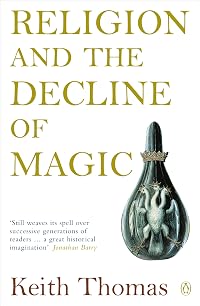
Religion and the Decline of Magic : Studies in popular beliefs in sixteenth- and seventeenth-century England
by Keith Thomas
On This Page
Description
Witchcraft, astrology, divination, and every kind of popular magic flourished in England during the 16th and 17th centuries, from the belief that a blessed amulet could prevent the assaults of the Devil to the use of the same charms to recover stolen goods. At the same time the Protestant Reformation attempted to take the magic out of religion, and scientists were developing new explanations of the universe. Keith Thomas's classic analysis of beliefs held on every level of English society show more begins with the collapse of the medieval Church and ends with the changing intellectual atmosphere around 1700, when science and rationalism began to challenge the older systems of belief. show lessTags
Recommendations








Member Reviews
Although scholarly interest in the topic has only increased in the subsequent decades, Religion and the Decline of Magic has not become obsolete. It is a voluminous history of magic in sixteenth and seventeenth-century England, with particular attention to its social and religious context. The style is that of a sort of old-fashioned documentary history, with copious references to primary and near-primary sources.
The first sections of the book establish the context, with an empirical attitude and a lot of careful observation. Author Keith Thomas weighs issues of elite and popular cultures, as well as Catholic, Protestant, and dissenting religion. He notes, "The conventional distinction between a prayer and a spell seems to have been show more first hammered out, not by the nineteenth-century anthropologists, with whom it is usually associated, but by sixteenth-century Protestant theologians" (69).
General areas of inquiry within "magic" for this book include healing, prophecy, astrology, ghosts, fairies, omens, and witchcraft. A large section towards the end provides a thorough summation of the English witch-craze, how it differed from its Continental counterpart, and how it subsided. Thomas is no fan of Murray-style theories of pagan survival for the witchcraft of this period. His analysis also shows up how accused witches' subaltern status and their justified ressentiment of those they had supposedly hexed were considered culpable in the theory that defined and indicted them.
Thomas observes that skepticism about magic was never entirely absent, even while larger cultural trends saw its credit wax and wane. The Elizabethan period seems to have been part of a long peak of magical operation in the early modern era. But "By 1655 Meric Causabon could go so far as to declare that every case of religious ecstasy was no more than 'a degree and species of epilepsy'" (172). The "decline" that began in the 17th century hit its nadir in the 18th, and the modern occultism of our contemporary world had its practical origins in the 19th, a larger course that Thomas treats briefly in his final chapters.
Those final chapters include an analysis in which he concludes that magic was not, in fact, made obsolete by scientific and technological achievement. On the contrary, there was a shift toward naturalistic explanation and against magic that preceded the significant advances of experimental science, and may have helped to make them possible. The shift in mentality may well have been a byproduct of the religious conflicts of the age. "Many post-Reformation writers busied themselves establishing the criteria by which one might distinguish a divine intimation from a diabolical imposture or the effects of indigestion" (151). Ultimately, systematization of efforts to "test the spirits" may have led to their banishment from intellectual culture.
This book is big--about 800 pages of expository, academic prose--and it took me a long while to read it all the way through, as it had to compete with an assortment of other current reading projects. At many points during my read, though, I was reminded of two works of fiction. The Aegypt cycle of John Crowley (where Thomas is one of several historians credited with influence in a prefatory note) is a tale about the decline of magic that evokes parallels between the 17th century described by Thomas and the demise of the 20th-century counterculture. Susanna Clarke's Jonathan Strange & Mr. Norrell is a story about a spectacular rebirth of magic immediately following the historical decline outlined by Thomas. Readers who enjoyed either of those could find a lot to engage them in the manifold details of this factual account. show less
The first sections of the book establish the context, with an empirical attitude and a lot of careful observation. Author Keith Thomas weighs issues of elite and popular cultures, as well as Catholic, Protestant, and dissenting religion. He notes, "The conventional distinction between a prayer and a spell seems to have been show more first hammered out, not by the nineteenth-century anthropologists, with whom it is usually associated, but by sixteenth-century Protestant theologians" (69).
General areas of inquiry within "magic" for this book include healing, prophecy, astrology, ghosts, fairies, omens, and witchcraft. A large section towards the end provides a thorough summation of the English witch-craze, how it differed from its Continental counterpart, and how it subsided. Thomas is no fan of Murray-style theories of pagan survival for the witchcraft of this period. His analysis also shows up how accused witches' subaltern status and their justified ressentiment of those they had supposedly hexed were considered culpable in the theory that defined and indicted them.
Thomas observes that skepticism about magic was never entirely absent, even while larger cultural trends saw its credit wax and wane. The Elizabethan period seems to have been part of a long peak of magical operation in the early modern era. But "By 1655 Meric Causabon could go so far as to declare that every case of religious ecstasy was no more than 'a degree and species of epilepsy'" (172). The "decline" that began in the 17th century hit its nadir in the 18th, and the modern occultism of our contemporary world had its practical origins in the 19th, a larger course that Thomas treats briefly in his final chapters.
Those final chapters include an analysis in which he concludes that magic was not, in fact, made obsolete by scientific and technological achievement. On the contrary, there was a shift toward naturalistic explanation and against magic that preceded the significant advances of experimental science, and may have helped to make them possible. The shift in mentality may well have been a byproduct of the religious conflicts of the age. "Many post-Reformation writers busied themselves establishing the criteria by which one might distinguish a divine intimation from a diabolical imposture or the effects of indigestion" (151). Ultimately, systematization of efforts to "test the spirits" may have led to their banishment from intellectual culture.
This book is big--about 800 pages of expository, academic prose--and it took me a long while to read it all the way through, as it had to compete with an assortment of other current reading projects. At many points during my read, though, I was reminded of two works of fiction. The Aegypt cycle of John Crowley (where Thomas is one of several historians credited with influence in a prefatory note) is a tale about the decline of magic that evokes parallels between the 17th century described by Thomas and the demise of the 20th-century counterculture. Susanna Clarke's Jonathan Strange & Mr. Norrell is a story about a spectacular rebirth of magic immediately following the historical decline outlined by Thomas. Readers who enjoyed either of those could find a lot to engage them in the manifold details of this factual account. show less
Now my Charmes are all ore-throwne,
And what strength I haue's mine owne.
Which is most faint…
—William Shakespeare, The Tempest
You might think from the title of Religion and the Decline of Magic that there is going to be some causal relationship between the two noun phrases: that this is a story of how religion grew as magic diminished.
But that is not at all the story being told in this fantastically wide-ranging, compendious study of the beliefs of sixteenth- and seventeenth-century England. Instead we are given something much more subtle – an examination of the magical thinking that pervaded all of society, religion included, and of what happened to religion and society when that magical thinking became untenable.
This isn't a show more didactic book, and most of the conclusions are held back until the end. Instead of sustained argument, what you get is a vast treasure-house of examples, anecdotes, quotations and calmly measured assessments demonstrating how people in the 1500s and 1600s thought about god, the devil, sorcery, ghosts, astrology, ancient prophecies, fairies, witchcraft, and much more besides.
DOE YOUER BEST
What is the difference between religion and magic, anyway? It's not easy, even for believers, to give a satisfying answer. Theologians liked to say that prayers and religious ceremonies, unlike spells, were ‘propitiatory, not constraining’ – one asked god for help, one did not compel him to act in a certain way. But this was a distinction made by the educated thinkers at the top: for ordinary people (much of the clergy not excluded) it just didn't exist.
Many wizards and conjurers called on God for their enchantments, and many religious rites and prayers were assumed to work purely mechanically as charms. Priests would routinely ring church bells during a thunderstorm to drive off evil spirits; women were ‘churched’ after childbirth to re-fit them for Christian society. The whole structure of the medieval Church ‘appeared as a vast reservoir of magical power, capable of being deployed for a variety of secular purposes’.
Though the Reformation deliberately tried to get rid of a lot of the hocus-pocus, even afterwards there were ‘magical elements surviving in religion, and there were religious facets to the practice of magic’.
The point is not just that religion and science were often seen as magical – it's that many of the practices we'd now dismiss as nonsense were in those days considered genuine scientific paths to knowledge. The great example of this is astrology, which Thomas respectfully describes as ‘probably the most ambitious attempt ever made to reduce the baffling diversity of human affairs to some sort of intelligible order’. Its pedigree was unimpeachable, and even the most sceptical rationalists were unwilling, until well into the seventeenth century, to dismiss the basic principle that heavenly bodies had some effect on men's lives.
Being an astrologer back then must have been a bit like being a private investigator now – sure, it sounds quite exciting, but most of the time you're dealing with boring requests concerning inheritance fraud or whether someone's husband is likely to remain faithful. One typical client sent the following letter:
Ser my desier is you would be pleased to anser me thes queareyes I am indetted and am in danger of aresting. My desier is to know wether the setey or the conterey will be best for me, if the setey whatt part thearof if the contery what partt therof, and whatt tim will be most dangeros unto me, and when best to agree with my creditores I pray doe youer best.
YOUR VERY GOOD HEALTH
It's true that the educated metropolitan classes could sometimes be sceptical about magic – but this was a tiny proportion of society. The vast majority of people still lived rural lives in small villages, and religion to them was just another brand of the supernatural.
You can get an inkling of what many people understood about religious doctrine from the interview carried out with one sixty-year-old on his deathbed, after a lifetime of attending church several times a week: ‘demanded what he thought of God, he answers that he was a good old man; and what of Christ, that he was a towardly young youth; and of his soul, that it was a great bone in his body’. One shepherd, when asked if he knew who the Father, Son and Holy Ghost were, replied, ‘The father and son I know well for I tend their sheep, but I know not that third fellow; there is none of that name in our village.’ This was admittedly somewhat earlier than the main period under discussion here, but the general attitude lasted through to the seventeenth century and beyond:
The Reverend Francis Kilvert recorded in his diary how the vicar of Fordington, Dorset, found total ignorance in his rural parish when he arrived there in the early nineteenth century. At one church in the area there were only two male communicants. When the cup was given to the first he touched his forelock and said, ‘Here's your good health, sir.’ The second, better informed, said, ‘Here's the good health of our Lord Jesus Christ.’
TWO SHILLINGS AND SIXPENCE
In fact the socioeconomic factor in all this becomes increasingly obvious. The Church had the power and it had the money, which meant ultimately the difference between magic and religion was what the Church said it was: ‘the ceremonies of which it disapproved were “superstitious”; those which it accepted were not.’
The difference between churchmen and magicians lay less in the effects they claimed to achieve than in their social position, and in the authority on which their respective claims rested.
Indeed the debate over magic was often a class issue. This is especially true of witchcraft (as Reginald Scot put it, the Pope ‘canonizeth the rich for saints and banneth the poor for witches’). When it came to accusations of witchcraft, Thomas makes the intriguing observation that, paradoxically, ‘it tended to be the witch who was morally in the right and the victim who was in the wrong’. Victims of witchcraft, in other words, often lodged formal complaints in situations where they were feeling guilty about something and considered that in some sense they'd had it coming.
A destitute old woman comes to your door to ask for some butter; you turn her away; you happen to break your ankle later on; and your own feelings of guilt connect the dots. Witches were rarely accused of responsibility for plagues or big fires – it was always personal disasters, individual calamities.
So this is really about poverty. It is both amusing and heartbreaking to read about how little the Devil supposedly had to tempt many of these women with in order to entice them over to Satanism: Elizabeth Pratt claimed to have been promised in 1677 that ‘she should live as well as the best woman in the town of Dunstable’, while Elizabeth Southern in 1645 said she agreed to sell her soul for 2s. 6d.
‘Witch’ (like ‘chav’ today) is a term flung at the very poor by the slightly less poor; what we are looking at in many witchcraft trials (this book suggests) is a society trying to resolve its ‘conflict between resentment and a sense of obligation’.
IT MAKES YOU FEEL HAPPY LIKE AN OLD-TIME MOVIE
The legal system in England was, happily, less willing to accept witch-hunts against defenceless old women than were courts on the continent: indeed one judge in 1712 is said to have responded to some of the more outlandish testimony against one ‘witch’ by remarking cheerfully that there was no law against flying, and promptly dismissing the case.
As mechanical science started to show its value, magic lost its cachet – though magical beliefs of some kind have lingered on well into modern times, as the vogue for horoscopes and new-age mumbo-jumbo demonstrates. It's easy to be snide about it, but what this book really shows is that such ideas do help people deal with things for which medicine or science have no helpful answers: they allow people to feel that they are taking matters into their own hands, they activate the placebo effect, they provide psychological release and reassurance.
The prose is clear and no-nonsense and chock-full of astonishing incidents and examples drawn from pamphlets, court records, diaries, letters and literature. Thomas is also anxious to take on board the latest (for 1971) findings in anthropology, and he looks, perhaps too hard, for parallels between Tudor England and traditional ‘African’ cultures: this analysis seems rather unsophisticated nowadays (although charges of ‘racism’, thrown around in a few other reviews here, are absurd). Perhaps too the sheer wealth of material leads him to drift slightly and repeat himself a couple of times. Still, it's hard to overstate the amount of pleasure on offer here, or the number of fascinating sidelights this book throws on the history of human society and ideas. As Hilary Mantel says, the book is so rewarding that it's not just about magic – it is a little slice of magic in itself. show less
And what strength I haue's mine owne.
Which is most faint…
—William Shakespeare, The Tempest
You might think from the title of Religion and the Decline of Magic that there is going to be some causal relationship between the two noun phrases: that this is a story of how religion grew as magic diminished.
But that is not at all the story being told in this fantastically wide-ranging, compendious study of the beliefs of sixteenth- and seventeenth-century England. Instead we are given something much more subtle – an examination of the magical thinking that pervaded all of society, religion included, and of what happened to religion and society when that magical thinking became untenable.
This isn't a show more didactic book, and most of the conclusions are held back until the end. Instead of sustained argument, what you get is a vast treasure-house of examples, anecdotes, quotations and calmly measured assessments demonstrating how people in the 1500s and 1600s thought about god, the devil, sorcery, ghosts, astrology, ancient prophecies, fairies, witchcraft, and much more besides.
DOE YOUER BEST
What is the difference between religion and magic, anyway? It's not easy, even for believers, to give a satisfying answer. Theologians liked to say that prayers and religious ceremonies, unlike spells, were ‘propitiatory, not constraining’ – one asked god for help, one did not compel him to act in a certain way. But this was a distinction made by the educated thinkers at the top: for ordinary people (much of the clergy not excluded) it just didn't exist.
Many wizards and conjurers called on God for their enchantments, and many religious rites and prayers were assumed to work purely mechanically as charms. Priests would routinely ring church bells during a thunderstorm to drive off evil spirits; women were ‘churched’ after childbirth to re-fit them for Christian society. The whole structure of the medieval Church ‘appeared as a vast reservoir of magical power, capable of being deployed for a variety of secular purposes’.
Though the Reformation deliberately tried to get rid of a lot of the hocus-pocus, even afterwards there were ‘magical elements surviving in religion, and there were religious facets to the practice of magic’.
The point is not just that religion and science were often seen as magical – it's that many of the practices we'd now dismiss as nonsense were in those days considered genuine scientific paths to knowledge. The great example of this is astrology, which Thomas respectfully describes as ‘probably the most ambitious attempt ever made to reduce the baffling diversity of human affairs to some sort of intelligible order’. Its pedigree was unimpeachable, and even the most sceptical rationalists were unwilling, until well into the seventeenth century, to dismiss the basic principle that heavenly bodies had some effect on men's lives.
Being an astrologer back then must have been a bit like being a private investigator now – sure, it sounds quite exciting, but most of the time you're dealing with boring requests concerning inheritance fraud or whether someone's husband is likely to remain faithful. One typical client sent the following letter:
Ser my desier is you would be pleased to anser me thes queareyes I am indetted and am in danger of aresting. My desier is to know wether the setey or the conterey will be best for me, if the setey whatt part thearof if the contery what partt therof, and whatt tim will be most dangeros unto me, and when best to agree with my creditores I pray doe youer best.
YOUR VERY GOOD HEALTH
It's true that the educated metropolitan classes could sometimes be sceptical about magic – but this was a tiny proportion of society. The vast majority of people still lived rural lives in small villages, and religion to them was just another brand of the supernatural.
You can get an inkling of what many people understood about religious doctrine from the interview carried out with one sixty-year-old on his deathbed, after a lifetime of attending church several times a week: ‘demanded what he thought of God, he answers that he was a good old man; and what of Christ, that he was a towardly young youth; and of his soul, that it was a great bone in his body’. One shepherd, when asked if he knew who the Father, Son and Holy Ghost were, replied, ‘The father and son I know well for I tend their sheep, but I know not that third fellow; there is none of that name in our village.’ This was admittedly somewhat earlier than the main period under discussion here, but the general attitude lasted through to the seventeenth century and beyond:
The Reverend Francis Kilvert recorded in his diary how the vicar of Fordington, Dorset, found total ignorance in his rural parish when he arrived there in the early nineteenth century. At one church in the area there were only two male communicants. When the cup was given to the first he touched his forelock and said, ‘Here's your good health, sir.’ The second, better informed, said, ‘Here's the good health of our Lord Jesus Christ.’
TWO SHILLINGS AND SIXPENCE
In fact the socioeconomic factor in all this becomes increasingly obvious. The Church had the power and it had the money, which meant ultimately the difference between magic and religion was what the Church said it was: ‘the ceremonies of which it disapproved were “superstitious”; those which it accepted were not.’
The difference between churchmen and magicians lay less in the effects they claimed to achieve than in their social position, and in the authority on which their respective claims rested.
Indeed the debate over magic was often a class issue. This is especially true of witchcraft (as Reginald Scot put it, the Pope ‘canonizeth the rich for saints and banneth the poor for witches’). When it came to accusations of witchcraft, Thomas makes the intriguing observation that, paradoxically, ‘it tended to be the witch who was morally in the right and the victim who was in the wrong’. Victims of witchcraft, in other words, often lodged formal complaints in situations where they were feeling guilty about something and considered that in some sense they'd had it coming.
A destitute old woman comes to your door to ask for some butter; you turn her away; you happen to break your ankle later on; and your own feelings of guilt connect the dots. Witches were rarely accused of responsibility for plagues or big fires – it was always personal disasters, individual calamities.
So this is really about poverty. It is both amusing and heartbreaking to read about how little the Devil supposedly had to tempt many of these women with in order to entice them over to Satanism: Elizabeth Pratt claimed to have been promised in 1677 that ‘she should live as well as the best woman in the town of Dunstable’, while Elizabeth Southern in 1645 said she agreed to sell her soul for 2s. 6d.
‘Witch’ (like ‘chav’ today) is a term flung at the very poor by the slightly less poor; what we are looking at in many witchcraft trials (this book suggests) is a society trying to resolve its ‘conflict between resentment and a sense of obligation’.
IT MAKES YOU FEEL HAPPY LIKE AN OLD-TIME MOVIE
The legal system in England was, happily, less willing to accept witch-hunts against defenceless old women than were courts on the continent: indeed one judge in 1712 is said to have responded to some of the more outlandish testimony against one ‘witch’ by remarking cheerfully that there was no law against flying, and promptly dismissing the case.
As mechanical science started to show its value, magic lost its cachet – though magical beliefs of some kind have lingered on well into modern times, as the vogue for horoscopes and new-age mumbo-jumbo demonstrates. It's easy to be snide about it, but what this book really shows is that such ideas do help people deal with things for which medicine or science have no helpful answers: they allow people to feel that they are taking matters into their own hands, they activate the placebo effect, they provide psychological release and reassurance.
The prose is clear and no-nonsense and chock-full of astonishing incidents and examples drawn from pamphlets, court records, diaries, letters and literature. Thomas is also anxious to take on board the latest (for 1971) findings in anthropology, and he looks, perhaps too hard, for parallels between Tudor England and traditional ‘African’ cultures: this analysis seems rather unsophisticated nowadays (although charges of ‘racism’, thrown around in a few other reviews here, are absurd). Perhaps too the sheer wealth of material leads him to drift slightly and repeat himself a couple of times. Still, it's hard to overstate the amount of pleasure on offer here, or the number of fascinating sidelights this book throws on the history of human society and ideas. As Hilary Mantel says, the book is so rewarding that it's not just about magic – it is a little slice of magic in itself. show less
The concept of magic is a fascinating one, no doubt. The amount of fiction that contains some or other kind of magic is astonishing, but what is even more astonishing is the beliefs that people have had (or continue to have) about “actual” magic. In Religion and the Decline of Magic, Keith Thomas takes a look at these beliefs as they were manifested in sixteenth- and seventeenth-century England. This is a fascinating study which reveals Thomas’s rigorous delving in the records and archives, and his deep insight into the beliefs of his ancestors.
I received this Folio edition as a present. It has a wonderful introduction by Hilary Mantel in which she expresses her admiration for Thomas’s erudition. What is even more remarkable show more about Thomas’s exhaustive research is that the book came out in the 1970s. Of course, there has also been more recent research into this field, and Mantel acknowledges that some of Thomas’s conclusions might require emendation. But on the whole she seems genuinely impressed with the book’s approach and judgements.
Thomas begins by considering the role of religion in people’s magical beliefs during the period. He first considers the quasi-magical practices of the traditional Catholic clergy, including exorcism, transubstantiation, saints, indulgences, and so forth. Thomas then considers the impact of the Reformation on people’s beliefs, which, despite the efforts of the Puritans, did not bring an end to beliefs in magic, witches, ghosts, fairies, etc. There are excellent subsections on the role of Providence in people’s beliefs, and how prayer and biblical prophecy influenced popular ideas about magic.
The next main section concerns magic itself, with Thomas investigating the idea of magical healing (which included healing by touch, as appropriated by the royalty, who claimed to be able to cure scrofula, or the “King’s evil”), and the role of “cunning men” and “wise women” in village life. Most of these “charmers” were concerned with finding lost property and with divination, and had little or no knowledge of theoretical magical learning, like that of Paracelsus, Agrippa, or Jakob Boehme. He then considers how these beliefs were attacked by the religious authorities, and yet were often instigated and supported by religious beliefs in concepts like the soul and the afterlife.
Thomas has an excellent section on astrology, in which he considers its practice and extent, its social and intellectual role, and the similarities and differences between it and religious practices. He then considers how ancient prophecies (which probably were not that ancient) influenced people during this time.
Probably the most interesting and thorough section is the one on witchcraft in England. Thomas considers how witchcraft became a crime and its history in England. Interestingly, he shows how most prosecutions were based on the belief in maleficent actions (those that caused harm to others), and not usually on the claim that witches were devil-worshipers. In his subsection on witchcraft and religion, Thomas considers contemporary beliefs concerning the Devil, as well as those concerning possession by demons. He has much to say about the Malleus Maleficarum (a Catholic treatise on witches) and how it influenced beliefs concerning witches. He has a wonderful section on “The Making of a Witch”, in which he considers cursing and the supposed temptation to devil-worship. Thomas shows that the idea of “covens” of witches and “black Sabbaths” are nearly completely unsupported by the evidence for the era. The idea of a far-ranging “witch-cult” in Western Europe is also dismissed. Despite this, Thomas does consider what might have tempted people (mostly women) into becoming witches, even though they did not have any real powers. He then investigates the social environment that led to witch-beliefs, and finally considers the reasons for the decline of belief in witchcraft.
The thinnest section is termed “Allied Beliefs”, in which Thomas considers the contemporary beliefs in ghosts and fairies, as well as omens. I say “thinnest”, but this is really only in comparison to the previous section, as Thomas still does an excellent job in delineating the popular beliefs concerning spirits and signs.
The whole book is a magisterial attempt to synthesise research on occult beliefs during the sixteenth and seventeenth centuries in England. Thomas accomplishes this with wit and excellent writing. The only real criticism I could level at the book is his use of examples from Africa to substantiate his conclusions. This might merely reflect views prominent in the 1970s, but “Africa” is hardly a homogenous continent to which one can blithely refer without specifying countries and peoples. Thomas does admittedly make this clearer in his notes, but it was a small irritation. On the whole, however, I found the book to be a wonderful compendium with rich insights into the beliefs of early modern England. show less
I received this Folio edition as a present. It has a wonderful introduction by Hilary Mantel in which she expresses her admiration for Thomas’s erudition. What is even more remarkable show more about Thomas’s exhaustive research is that the book came out in the 1970s. Of course, there has also been more recent research into this field, and Mantel acknowledges that some of Thomas’s conclusions might require emendation. But on the whole she seems genuinely impressed with the book’s approach and judgements.
Thomas begins by considering the role of religion in people’s magical beliefs during the period. He first considers the quasi-magical practices of the traditional Catholic clergy, including exorcism, transubstantiation, saints, indulgences, and so forth. Thomas then considers the impact of the Reformation on people’s beliefs, which, despite the efforts of the Puritans, did not bring an end to beliefs in magic, witches, ghosts, fairies, etc. There are excellent subsections on the role of Providence in people’s beliefs, and how prayer and biblical prophecy influenced popular ideas about magic.
The next main section concerns magic itself, with Thomas investigating the idea of magical healing (which included healing by touch, as appropriated by the royalty, who claimed to be able to cure scrofula, or the “King’s evil”), and the role of “cunning men” and “wise women” in village life. Most of these “charmers” were concerned with finding lost property and with divination, and had little or no knowledge of theoretical magical learning, like that of Paracelsus, Agrippa, or Jakob Boehme. He then considers how these beliefs were attacked by the religious authorities, and yet were often instigated and supported by religious beliefs in concepts like the soul and the afterlife.
Thomas has an excellent section on astrology, in which he considers its practice and extent, its social and intellectual role, and the similarities and differences between it and religious practices. He then considers how ancient prophecies (which probably were not that ancient) influenced people during this time.
Probably the most interesting and thorough section is the one on witchcraft in England. Thomas considers how witchcraft became a crime and its history in England. Interestingly, he shows how most prosecutions were based on the belief in maleficent actions (those that caused harm to others), and not usually on the claim that witches were devil-worshipers. In his subsection on witchcraft and religion, Thomas considers contemporary beliefs concerning the Devil, as well as those concerning possession by demons. He has much to say about the Malleus Maleficarum (a Catholic treatise on witches) and how it influenced beliefs concerning witches. He has a wonderful section on “The Making of a Witch”, in which he considers cursing and the supposed temptation to devil-worship. Thomas shows that the idea of “covens” of witches and “black Sabbaths” are nearly completely unsupported by the evidence for the era. The idea of a far-ranging “witch-cult” in Western Europe is also dismissed. Despite this, Thomas does consider what might have tempted people (mostly women) into becoming witches, even though they did not have any real powers. He then investigates the social environment that led to witch-beliefs, and finally considers the reasons for the decline of belief in witchcraft.
The thinnest section is termed “Allied Beliefs”, in which Thomas considers the contemporary beliefs in ghosts and fairies, as well as omens. I say “thinnest”, but this is really only in comparison to the previous section, as Thomas still does an excellent job in delineating the popular beliefs concerning spirits and signs.
The whole book is a magisterial attempt to synthesise research on occult beliefs during the sixteenth and seventeenth centuries in England. Thomas accomplishes this with wit and excellent writing. The only real criticism I could level at the book is his use of examples from Africa to substantiate his conclusions. This might merely reflect views prominent in the 1970s, but “Africa” is hardly a homogenous continent to which one can blithely refer without specifying countries and peoples. Thomas does admittedly make this clearer in his notes, but it was a small irritation. On the whole, however, I found the book to be a wonderful compendium with rich insights into the beliefs of early modern England. show less
This is my kind of book! Thoroughly researched with all the sources at the bottom of every page, beautyfully written, clearly expressed ideas, a surprising or enlightening fact or remark in almost every paragraph. There is no magic in professor Thomas's method, but it works magic with me: it makes me think and understand. His basic approach to religion is sound: it is the work of men, not of any God. His verdict on the churches is subtly but unmistakingly there: like the witches, the wizards and the cunning men and women, the priests are taking advantage of the need some people have for magic, and exploit them for their own profit. I admired professor Richard Dawkins' effort, but professor Thomas's 'Decline' is more damning for religion show more than 'The God Delusion'. show less
A demanding read but absolutely worthwhile. We live with more uncertainty today than ever before and the mystery is why we rely less on diviners, magicians and wizards, not why they were abandoned. Although dodgy statistics and intricate computer models play the part of the entrail reader as decision makers today leap into the dark!
This is a mighty big book! I don't remember when I started it... probably a couple years ago. I would generally read one chapter at a time, then read another book or two before reading the next chapter. It's pretty easy to do that with this book - each chapter is decently self contained.
This is practically an encyclopedia. There is so much material gathered from primary sources. There are copious footnotes to guide scholars to deeper digging. This is like a treasure trove of beliefs. It is focused on England in the sixteenth and seventeenth centuries. It's a study of society. It definitely takes a modern point of view. Thomas dismisses notions that witches really had black sabbath bacchanals etc. - the evidence makes it plenty clear show more that they didn't. Thomas focuses on the social function of these beliefs and practices.
It's very scholarly and thorough, but it's actually a great read for someone like myself with very little background in any of this. show less
This is practically an encyclopedia. There is so much material gathered from primary sources. There are copious footnotes to guide scholars to deeper digging. This is like a treasure trove of beliefs. It is focused on England in the sixteenth and seventeenth centuries. It's a study of society. It definitely takes a modern point of view. Thomas dismisses notions that witches really had black sabbath bacchanals etc. - the evidence makes it plenty clear show more that they didn't. Thomas focuses on the social function of these beliefs and practices.
It's very scholarly and thorough, but it's actually a great read for someone like myself with very little background in any of this. show less
An interesting and quite hefty volume dealing with the various magical beliefs during the stated centuries in England - although the author does contrast the situation then with that in the middle ages - describing the tensions between them and the established church, and the change in the strength of those beliefs over time, especially with the effect of the Reformation and later Civil War. He makes a good case that in the middle ages, the church had its own "magic" in the form of rituals, Latin prayers, holy water, etc, which people could have confidence in when these were deployed against negative magic such as that of bad witches. In the later period, with all these swept away, the only remedy the church could offer was fasting and show more prayer, which led people to look more to alternative means of protection such as the services of cunning/wise men and women, and astrologers.
The book is divided into sections dealing with various topics, with the role of wise/cunning people aka white witches and natural healers etc, astrology and witchcraft forming the largest sections. Smaller ones cover areas such as the belief in old prophecies or fairy folk. A section towards the end discusses how the belief in the various magical systems faded out and were eventually replaced by rationalism and a faith in human progress rather than the previous harking back to the past and to precedent. This charts the development of, among other things, progress in medicine, the development of insurance, better means of fire fighting, and the development of statistical methods which helped to reduce uncertainty about the future which had previously been the province of the various magical systems.
The main weakness of the book is that the author decided against compiling a bibliography. There is an index, but all references to publications are in the form of footnotes, sometimes copious indeed and taking up half a page in places. This makes it pretty impossible to do follow up reading. The other oddity is that the conclusion which brings together the various threads including a discussion of why the belief in magic petered out well ahead of the technological advances that filled the voids left by its disappearance is pretty inconclusive. I suppose the author is honest enough to admit that he doesn't know, but it does make the conclusion fall a bit flat. On the whole would rate this at 4 stars. show less
The book is divided into sections dealing with various topics, with the role of wise/cunning people aka white witches and natural healers etc, astrology and witchcraft forming the largest sections. Smaller ones cover areas such as the belief in old prophecies or fairy folk. A section towards the end discusses how the belief in the various magical systems faded out and were eventually replaced by rationalism and a faith in human progress rather than the previous harking back to the past and to precedent. This charts the development of, among other things, progress in medicine, the development of insurance, better means of fire fighting, and the development of statistical methods which helped to reduce uncertainty about the future which had previously been the province of the various magical systems.
The main weakness of the book is that the author decided against compiling a bibliography. There is an index, but all references to publications are in the form of footnotes, sometimes copious indeed and taking up half a page in places. This makes it pretty impossible to do follow up reading. The other oddity is that the conclusion which brings together the various threads including a discussion of why the belief in magic petered out well ahead of the technological advances that filled the voids left by its disappearance is pretty inconclusive. I suppose the author is honest enough to admit that he doesn't know, but it does make the conclusion fall a bit flat. On the whole would rate this at 4 stars. show less
Members
- Recently Added By
Lists

Top Five Books of 2014
1,064 works; 397 members

Folio Society
831 works; 48 members

r/AskHistorians' Recommended Books
1,068 works; 19 members

Mustich's 1000 Books to Read Before You Die: A Life Changing List
1,001 works; 20 members

Books in the Bibliography of The Dawn of Everything by Graeber & Wengrow
478 works; 2 members
Author Information

13+ Works 2,238 Members
Sir Keith Thomas is a highly regarded historian of early modern Britain. His classic works include Religion and the Decline of Magic and Man and the Natural World.
Some Editions
Awards and Honors
Series
Belongs to Publisher Series
Work Relationships
Common Knowledge
- Canonical title
- Religion and the Decline of Magic : Studies in popular beliefs in sixteenth- and seventeenth-century England
- Original title
- Religion and the Decline of Magic : Studies in popular beliefs in sixteenth- and seventeenth-century England
- Original publication date
- 1971
- Important places
- England, UK
- Epigraph
- For this is man's nature, that where he is persuaded that there is the power to bring prosperity and adversity, there will he worship.
George Gifford, A Discourse on the Subtill Practices of Devilles by Witches and ... (show all)Sorcerers (1587), sigs.B4v-C1 - Dedication
- To my parents
- First words
- In the sixteenth and seventeenth centuries, England was still a pre-industrial society, and many of its features closely resembled those of the 'under-developed areas' of today.
- Quotations
- Indeed the conventional distinction between a prayer and a spell seems to have been first hammered out, not by the nineteenth-century anthropologists, with whom it is usually associated, but by sixteenth-century Protestant th... (show all)eologians.
- Last words
- (Click to show. Warning: May contain spoilers.)If magic is to be defined as the employment of ineffective techniques to allay anxiety when effective ones are not available, then we must recognize that no society will ever be free from it.
- Blurbers
- Barry, Jonathan
- Canonical DDC/MDS
- 133.0942
- Disambiguation notice
- Full title (1971): Religion and the decline of magic: studies in popular beliefs in sixteenth and seventeenth century England.
Classifications
- Genres
- History, Religion & Spirituality, Nonfiction, General Nonfiction
- DDC/MDS
- 133.0942 — Philosophy & psychology Parapsychology & occultism Specific topics in parapsychology and occultism Biography And History Europe
- LCC
- BR377 .T48 — Philosophy, Psychology and Religion Christianity Christianity History By period Modern period
- BISAC
Statistics
- Members
- 1,556
- Popularity
- 14,734
- Reviews
- 20
- Rating
- (4.13)
- Languages
- 6 — Chinese, Dutch, English, Italian, Portuguese, Spanish
- Media
- Paper, Ebook
- ISBNs
- 17
- ASINs
- 13