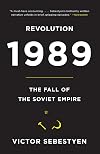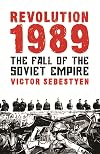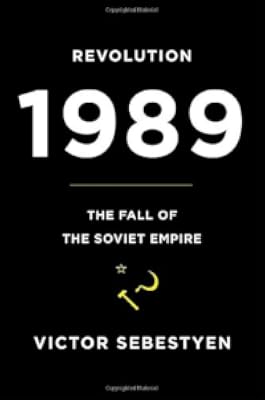
Revolution 1989: The Fall of the Soviet Empire
by Victor Sebestyen
On This Page
Description
Documents the collapse of the Soviet Union's European empire (East Germany, Poland, Czechoslvakia, Hungary, Romania, and Bulgaria) and the transition of each to independent states, drawing on interviews and newly uncovered archival material to offer insight into 1989's rapid changes and the USSR's minimal resistance.Tags
Recommendations










Member Reviews
(5/12/14-12/12/14)
This is an excellent, detailed and exciting narrative covering the events leading up to and during the almost simultaneous fall of communism in 1989 in the six central and east European countries in the Soviet sphere of influence for the previous 40 years.
The book is divided into three parts: the first deals with the deeper background, in particular worker unrest in Poland in the 1970s and the reasons why the Soviet Union became progressively unable and unwilling to maintain its commitments in eastern Europe - the effect of the Soviet invasion of Afghanistan in 1979 and resulting long drawn out war on its military stretch and morale, and the collapse of world oil prices meaning the decrease of revenue from the sale of show more its natural resources to eastern European and other countries; the second part deals with accelerating developments throughout the mid to late 1980s across the countries; and the third is a chronological account covering events throughout the year, especially during the crucial October to December period.
All six countries are covered, though there is relatively little coverage of Bulgaria, the least familiar of the six to western readers, and the most loyal to the USSR (its leader Zhivkov, in power from 1954-89, once applied to Brezhnev for his country to be accepted as the 16th republic within the USSR). The main stories will be very familiar to most readers of a certain age: in Poland, the rise of Lech Walesa's Solidarity to a position where it challenged Jaruzelski's power but where, in a huge turnaround, they were able to find an accommodation and work together in government; the "Trabi trail" of East Germans across the border to the much freer Hungary and thence to Austria via the defunct electrified fence on the border; (of course) the fall of the Berlin Wall, triggered off accidentally by a mistaken answer by Gunter Schabowski to a journalist's question at a crucial press conference; and the bloody overthrow of Romania's Ceausescu, the worst of the lot in a violent confrontation which distinguished events in that country from the otherwise very largely peaceful revolutions in the others, as epitomised by the name of the Velvet Revolution in Czechoslovakia.
Another common feature between nearly all of the six countries was the fact that they had become massively indebted to western banks to keep their economies going and to maintain a decent standard of living for their people; and this combined with the refusal of the Soviets under Gorbachev to bail them out, brought out a degree of opposition from workers who might not have been motivated to oppose their governments purely on the grounds of the lack of political freedoms and civil liberties. 5/5
[A brief note on the Kindle version of this book: the publishers seem to have a problem with diacritical signs in Czech and Romanian, so some of the names come out oddly.] show less
This is an excellent, detailed and exciting narrative covering the events leading up to and during the almost simultaneous fall of communism in 1989 in the six central and east European countries in the Soviet sphere of influence for the previous 40 years.
The book is divided into three parts: the first deals with the deeper background, in particular worker unrest in Poland in the 1970s and the reasons why the Soviet Union became progressively unable and unwilling to maintain its commitments in eastern Europe - the effect of the Soviet invasion of Afghanistan in 1979 and resulting long drawn out war on its military stretch and morale, and the collapse of world oil prices meaning the decrease of revenue from the sale of show more its natural resources to eastern European and other countries; the second part deals with accelerating developments throughout the mid to late 1980s across the countries; and the third is a chronological account covering events throughout the year, especially during the crucial October to December period.
All six countries are covered, though there is relatively little coverage of Bulgaria, the least familiar of the six to western readers, and the most loyal to the USSR (its leader Zhivkov, in power from 1954-89, once applied to Brezhnev for his country to be accepted as the 16th republic within the USSR). The main stories will be very familiar to most readers of a certain age: in Poland, the rise of Lech Walesa's Solidarity to a position where it challenged Jaruzelski's power but where, in a huge turnaround, they were able to find an accommodation and work together in government; the "Trabi trail" of East Germans across the border to the much freer Hungary and thence to Austria via the defunct electrified fence on the border; (of course) the fall of the Berlin Wall, triggered off accidentally by a mistaken answer by Gunter Schabowski to a journalist's question at a crucial press conference; and the bloody overthrow of Romania's Ceausescu, the worst of the lot in a violent confrontation which distinguished events in that country from the otherwise very largely peaceful revolutions in the others, as epitomised by the name of the Velvet Revolution in Czechoslovakia.
Another common feature between nearly all of the six countries was the fact that they had become massively indebted to western banks to keep their economies going and to maintain a decent standard of living for their people; and this combined with the refusal of the Soviets under Gorbachev to bail them out, brought out a degree of opposition from workers who might not have been motivated to oppose their governments purely on the grounds of the lack of political freedoms and civil liberties. 5/5
[A brief note on the Kindle version of this book: the publishers seem to have a problem with diacritical signs in Czech and Romanian, so some of the names come out oddly.] show less
4680. Revolution 1989 The Fall of the Soviet Empire, by Victor Sebestyen (read 4 Mar 2010) This book tells the story of the events leading to the gloried year of 1989 when Communism in eastern Europe fell. It is not really history but it is more than journalism and I think it is well-done. I found it consistently interest-holding and informative, even though I lived through those momentous years. One marvels at the boon Gorbachov bestowed on the world by his determined effort not to impede the revolutions in the six satellites. And that Bush 42 did so little to encourage them. A worthwhile book and easy to read.
This book details what happened in the Warsaw Pact states in 1989: Poland, East Germany, Czechoslovakia, Hungary, Romania and Bugaria. Each chapter is a short summary of a specific event in a location, and most chapters are no more than 3 or 4 pages long. The first half of the book explains the events leading up to 1989 and why Communism fell in that year, staring from about 1970. The second half is all about different events in 1989 throughout Eastern Europe. There is no discussion about events in the Soviet Union, except for going over the changes of leadership in the early 1980's and the policies Gorbachev enacted to allow the revolutions to take place. All together, a very detailed look at the events of the non-Soviet Communist show more states, with all six states nearly equally examined. show less
Ratings
Members
- Recently Added By
Published Reviews
ThingScore 75
A lot of this is familiar ground... But [Sebestyen offers] new vantages on the 1989 revolutions, alternating accounts of protests on the streets of East Berlin, Warsaw, Prague, and other Eastern-bloc capitals with deliberations behind the scenes in Moscow and Washington from sources unavailable to earlier chroniclers.
added by Shortride
Lists

Best General History Books
103 works; 23 members

The Cold War
54 works; 2 members
Non-Fiction Worth Reading
1,025 works; 264 members

All Things Russia
459 works; 11 members

Europe
205 works; 6 members
Author Information

14 Works 1,301 Members
Common Knowledge
- Canonical title
- Revolution 1989: The Fall of the Soviet Empire
- Original publication date
- 2009
- Important places
- USSR
- Dedication
- In memory of my mother Eva
and Patricia Diggory - Publisher's editor
- Ion Trewin; Bea Hemming; Linden Lawson
Classifications
- Genres
- History, Nonfiction, General Nonfiction, Politics and Government
- DDC/MDS
- 947.0854 — History & geography History of Europe Eastern European Counties and Russia Russian & Slavic History by Period 1855- 1953-1991 1982- (Andropov, Chernenko, Gorbachev)
- LCC
- DK288 .S393 — History of Europe, Asia, Africa and Oceania Russia. Soviet Union. Former Soviet Republics – Poland History of Russia. Soviet Union. Former Soviet Republics History Soviet regime, 1918-1991
- BISAC
Statistics
- Members
- 299
- Popularity
- 107,805
- Reviews
- 3
- Rating
- (4.17)
- Languages
- English, Polish, Portuguese
- Media
- Paper, Audiobook, Ebook
- ISBNs
- 10
- ASINs
- 6