
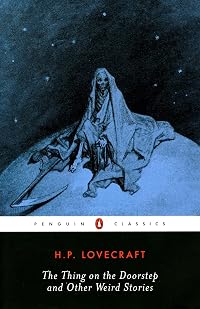
The Thing on the Doorstep and Other Weird Stories
by H. P. Lovecraft
H. P. Lovecraft Omnibus Collections (Penguin Classics) (2)
On This Page
Description
"Part of a new six-volume series of the best in classic horror, selected by award-winning director Guillermo del Toro Filmmaker and longtime horror literature fan Guillermo del Toro serves as the curator for the Penguin Horror series, a new collection of classic tales and poems by masters of the genre. Included here are some of del Toro's favorites, from Mary Shelley's Frankenstein and Ray Russell's short story "Sardonicus," considered by Stephen King to be "perhaps the finest example of the show more modern Gothic ever written," to Shirley Jackson's The Haunting of Hill House and stories by Ray Bradbury, Joyce Carol Oates, Ted Klein, and Robert E. Howard. Featuring original cover art by Penguin Art Director Paul Buckley, these stunningly creepy deluxe hardcovers will be perfect additions to the shelves of horror, sci-fi, fantasy, and paranormal aficionados everywhere. The Thing on the Doorstep and Other Weird Stories Howard Phillips Lovecraft's unique contribution to American literature was a melding of traditional supernaturalism (derived chiefly from Edgar Allan Poe) with the genre of science fiction that emerged in the early 1920s. The Thing on the Doorstep and Other Weird Stories brings together a dozen of the master's tales-from his early short stories "Under the Pyramids" (originally ghostwritten for Harry Houdini) and "The Music of Erich Zann" (which Lovecraft ranked second among his own favorites) through his more fully developed works, "The Dunwich Horror," "The Case of Charles Dexter Ward," and "At the Mountains of Madness." The book presents the definitive corrected texts of these works, along with Lovecraft critic and biographer S.T. Joshi's illuminating introduction and notes to each story"-- show lessTags
Recommendations



















Member Reviews
Lovecraft's stories could be classic - the Cthulhu ones, for example - but his collection was a mix of hit-and-misses.
This story however, is definitely one of the hits. It conveys a nice sense of horror with what happened with the real Asenath Waite, and the ultimate fate of the narrator's friend. There's a movie of this, but I haven't seen it, so I can't compare the two, but the written story is bloody fantastic on its own and in my opinion, one of Lovecraft's best.
This story however, is definitely one of the hits. It conveys a nice sense of horror with what happened with the real Asenath Waite, and the ultimate fate of the narrator's friend. There's a movie of this, but I haven't seen it, so I can't compare the two, but the written story is bloody fantastic on its own and in my opinion, one of Lovecraft's best.
"The Thing On The Doorstep" is a super creepy short story as only H.P. can do! It's a body/soul switching thing, steeped in mystery and the arcane arts that just freaks the reader out! Whew! But I did keep having one "weird" thought as the story progressed - did Edward and Asenath consummate their marriage? Eww...
This is my personal favourite of the three Penguin volumes that S. T. has edited for Penguin Classics. It begins with an in-depth Introduction of over eight pages. The stories are arranged in chronological order according to date written, and thus to read the book in order is to watch Lovecraft's growth as a writer. Again, as with THE CALL OF CTHULHU AND OTHER WEIRD STORIES, we find that Lovecraft was an excellent writing in complete control of his prose styles, which varied according to the mood and tone he wished to produce with individual tales. The Contents:
The Tomb
Beyond the Wall of Sleep
The White Ship
The Temple
The Quest of Iranon
The Music of Erich Zann
Under the Pyramids
Pickman's Model
The Case of Charles Dexter Ward
The Dunwich show more Horror
At the Mountains of Madness
The Thing on the Doorstep
With this book we discover an author who wrote in all genres of fantasy, horror and science fiction, and an author who combined these genres and thus created his own: Lovecraftian horror. Lovecraft began writing primarily as a poet, and his prose is often beautifully poetic, as we find in the dream-like narratives of tales such as "The White Ship," "The Quest of Iranon," and "The Music of Erich Zann." "Zann" is intriguing in that, similar to "The Outsider," it is told as though the narrator is relating an actual incident, but it could easily be an exposition of remembered dream, or a confused recollection of a mixture of dream and reality. The city in which the narrator exists seems at times a tissue of smoke and darkness, an outre and unearthly realm. The writing of this beautiful tale is especially effective and precise, shewing an author who is in complete control.
Completely different is "Pickman's Model," the narrative tone of which is different from anything else in Lovecraft. It's a simple tale easily told, and yet it has delicious depths of suggested horror. What is the painter's link to the nightmares revealed on his canvases? Why is he eventually shunned as if he himself is some sinister thing less than human? (And what is his connection with the dreamlands, wherein he indeed becomes the monster hinted at in "Pickman's Model"?) Unlike "Zann," we know absolutely that this tale is set in solid reality, in the air we breathe in; an air that is tainted with unknown, nightmarish things. The story is also fascinating in that with it Lovecraft discusses his ideas concerning the fantastic as it is manifested in Art. I took this book with me when I went to visit Boston's North End, and used it as a kid of guide to that delicious realm within the city.
It is incredible that such a solid accomplish as THE CASE OF CHARLES DEXTER WARD is in fact a rough first draft that Lovecraft decided not to destroy, as he destroy'd so many other experiments. I have often rued that Lovecraft never polished and submitted this work to book publishers, some few of which requested a novel from him; but perhaps the novel would have been rejected as had all of the collections that HPL did submit to publishers. I am re-reading this novel now, as I prepare to visit Providence next month for what will be an intensely excellent convention, NecronomiCon Providence 2013 (August 22-25, 2013). I find this one of Lovecraft's most compelling works, and it is indeed my favourite of his tales following "The Haunter of the Dark." Especially intriguing is the idea of Yog-Sothoth as an alchemical agent that one can conjure through arcane formula. Some scholars have concluded that Lovecraft's gods and monsters are "merely" outrageous aliens from outer space; but this idea cannot be applied to a creature of alien DIMENSION that can be called forth via black magick.
"The Dunwich Horror" remains one of my favourite tales, up to its rather clumsy ending. There are so many fascinating aspects: the idea of who, or what, actually impregnated Lavinia (why does the offspring, at the climax of the tale, have half a face that resembles the face of Lavinia's sire...?) Wilbur Whateley is one of the coolest creations in weird literature, and his death scene is amazing. But with the release of the actual Dunwich Horror, especially toward the end when the men of science trail the daemon, with one fellow carrying an insecticide canister containing a magic powder to be shot at the monster, for no other purpose that revealing the creature's outline--well, I just have to shake my head in confusion at Lovecraft's choices here.
When I was young, AT THE MOUNTAINS OF MADNESS proved too intimidating for me. It was too intellectual, too scientific, too difficult, and I couldn't get into it. Over the years, blessed by maturity, I have return'd to this work again and again, and with each new reading this story grows in magnificence and power. It is indeed a masterpiece.
All in all, a very fine collection of excellent stories from a Master of Horror. These are classics to which I return again and again, finding with each new reading new depths of dark wonder. show less
The Tomb
Beyond the Wall of Sleep
The White Ship
The Temple
The Quest of Iranon
The Music of Erich Zann
Under the Pyramids
Pickman's Model
The Case of Charles Dexter Ward
The Dunwich show more Horror
At the Mountains of Madness
The Thing on the Doorstep
With this book we discover an author who wrote in all genres of fantasy, horror and science fiction, and an author who combined these genres and thus created his own: Lovecraftian horror. Lovecraft began writing primarily as a poet, and his prose is often beautifully poetic, as we find in the dream-like narratives of tales such as "The White Ship," "The Quest of Iranon," and "The Music of Erich Zann." "Zann" is intriguing in that, similar to "The Outsider," it is told as though the narrator is relating an actual incident, but it could easily be an exposition of remembered dream, or a confused recollection of a mixture of dream and reality. The city in which the narrator exists seems at times a tissue of smoke and darkness, an outre and unearthly realm. The writing of this beautiful tale is especially effective and precise, shewing an author who is in complete control.
Completely different is "Pickman's Model," the narrative tone of which is different from anything else in Lovecraft. It's a simple tale easily told, and yet it has delicious depths of suggested horror. What is the painter's link to the nightmares revealed on his canvases? Why is he eventually shunned as if he himself is some sinister thing less than human? (And what is his connection with the dreamlands, wherein he indeed becomes the monster hinted at in "Pickman's Model"?) Unlike "Zann," we know absolutely that this tale is set in solid reality, in the air we breathe in; an air that is tainted with unknown, nightmarish things. The story is also fascinating in that with it Lovecraft discusses his ideas concerning the fantastic as it is manifested in Art. I took this book with me when I went to visit Boston's North End, and used it as a kid of guide to that delicious realm within the city.
It is incredible that such a solid accomplish as THE CASE OF CHARLES DEXTER WARD is in fact a rough first draft that Lovecraft decided not to destroy, as he destroy'd so many other experiments. I have often rued that Lovecraft never polished and submitted this work to book publishers, some few of which requested a novel from him; but perhaps the novel would have been rejected as had all of the collections that HPL did submit to publishers. I am re-reading this novel now, as I prepare to visit Providence next month for what will be an intensely excellent convention, NecronomiCon Providence 2013 (August 22-25, 2013). I find this one of Lovecraft's most compelling works, and it is indeed my favourite of his tales following "The Haunter of the Dark." Especially intriguing is the idea of Yog-Sothoth as an alchemical agent that one can conjure through arcane formula. Some scholars have concluded that Lovecraft's gods and monsters are "merely" outrageous aliens from outer space; but this idea cannot be applied to a creature of alien DIMENSION that can be called forth via black magick.
"The Dunwich Horror" remains one of my favourite tales, up to its rather clumsy ending. There are so many fascinating aspects: the idea of who, or what, actually impregnated Lavinia (why does the offspring, at the climax of the tale, have half a face that resembles the face of Lavinia's sire...?) Wilbur Whateley is one of the coolest creations in weird literature, and his death scene is amazing. But with the release of the actual Dunwich Horror, especially toward the end when the men of science trail the daemon, with one fellow carrying an insecticide canister containing a magic powder to be shot at the monster, for no other purpose that revealing the creature's outline--well, I just have to shake my head in confusion at Lovecraft's choices here.
When I was young, AT THE MOUNTAINS OF MADNESS proved too intimidating for me. It was too intellectual, too scientific, too difficult, and I couldn't get into it. Over the years, blessed by maturity, I have return'd to this work again and again, and with each new reading this story grows in magnificence and power. It is indeed a masterpiece.
All in all, a very fine collection of excellent stories from a Master of Horror. These are classics to which I return again and again, finding with each new reading new depths of dark wonder. show less
This collection is part of a series of six volumes of Penguin Horror selected by film director Guillermo Del Toro who as Series Editor provides an introduction which covers the entire series while Lovecraft biographer S. T. Joshi acts as Editor providing an introduction as well as commentary on each story along with extensive endnotes. Lovecraft has a unique style which definitely creates an enveloping atmosphere and sense of dread. His stories of the fantastic frequently feature doomed characters, always male, confronting cosmic horrors that even when they survive with their lives are left broken in mind and spirit. If the telling and the tales get a bit repetitive I was still glad to have finally experienced the chills of Lovecraft's show more doom-laden oeuvre. I look forward to returning to his Arkham along the Miskatonic River and answering the call of Cthuhlu. show less
Brilliantly written and often super scary collection of some of H.P.Lovecraft's best work. This collection includes "The Dunwich Horror" and my favourite Lovecraft short story "The Music of Erik Zahnn" (Apologies for the spelling there). A must for lovers of horror and the occult.
THE TOMB
An horror short story written in June 1917.
‘All things appear as they do only by virtue of the delicate individual physical and mental media through which we are made conscious of them.’ (p. 1)
Jervas Dudley discovered the entrance to a mausoleum belonging to the Hyde family , whose house had burnt many years before.
Jervas attempts to enter in the tomb, but he is unable; so, inspired by an example of Plutarch’s Lives, he decides to wait until it is his time to gain entrance to the tomb.
After several years, while Jervas is sleeping beside the mausoleum, he believes to see a light from inside the tomb. He finds the key to the tomb and inside the mausoleum Jervas discovers an empty coffin with the name of Jervas Hyde upon the show more plate.
Following again the example of Plutarch he starts to sleep inside the coffin, so to gain the name upon it.
Jervas is awoken by his father and discovers that he has never been inside the tomb.
A desire becomes dream, or nightmare: every person change with his consciousness the appearances of the things.
////////////////////// ///////////////////////// //////////////////////////////////////
BEYOND THE WALL OF SLEEP and THE WHITE SHIP
‘There is probably a tremendous but invisible stellar orbit in which our very different ways and goals may be included as small parts of this path — let us rise up to this thought! But our life is too short and our power of vision too small for us to be more than friends in the sense of this sublime possibility.
Let us then believe in our star friendship even if we should be compelled to be earth enemies.’
Friedrich Nietzsche
Beyond the Wall of Sleep was written in 1919. Joe Slater is a murderer confined in a mental hospital. He dreams of otherworld with fantastic visions.
An intern of the hospital has built a device for two-way telepathic communication. To test the device the intern attaches himself with Slater. The intern starts to receive a message from a being of light, who explains that all men are light beings. Beyond the wall of sleep, humans are light beings and they experience visions of other world.
Is Slater a star in the sky?
The best parts:
‘I am your brother of light, and have floated with you in the effulgent valleys. … we are all roamers of vast spaces and travellers in many ages. Next year I may be dwelling in the dark Egypt which you call ancient, or in the cruel empire of Tsan-Chan which isto come three thousand years hence.’
‘We shall meet again - perhaps in the shining mists of Orion’s Sword, perhaps on a bleak plateau in prehistoric Asia. Perhaps in unremembered dreams tonight; perhaps in some other form an aeon hence, when the solar system shall have been swept away.’ (p. 19)
*********************************************************************
The White Ship was first published in 1919.
Dream or imagination?
Basil Elton is a lighthouse keeper when a bearded man piloting a white ship and sailing upon a bridge of moonlight, takes Basil on board. They start a voyage towards mystical islands. Basil learns about Cathuria, the land of Hope. This land is ‘beyond the basalt pillars of the West. … but who can tell what lies beyond the basalt pillars of the West?’ (p.24)
Maybe:
Beyond some symbolical connections between The White Ship and desire of the unknown …
Beyond some connection between The White Ship and Plato’s lost realm of Atlantis situated beyond, again, the Pillars of Hercules …
The White Ship is the calling / imagination / evocation of fantastic worlds beyond and inside the Pillars of Hercules.
A quotation:
‘for ocean is more ancient than the mountains, and freighted with the memories and the dreams of Time.’ (p. 21)
*********************************************************************
THE MUSIC OF ERICH ZANN
The Music of Erich Zann was written December 1921.
An university student rents an apartment in an almost empty building. Another tenant of the building is an old German man named Erich Zann.
Erich is mute and plays melodies ‘never heard before.’ Erich tells to the student that he has discovered sounds of an otherworldly nature. But Erich’s main reason to play these melodies is to keep back from his window unknown creatures looking ‘illimitable blackness.’
‘Then I remembered my old wish to gaze from this window … It was very dark, but the city’s lights always burned, and I expected to see them there amidst the rain and wind. Yet when I looked from the highest of all gable windows, looked while the candles sputtered and the insane viol howled with the night-wind, I saw no city spread below, and no friendly lights, gleaming from remembered streets, but only the blackness of space illimitable; unimagined space alive with motion and music, and having no semblance to anything on earth.’ (page 51)
Lovecraft can hear from the space without end the planet’s motion: a music indescribable with words.
********************************************************************
THE TEMPLE
The Temple (1920) is narrated as a found manuscript written by Lieutenant Commander in the Imperial German Navy, Altberg and during WWI.
The manuscript describes the last days of Altberg and his U-boat before sinking at the bottom of the ocean.
After defeating a British freighter, Altberg and his crew find a dead body with a strange piece of carved ivory in his pocket. One of Altberg’s officers keeps the object, but soon after a series of unexplained accidents occurs.
Altberg survives after his crew, but he doesn’t manage to con the U-boat and lands at the bottom of the ocean.
Altberg discovers that he is surrounded by the remains of an ancient city: Atlantis?
Lovecraft spoils this story when he describes Altberg’s germanophile feeling.
‘But the story is significant in postulating an entire civilization antedating humanity and possibly responsible for many of the intellectual and aesthetic acievements of humanity.’ (from explanatory notes by S.T. Joshi, page 374)
********************************************************************* show less
An horror short story written in June 1917.
‘All things appear as they do only by virtue of the delicate individual physical and mental media through which we are made conscious of them.’ (p. 1)
Jervas Dudley discovered the entrance to a mausoleum belonging to the Hyde family , whose house had burnt many years before.
Jervas attempts to enter in the tomb, but he is unable; so, inspired by an example of Plutarch’s Lives, he decides to wait until it is his time to gain entrance to the tomb.
After several years, while Jervas is sleeping beside the mausoleum, he believes to see a light from inside the tomb. He finds the key to the tomb and inside the mausoleum Jervas discovers an empty coffin with the name of Jervas Hyde upon the show more plate.
Following again the example of Plutarch he starts to sleep inside the coffin, so to gain the name upon it.
Jervas is awoken by his father and discovers that he has never been inside the tomb.
A desire becomes dream, or nightmare: every person change with his consciousness the appearances of the things.
////////////////////// ///////////////////////// //////////////////////////////////////
BEYOND THE WALL OF SLEEP and THE WHITE SHIP
‘There is probably a tremendous but invisible stellar orbit in which our very different ways and goals may be included as small parts of this path — let us rise up to this thought! But our life is too short and our power of vision too small for us to be more than friends in the sense of this sublime possibility.
Let us then believe in our star friendship even if we should be compelled to be earth enemies.’
Friedrich Nietzsche
Beyond the Wall of Sleep was written in 1919. Joe Slater is a murderer confined in a mental hospital. He dreams of otherworld with fantastic visions.
An intern of the hospital has built a device for two-way telepathic communication. To test the device the intern attaches himself with Slater. The intern starts to receive a message from a being of light, who explains that all men are light beings. Beyond the wall of sleep, humans are light beings and they experience visions of other world.
Is Slater a star in the sky?
The best parts:
‘I am your brother of light, and have floated with you in the effulgent valleys. … we are all roamers of vast spaces and travellers in many ages. Next year I may be dwelling in the dark Egypt which you call ancient, or in the cruel empire of Tsan-Chan which isto come three thousand years hence.’
‘We shall meet again - perhaps in the shining mists of Orion’s Sword, perhaps on a bleak plateau in prehistoric Asia. Perhaps in unremembered dreams tonight; perhaps in some other form an aeon hence, when the solar system shall have been swept away.’ (p. 19)
*********************************************************************
The White Ship was first published in 1919.
Dream or imagination?
Basil Elton is a lighthouse keeper when a bearded man piloting a white ship and sailing upon a bridge of moonlight, takes Basil on board. They start a voyage towards mystical islands. Basil learns about Cathuria, the land of Hope. This land is ‘beyond the basalt pillars of the West. … but who can tell what lies beyond the basalt pillars of the West?’ (p.24)
Maybe:
Beyond some symbolical connections between The White Ship and desire of the unknown …
Beyond some connection between The White Ship and Plato’s lost realm of Atlantis situated beyond, again, the Pillars of Hercules …
The White Ship is the calling / imagination / evocation of fantastic worlds beyond and inside the Pillars of Hercules.
A quotation:
‘for ocean is more ancient than the mountains, and freighted with the memories and the dreams of Time.’ (p. 21)
*********************************************************************
THE MUSIC OF ERICH ZANN
The Music of Erich Zann was written December 1921.
An university student rents an apartment in an almost empty building. Another tenant of the building is an old German man named Erich Zann.
Erich is mute and plays melodies ‘never heard before.’ Erich tells to the student that he has discovered sounds of an otherworldly nature. But Erich’s main reason to play these melodies is to keep back from his window unknown creatures looking ‘illimitable blackness.’
‘Then I remembered my old wish to gaze from this window … It was very dark, but the city’s lights always burned, and I expected to see them there amidst the rain and wind. Yet when I looked from the highest of all gable windows, looked while the candles sputtered and the insane viol howled with the night-wind, I saw no city spread below, and no friendly lights, gleaming from remembered streets, but only the blackness of space illimitable; unimagined space alive with motion and music, and having no semblance to anything on earth.’ (page 51)
Lovecraft can hear from the space without end the planet’s motion: a music indescribable with words.
********************************************************************
THE TEMPLE
The Temple (1920) is narrated as a found manuscript written by Lieutenant Commander in the Imperial German Navy, Altberg and during WWI.
The manuscript describes the last days of Altberg and his U-boat before sinking at the bottom of the ocean.
After defeating a British freighter, Altberg and his crew find a dead body with a strange piece of carved ivory in his pocket. One of Altberg’s officers keeps the object, but soon after a series of unexplained accidents occurs.
Altberg survives after his crew, but he doesn’t manage to con the U-boat and lands at the bottom of the ocean.
Altberg discovers that he is surrounded by the remains of an ancient city: Atlantis?
Lovecraft spoils this story when he describes Altberg’s germanophile feeling.
‘But the story is significant in postulating an entire civilization antedating humanity and possibly responsible for many of the intellectual and aesthetic acievements of humanity.’ (from explanatory notes by S.T. Joshi, page 374)
********************************************************************* show less
THE TOMB
An horror short story written in June 1917.
‘All things appear as they do only by virtue of the delicate individual physical and mental media through which we are made conscious of them.’ (p. 1)
Jervas Dudley discovered the entrance to a mausoleum belonging to the Hyde family , whose house had burnt many years before.
Jervas attempts to enter in the tomb, but he is unable; so, inspired by an example of Plutarch’s Lives, he decides to wait until it is his time to gain entrance to the tomb.
After several years, while Jervas is sleeping beside the mausoleum, he believes to see a light from inside the tomb. He finds the key to the tomb and inside the mausoleum Jervas discovers an empty coffin with the name of Jervas Hyde upon the show more plate.
Following again the example of Plutarch he starts to sleep inside the coffin, so to gain the name upon it.
Jervas is awoken by his father and discovers that he has never been inside the tomb.
A desire becomes dream, or nightmare: every person change with his consciousness the appearances of the things.
/////////////// /////////// //////////////////
BEYOND THE WALL OF SLEEP and THE WHITE SHIP
‘There is probably a tremendous but invisible stellar orbit in which our very different ways and goals may be included as small parts of this path — let us rise up to this thought! But our life is too short and our power of vision too small for us to be more than friends in the sense of this sublime possibility.
Let us then believe in our star friendship even if we should be compelled to be earth enemies.’
Friedrich Nietzsche
Beyond the Wall of Sleep was written in 1919. Joe Slater is a murderer confined in a mental hospital. He dreams of otherworld with fantastic visions.
An intern of the hospital has built a device for two-way telepathic communication. To test the device the intern attaches himself with Slater. The intern starts to receive a message from a being of light, who explains that all men are light beings. Beyond the wall of sleep, humans are light beings and they experience visions of other world.
Is Slater a star in the sky?
The best parts:
‘I am your brother of light, and have floated with you in the effulgent valleys. … we are all roamers of vast spaces and travellers in many ages. Next year I may be dwelling in the dark Egypt which you call ancient, or in the cruel empire of Tsan-Chan which isto come three thousand years hence.’
‘We shall meet again - perhaps in the shining mists of Orion’s Sword, perhaps on a bleak plateau in prehistoric Asia. Perhaps in unremembered dreams tonight; perhaps in some other form an aeon hence, when the solar system shall have been swept away.’ (p. 19)
*********************************************************************
The White Ship was first published in 1919.
Dream or imagination?
Basil Elton is a lighthouse keeper when a bearded man piloting a white ship and sailing upon a bridge of moonlight, takes Basil on board. They start a voyage towards mystical islands. Basil learns about Cathuria, the land of Hope. This land is ‘beyond the basalt pillars of the West. … but who can tell what lies beyond the basalt pillars of the West?’ (p.24)
Maybe:
Beyond some symbolical connections between The White Ship and desire of the unknown …
Beyond some connection between The White Ship and Plato’s lost realm of Atlantis situated beyond, again, the Pillars of Hercules …
The White Ship is the calling / imagination / evocation of fantastic worlds beyond and inside the Pillars of Hercules.
A quotation:
‘for ocean is more ancient than the mountains, and freighted with the memories and the dreams of Time.’ (p. 21)
/////////////// //////////////// ///////////////////
THE MUSIC OF ERICH ZANN
The Music of Erich Zann was written December 1921.
An university student rents an apartment in an almost empty building. Another tenant of the building is an old German man named Erich Zann.
Erich is mute and plays melodies ‘never heard before.’ Erich tells to the student that he has discovered sounds of an otherworldly nature. But Erich’s main reason to play these melodies is to keep back from his window unknown creatures looking ‘illimitable blackness.’
‘Then I remembered my old wish to gaze from this window … It was very dark, but the city’s lights always burned, and I expected to see them there amidst the rain and wind. Yet when I looked from the highest of all gable windows, looked while the candles sputtered and the insane viol howled with the night-wind, I saw no city spread below, and no friendly lights, gleaming from remembered streets, but only the blackness of space illimitable; unimagined space alive with motion and music, and having no semblance to anything on earth.’ (page 51)
Lovecraft can hear from the space without end the planet’s motion: a music indescribable with words.
***********************************************************************
THE TEMPLE
The Temple (1920) is narrated as a found manuscript written by Lieutenant Commander in the Imperial German Navy, Altberg and during WWI.
The manuscript describes the last days of Altberg and his U-boat before sinking at the bottom of the ocean.
After defeating a British freighter, Altberg and his crew find a dead body with a strange piece of carved ivory in his pocket. One of Altberg’s officers keeps the object, but soon after a series of unexplained accidents occurs.
Altberg survives after his crew, but he doesn’t manage to con the U-boat and lands at the bottom of the ocean.
Altberg discovers that he is surrounded by the remains of an ancient city: Atlantis?
Lovecraft spoils this story when he describes Altberg’s germanophile feeling.
‘But the story is significant in postulating an entire civilization antedating humanity and possibly responsible for many of the intellectual and aesthetic acievements of humanity.’ (from explanatory notes by S.T. Joshi, page 374)
************************************************************************ show less
An horror short story written in June 1917.
‘All things appear as they do only by virtue of the delicate individual physical and mental media through which we are made conscious of them.’ (p. 1)
Jervas Dudley discovered the entrance to a mausoleum belonging to the Hyde family , whose house had burnt many years before.
Jervas attempts to enter in the tomb, but he is unable; so, inspired by an example of Plutarch’s Lives, he decides to wait until it is his time to gain entrance to the tomb.
After several years, while Jervas is sleeping beside the mausoleum, he believes to see a light from inside the tomb. He finds the key to the tomb and inside the mausoleum Jervas discovers an empty coffin with the name of Jervas Hyde upon the show more plate.
Following again the example of Plutarch he starts to sleep inside the coffin, so to gain the name upon it.
Jervas is awoken by his father and discovers that he has never been inside the tomb.
A desire becomes dream, or nightmare: every person change with his consciousness the appearances of the things.
/////////////// /////////// //////////////////
BEYOND THE WALL OF SLEEP and THE WHITE SHIP
‘There is probably a tremendous but invisible stellar orbit in which our very different ways and goals may be included as small parts of this path — let us rise up to this thought! But our life is too short and our power of vision too small for us to be more than friends in the sense of this sublime possibility.
Let us then believe in our star friendship even if we should be compelled to be earth enemies.’
Friedrich Nietzsche
Beyond the Wall of Sleep was written in 1919. Joe Slater is a murderer confined in a mental hospital. He dreams of otherworld with fantastic visions.
An intern of the hospital has built a device for two-way telepathic communication. To test the device the intern attaches himself with Slater. The intern starts to receive a message from a being of light, who explains that all men are light beings. Beyond the wall of sleep, humans are light beings and they experience visions of other world.
Is Slater a star in the sky?
The best parts:
‘I am your brother of light, and have floated with you in the effulgent valleys. … we are all roamers of vast spaces and travellers in many ages. Next year I may be dwelling in the dark Egypt which you call ancient, or in the cruel empire of Tsan-Chan which isto come three thousand years hence.’
‘We shall meet again - perhaps in the shining mists of Orion’s Sword, perhaps on a bleak plateau in prehistoric Asia. Perhaps in unremembered dreams tonight; perhaps in some other form an aeon hence, when the solar system shall have been swept away.’ (p. 19)
*********************************************************************
The White Ship was first published in 1919.
Dream or imagination?
Basil Elton is a lighthouse keeper when a bearded man piloting a white ship and sailing upon a bridge of moonlight, takes Basil on board. They start a voyage towards mystical islands. Basil learns about Cathuria, the land of Hope. This land is ‘beyond the basalt pillars of the West. … but who can tell what lies beyond the basalt pillars of the West?’ (p.24)
Maybe:
Beyond some symbolical connections between The White Ship and desire of the unknown …
Beyond some connection between The White Ship and Plato’s lost realm of Atlantis situated beyond, again, the Pillars of Hercules …
The White Ship is the calling / imagination / evocation of fantastic worlds beyond and inside the Pillars of Hercules.
A quotation:
‘for ocean is more ancient than the mountains, and freighted with the memories and the dreams of Time.’ (p. 21)
/////////////// //////////////// ///////////////////
THE MUSIC OF ERICH ZANN
The Music of Erich Zann was written December 1921.
An university student rents an apartment in an almost empty building. Another tenant of the building is an old German man named Erich Zann.
Erich is mute and plays melodies ‘never heard before.’ Erich tells to the student that he has discovered sounds of an otherworldly nature. But Erich’s main reason to play these melodies is to keep back from his window unknown creatures looking ‘illimitable blackness.’
‘Then I remembered my old wish to gaze from this window … It was very dark, but the city’s lights always burned, and I expected to see them there amidst the rain and wind. Yet when I looked from the highest of all gable windows, looked while the candles sputtered and the insane viol howled with the night-wind, I saw no city spread below, and no friendly lights, gleaming from remembered streets, but only the blackness of space illimitable; unimagined space alive with motion and music, and having no semblance to anything on earth.’ (page 51)
Lovecraft can hear from the space without end the planet’s motion: a music indescribable with words.
***********************************************************************
THE TEMPLE
The Temple (1920) is narrated as a found manuscript written by Lieutenant Commander in the Imperial German Navy, Altberg and during WWI.
The manuscript describes the last days of Altberg and his U-boat before sinking at the bottom of the ocean.
After defeating a British freighter, Altberg and his crew find a dead body with a strange piece of carved ivory in his pocket. One of Altberg’s officers keeps the object, but soon after a series of unexplained accidents occurs.
Altberg survives after his crew, but he doesn’t manage to con the U-boat and lands at the bottom of the ocean.
Altberg discovers that he is surrounded by the remains of an ancient city: Atlantis?
Lovecraft spoils this story when he describes Altberg’s germanophile feeling.
‘But the story is significant in postulating an entire civilization antedating humanity and possibly responsible for many of the intellectual and aesthetic acievements of humanity.’ (from explanatory notes by S.T. Joshi, page 374)
************************************************************************ show less
Members
- Recently Added By
Lists

Weird and Weirder Fiction
270 works; 35 members

Best Horror Books
281 works; 85 members

Classics you know you should have read but probably haven't
421 works; 408 members

Survey of Gothic and Horror Literature
18 works; 4 members

Short Story Collections and Anthologies
261 works; 42 members

20th Century Literature
1,161 works; 55 members
Nightmare Magazine's Top 100 Horror Books
100 works; 7 members

Unread books
1,063 works; 87 members

Most Popular Penguins
70 works; 5 members

Best of American Literature
146 works; 9 members
Author Information

1,921+ Works 73,844 Members
Howard Phillips Lovecraft, 1890 - 1937 H. P. Lovecraft was born on August 20, 1890 in Providence, Rhode Island. His mother was Sarah Susan Phillips Lovecraft and his father was Winfield Scott Lovecraft, a traveling salesman for Gorham & Co. Silversmtihs. Lovecraft was reciting poetry at the age of two and when he was three years old, his father show more suffered a mental breakdown and was admitted to Butler Hospital. He spent five years there before dying on July 19, 1898 of paresis, a form of neurosyphillis. During those five years, Lovecraft was told that his father was paralyzed and in a coma, which was not the case. His mother, two aunts and grandfather were now bringing up Lovecraft. He suffered from frequent illnesses as a boy, many of which were psychological. He began writing between the ages of six and seven and, at about the age of eight, he discovered science. He began to produce the hectographed journals, "The Scientific Gazette" (1899-1907) and "The Rhode Island Journal of Astronomy" (1903-07). His first appearance in print happened, in 1906, when he wrote a letter on an astronomical matter to The Providence Sunday Journal. A short time later, he began writing a monthly astronomy column for The Pawtuxet Valley Gleaner - a rural paper. He also wrote columns for The Providence Tribune (1906-08), The Providence Evening News (1914-18), The Asheville (N.C.) Gazette-News (1915). In 1904, his grandfather died and the family suffered severe financial difficulties, which forced him and his mother to move out of their Victorian home. Devastated by this, he apparently contemplated suicide. In 1908, before graduating from high school, he suffered a nervous breakdown. He didn't receive a diploma and failed to get into Brown University, both of which caused him great shame. Lovecraft was not heard from for five years, re-emerging because of a letter he wrote in protest to Fred Jackson's love story in The Argosy. His letter was published in 1913 and caused great controversy, which was noted by Edward F. Daas, President of the United Amateur Press Association (UAPA). Daas invited Lovecraft to join the UAPA, which he did in early 1914. He eventually became President and Official Editor of the UAPA and served briefly as President of the rival National Amateur Press Association (NAPA). He published thirteen issues of his own paper, The Conservative (1915-23) and contributed poetry and essays to other journals. He also wrote some fiction which titles include "The Beast in the Cave" (1905), "The Alchemist" (1908), "The Tomb" and "Dagon" (1917). In 1919, Lovecraft's mother was deteriorating, mentally and physically, and was admitted to Butler Hospital. On May 24, 1921, his mother died from a gall bladder operation. While attending an amateur journalism convention in Boston, Lovecraft met his future wife Sonia Haft Greene, a Russian Jew. They were married on March 3, 1924 and Lovecraft moved to her apartment in Brooklyn. Sonia had a shop on Fifth Avenue that went bankrupt. In 1925, Sonia went to Cleveland for a job and Lovecraft moved to a smaller apartment in the Red Hook district of Brooklyn. In 1926, he decided to move back to Providence. Lovecraft had his aunts bar his wife, Sonia, from going to Providence to start a business because he couldn't have the stigma of a tradeswoman wife. They were divorced in 1929. After his return to Providence, he wrote his greatest fiction, which included the titles "The Call of Cthulhu" (1926), "At the Mountains of Madness" (1931), and "The Shadow Out of Time" (1934-35). In 1932, his aunt, Mrs. Clark, died; and he moved in with his other aunt, Mrs. Gamwell, in 1933. Suffering from cancer of the intestine, Lovecraft was admitted to Jane Brown Memorial Hospital and on March 15, 1937 he died. (Bowker Author Biography) show less
Some Editions
Series

Belongs to Publisher Series
Work Relationships
Contains
Common Knowledge
- Canonical title
- The Thing on the Doorstep and Other Weird Stories
- Original title
- The Thing on the Doorstep and Other Weird Stories
- Original publication date
- 2001-10-02
- People/Characters
- Harry Houdini
- Important places
- Dunwich, Massachusetts, USA; Massachusetts, USA
- First words
- In relating the circumstances which have led to my confinement within this refuge for the demented, I am aware that my present position will create a natural doubt of the authenticity of my narrative.
- Last words
- (Click to show. Warning: May contain spoilers.)Some dental work positively identified the skull as Asenath's.
- Disambiguation notice
- This is a collection of stories.
Classifications
Statistics
- Members
- 1,072
- Popularity
- 23,786
- Reviews
- 13
- Rating
- (4.16)
- Languages
- English, Norwegian (Bokmål)
- Media
- Paper, Ebook
- ISBNs
- 20
- ASINs
- 12