On This Page
Description
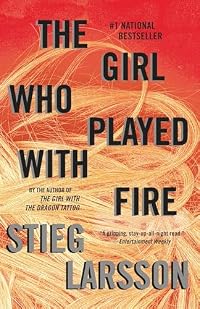
On the eve of publisher Mikael Blomkvist's story about sex trafficking between Eastern Europe and Sweden, two investigating reporters are murdered. And even more shocking for Mikael Blomkvist: the fingerprints found on the murder weapon belong to Lisbeth Salander--the troubled, wise-beyond-her-years genius hacker who came to his aid years before.Tags
Recommendations




























Member Recommendations
julienne_preacher Dark themes and tough yet vulnerable heroines.

Member Reviews
Oh Lisbeth, how I've missed you. This second installment of the Millennium Trilogy finds two of Mikael Blomkvist's friends murdered and Lisbeth's fingerprints on the gun. Thus begins a complicated story of Lisbeth's past, prostitution, and Swedish government secrets. Meanwhile, we're introduced to the various people Lisbeth has touched and who line up to be in her corner during this her darkest hour. When I think of "strong female characters" I don't think about Buffy the Vampire Slayer; I think of people like Lisbeth. She's fascinating and flawed and wonderful to read about. I doubt she'd be all that impressed with me were we to meet, but I've enjoyed witnessing her adventures so far. In fact, the very last couple lines of the book had show more me laughing with joy. Can't wait to read the third book, but part of me is a little reluctant because I don't want to say goodbye. show less
Why is a book filled with violence compelling? The good guys like Mikael Blomkvist help redeem the book's focus on abusively misogynistic men in all walks of life, i.e. police, politics, medicine, law, in addition to gang members.
Salander is one hell of a character. She doesn't suffer fools or abuse. Justifiably cynical, stubborn, temperamental but bright, just, sensitive and loving!
In general I've come to enjoy more intelligent, more nuanced, and less violent mysteries but Larsson's writing is bewitching. Will definitely continue reading the series.
Salander is one hell of a character. She doesn't suffer fools or abuse. Justifiably cynical, stubborn, temperamental but bright, just, sensitive and loving!
In general I've come to enjoy more intelligent, more nuanced, and less violent mysteries but Larsson's writing is bewitching. Will definitely continue reading the series.
If you liked the first one, then you'll like the second book in Stieg Larsson's trilogy about Lisbeth Salander.
And first, my favorite similie: "Salander felt like a bag of bananas that had been left too long in the sun." That made me laugh when I first read it.
In terms of characters, we are given some additional cast members to take into consideration, as well as some familiar faces who reveal more about themselves. If you didn't know already, a main thematic element to this trilogy is a critique on how society treats women. Perhaps some of the attitudes and actions taken by certain characters might be a little exaggerated, but I wouldn't be surprised if I met someone who is as much of a chauvinistic creep as some of the people here. show more Many of the male characters come off as either sadistic perverts who breed off of torturing women, or as reluctant do-gooders when faced with a choice. Obviously, our male hero arrives just in the nick of time to save a zombiefied Salander from imminent death.
The female characters, on the other hand, are all people who have been oppressed by society, whether is be on the basis of their gender, sexual identity, position, or professionalism. They're there to show the reader that no matter how we as a society may grow, there is always some form of discrimination lurking just around the corner. As Salander progresses through the story, she gives us her thoughts on the situation at hand: "Nobody was innocent. There were only varying degrees of responsibility." That line pretty much sums up the mess of problems that seems to be plaguing our characters, not to mention our own selves.
If the characterization weren't enough, Larsson pulls a double whammy on us and pretty much just throws this theme of violence to women out there at us. The sequence of events starts when two people are murdered just before they are about to publish their tell-all revelation on sex trafficking and just how much those in power in society are a part of it. Maybe it's living in the 21st century that has made society more lax in terms of social justice. The fight for women's suffrage was so last century. Correct? Technically, it was only 91 years ago in America (as of this writing). So does that mean that all is well in the world?
Larsson really wants to emphasize the ongoing discrimination and violence that still occurs in our society today. Not just to women, but to people of all minority groups. Some of us might thing that in this technologically advanced society, we are all equal. But not necessarily so: "They were twins, born within twenty minutes of each other. Lisbeth was first. Camilla was beautiful." From her own perspective, Salander is just a number while her twin sister, the same in every regard (figuratively speaking), was identified as 'beautiful.' When we're not treated equally, we may begin to believe that we're not equal.
Thoughts?
Moving on to a more technical standpoint of the story, I would like to mention Larsson's introduction to this part of the story. The first part basically depicts Lisbeth as a heroic figure, someon who saves a life, who is still capable of killing another in the process. Cut to the second part, and we are given a scenario where she murdered three people in cold blood. The stark contrast between both parts seems to be meant to make the reader question their own assumptions about Lisbeth, and thus about what we know about those close to us versus what others may say about them. For most of the book, we are presented with two possibilities: either she killed them, or she didn't. It is up to us to decide which side we are on. Furthermore, Bloomkvist mentions this a number of times, asking other characters to pick a side on what they think about Salander. This choice is also given to us.
I have to say that I really enjoyed this book. Luckily with my Kindle, I can jump right into the next book without fear of wasting time. Mwahahaha. show less
And first, my favorite similie: "Salander felt like a bag of bananas that had been left too long in the sun." That made me laugh when I first read it.
In terms of characters, we are given some additional cast members to take into consideration, as well as some familiar faces who reveal more about themselves. If you didn't know already, a main thematic element to this trilogy is a critique on how society treats women. Perhaps some of the attitudes and actions taken by certain characters might be a little exaggerated, but I wouldn't be surprised if I met someone who is as much of a chauvinistic creep as some of the people here. show more Many of the male characters come off as either sadistic perverts who breed off of torturing women, or as reluctant do-gooders when faced with a choice. Obviously, our male hero arrives just in the nick of time to save a zombiefied Salander from imminent death.
The female characters, on the other hand, are all people who have been oppressed by society, whether is be on the basis of their gender, sexual identity, position, or professionalism. They're there to show the reader that no matter how we as a society may grow, there is always some form of discrimination lurking just around the corner. As Salander progresses through the story, she gives us her thoughts on the situation at hand: "Nobody was innocent. There were only varying degrees of responsibility." That line pretty much sums up the mess of problems that seems to be plaguing our characters, not to mention our own selves.
If the characterization weren't enough, Larsson pulls a double whammy on us and pretty much just throws this theme of violence to women out there at us. The sequence of events starts when two people are murdered just before they are about to publish their tell-all revelation on sex trafficking and just how much those in power in society are a part of it. Maybe it's living in the 21st century that has made society more lax in terms of social justice. The fight for women's suffrage was so last century. Correct? Technically, it was only 91 years ago in America (as of this writing). So does that mean that all is well in the world?
Larsson really wants to emphasize the ongoing discrimination and violence that still occurs in our society today. Not just to women, but to people of all minority groups. Some of us might thing that in this technologically advanced society, we are all equal. But not necessarily so: "They were twins, born within twenty minutes of each other. Lisbeth was first. Camilla was beautiful." From her own perspective, Salander is just a number while her twin sister, the same in every regard (figuratively speaking), was identified as 'beautiful.' When we're not treated equally, we may begin to believe that we're not equal.
Thoughts?
Moving on to a more technical standpoint of the story, I would like to mention Larsson's introduction to this part of the story. The first part basically depicts Lisbeth as a heroic figure, someon who saves a life, who is still capable of killing another in the process. Cut to the second part, and we are given a scenario where she murdered three people in cold blood. The stark contrast between both parts seems to be meant to make the reader question their own assumptions about Lisbeth, and thus about what we know about those close to us versus what others may say about them. For most of the book, we are presented with two possibilities: either she killed them, or she didn't. It is up to us to decide which side we are on. Furthermore, Bloomkvist mentions this a number of times, asking other characters to pick a side on what they think about Salander. This choice is also given to us.
I have to say that I really enjoyed this book. Luckily with my Kindle, I can jump right into the next book without fear of wasting time. Mwahahaha. show less
It feels like a ridiculous cliché to call Stieg Larsson’s premature death a tragedy—no matter how true it is. But now, as I am still breathless having finished the second novel of his dazzling Millennium Trilogy, I truly believe this man has achieved immortality. I can easily imagine his creation Lisbeth Salander joining the ranks of the most enduring literary characters. Once you’ve met Lisbeth, you’ll never forget her.
The Girl Who Played With Fire opens quite provocatively, with an unknown 13-year-old girl being held captive by a sexual predator. Whatever ideas you form at that point—you’re wrong. Trust me, you are. From there, we have some one-on-one time with Lisbeth. She’s been busy since we last saw her, getting a show more personal makeover and taking some time to see the world. She’s been away from Sweden for about a year, and it’s time for her to return home. She left without a word to anyone, and she cautiously begins making contact with the people who care about her, with the notable exception of Mikael Blomkvist. Much to his consternation, she wants nothing to do with him, and has refused all contact.
That’s okay. Mikael’s busy running Millennium magazine and jumping in and out of affairs. And, as it happens, a huge story has just walked into Millennium’s office in the form of Dag Svensson. Dag’s a young journalist who has been researching sex trafficking in Sweden for years. He’s written an explosive book, and he wants Millennium to publish it. They decide not only to take the book, but to build an entire issue of the magazine around it. The question is, how far is someone willing to go to keep a crime quiet?
As an American, I’ve always had a very positive opinion of the Scandinavian peoples. They always seemed “better” than us, more enlightened somehow. Let me tell you, Stieg Larsson has disavowed me of that notion. The Swedes are just as unpleasant as we are. God, maybe worse! Reading this book, written by a native, is a fascinating glimpse at a culture in many ways quite different from our own. Regardless, it seems that people are people and there’s a lot of ignorance, hatred, violence, venality, and sickness in the world.
Others will write more about the plot, but I see no reason to go there. I read this novel without knowing what to expect, and the reading experience was the more enjoyable for it. There were some BIG surprises. That said, the plot was the most flawed part of a luminous novel. On the one had, I absolutely loved it. On the other, Stieg Larsson cheated—not once, but twice! Deep into the middle of the novel, a major plot point revolves around a coincidence. That’s not cool. I had a conflicted internal debate, and had just about decided to let Larsson have a pass on at least a semi-plausible coincidence when he did it again! A second major plot point based on a coincidence. That’s bad. I was so disgusted at that point that I put the book down for a day. But, I have to admit that when I picked it back up, the story moved along at such a headlong pace that I could hardly bare to set it down again. Seriously, I went without food. Ultimately, it’s an amazing story being told, but very flawed from a technical standpoint. As much as I want to, I just can’t give it five stars.
Now, what aren’t flawed are Larsson’s characterizations, and that’s what elevates this novel from being one hell of a good mystery to a work of far greater significance. And as I alluded earlier, it is Lisbeth Salander that is his showstopper. I’ve never met anyone like her. You’ve never met anyone like her. She’s one of a kind; a damaged genius who will break your heart while pissing you off. Lisbeth’s past had only been hinted at in Dragon. We learn a lot more about her in Fire. Happily, I feel confident there is still much to unravel in Hornet’s Nest. The ending of this novel will leave you deeply impatient to get your hands on the final installment, and fearful of how that one will end. show less
The Girl Who Played With Fire opens quite provocatively, with an unknown 13-year-old girl being held captive by a sexual predator. Whatever ideas you form at that point—you’re wrong. Trust me, you are. From there, we have some one-on-one time with Lisbeth. She’s been busy since we last saw her, getting a show more personal makeover and taking some time to see the world. She’s been away from Sweden for about a year, and it’s time for her to return home. She left without a word to anyone, and she cautiously begins making contact with the people who care about her, with the notable exception of Mikael Blomkvist. Much to his consternation, she wants nothing to do with him, and has refused all contact.
That’s okay. Mikael’s busy running Millennium magazine and jumping in and out of affairs. And, as it happens, a huge story has just walked into Millennium’s office in the form of Dag Svensson. Dag’s a young journalist who has been researching sex trafficking in Sweden for years. He’s written an explosive book, and he wants Millennium to publish it. They decide not only to take the book, but to build an entire issue of the magazine around it. The question is, how far is someone willing to go to keep a crime quiet?
As an American, I’ve always had a very positive opinion of the Scandinavian peoples. They always seemed “better” than us, more enlightened somehow. Let me tell you, Stieg Larsson has disavowed me of that notion. The Swedes are just as unpleasant as we are. God, maybe worse! Reading this book, written by a native, is a fascinating glimpse at a culture in many ways quite different from our own. Regardless, it seems that people are people and there’s a lot of ignorance, hatred, violence, venality, and sickness in the world.
Others will write more about the plot, but I see no reason to go there. I read this novel without knowing what to expect, and the reading experience was the more enjoyable for it. There were some BIG surprises. That said, the plot was the most flawed part of a luminous novel. On the one had, I absolutely loved it. On the other, Stieg Larsson cheated—not once, but twice! Deep into the middle of the novel, a major plot point revolves around a coincidence. That’s not cool. I had a conflicted internal debate, and had just about decided to let Larsson have a pass on at least a semi-plausible coincidence when he did it again! A second major plot point based on a coincidence. That’s bad. I was so disgusted at that point that I put the book down for a day. But, I have to admit that when I picked it back up, the story moved along at such a headlong pace that I could hardly bare to set it down again. Seriously, I went without food. Ultimately, it’s an amazing story being told, but very flawed from a technical standpoint. As much as I want to, I just can’t give it five stars.
Now, what aren’t flawed are Larsson’s characterizations, and that’s what elevates this novel from being one hell of a good mystery to a work of far greater significance. And as I alluded earlier, it is Lisbeth Salander that is his showstopper. I’ve never met anyone like her. You’ve never met anyone like her. She’s one of a kind; a damaged genius who will break your heart while pissing you off. Lisbeth’s past had only been hinted at in Dragon. We learn a lot more about her in Fire. Happily, I feel confident there is still much to unravel in Hornet’s Nest. The ending of this novel will leave you deeply impatient to get your hands on the final installment, and fearful of how that one will end. show less
4 stars
RECOMMENDED!
Nearly a year after magazine publisher Mikael Blomkvist brought down a corrupt business man and was nearly killed, he decides to publish someone else’s book detailing the extensive sex trafficking taking place in Sweden. But when the couple producing the story is murdered and the evidence points to the troubled woman who saved Mikael’s live – the genius computer hacker Lisbeth Salander – Mikael must decide who he can trust and just how far he is willing to go to save a friend who refuses to even talk to him.
“No matter how hard she tried to concentrate on something else, to pass the time and to distract her from the situation she was in, the fear came trickling out. It hovered like a cloud of gas around her, show more threatening to penetrate her pores and poison her.”
The Girl Who Played With Fire – the second book of Larsson’s Millennium trilogy – picks up a year after the events of The Girl With The Dragon Tattoo (4.5 stars, Recommended). One of the differences between the books is that the first half of Fire is seen primarily from Lisbeth’s point of view as she returns from traveling the world only to find she is in the crosshairs of several enemies at once. Having walled herself off from Mikael without ever telling him why, she tries to survive on her own. But one by one her few friends are swept up in the trouble surrounding her and she must use her resourcefulness to save them and herself from a man known as Zala – who she knows all too well.
Larsson once again brings his primary characters to life with deft skill. His ability to juggle the dramatically different personalities of Mikael Blomkvist and Lisbeth Salander is quite an accomplishment in and of itself. The story is compelling and Larsson’s writing style is very readable. There are times when Larsson gets bogged down with description, especially in the first half of the book. He also shows an overindulgence in laying bare the sexual history and inclinations of every single character – to the point of distraction in many cases. But when the story hits its stride all of those minor flaws are forgiven. The ending is both exciting and unexpected.
All in all, The Girl Who Played With Fire is a worthy sequel to The Girl With The Dragon Tattoo. While I didn’t find it quite as compelling as the first – and this is really splitting hairs – it was engrossing enough to ensure that I will be reading the final installment very soon. show less
RECOMMENDED!
Nearly a year after magazine publisher Mikael Blomkvist brought down a corrupt business man and was nearly killed, he decides to publish someone else’s book detailing the extensive sex trafficking taking place in Sweden. But when the couple producing the story is murdered and the evidence points to the troubled woman who saved Mikael’s live – the genius computer hacker Lisbeth Salander – Mikael must decide who he can trust and just how far he is willing to go to save a friend who refuses to even talk to him.
“No matter how hard she tried to concentrate on something else, to pass the time and to distract her from the situation she was in, the fear came trickling out. It hovered like a cloud of gas around her, show more threatening to penetrate her pores and poison her.”
The Girl Who Played With Fire – the second book of Larsson’s Millennium trilogy – picks up a year after the events of The Girl With The Dragon Tattoo (4.5 stars, Recommended). One of the differences between the books is that the first half of Fire is seen primarily from Lisbeth’s point of view as she returns from traveling the world only to find she is in the crosshairs of several enemies at once. Having walled herself off from Mikael without ever telling him why, she tries to survive on her own. But one by one her few friends are swept up in the trouble surrounding her and she must use her resourcefulness to save them and herself from a man known as Zala – who she knows all too well.
Larsson once again brings his primary characters to life with deft skill. His ability to juggle the dramatically different personalities of Mikael Blomkvist and Lisbeth Salander is quite an accomplishment in and of itself. The story is compelling and Larsson’s writing style is very readable. There are times when Larsson gets bogged down with description, especially in the first half of the book. He also shows an overindulgence in laying bare the sexual history and inclinations of every single character – to the point of distraction in many cases. But when the story hits its stride all of those minor flaws are forgiven. The ending is both exciting and unexpected.
All in all, The Girl Who Played With Fire is a worthy sequel to The Girl With The Dragon Tattoo. While I didn’t find it quite as compelling as the first – and this is really splitting hairs – it was engrossing enough to ensure that I will be reading the final installment very soon. show less
How did Stieg Larsson get to be such a feminist? If this book had been written by any other (particularly male) author it would have been a much different read. A book about an investigation into human trafficking - prostitution and the gangs of men who import and exploit young girls and women lends itself so well to the salacious exploitation of women's suffering in the guise of "information". One would normally expect juicy rendering of torture scenes designed to titillate. Larsson evidently doesn't believe torture should be used for entertainment. His main character, Salander, consistently fights against men who hate women, and I think men who enjoy "lovingly" rendered scenes of pain and suffering are just that sort of men. So once show more again yea Salander and yea Larsson for writing a mystery that keeps you guessing without pouring on the prurience. show less
Basically this is a comic book in prose. There are very few characters that are not extremes. The villains are super-villains, the heroes are super-heroes. Everything is big, bold and brightly colored. When there is action it is swift and intense. When there is dialogue it’s pithy and snappy. Reality hardly enters into the equation and that’s what makes these so much fun to read. That and the convoluted plot which, however improbable, is engrossing. This book makes an even bigger statement than the first one I think. The central conspiracy is more personal since it revolves around Salander herself. Yes, she’s a Mary-Sue, but like a performer on a stage in front of thousands, he must make every gesture huge, every expression show more grotesque, every move exaggerated in order for it to come across to the poor slobs in the nosebleed seats. Larsson’s contempt and enmity for men who hate women is an extreme one and a light hand cannot convey what he feels.
I don’t know where he wanted to take this series ultimately since his life was cut short before he could finish, but it’s clear that this second book is only a rung on the ladder. The action ends abruptly and without resolution and I hope we get that in the next book. show less
I don’t know where he wanted to take this series ultimately since his life was cut short before he could finish, but it’s clear that this second book is only a rung on the ladder. The action ends abruptly and without resolution and I hope we get that in the next book. show less
Members
- Recently Added By
Published Reviews
ThingScore 92
When a novel moves or affects me deeply, I think about it when I’m walking around. I don’t find myself thinking about The Girl Who Played With Fire, but while I was reading it, I was useless until I got to the end. In retrospect, my experience of the book, like it’s characters, seems unreal. As, of course, it was.
added by Shortride
When Larsson gets down to the business of telling a story, he tells a nerve-tingling tale.
added by Shortride
For all the complications of the melodramatic story, which advances at a brisk, violently cinematic clip in Reg Keeland’s translation, it’s clear where Larsson’s strongest interests lie — in his heroine and the ill-concealed attitudes she brings out in men.
added by Shortride
Lists

Scandinavian Crime Fiction
224 works; 37 members

Best Crime Fiction
262 works; 39 members
Nordic Crime Fiction
66 works; 10 members

Best Noir Fiction
160 works; 14 members

NPRs your picks: top 100 Killer Thrillers
100 works; 17 members
Swedish Crime Fiction
32 works; 6 members

Crime and Mysteries to Read
746 works; 31 members

Best 21st Century Books (So Far)
670 works; 86 members

Favorite Long Books
330 works; 41 members
Scandinavian Crime
90 works; 3 members

Female Protagonist
1,056 works; 56 members

Books About Murder
313 works; 7 members

Pageturners
40 works; 6 members

Detective Stories
343 works; 5 members

Reading List - Scandinavian Fiction
134 works; 3 members

Secrets Books
94 works; 3 members

Llibres que he llegit el 2009
35 works; 1 member

Books Read in 2009
464 works; 11 members

Best of World Literature
431 works; 51 members
Books Tagged Abuse
152 works; 4 members

Overdue Podcast
803 works; 9 members
EU Fiction: 1950-2022
223 works; 68 members

living room bookshelf
150 works; 1 member

Favorite Books in Translation
320 works; 133 members

Books Read in 2022
5,164 works; 113 members

Books Read in 2011
684 works; 20 members

Books Read in 2018
4,360 works; 110 members

Best Feminist Literature
188 works; 26 members

Books on my Kindle
162 works; 3 members

Books Read in 2016
4,666 works; 199 members

Literature in Translation
113 works; 5 members

Unread books
1,063 works; 83 members

Penultimate Books
5 works; 1 member

Books Read in 2014
2,341 works; 86 members

Carole's List
445 works; 13 members

2000s decade
85 works; 7 members

Biggest Disappointments
606 works; 168 members

Best books I read in 2013
152 works; 3 members
Books - Larsson, Stieg and others: Millennium
8 works; 1 member
Talk Discussions
Past Discussions
novel I read a few years ago - I'm thinking epic fantasy, "mathematics" in Name that Book (February 2013)
Author Information

37+ Works 111,682 Members
Prior to his sudden death of a heart attack in November 2004, Stieg Larsson finished three detective novels in his Millenium series. Before his career as a writer, Stieg Larsson was mostly known for his struggle against racism and right-wing extremism. In the middle of the 1980s he helped start the anti-violence project "Stop the Racism". This was show more followed by the founding of the Expo foundation in 1995. In 1999 he was appointed the chief editor of Expo, a magazine published by the organization. (Bowker Author Biography) show less
Some Editions
Awards and Honors
Awards
Distinctions
Series

Belongs to Publisher Series
Work Relationships
Is contained in
Contains
Has the adaptation
Common Knowledge
- Canonical title
- The Girl Who Played with Fire
- Original title
- Flickan Som Lekte Med Elden
- Original publication date
- 2006-06 (original Swedish) (original Swedish); 2009 (English: Keeland) (English: Keeland)
- People/Characters
- Lisbeth Salander; Mikael Blomkvist; Nils Bjurman; Erika Berger; Dr. Peter Teleborian; Dragan Armansky (show all 40); Holger Palmgren; Harriet Vanger; Miriam Wu 'Mimmi'; Mia Johansson; Dag Svensson; Carl-Magnus 'Magge' Lundin; Christer Malm; Annika Giannini; Greger Beckman; Richard Ekström; Jan Bublanski; Sonja Modig; Curt Andersson; Paolo Roberto; Alexander Zalachenko; Per-Ake Sandström; Ronald Niedermann; Malin Eriksson; Hans Faste; Gunnar Björck; Jercker Holmberg; Dr Andreas Sivarnandan; Dr. Forbes; Niklas Hedstrom; Freddy McBain; Ella Carmichael; George Bland; Sonny Bohman; Cilla Norén; Geraldine Forbes; Henry Cortez; Oswald Martensson; Inspector Nyberg; Plague
- Important places
- Stockholm, Sweden; Grenada; Gibraltar; Sweden
- Related movies
- Flickan som lekte med elden (2009 | IMDb); The Girl Who Played with Fire (2009 | IMDb)
- First words
- She lay on her back fastened by leather straps to a narrow bed with a steel frame.
- Last words
- (Click to show. Warning: May contain spoilers.)He put it on the floor, took out his mobile and dialed the number for emergency services.
- Publisher's editor*
- Marc de Gouvenain (Sé | rie Actes noirs)
- Blurbers
- Ondaatje, Michael
- Original language
- Swedish
*Some information comes from Common Knowledge in other languages. Click "Edit" for more information.
Classifications
- Genres
- Mystery, Fiction and Literature
- DDC/MDS
- 839.738 — Literature & rhetoric German & related literatures Other Germanic literatures Swedish literature Swedish fiction 2000-
- LCC
- PT9876.22 .A6933 .F5713 — Language and Literature German, Dutch and Scandinavian literatures Swedish literature Individual authors or works 1961-2000
- BISAC
Statistics
- Members
- 33,609
- Popularity
- 94
- Reviews
- 973
- Rating
- (4.12)
- Languages
- 34 — Arabic, Bosnian, Bulgarian, Catalan, Czech, Danish, Dutch, English, Estonian, Finnish, French, German, Greek, Hebrew, Hungarian, Icelandic, Indonesian, Italian, Japanese, Korean, Norwegian (Bokmål), Norwegian, Polish, Romanian, Russian, Croatian, Slovak, Slovenian, Spanish, Swedish, Turkish, Portuguese (Portugal), Portuguese (Brazil), Chinese, traditional
- Media
- Paper, Audiobook, Ebook
- ISBNs
- 199
- UPCs
- 1
- ASINs
- 106