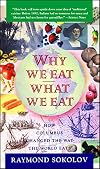
Why We Eat What We Eat
by Raymond Sokolov
On This Page
Description
Who is the most important figure in the history of food? Not a chef but an explorer - Christopher Columbus - whose journeys set in motion a transoceanic migration of ingredients and ideas that are still transforming food cultures around the world. Before 1492, Europe had no tomatoes, potatoes, chocolate, green beans or peppers. Today's "classic" Italian cuisine, featuring pasta with tomato sauce, simply did not exist. On the other side of the ocean, fifteenth-century Mexico had no dairy show more products and no beef, pork or lamb dishes; the Aztecs were eating worms and grasshoppers instead of the cheese quesadillas and chicken tacos that we regard as "traditional" Mexican food today. In this lively and informative history of the world as seen from a gourment's table, Sokolov explains how all of us - Europeans, Americans and Asians - came to eat what we eat today. show lessTags
Recommendations


















Member Reviews
Raymond Sokolov's Why We Eat What We Eat is a fascinating account of the modern American diet. I've never read a book quite like it, and what immediately comes to mind isn't more food writing but rather Jared Diamond's Guns, Germs, and Steel, a more general history of why certain cultures (rather than cuisines) came to be dominant. Sokolov's book is, likewise, concerned with domination, though here it's food rather than society that ultimately reigns supreme.Unfortunately, Sokolov's thesis is a bit hazy, and the organization of the book haphazard. Later chapters, especially, feel a bit like asides and could have easily been combined to create more balance overall. Nevertheless, Sokolov's prose and affection for the food in question, show more respectively, carry and unify this book. It's food porn to the nth degree, lovingly researched and written. It made me hungry for all sorts of things I've never eaten--persimmons and old varieties of apples and extinct key limes--and some things I have. Even with its imperfections, this is a really worthwhile read for both foodies and history buffs. Like an old-fashioned, mottled apple, Why We Eat What We Eat is tasty, despite its flaws. show less
Interesting, but not exactly compelling. The chapters on food migration between the new world and the old world dragged a bit, perhaps because most of it was not new information to me. The chapters on the effect of Colonization on the food habits of the native peoples, and those on individual new world ingredients and their effect on the world both past and present were the most interesting for me. Those on the history and future of restaurant fine dining were less so, but informative none the less.
Sokolov says that Columbus greatly influenced our eating habits when such New World delights as tomatoes, chocolate, green beans, chili peppers, and maize were introduced into cuisine throughout the world and when the delicacies of the Old World found their way into the cooking pots of America. Sokolov is the Leisure & Arts Editor of The Wall Street Journal.
How the encounter between the new world and the old changed the way everyone on teh planet eats. Read. Not great.
Journalist Raymond Sokolov sets out to examine the origins of commons foods and dishes. Fascinating mix of anthropology, linguistics, genetic research, and gastronomy.
Ratings
Members
- Recently Added By
Author Information

15+ Works 1,121 Members
Raymond Sokolov, former restaurant critic and food editor of the New York Times, served as the editor of the Wall Street Journal's "Leisure and Arts" page for twenty years and continues to write about food for national publications. Sokolov has written several cookbooks, He also wrote a column on America's foodways for Natural History magazine Mr. show more Sokolov lives in New York City show less
Common Knowledge
- Canonical title
- Why We Eat What We Eat
- Alternate titles
- Why we eat what we eat : how the encounter between the New World and the Old changed the way everyone on the planet eats
- Original publication date
- 1991
- People/Characters
- Christopher Columbus; Marco Polo
- Important places
- Brazil; Peru; Caribbean Region; China; Europe; France (show all 11); Latin America; Mexico; The Philippines; Puerto Rico; Spain
- Dedication
- For Alan Ternes,
who told me to rediscover Columbus - First words
- Columbus may be history's foremost example of a man who did great things without knowing what they were, but posterity has honored even his most spectacular blunders.
- Last words
- (Click to show. Warning: May contain spoilers.)Even with no new worlds for Columbuses to discover, the human imagination is always hungry for the new and eager to concoct it.
- Blurbers
- Fisher, M.F.K.
Classifications
- Genres
- Nonfiction, Food & Cooking, History, General Nonfiction, Anthropology, Science & Nature
- DDC/MDS
- 641.01 — Technology Home economics & family management Food and drink standard subdivisions Philosophy and theory [formerly: Epicurism]
- LCC
- TX631 .S65 — Technology Home economics Home economics Nutrition. Foods and food supply
- BISAC
Statistics
- Members
- 291
- Popularity
- 110,767
- Reviews
- 5
- Rating
- (3.57)
- Languages
- English
- Media
- Paper
- ISBNs
- 2
- ASINs
- 3