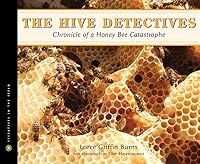
The Hive Detectives: Chronicle of a Honey Bee Catastrophe
by Loree Griffin Burns 
Scientists in the Field
On This Page
Description
Bees don't just produce honey. Your food supply depends on them. Apiarist Dave Hackenberg's bees have a busy travel schedule, pollinating around the United States from February to July. So when Dave inspected four hundred of his hives and found that the bees had simply vanished, a dream team of bee scientists got to work.Tags
Recommendations


Member Recommendations
Member Reviews
The Hive Detectives follows real scientists as they investigate a mysterious problem threatening honeybee populations known as Colony Collapse Disorder. Set in fields, labs, and apiaries across the United States, the story blends science, mystery, and discovery as researchers work to find out why bees were disappearing. Written for middle-grade readers, the book uses vivid photos and clear explanations to make complex science understandable and exciting. Academic vocabulary such as ecosystem, hypothesis, and pollination helps students expand their scientific and informational reading skills. In ELA, this book can be used to teach cause-and-effect relationships, text structure, and how authors use evidence to support claims. It’s a show more great addition to any classroom library because it encourages curiosity, problem-solving, and awareness of environmental issues. show less
Retelling: The bee drama begins when commercial bee and bee farmers discover that the bees from their mobile hives have vanished! This book weaves a description of bee-life and anatomy with the story of four bee detectives who investigate the possible causes of the vanishing honey bees of 2006-2007. The scientists systematically investigate known possibilities (pests, viruses, and pesticides) before concluding that no single one of these caused the catastrophe. By the end of the book they begin researching possible causes in a variety of combinations.
Thoughts and Feelings: School is filled with carefully designed problems with one clear solution, but life isn't like that. It's far more mysterious and filled with unexpected twists and show more inconclusive data. The bee saga shows how real scientists used their prior knowledge to approach a real problem. It takes great discipline to say "we worked our butt off and we know more than we did before, but we're still searching for the answer" (my words, not theirs).
The end of the book lists websites where students can learn more. I'm looking forward to exploring beespotter.mste.uiuc.edu to see if I can still help the scientists figure out what happened to the bees. show less
Thoughts and Feelings: School is filled with carefully designed problems with one clear solution, but life isn't like that. It's far more mysterious and filled with unexpected twists and show more inconclusive data. The bee saga shows how real scientists used their prior knowledge to approach a real problem. It takes great discipline to say "we worked our butt off and we know more than we did before, but we're still searching for the answer" (my words, not theirs).
The end of the book lists websites where students can learn more. I'm looking forward to exploring beespotter.mste.uiuc.edu to see if I can still help the scientists figure out what happened to the bees. show less
After reading this in my garden, I couldn't help but stop to observe the different bees buzzing about on our blue spirea and wonder where their hives were! Informative, readable and compelling, with plenty of color photos for poring over. Let's hope the mystery of colony collapse disorder is solved soon!
Why can I never find a definite list of the Scientists in the Field series? Every time I think I've got them all, a new one pops up without warning. Oh well.
I had no idea that thousands of bees mysteriously died and disappeared in 2006. Obviously, me and the new have a distant relationship. Anyways.
There are three main sections of this fascinating non-fiction. First, is the work and life of a small beekeeper, Mary Duane. Burns tells us how Duane came to beekeeping and what it means to keep bees as a part of life in Duane's own words, amply illustrated by Ellen Harasimowicz's photographs. The second and main section of the story is the mystery of the bee disappearance, starting with Dave Hackenberg's discovery of millions of missing bees show more among his thousands of hives. The mystery continues with the work of three scientists, each pursuing a different angle of the problem through research and experimentation. Finally, these two narrative threads are interspersed with facts about the life cycle of bees, honey production, and more.
Like all Scientists in the Field books, this is an excellent resource for school reports or for students interested in the lives and work of real scientists. It takes the reader through the steps of a scientific investigation, and shows how science in the real world is very different from a cut and dried experiment in a textbook. As in this example, sometimes the answers aren't found right away - or at all. Science enthusiasts or budding entomologists and apiarists will find much to fascinate them in this excellent book.
Verdict: Another excellent entry in the Scientists in the Field.
ISBN: 978-0547152318; Published May 2010 by Houghton Mifflin; Borrowed from the library; Added to the library's wishlist show less
I had no idea that thousands of bees mysteriously died and disappeared in 2006. Obviously, me and the new have a distant relationship. Anyways.
There are three main sections of this fascinating non-fiction. First, is the work and life of a small beekeeper, Mary Duane. Burns tells us how Duane came to beekeeping and what it means to keep bees as a part of life in Duane's own words, amply illustrated by Ellen Harasimowicz's photographs. The second and main section of the story is the mystery of the bee disappearance, starting with Dave Hackenberg's discovery of millions of missing bees show more among his thousands of hives. The mystery continues with the work of three scientists, each pursuing a different angle of the problem through research and experimentation. Finally, these two narrative threads are interspersed with facts about the life cycle of bees, honey production, and more.
Like all Scientists in the Field books, this is an excellent resource for school reports or for students interested in the lives and work of real scientists. It takes the reader through the steps of a scientific investigation, and shows how science in the real world is very different from a cut and dried experiment in a textbook. As in this example, sometimes the answers aren't found right away - or at all. Science enthusiasts or budding entomologists and apiarists will find much to fascinate them in this excellent book.
Verdict: Another excellent entry in the Scientists in the Field.
ISBN: 978-0547152318; Published May 2010 by Houghton Mifflin; Borrowed from the library; Added to the library's wishlist show less
Overall I really liked the book. It has a nice flow to it! It starts small focusing on one bee keeper (trying to make kids less scared of bees) and moves into the big picture with the bee epidemic/extinction. I really enjoyed a lot of the photos and at times noticed myself just staring at the photos instead of reading. I'm also very passionate about the bee epidemic. Save the Bees!
The Hive Detectives: Chronicle of a Honey Bee Catastrophe discusses the colony collapse disorder. The author wrote the book to present the colony collapse disorder in an engaging, interesting, informative manner. First, Burns presents the hives collapsing a mystery by explaining many of the ways it is atypical from other bee disorders. Then, she presents a research team to solve the mystery. Next, each member of the research team investigates the disorder and reports back on their findings. Additionally, Burns intermittently injects a page that explains basic science related to bees.
The style of the book was clearly laid out as a problem to be solved. The format led to some excitement on the topic. It read like a “Who did it?” for show more the agricultural world. The occasional page interspersed about bees were informative and not distracting. Additionally, the captions for the photographs were clear. The photographs themselves, while not artistic, were clear and informative.
The facts of the book are accurate and current. I have never learned about colony collapse disorder outside of news reports, so I conducted some additional research on the EPA’s website. The theories that the book investigates are consistent with the government reports. The book was published recently, in 2010, and was not yet outdated. The puzzle has not yet been solved. Additionally, there are extensive citations and references.
Colony collapse syndrome is essential for everyone, including young adults to learn about. Bees are necessary to pollinate most plants that we eat. This book could be of specific interest to young adults because many young adults are concerned with social justice and environmental issues.
Burns also does an excellent job showing multiple sides of the same issue. The idea that there may be disagreements in science and different perspectives could be appealing to developing abstract mind of young adults. Since the book presents competing theories from a variety of scientists, it clearly delineates which parts of the science are theory and which are fact. Young adults are often interested in catastrophic situations, which we would be in if we did not have any more bees to pollinate our plants.
Overall, the book was very enjoyable and would make an excellent addition to a library. It would also be a very good non-fiction read aloud. show less
The style of the book was clearly laid out as a problem to be solved. The format led to some excitement on the topic. It read like a “Who did it?” for show more the agricultural world. The occasional page interspersed about bees were informative and not distracting. Additionally, the captions for the photographs were clear. The photographs themselves, while not artistic, were clear and informative.
The facts of the book are accurate and current. I have never learned about colony collapse disorder outside of news reports, so I conducted some additional research on the EPA’s website. The theories that the book investigates are consistent with the government reports. The book was published recently, in 2010, and was not yet outdated. The puzzle has not yet been solved. Additionally, there are extensive citations and references.
Colony collapse syndrome is essential for everyone, including young adults to learn about. Bees are necessary to pollinate most plants that we eat. This book could be of specific interest to young adults because many young adults are concerned with social justice and environmental issues.
Burns also does an excellent job showing multiple sides of the same issue. The idea that there may be disagreements in science and different perspectives could be appealing to developing abstract mind of young adults. Since the book presents competing theories from a variety of scientists, it clearly delineates which parts of the science are theory and which are fact. Young adults are often interested in catastrophic situations, which we would be in if we did not have any more bees to pollinate our plants.
Overall, the book was very enjoyable and would make an excellent addition to a library. It would also be a very good non-fiction read aloud. show less
A good book tackling a significant subject. Just a little too much human interest cliche in it and not enough science.
Members
- Recently Added By
Lists

Recommended Nature Writing
346 works; 180 members
Author Information

11 Works 1,454 Members
Loree Griffin Burns is a LibraryThing Author, an author who lists their personal library on LibraryThing.
Awards and Honors
Awards
Distinctions
Series

Common Knowledge
- Canonical title
- The Hive Detectives: Chronicle of a Honey Bee Catastrophe
- Original publication date
- 2010-05-03
- First words
- Put on your veil, grab your hive tool, and light up your smoker we're going into a beehive.
Classifications
Statistics
- Members
- 342
- Popularity
- 92,011
- Reviews
- 22
- Rating
- (4.22)
- Languages
- English
- Media
- Paper, Ebook
- ISBNs
- 8
- ASINs
- 3