
On Aggression
by Konrad Lorenz
On This Page
Description
First published in the 1960s, On Aggression has been the target of criticism and controversy ever since. It is not Lorenz's careful descriptions of animal behaviour that are contentious, but his extrapolations to the human world that have caused reverberations resulting in a statement adopted by UNESCO in 1989 and subsequently endorsed by the American Psychological Association that appears to condemn his work. But does On Aggression actually make the claims implicit in the Seville show more statement?In a new introduction by Professor Eric Salzen, the debate about Lorenz's work is set in its social and political context and his claims and those of his critics reassessed. Human aggression has not lessened since this seminal work first appeared and there are no convincing new solutions. On Aggression should be read by all new students and re-read by more experienced scholars so that the important evidence he presents from ethnology may be reappraised in the light of the most recent research. show lessTags
Recommendations







































Member Reviews
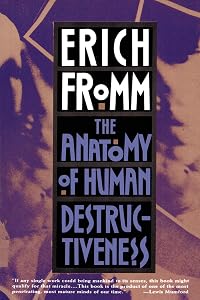
Konrad Lorenz proposed in “On Aggression” the theory that the violence is something good and necessary for all the animals. Self-defense would be the reason why species have developed this mechanism of behavior over the centuries. Unfortunately, Lorenz had a big knowledge about animals, but he did not understand this matter in all its complexity. Erich Fromm, in his book “The Anatomy of Human Destructiveness”, made a total critique of the theories that Lorenz proposed in“On Aggression”. Although I think that Fromm's book is questionable in several aspects, what also seems certain to me is that his critiques against Lorenz are correct.
Fromm realized that Lorenz didn't see that in the humans (and in other species) there are show more other types of aggression, in addition to the defensive. When soldiers of an army, with imperialist intentions, invade a country that is not their country, they do not use a defensive violence. The aggressiveness of a serial killer is criminal and evil. Policemen and mercenaries on the pay of a political dictator, do not use violence for defensive purposes, but to terrorize and dominate the citizens of a country. The aggressiveness of animals is much more complex than Lorenz thought. It is very difficult to understand this subject by studying only ducks and rats. To understand it, it is necessary to study, in addition, history, psychology and religion.
Richard Dawkins is another writer who, in his book “The Selfish Gene”, has made critics to Lorenz's positive vision of violence postulated in “On Aggression”. show less
Fromm realized that Lorenz didn't see that in the humans (and in other species) there are show more other types of aggression, in addition to the defensive. When soldiers of an army, with imperialist intentions, invade a country that is not their country, they do not use a defensive violence. The aggressiveness of a serial killer is criminal and evil. Policemen and mercenaries on the pay of a political dictator, do not use violence for defensive purposes, but to terrorize and dominate the citizens of a country. The aggressiveness of animals is much more complex than Lorenz thought. It is very difficult to understand this subject by studying only ducks and rats. To understand it, it is necessary to study, in addition, history, psychology and religion.
Richard Dawkins is another writer who, in his book “The Selfish Gene”, has made critics to Lorenz's positive vision of violence postulated in “On Aggression”. show less
When I was an undergraduate, this book was one of the books lots of my classmates seemed to be reading. It owed its popularity to the eminence of the author, who applied his knowledge and expertise in the field of animal behavior to the human species. As noted by the New York Times review, the book was "the revolutionary study of the 'killer instinct' in animals and man... one of the most important works of our time!" At a time when the threat that small wars would devolve into larger ones, and with the threat of nuclear devastation on everyone's mind, it's easy to see why Lorenz's warnings found a wide audience. Decades later, wars continue to proliferate and the threat of nuclear devastation has not dissipated. However, the idea that show more groups of humans are genetically programmed to kill one another has given way to more nuanced and complex perspectives. Had I been rating this work when I first read it, I would have awarded 4 or more stars. But by a few years later, it had lost its luster; and Lorenz's cavalier generalizations from other vertebrate animals to humans seem superficial and ideologically- driven. That's not to say, however, that the author's grim perspective on our likely future won't eventually turn out to have been prophetic. show less
This book is a study of aggression in animals, where aggression refers to intra-species conflict for mating rights and territory, and also for protection of the young (against members of the same species or others). Having discussed aggression, ritual behaviour, instincts and the role of displaced aggression, he moves onto discuss various types of intra-specific relationships. Starting with flocking animals and shoaling fish where there are no individual relationships between members of the shoal or flock, and moving on via creatures like rats where the pack is violently aggressive to any rat that isn't a member of their pack, he finally comes to creatures that do have personal bonds with their mate and children, and even with show more 'friends', such as greylag geese.
The most interesting part of the book comes at the end, where Lorenz discusses the role of aggression in human culture and relationships and compares us to other animals. One thing he suggests is that war is possible because man did not evolve as a predator, with teeth or claws that could kill another member of the species with a single blow. Therefore humans did not develop the inhibitions that prevent predators from fighting to the death, so when we invented weapons there was noting to restrain us from using them to wage war and kill huge numbers of our own species.
Anonymity of the person to be attacked greatly facilitates the releasing of aggressive behaviour. It is an observation familiar to anybody who has travelled in trains that well-bred people behave atrociously towards strangers in the territorial defence of their compartment. When they discover that the intruder is an acquaintance, however casual, there is an amazing and ridiculous switch in their behaviour from extreme rudeness to exaggerated and extreme politeness.
Written in the early sixties, this probably isn't the most up to date book on the subject that you could find, but it is still very interesting.
The cover picture, "Lion Attacking a Horse" by George Stubbs was badly chosen, as early on in the book the author makes it clear that inter-species predation is not motivated by aggression, so a picture of a horse protecting its foal against a lion would have been relevant to the book's topic, but a picture of a lion attacking a horse is not. show less
The most interesting part of the book comes at the end, where Lorenz discusses the role of aggression in human culture and relationships and compares us to other animals. One thing he suggests is that war is possible because man did not evolve as a predator, with teeth or claws that could kill another member of the species with a single blow. Therefore humans did not develop the inhibitions that prevent predators from fighting to the death, so when we invented weapons there was noting to restrain us from using them to wage war and kill huge numbers of our own species.
Anonymity of the person to be attacked greatly facilitates the releasing of aggressive behaviour. It is an observation familiar to anybody who has travelled in trains that well-bred people behave atrociously towards strangers in the territorial defence of their compartment. When they discover that the intruder is an acquaintance, however casual, there is an amazing and ridiculous switch in their behaviour from extreme rudeness to exaggerated and extreme politeness.
Written in the early sixties, this probably isn't the most up to date book on the subject that you could find, but it is still very interesting.
The cover picture, "Lion Attacking a Horse" by George Stubbs was badly chosen, as early on in the book the author makes it clear that inter-species predation is not motivated by aggression, so a picture of a horse protecting its foal against a lion would have been relevant to the book's topic, but a picture of a lion attacking a horse is not. show less
Konrad Lorenz’s book, On Aggression, wasn’t what I was expecting at all. I thought it would be an in-depth look at human aggression, and how it affects humanity in general and small populations in particular. Instead, what the book is about is Lorenz’s studies of the aggressive behavior of fish and bird species. While these studies are interesting to read about, and may provide insight into some of the behavior of people, I found it ultimately unsatisfactory in meeting its goal of explaining human aggression.
Full review: http://libwen.wordpress.com/2010/09/17/on-aggression-by-konrad-lorenz/
Full review: http://libwen.wordpress.com/2010/09/17/on-aggression-by-konrad-lorenz/
The english translation of the german original Das Sogenannte Böse, Zur Naturgeschichte der Aggression, this book is a masterpiece. A brilliant essay on animal behaviour by an outstanding scientist, with deep insights into human nature and society. Outstanding!
Required reading in college. Basically a treatise on aggression and how it manifests itself in nature (and in us). Puts "militant enthusiasm" on the map for the first time and is therefore a ground-breaking book. "The obvious conclusion is that love and friendship should embrace all humanity, that we should love all human brothers indescriminately."
An interesting study of the triggers for aggressive behaviour for Fish, birds and mammals. A seminal study it has often been reprinted and drawn from since its publication in 1962
Members
- Recently Added By
Lists

Best Science Books for Non-Scientists
113 works; 57 members

Psicología - Clásicos
165 works; 2 members

Books Read in 2006
424 works; 8 members

Read in 2006
140 works; 1 member
Author Information

Konrad Lorenz was an Austrian zoologist whose specialty, the biological origins of social behavior, is of major interest to psychologists. Lorenz pioneered in the direct study of animal behavior and was the founder of modern ethology (the study of animals in their natural surroundings). He received the Nobel Prize for physiology in 1973 for his show more research on instinctive behavior patterns and on imprinting---the process through which an animal very early in life acquires a social bond, usually with its parents, that enables it to become attached to other members of its own species. His major book, "On Aggression" (1963), was attacked by many anthropologists, psychologists, and sociologists, who maintained that Lorenz's claim that aggression is inborn means that it cannot be controlled. His supporters countered that Lorenz never stated that inborn traits could not be changed. Lorenz's work continues to play a key role in this contemporary version of the nature-nurture debate. (Bowker Author Biography) show less
Some Editions
Awards and Honors
Series
Belongs to Publisher Series
Work Relationships
Is contained in
Common Knowledge
- Canonical title*
- L'aggressività
- Original title
- Das Sogenannte Böse: Zur Naturgeschichte der Aggression
- Alternate titles*
- l cosiddetto male: per una storia naturale dell'aggressione
- Original publication date
- 1963 (German) (German); 1966 (English: Wilson) (English: Wilson)
- First words
- My childhood dream of flying is realized: I am floating weightlessly in an invisible medium, gliding without effort over sunlit fields.
- Quotations*
- Wenn ich den Menschen für das endgültige Ebenbild Gottes halten müßte, würde ich an Gott irrewerden. Wenn ich mir aber vor Augen halte, daß unsere Ahnen in einer erdgeschichtlich betrachtet erst jüngstvergangenen Zeit ... (show all)ganz ordinäre Affen aus nächster Verwandtschaft des Schimpansen waren, vermag ich einen Hoffnungsschimmer zu sehen. Es ist kein allzu großer Optimismus nötig, um anzunehmen, daß aus uns Menschen noch etwas Besseres und Höheres entstehen kann. Weit davon entfernt, im Menschen das unwiderruflich unübertreffliche Ebenbild Gottes zu sehen, behaupte ich bescheidener und, wie ich glaube, in größerer Ehrfurcht vor der Schöpfung und ihren unerschöpflichen Möglichkeiten: Das langgesuchte Zwischenglied zwischen dem Tiere und dem wahrhaft humanen Menschen – sind wir!
- Last words
- (Click to show. Warning: May contain spoilers.)I believe that this, in the not too distant future, will endow our descendants with the faculty of fulfilling the greatest and most beautiful of all commandments.
- Original language
- German
*Some information comes from Common Knowledge in other languages. Click "Edit" for more information.
Classifications
Statistics
- Members
- 1,036
- Popularity
- 25,076
- Reviews
- 11
- Rating
- (3.85)
- Languages
- 18 — Czech, Danish, Dutch, English, Estonian, French, German, Greek (Ancient), Hungarian, Italian, Norwegian (Bokmål), Polish, Portuguese, Romanian, Russian, Spanish, Swedish, Turkish
- Media
- Paper, Ebook
- ISBNs
- 55
- ASINs
- 47