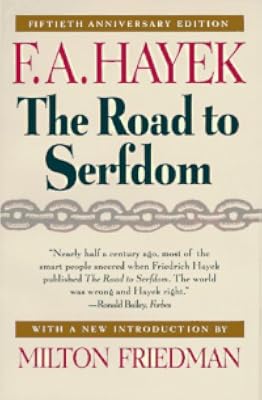
The Road to Serfdom
by F. A. Hayek
On This Page
Description
Originally published in 1944, this book offers persuasive warnings against the dangers of central planning, along with what Orwell described as "an eloquent defense of laissez-faire capitalism." Hayek shows that the idea that "under a dictatorial government you can be free inside," is nothing less than a grievous fallacy. Such dictatorial governments prevent individual freedoms and they often use psychological measures to perform "an alteration of the character of the people." Gradually, the show more people yield their individuality to the point where they become part of the collectivist mass. show lessTags
Recommendations











Member Recommendations


by anonymous user

by anonymous user

by anonymous user
Member Reviews
Summary: An argument that collectivist, planned economies lead to the erosion of individual liberties, the rule of law, and result in the rise of totalitarian governments.
It is probably not insignificant that F. A. Hayek, an economist who grew up and was educated in Austria, emigrated to England in 1938 and wrote this work during World War Two. He later moved to the United States. This book, less a work on economics than political philosophy, is an argument for the classic (not contemporary) liberal ideal that emphasized the rights and initiative of the individual, a limited role for government, a relatively unrestrained marketplace, and the rule of law. His basic argument is that the shift he was seeing from this liberal ideal to show more socialist, planned economies in England reflected the same course that he witnessed in the rise of National Socialism in Nazi Germany and Communism in the Stalinist Russia.
He argues that planned economies can never plan for all the variables of the marketplace, that those who buy and sell goods and services can more nimbly respond to. Planning undercuts the initiative of the individual and leads to increasingly authoritarian forms of government, required to enforce the efforts needed toward economic plans. Instead of seeking equality in liberty, the collectivist system achieves equality through restraint and servitude. These increasing coercive efforts result in the arbitrary use of authority rather than the rule of law. Paradoxically, even the poor are less free under such a system.
The question is who ultimately occupies the role of planners. Hayek offers a telling critique of the idea of the “common good,” which often remains undefined. And often, this happens to be the worst among us, those who are not constrained by moral restraints or concerns about truth. Perhaps the most chilling chapter in this work is the one titled, “The End of Truth,” reminding one of the “Post-truth era” in which we live. Authoritarian rulers develop their own myths to justify their rise to power and rule. Instead, all the channels used to spread knowledge are pressed into service to “strengthen the belief in the rightness of the decisions taken by the authority” (p. 175).
Hayek does allow a role for government in a capitalist economy, not in restricting trade but in regulating methods of legal production, sanitary and safe practices, the protection of environmental resources, and preventing fraud. He also allows a basic level of economic and health security as a concern of government.
It strikes me that Hayek’s fears of planned economies have not been realized in the socialist countries of Europe. My own sense is that what has occurred instead is an enlarged role of government to protect us from recessions, economic cycles, the consequences of shifts in the marketplace, and even personal misfortunes. This diminishment of the individual and dependency does leave us vulnerable to Hayek’s feared authoritarianism and the eclipse of the rule of law.
What troubles me in Hayek’s liberal ideal of individual liberty is that such systems are often blind to the inequities baked into the system, protecting individual liberty for only some who are citizens. Furthermore, these systemic inequities leave capitalist economies vulnerable to being supplanted by more planned economies that offer a vision of equality for the disadvantaged.
Nevertheless, Hayek’s critique of “planning,” of the rise of coercion, of the justification of means to achieve ends, the rise of authority and the suspension of rule of law, and the jettisoning of truth are all important to consider in our day. Hayek’s concern in looking at Nazi Germany was the recognition that it could happen in socialist England. While I suspect that there are more variant roads to totalitarian, Hayek’s recognition of the important elements of liberal democracy are worth attending to, as is the recognition that should we neglect these elements, it can happen here as well. show less
It is probably not insignificant that F. A. Hayek, an economist who grew up and was educated in Austria, emigrated to England in 1938 and wrote this work during World War Two. He later moved to the United States. This book, less a work on economics than political philosophy, is an argument for the classic (not contemporary) liberal ideal that emphasized the rights and initiative of the individual, a limited role for government, a relatively unrestrained marketplace, and the rule of law. His basic argument is that the shift he was seeing from this liberal ideal to show more socialist, planned economies in England reflected the same course that he witnessed in the rise of National Socialism in Nazi Germany and Communism in the Stalinist Russia.
He argues that planned economies can never plan for all the variables of the marketplace, that those who buy and sell goods and services can more nimbly respond to. Planning undercuts the initiative of the individual and leads to increasingly authoritarian forms of government, required to enforce the efforts needed toward economic plans. Instead of seeking equality in liberty, the collectivist system achieves equality through restraint and servitude. These increasing coercive efforts result in the arbitrary use of authority rather than the rule of law. Paradoxically, even the poor are less free under such a system.
The question is who ultimately occupies the role of planners. Hayek offers a telling critique of the idea of the “common good,” which often remains undefined. And often, this happens to be the worst among us, those who are not constrained by moral restraints or concerns about truth. Perhaps the most chilling chapter in this work is the one titled, “The End of Truth,” reminding one of the “Post-truth era” in which we live. Authoritarian rulers develop their own myths to justify their rise to power and rule. Instead, all the channels used to spread knowledge are pressed into service to “strengthen the belief in the rightness of the decisions taken by the authority” (p. 175).
Hayek does allow a role for government in a capitalist economy, not in restricting trade but in regulating methods of legal production, sanitary and safe practices, the protection of environmental resources, and preventing fraud. He also allows a basic level of economic and health security as a concern of government.
It strikes me that Hayek’s fears of planned economies have not been realized in the socialist countries of Europe. My own sense is that what has occurred instead is an enlarged role of government to protect us from recessions, economic cycles, the consequences of shifts in the marketplace, and even personal misfortunes. This diminishment of the individual and dependency does leave us vulnerable to Hayek’s feared authoritarianism and the eclipse of the rule of law.
What troubles me in Hayek’s liberal ideal of individual liberty is that such systems are often blind to the inequities baked into the system, protecting individual liberty for only some who are citizens. Furthermore, these systemic inequities leave capitalist economies vulnerable to being supplanted by more planned economies that offer a vision of equality for the disadvantaged.
Nevertheless, Hayek’s critique of “planning,” of the rise of coercion, of the justification of means to achieve ends, the rise of authority and the suspension of rule of law, and the jettisoning of truth are all important to consider in our day. Hayek’s concern in looking at Nazi Germany was the recognition that it could happen in socialist England. While I suspect that there are more variant roads to totalitarian, Hayek’s recognition of the important elements of liberal democracy are worth attending to, as is the recognition that should we neglect these elements, it can happen here as well. show less
Hayek is a difficult and controversial subject for review. He and Milton Friedman are heroes to advocates of free market economics, and they are villains to others. I’ll say a little more about contemporary relevance at the end, but I’ll do my best to stay focused on Hayek’s thought as expressed in The Road to Serfdom.
Hayek originally wrote The Road to Serfdom during World War II, for a British audience. He was warning his readers that the seeds of Nazi Germany were not exclusively German, that the danger was widespread throughout England itself and was coming to fulfillment in the Soviet Union, in a different form but still from the same seeds.
The seeds that Hayek identified have to do with “central planning.” Actually he show more uses three terms, “socialism,” “collectivism,” and “central planning” to identify different perspectives on what he regards as a dangerous way of thinking about and organizing a nation’s economy.
“Planning” is, I think, the core concept. Hayek views planning or “central planning” as essential to socialism. The insight behind socialism, as he discusses it, is that a rational economy is a planned economy, one organized efficiently toward some end by a central governing power. Coercion then becomes, in Hayek’s view, as essential as planning itself, in so far as the aspirations and activities of individuals must, for planning to succeed, be subservient to the decisions of the central governing power.
Given the importance of planning as the object of Hayek’s thinking, we need to know what “planning” means. Hayek distinguishes two types of economic rules or legislation on economic matters. “Formal rules” are instrumental. They have to do with that system of laws that establish and maintain the playing ground of economic activity, rules of competition for example. In one illustration, Hayek refers to such instrumental rules as “rules of the road” analogous to rules for highways — speed limits, rights of way, etc.
By contrast to rules of the road there are rules that would prescribe destinations — call them rules pertaining to ends rather than means or instrumental rules. As opposed to rules regarding speed limits and rights of way, these would be rules regarding where one should travel.
The latter rules would constitute “planning” or “central planning” if they have to do with the direction of the economic activities of a state toward a chosen particular goal or a set of goals.
Note that the means of legislation is not the crux of the matter for Hayek. Although he certainly favors democratic institutions, rules can be legislated by democratic bodies, or they could be set in place by dictatorships. In either case, for this discussion what matters is their scope and whether they constitute planning. Hayek is not blind of course to the greater likelihood that a dictatorship (or a select group of decision-makers) will pursue ends of its own choosing as opposed to a democratic body reaching agreement on those ends. But he expresses his opposition to democratic bodies engaging in planning, just as he does for dictatorial governments doing so.
In understanding this point, keep in mind that Hayek is writing this book during the reign of Hitler in Germany, and that the question of whether Hitler’s rise to power and securing of broad governmental power was achieved legally and even democratically was in debate. It's also worthwhile to keep in mind that Hayek’s objections to planning may override the value he places on democratic self-determination when we consider his much later embrace of non-democratically established governments like Pinochet’s in Chile (and its overthrow of a democratically elected socialist government).
Overstepping formal rules to engage in planning could happen in lots of ways. The most straightforward, and the one that Hayek gives most attention to, is when governments take it upon themselves to plan, to organize economies toward particular goals. This is “state socialism.” He criticizes both the very idea of a government organizing the economy toward specific goals and what he regards as the emptiness or vagueness of goals such as “the common good” or “the general welfare.”
Other ways, though, in which central planning might develop involve exertion of influence by particular individuals or entities in their own interests, to serve their particular economic ends. Thus corporations or wealthy individuals who exert influence over the legislative process to further their own advantages and ends would be guilty of “planning.” That sort of corruption (or “crony capitalism”) isn’t Hayek’s concern so much in this book, but it does fit his conception of governmental overstepping, or ‘planning” by his terms, and results likewise in coercion of some to support the goals of others.
Of course, all government is in some sense coercive. Laws coerce behavior. But a contrast between central planning and how Hayek understands “liberalism” will help.
Remember that “liberalism” for Hayek is meant in its nineteenth century use, not in its current popular use, especially in American politics. “Liberalism” is an organization of economic behavior in which Individuals are left free to pursue their own ambitions in a competitive environment. It is not an entirely unplanned economy — that competitive environment is maintained by “a carefully thought out legal framework.”
The key elements are individualism and competition. Hayek is proposing a legally maintained arena of competitive individuals each pursuing their own ambitions and plans, as opposed to a centrally planned economy, rationally organized to some end (e.g., general welfare, a high standard of living, or, I suppose, simply an egalitarian distiribution of goods).
Hayek is not a proponent of laissez faire economics. In rejecting that term, he says, “An effective competitive system is an intelligently designed and continuously adjusted legal framework as much as any other.” The role he allots to government and the legal system is to assure that “competition should work beneficially.” Laws to regulate monopolistic power, barriers to entry to markets, manipulation of prices, etc. are all fair game, in so far as they promote competition as a “beneficial” engine of economic activity.
Nor does he exclude from that legal framework provisions for minimum wages and other labor-facing protections so long as they do the same, that is, promote competition as a beneficial force.
He also does not think that prices (and here he may disagree with Friedman) provide a universal mechanism for preventing and controlling such things as environmental damage (Hayek specificaly calls out deforestation) or other harmful effects of economic production. These, he says, do require other mechanisms, namely legal authority and regulation.
It’s worth pointing out some of these points on which Hayek favors government action, not only just to get his position correct, but also to dissociate him from others who may take more extreme positions. Hayek is not an opponent of the welfare state per se. As he says, “ . . . there can be no doubt that some minimum of food, shelter, and clothing, sufficient to preserve health and the capacity to work, can be assured to everyone.” He would also include the provision of something he terms “social insurance” — “Nor is there any reason why the state should not assist the individuals in providing for those common hazards of life against which, because of their uncertainty, few individuals can make adequate provision.” He includes “sickness and accident” as examples.
He also discusses, in the same passage, the damages to individuals that arise from economic fluctuations. Hayek after all was writing in the aftermath of the Great Depression. He considers monetary policy interventions as well as large scale public works programs as measures that do not reach into the kind of planning he believes a threat to freedom, although he regards public works programs as experiments to be watched carefully.
He specifically rules out any kind of insurance or security that would protect individuals from a competitive loss of value in their trade or their products. That kind of intervention, like price or wage controls, he believes, would imperil the function of competition as the engine of free economic activity.
The key criteria that Hayek leans on to distinguish a healthy economic structure from an unhealthy one are competition and economic freedom (as distinct from central planning and coercion in the senses we’ve discussed).
Given that, let’s look more closely at Hayek’s central claim regarding freedom and coercion.
Hayek’s claim that central planning (“socialism” in his understanding of the term) inevitably leads to political fascism or totalitarianism is a claim about the interplay of political and economic freedom and power.
Hayek (and others) distinguish political freedom, e.g., the freedoms protected by the American Bill of Rights, from economic freedoms. The former provide for participation in self-determination (voting), speech or expression, etc. The latter provide for participation in specifically economic activities — buying, selling, practicing a trade, etc.
It is critical for Hayek that the two, economic and political power, are kept separate. Where political power assumes economic power, you have central planning and coercion.
The two are certainly distinguishable, but they also interact, even are entwined in practice. Hayek’s attention is more strongly focused on political power crossing the boundary to assume economic power. But the reverse is also dangerous.
In our own American system, the influence of economic power on political power is obvious. Manipulation of the rules of competition via political power, based on economic power, is in play. As is a vicious cycle in which economic power drives political power to tilt competition in the favor of powerful economic players (large companies), which contributes to gains for those players in economic terms, which drives more political influence, and so on. The kinds of political influence that economic players may exercise, it should be unnecessary to mention, include lobbying to push favorable legislation, influence over appointments to executive government positions, campaign finance and its regulation or deregulation, etc.
That argument in fact suggests a similar tendency to Hayek’s own argument for the inevitability of coercion in socialist economies, a tendency toward corruption in economies where economic and political power are not kept separate. In an economy grounded on competition, competitive advantage is prized. And if economic power, once attained, can be used to gain political power and skew the competitive playing field in someone’s favor, that’s presumably what they will do — an argument for the “inevitability” of corruption unless prevented by adequate laws or political structures like checks and balances.
So far as I see, Hayek does not address that danger here in this book, although his insistence on the separation of political and economic power implies its presence.
Bringing Hayek’s thinking here into the context of our own contemporary concerns is going to require close attention to the finer points of political and economic power relationships.
The boundary between harmful and beneficial economic regulation, or intervention in general isn’t always going to be clear. Hayek thinks that the engine that drives healthy economic activity is competition. Interventions that limit competition are harmful, and ones that promote competition are healthy. But it’s not always going to be clear which is which.
It’s also not clear that he would rule out public management of some areas of economic activity, where competition does not serve a beneficial purpose. Although, relevant to our contemporary concerns, it is clear that he sees some role for intervention in healthcare, for example, it’s not clear what that role is, whether it should be confined for example to catastrophic “social insurance” or something broader. And of course that’s for us to debate.
He does not favor government management of parts of the economy where monopolies develop organically, as in utilities where infrastructure investments or other factors favor the emergence of a dominant player. In such cases, he favors what he calls the “American” approach to regulation rather than public takeover.
Hayek himself doesn’t focus on these finer points of political and economic power in this book. At the time of writing this book, he was less concerned with the finer points than the larger ones — his concerns were more directly focused on Nazi Germany and the centrally planned economy of the Soviet Union.
He does mention, in a preface written later, economies like Sweden’s that do contain some elements of what he would consider central planning, and he warns that such countries will find their way inevitably to a broadening of central planning and coercion. Whether that is true of Sweden, for example, is something we could debate as well, although it seems a stretch to claim that Sweden is, or is on a trajectory toward, a totalitarian state.
Hayek’s own later work will fill in some holes from The Road to Serfdom, in particular, his theory of local knowledge and self-organization as the basis for stability in a competitive economy. That theory is also historically interesting in the light of Hayek’s peripheral participation in the Vienna Circle prior to World War II. The Vienna Circle, especially as influenced by Ludwig Wittgenstein (a second cousin to Hayek), often took anti-theoretical positions, the kinds that would support a rejection of the kind of knowledge presumed by central planning economic models.
Hayek mentions in The Road to Serfdom the claim that the kind of knowledge necessary to central planning is inaccessible, given the complexity and dynamism of a national economy, but he doesn’t flesh out his arguments here.
We could go on to much larger discussions of planning, economic and political freedom, competition, the “free market system”, the role of government, and more. I think, if you want to read something that furthers your thinking after reading Hayek, one contemporary book that would be helpful is Joseph Stiglitz’s recent book, The Road to Freedom. Stiglitz challenges Hayek’s notion of freedom, in fact arguing that that notion is unexamined and undeveloped, proposing his own conception of freedom as “opportunity sets.” He also challenges assumptions he believes necessary to the beneficial workings of a free market, assumptions not met by actual economies.
Hayek and Stiglitz are economists. If you want to pursue a more philosophical vein, Robert Nozick’s Anarchy, State, and Utopia is an updated (although now itself about 50 years old) argument for libertarianism and minimalistic government. And, by counterpoint to both Hayek and Nozick, John Rawls’ A Theory of Justice presents and defends a more active role for the state in providing for a just distribution of resources, while also respecting and enabling individualiastic life plans and conceptions of a good life. Rawls’ book is a classic and a touchstone for any modern discussion of political philosophy.
All grist for thought, and all the more needed at a time when political talk so far outpaces political thought. show less
Hayek originally wrote The Road to Serfdom during World War II, for a British audience. He was warning his readers that the seeds of Nazi Germany were not exclusively German, that the danger was widespread throughout England itself and was coming to fulfillment in the Soviet Union, in a different form but still from the same seeds.
The seeds that Hayek identified have to do with “central planning.” Actually he show more uses three terms, “socialism,” “collectivism,” and “central planning” to identify different perspectives on what he regards as a dangerous way of thinking about and organizing a nation’s economy.
“Planning” is, I think, the core concept. Hayek views planning or “central planning” as essential to socialism. The insight behind socialism, as he discusses it, is that a rational economy is a planned economy, one organized efficiently toward some end by a central governing power. Coercion then becomes, in Hayek’s view, as essential as planning itself, in so far as the aspirations and activities of individuals must, for planning to succeed, be subservient to the decisions of the central governing power.
Given the importance of planning as the object of Hayek’s thinking, we need to know what “planning” means. Hayek distinguishes two types of economic rules or legislation on economic matters. “Formal rules” are instrumental. They have to do with that system of laws that establish and maintain the playing ground of economic activity, rules of competition for example. In one illustration, Hayek refers to such instrumental rules as “rules of the road” analogous to rules for highways — speed limits, rights of way, etc.
By contrast to rules of the road there are rules that would prescribe destinations — call them rules pertaining to ends rather than means or instrumental rules. As opposed to rules regarding speed limits and rights of way, these would be rules regarding where one should travel.
The latter rules would constitute “planning” or “central planning” if they have to do with the direction of the economic activities of a state toward a chosen particular goal or a set of goals.
Note that the means of legislation is not the crux of the matter for Hayek. Although he certainly favors democratic institutions, rules can be legislated by democratic bodies, or they could be set in place by dictatorships. In either case, for this discussion what matters is their scope and whether they constitute planning. Hayek is not blind of course to the greater likelihood that a dictatorship (or a select group of decision-makers) will pursue ends of its own choosing as opposed to a democratic body reaching agreement on those ends. But he expresses his opposition to democratic bodies engaging in planning, just as he does for dictatorial governments doing so.
In understanding this point, keep in mind that Hayek is writing this book during the reign of Hitler in Germany, and that the question of whether Hitler’s rise to power and securing of broad governmental power was achieved legally and even democratically was in debate. It's also worthwhile to keep in mind that Hayek’s objections to planning may override the value he places on democratic self-determination when we consider his much later embrace of non-democratically established governments like Pinochet’s in Chile (and its overthrow of a democratically elected socialist government).
Overstepping formal rules to engage in planning could happen in lots of ways. The most straightforward, and the one that Hayek gives most attention to, is when governments take it upon themselves to plan, to organize economies toward particular goals. This is “state socialism.” He criticizes both the very idea of a government organizing the economy toward specific goals and what he regards as the emptiness or vagueness of goals such as “the common good” or “the general welfare.”
Other ways, though, in which central planning might develop involve exertion of influence by particular individuals or entities in their own interests, to serve their particular economic ends. Thus corporations or wealthy individuals who exert influence over the legislative process to further their own advantages and ends would be guilty of “planning.” That sort of corruption (or “crony capitalism”) isn’t Hayek’s concern so much in this book, but it does fit his conception of governmental overstepping, or ‘planning” by his terms, and results likewise in coercion of some to support the goals of others.
Of course, all government is in some sense coercive. Laws coerce behavior. But a contrast between central planning and how Hayek understands “liberalism” will help.
Remember that “liberalism” for Hayek is meant in its nineteenth century use, not in its current popular use, especially in American politics. “Liberalism” is an organization of economic behavior in which Individuals are left free to pursue their own ambitions in a competitive environment. It is not an entirely unplanned economy — that competitive environment is maintained by “a carefully thought out legal framework.”
The key elements are individualism and competition. Hayek is proposing a legally maintained arena of competitive individuals each pursuing their own ambitions and plans, as opposed to a centrally planned economy, rationally organized to some end (e.g., general welfare, a high standard of living, or, I suppose, simply an egalitarian distiribution of goods).
Hayek is not a proponent of laissez faire economics. In rejecting that term, he says, “An effective competitive system is an intelligently designed and continuously adjusted legal framework as much as any other.” The role he allots to government and the legal system is to assure that “competition should work beneficially.” Laws to regulate monopolistic power, barriers to entry to markets, manipulation of prices, etc. are all fair game, in so far as they promote competition as a “beneficial” engine of economic activity.
Nor does he exclude from that legal framework provisions for minimum wages and other labor-facing protections so long as they do the same, that is, promote competition as a beneficial force.
He also does not think that prices (and here he may disagree with Friedman) provide a universal mechanism for preventing and controlling such things as environmental damage (Hayek specificaly calls out deforestation) or other harmful effects of economic production. These, he says, do require other mechanisms, namely legal authority and regulation.
It’s worth pointing out some of these points on which Hayek favors government action, not only just to get his position correct, but also to dissociate him from others who may take more extreme positions. Hayek is not an opponent of the welfare state per se. As he says, “ . . . there can be no doubt that some minimum of food, shelter, and clothing, sufficient to preserve health and the capacity to work, can be assured to everyone.” He would also include the provision of something he terms “social insurance” — “Nor is there any reason why the state should not assist the individuals in providing for those common hazards of life against which, because of their uncertainty, few individuals can make adequate provision.” He includes “sickness and accident” as examples.
He also discusses, in the same passage, the damages to individuals that arise from economic fluctuations. Hayek after all was writing in the aftermath of the Great Depression. He considers monetary policy interventions as well as large scale public works programs as measures that do not reach into the kind of planning he believes a threat to freedom, although he regards public works programs as experiments to be watched carefully.
He specifically rules out any kind of insurance or security that would protect individuals from a competitive loss of value in their trade or their products. That kind of intervention, like price or wage controls, he believes, would imperil the function of competition as the engine of free economic activity.
The key criteria that Hayek leans on to distinguish a healthy economic structure from an unhealthy one are competition and economic freedom (as distinct from central planning and coercion in the senses we’ve discussed).
Given that, let’s look more closely at Hayek’s central claim regarding freedom and coercion.
Hayek’s claim that central planning (“socialism” in his understanding of the term) inevitably leads to political fascism or totalitarianism is a claim about the interplay of political and economic freedom and power.
Hayek (and others) distinguish political freedom, e.g., the freedoms protected by the American Bill of Rights, from economic freedoms. The former provide for participation in self-determination (voting), speech or expression, etc. The latter provide for participation in specifically economic activities — buying, selling, practicing a trade, etc.
It is critical for Hayek that the two, economic and political power, are kept separate. Where political power assumes economic power, you have central planning and coercion.
The two are certainly distinguishable, but they also interact, even are entwined in practice. Hayek’s attention is more strongly focused on political power crossing the boundary to assume economic power. But the reverse is also dangerous.
In our own American system, the influence of economic power on political power is obvious. Manipulation of the rules of competition via political power, based on economic power, is in play. As is a vicious cycle in which economic power drives political power to tilt competition in the favor of powerful economic players (large companies), which contributes to gains for those players in economic terms, which drives more political influence, and so on. The kinds of political influence that economic players may exercise, it should be unnecessary to mention, include lobbying to push favorable legislation, influence over appointments to executive government positions, campaign finance and its regulation or deregulation, etc.
That argument in fact suggests a similar tendency to Hayek’s own argument for the inevitability of coercion in socialist economies, a tendency toward corruption in economies where economic and political power are not kept separate. In an economy grounded on competition, competitive advantage is prized. And if economic power, once attained, can be used to gain political power and skew the competitive playing field in someone’s favor, that’s presumably what they will do — an argument for the “inevitability” of corruption unless prevented by adequate laws or political structures like checks and balances.
So far as I see, Hayek does not address that danger here in this book, although his insistence on the separation of political and economic power implies its presence.
Bringing Hayek’s thinking here into the context of our own contemporary concerns is going to require close attention to the finer points of political and economic power relationships.
The boundary between harmful and beneficial economic regulation, or intervention in general isn’t always going to be clear. Hayek thinks that the engine that drives healthy economic activity is competition. Interventions that limit competition are harmful, and ones that promote competition are healthy. But it’s not always going to be clear which is which.
It’s also not clear that he would rule out public management of some areas of economic activity, where competition does not serve a beneficial purpose. Although, relevant to our contemporary concerns, it is clear that he sees some role for intervention in healthcare, for example, it’s not clear what that role is, whether it should be confined for example to catastrophic “social insurance” or something broader. And of course that’s for us to debate.
He does not favor government management of parts of the economy where monopolies develop organically, as in utilities where infrastructure investments or other factors favor the emergence of a dominant player. In such cases, he favors what he calls the “American” approach to regulation rather than public takeover.
Hayek himself doesn’t focus on these finer points of political and economic power in this book. At the time of writing this book, he was less concerned with the finer points than the larger ones — his concerns were more directly focused on Nazi Germany and the centrally planned economy of the Soviet Union.
He does mention, in a preface written later, economies like Sweden’s that do contain some elements of what he would consider central planning, and he warns that such countries will find their way inevitably to a broadening of central planning and coercion. Whether that is true of Sweden, for example, is something we could debate as well, although it seems a stretch to claim that Sweden is, or is on a trajectory toward, a totalitarian state.
Hayek’s own later work will fill in some holes from The Road to Serfdom, in particular, his theory of local knowledge and self-organization as the basis for stability in a competitive economy. That theory is also historically interesting in the light of Hayek’s peripheral participation in the Vienna Circle prior to World War II. The Vienna Circle, especially as influenced by Ludwig Wittgenstein (a second cousin to Hayek), often took anti-theoretical positions, the kinds that would support a rejection of the kind of knowledge presumed by central planning economic models.
Hayek mentions in The Road to Serfdom the claim that the kind of knowledge necessary to central planning is inaccessible, given the complexity and dynamism of a national economy, but he doesn’t flesh out his arguments here.
We could go on to much larger discussions of planning, economic and political freedom, competition, the “free market system”, the role of government, and more. I think, if you want to read something that furthers your thinking after reading Hayek, one contemporary book that would be helpful is Joseph Stiglitz’s recent book, The Road to Freedom. Stiglitz challenges Hayek’s notion of freedom, in fact arguing that that notion is unexamined and undeveloped, proposing his own conception of freedom as “opportunity sets.” He also challenges assumptions he believes necessary to the beneficial workings of a free market, assumptions not met by actual economies.
Hayek and Stiglitz are economists. If you want to pursue a more philosophical vein, Robert Nozick’s Anarchy, State, and Utopia is an updated (although now itself about 50 years old) argument for libertarianism and minimalistic government. And, by counterpoint to both Hayek and Nozick, John Rawls’ A Theory of Justice presents and defends a more active role for the state in providing for a just distribution of resources, while also respecting and enabling individualiastic life plans and conceptions of a good life. Rawls’ book is a classic and a touchstone for any modern discussion of political philosophy.
All grist for thought, and all the more needed at a time when political talk so far outpaces political thought. show less
Hayek’s classic defense of classical liberalism is a political and moral tour de force. Considering that it was written by an Austrian Jew who’d emigrated to Britain early in the Nazi era, its grace and generosity towards national enemies and ideological opponents is remarkable. His main argument isn’t so much that individual liberty, limited government, the rule of law, and competitive markets constitute the most efficient economic system producing the greatest general prosperity and the greatest personal freedom. Hayek makes this argument powerfully, but he’s most concerned to show that the then-current disdain for classical liberalism and the clamor for centralized economic planning would inevitably lead to arbitrary, show more coercive government, destruction of individual liberties and of the rule of law, greater class or interest group resentments, and also to economic inefficiency with less general prosperity. At least if the movement toward collectivism goes unchecked, it leads to totalitarianism, which necessarily is anti-democratic, anti-rational, dangerously amoral with the concept of truth largely inverted, and it consequently attracts the most unscrupulous people to positions of power. Hayek also points out the essential equivalence of collectivism of the Right and of the Left.
Although widely panned by the intelligentsia of the time, the book has always gotten a lot of attention and it’s been very influential. I believe history has amply demonstrated the soundness of the overall arguments. Considering history and the stakes, I find it difficult to be as generous as Hayek was toward those whose ideological rigidity prevents them from learning its lessons. If the book has any weaknesses, perhaps the most important one is that it doesn’t systematically outline the appropriate roles of government in a capitalist democracy. The book could be construed as being anti-government, which it isn’t; Hayek clearly says that an extensive welfare state isn’t incompatible with a competitive market economy, and that wealthy nations can and even should provide some forms of social insurance. He especially emphasizes the importance of government establishing the rule of law – based on general principles and applied equally to all – along with effective enforcement of contracts and administration of justice generally, as critical to the context in which markets operate properly. He’s also very much concerned with prevention of monopolies, or their minimization where elimination isn’t possible, something equally applicable to private enterprise as to government (except in the few areas where government monopolies are necessary, e.g. the military, some public utilities, etc.), but in particular a critical function of government in free markets.
Hayek just touches on monetary policy, he doesn’t deal directly with government fiscal policy, he doesn’t describe the appropriate role of central banks in economies, and he only briefly touches on what we’d call Keynesian approaches to downturns and unemployment (to say that they’re generally not effective and there are better ways to deal with those problems, without elaborating much). I think it would have clarified and strengthened his arguments if he had provided a systematic treatment of the appropriate functions of the state in a society founded on principles of classical liberalism. But it also would have made a compact and pointed book much less so – a book he considered to be urgently needed, and I think rightly. A careful reader can grasp enough of Hayek’s picture of government in a capitalist democracy to see its essential functions and limitations, and that they’re sensible. The book as is keeps the focus on the less-than-obvious but potentially great and possibly imminent danger, and it does a superb job of tracing its history and development (particularly in Germany over several decades prior to the Nazis’ rise), of describing the dreadful society it leads to, and of showing how and why this happens. It’s a fairly detailed 20th c. way of saying, like Franklin, “A Republic, if you can keep it.” Basically, economic and political freedom are inseparable, both of which require private property and free, competitive markets with the state ensuring the rule of law. show less
Although widely panned by the intelligentsia of the time, the book has always gotten a lot of attention and it’s been very influential. I believe history has amply demonstrated the soundness of the overall arguments. Considering history and the stakes, I find it difficult to be as generous as Hayek was toward those whose ideological rigidity prevents them from learning its lessons. If the book has any weaknesses, perhaps the most important one is that it doesn’t systematically outline the appropriate roles of government in a capitalist democracy. The book could be construed as being anti-government, which it isn’t; Hayek clearly says that an extensive welfare state isn’t incompatible with a competitive market economy, and that wealthy nations can and even should provide some forms of social insurance. He especially emphasizes the importance of government establishing the rule of law – based on general principles and applied equally to all – along with effective enforcement of contracts and administration of justice generally, as critical to the context in which markets operate properly. He’s also very much concerned with prevention of monopolies, or their minimization where elimination isn’t possible, something equally applicable to private enterprise as to government (except in the few areas where government monopolies are necessary, e.g. the military, some public utilities, etc.), but in particular a critical function of government in free markets.
Hayek just touches on monetary policy, he doesn’t deal directly with government fiscal policy, he doesn’t describe the appropriate role of central banks in economies, and he only briefly touches on what we’d call Keynesian approaches to downturns and unemployment (to say that they’re generally not effective and there are better ways to deal with those problems, without elaborating much). I think it would have clarified and strengthened his arguments if he had provided a systematic treatment of the appropriate functions of the state in a society founded on principles of classical liberalism. But it also would have made a compact and pointed book much less so – a book he considered to be urgently needed, and I think rightly. A careful reader can grasp enough of Hayek’s picture of government in a capitalist democracy to see its essential functions and limitations, and that they’re sensible. The book as is keeps the focus on the less-than-obvious but potentially great and possibly imminent danger, and it does a superb job of tracing its history and development (particularly in Germany over several decades prior to the Nazis’ rise), of describing the dreadful society it leads to, and of showing how and why this happens. It’s a fairly detailed 20th c. way of saying, like Franklin, “A Republic, if you can keep it.” Basically, economic and political freedom are inseparable, both of which require private property and free, competitive markets with the state ensuring the rule of law. show less
This is one of the foundation books for my personal philosophy. Along with his other works, the thought of Friedrich von Hayek is basic to my own individualist world view. In this book Hayek contends that liberty is fragile, easily harmed but seldom extinguished in one fell swoop. Instead, over the years “the unforeseen but inevitable consequences of socialist planning create a state of affairs in which, if the policy is to be pursued, totalitarian forces will get the upper hand.” He asserts that liberty has developed from an a posteriori recognition of humans’ inherent limitations – particularly the restrictions of their knowledge and reasoning. Most importantly, no planner or group of planners, however intelligent and well show more resourced, can possibly obtain and process the countless bits of localized and tacit information required such that a government plan meets its objectives. Only price signals emitted in an unhampered market enable harmony and efficiency to arise spontaneously from many millions of individuals’ plans. Hence government intervention in the plans of individuals, even if undertaken by men of good will, inevitably leads to loss of liberty, economic stagnation (at best) and war and impoverishment (at worst).
While much of Friedrich Hayek’s The Road to Serfdom focused on correcting erroneous ideas and sloppy thinking that misled (and still mislead) many to support socialistic expansions of government power, that is not all it did. It also reiterated the case for individualism and its economic manifestation—free markets. Since convincing careful thinkers requires such an affirmative case as well as defensive debunking, the book’s diamond 75th anniversary is a propitious time to remember what only individualism provides, so that we will not continue to follow a path of “replacing what works with what sounds good,” as Thomas Sowell described it.
The essential features of…individualism…are the respect for the individual man qua man…the recognition of his own views and tastes as supreme in his own sphere…and the belief that it is desirable that men should develop their own individual gifts and bents.
The attitude of the liberal toward society is like that of the gardener who tends a plant and, in order to create the conditions most favorable to its growth, must know as much as possible about its structure and the way it functions.
The holder of coercive power should confine himself in general to creating conditions under which the knowledge and initiative of individuals are given the best scope so that they can plan most successfully. The successful use of competition as the principle of social organization precludes certain types of coercive interference with economic life. Planning and competition can be combined only by planning for competition but not…planning which is to be substituted for competition.
It is the very complexity of the division of labor under modern conditions which makes competition the only method by which such coordination can be adequately brought about.
Nobody can consciously balance all the considerations bearing on the decisions of so many individuals…coordination can clearly be effective only by… arrangements which convey to each agent the information he must possess in order effectively to adjust his decisions to those of others…This is precisely what the price system does under competition and what no other system even promises to accomplish. The economist's plea is for a method which effects such co-ordination without the need for an omniscient dictator. Recognition of the individual as the ultimate judge of his ends…that as far as possible his own views ought to govern his actions…forms the essence of the individualist position.
What are called “social ends” are…merely identical ends of many individuals…to the achievement of which individuals are willing to contribute…Common action is thus limited to the fields where people agree on common ends. The clash between planning and democracy arises simply from the fact that the latter is an obstacle to the suppression of freedom which the direction of economic activity requires. The more the state “plans,” the more difficult planning becomes for the individual.
Economic control is not merely control of a sector of human life…it is the control of the means for all our ends. To believe that the power which is thus conferred on the state is merely transferred to it from others is erroneous. It is a power which is newly created and which in a competitive society nobody possesses. So long as property is divided among many owners, none of them acting independently has exclusive power to determine the income and position of particular people.
Contrast…two types of security: the limited one, which can be achieved for all, and which is therefore no privilege but a legitimate object of desire; and absolute security, which…if it is provided for some, it becomes a privilege at the expense of others. Individualism is thus an attitude of humility…the exact opposite of that intellectual hubris which is at the root of the demand for comprehensive direction of the social process.
Friedrich Hayek’s The Road to Serfdom defended the individual—the only ultimate locus of choice, responsibility and morality—as the appropriate focus of efforts toward human improvement, at a time when failing to keep that focus threatened the entire world. That is a lesson we need to remember now as well, when many do not remember the horrors that can lead to, and so support constantly expanding government powers over its citizens. show less
While much of Friedrich Hayek’s The Road to Serfdom focused on correcting erroneous ideas and sloppy thinking that misled (and still mislead) many to support socialistic expansions of government power, that is not all it did. It also reiterated the case for individualism and its economic manifestation—free markets. Since convincing careful thinkers requires such an affirmative case as well as defensive debunking, the book’s diamond 75th anniversary is a propitious time to remember what only individualism provides, so that we will not continue to follow a path of “replacing what works with what sounds good,” as Thomas Sowell described it.
The essential features of…individualism…are the respect for the individual man qua man…the recognition of his own views and tastes as supreme in his own sphere…and the belief that it is desirable that men should develop their own individual gifts and bents.
The attitude of the liberal toward society is like that of the gardener who tends a plant and, in order to create the conditions most favorable to its growth, must know as much as possible about its structure and the way it functions.
The holder of coercive power should confine himself in general to creating conditions under which the knowledge and initiative of individuals are given the best scope so that they can plan most successfully. The successful use of competition as the principle of social organization precludes certain types of coercive interference with economic life. Planning and competition can be combined only by planning for competition but not…planning which is to be substituted for competition.
It is the very complexity of the division of labor under modern conditions which makes competition the only method by which such coordination can be adequately brought about.
Nobody can consciously balance all the considerations bearing on the decisions of so many individuals…coordination can clearly be effective only by… arrangements which convey to each agent the information he must possess in order effectively to adjust his decisions to those of others…This is precisely what the price system does under competition and what no other system even promises to accomplish. The economist's plea is for a method which effects such co-ordination without the need for an omniscient dictator. Recognition of the individual as the ultimate judge of his ends…that as far as possible his own views ought to govern his actions…forms the essence of the individualist position.
What are called “social ends” are…merely identical ends of many individuals…to the achievement of which individuals are willing to contribute…Common action is thus limited to the fields where people agree on common ends. The clash between planning and democracy arises simply from the fact that the latter is an obstacle to the suppression of freedom which the direction of economic activity requires. The more the state “plans,” the more difficult planning becomes for the individual.
Economic control is not merely control of a sector of human life…it is the control of the means for all our ends. To believe that the power which is thus conferred on the state is merely transferred to it from others is erroneous. It is a power which is newly created and which in a competitive society nobody possesses. So long as property is divided among many owners, none of them acting independently has exclusive power to determine the income and position of particular people.
Contrast…two types of security: the limited one, which can be achieved for all, and which is therefore no privilege but a legitimate object of desire; and absolute security, which…if it is provided for some, it becomes a privilege at the expense of others. Individualism is thus an attitude of humility…the exact opposite of that intellectual hubris which is at the root of the demand for comprehensive direction of the social process.
Friedrich Hayek’s The Road to Serfdom defended the individual—the only ultimate locus of choice, responsibility and morality—as the appropriate focus of efforts toward human improvement, at a time when failing to keep that focus threatened the entire world. That is a lesson we need to remember now as well, when many do not remember the horrors that can lead to, and so support constantly expanding government powers over its citizens. show less
The five star rating isn't for the philosophical contents of this book. When I get around to reading it, I'll probably give just as high a rating to Das Kapital, Hayek's opposition. The rating reflects the value of reading extremely influential books for yourself to see how distorted their reputations are.
Yes, this is Hayek's concise attack on the idea of planned economies. As Friedman's introduction explains, that wasn't an obvious or popular position in 1944 - quite the opposite. Most of the best and brightest thought the future belonged to technocratic central planners.
Here are some things the book's reputation didn't prepare me for.
Stylistically, I expected a more difficult read. Hayek was an Austrian, but his prose only show more occasionally shows a certain Germanic length and convolution. He largely meets his goal of writing for a general audience.
Hayek dedicates his book to "socialists of all parties" and that dedication is sincere. Hayek shared their main goals but thought their chosen method led inevitably to totalitarianism.
Hayek is not a laissez-faire capitalist or a panglossian apologist for the free market. He does not try to convince us that capitalism is a moral system, merely, appealing to what he assumes is a value of his readers, the system that best guarantees true liberty.
Hayek's arguments on the merits of the market and the planner can be paraphrased in two observations he made. The ultimate sanction in a capitalist society for failure to be economically productive is bankruptcy court. In the totalitarian society that must emerge from central planning, it's the hangman. Man, he argues, either submits to impersonal and irrational forces of the market or he submits to the uncontrollable, arbitrary power of the planner.
Hayek, in his chapter "The Socialist Roots of Nazism", provides further evidence for the thesis of Jonah Goldberg's Liberal Fascism: The Secret History of the American Left, From Mussolini to the Politics of Meaning: communism and fascism are idealogical kin, both rooted to the idea of central planning.
Most of the book goes into practical details why planning cannot deliver the goods of freedom from coercion, equality, and the dispersion of power. After explaining why even the brightest planners cannot deliver these goods, the chapter "Why the Worst Get on Top", explains why it is inevitably the ruthless and unethical, untroubled by the choices they must make, who come to be those planners. And 60 years of history has backed that observation up.
Planners will often cloak themselves in the term "rule of law", but Hayek makes a crucial distinction in planners simply creating a legal camouflage intended to produce a specific economic end favoring specific economic players. As opposed to this specific code cloaking monopolistic concentrations of power, the true rule of law is general and intended not to produce a specific end but to set broad boundaries on the actions of all players.
Closer to that society in time and space than me, I'll take Hayek's word for the totalitarian streak inherent in Bismarck's Germany and Prussianism in general; however, America's 19th century tariffs were not part of a growing trend toward central planning in American economic life which he insinuates.
The concluding chapter is of historic interest only. It's Hayek's hopes for an international order which would avoid future world wars. Things there didn't work as he expected, and the book as a whole is rather negative on nationalism which is odd given that internationalism these days is usually associated with central planning on a global level.
Bad ideas never really go away, and this book's reputation as one of the best antidotes against one of the most destructive of those ideas - central planning - is well earned. show less
Yes, this is Hayek's concise attack on the idea of planned economies. As Friedman's introduction explains, that wasn't an obvious or popular position in 1944 - quite the opposite. Most of the best and brightest thought the future belonged to technocratic central planners.
Here are some things the book's reputation didn't prepare me for.
Stylistically, I expected a more difficult read. Hayek was an Austrian, but his prose only show more occasionally shows a certain Germanic length and convolution. He largely meets his goal of writing for a general audience.
Hayek dedicates his book to "socialists of all parties" and that dedication is sincere. Hayek shared their main goals but thought their chosen method led inevitably to totalitarianism.
Hayek is not a laissez-faire capitalist or a panglossian apologist for the free market. He does not try to convince us that capitalism is a moral system, merely, appealing to what he assumes is a value of his readers, the system that best guarantees true liberty.
Hayek's arguments on the merits of the market and the planner can be paraphrased in two observations he made. The ultimate sanction in a capitalist society for failure to be economically productive is bankruptcy court. In the totalitarian society that must emerge from central planning, it's the hangman. Man, he argues, either submits to impersonal and irrational forces of the market or he submits to the uncontrollable, arbitrary power of the planner.
Hayek, in his chapter "The Socialist Roots of Nazism", provides further evidence for the thesis of Jonah Goldberg's Liberal Fascism: The Secret History of the American Left, From Mussolini to the Politics of Meaning: communism and fascism are idealogical kin, both rooted to the idea of central planning.
Most of the book goes into practical details why planning cannot deliver the goods of freedom from coercion, equality, and the dispersion of power. After explaining why even the brightest planners cannot deliver these goods, the chapter "Why the Worst Get on Top", explains why it is inevitably the ruthless and unethical, untroubled by the choices they must make, who come to be those planners. And 60 years of history has backed that observation up.
Planners will often cloak themselves in the term "rule of law", but Hayek makes a crucial distinction in planners simply creating a legal camouflage intended to produce a specific economic end favoring specific economic players. As opposed to this specific code cloaking monopolistic concentrations of power, the true rule of law is general and intended not to produce a specific end but to set broad boundaries on the actions of all players.
Closer to that society in time and space than me, I'll take Hayek's word for the totalitarian streak inherent in Bismarck's Germany and Prussianism in general; however, America's 19th century tariffs were not part of a growing trend toward central planning in American economic life which he insinuates.
The concluding chapter is of historic interest only. It's Hayek's hopes for an international order which would avoid future world wars. Things there didn't work as he expected, and the book as a whole is rather negative on nationalism which is odd given that internationalism these days is usually associated with central planning on a global level.
Bad ideas never really go away, and this book's reputation as one of the best antidotes against one of the most destructive of those ideas - central planning - is well earned. show less
A masterpiece of classical liberal thought, Hayek's book should be read by every member of the target audience to which he dedicated the work ("To Socialists of All Parties"). In the preface to one of the earlier editions, he mentions the invective directed toward him by allegedly open-minded intellectuals of his time. He modified little between each edition but did update the preface to reflect the most recent times. Milton Friedman wrote the introduction to the 50th anniversary edition. In the 1956 preface, Hayek talks about the attention the National Planning Board gave to the progressive social policies in Italy and Germany 10 years before Fascism attempted to take over all of Europe. Hayek does a superlative job of showing the show more contradictory result in creating state monopolies to limit the negative effects of private monopolies. He demonstrates that competition is needed most when the business and interactions are most complex, because any monopoly - and especially a state monopoly - cannot adequately plan.
Differentiating himself from the anarchist form of libertarian, he argues the importance of Rule of Law: "Nothing distinguishes more clearly conditions in a free country from those in a country under arbitrary government than the observance in the former of the great principles known as the Rule of Law. Stripped of all technicalities, this means that government in all its actions is bound by rules fixed and announced beforehand -- rules which make it possible to foresee with fair certainty how the authority will use its coercive powers in given circumstances and to plan one's individual affairs on the basis of knowledge... Within the known rules of the game the individual is free to pursue his personal ends and desires, certain that the powers of government will not be used deliberately to frustrate his efforts." (p. 80)
Hayek also discusses the meaning of "truth" and how it becomes something to be defined by government under totalitarianism, rather than something each individual seeks for themselves. The resulting culture is one of cynicism and irrationality: "Individualism is thus an attitude of humility before the social process and of tolerance to other opinions and is the exact opposite of that intellectual hubris which is at the root of the demand for comprehensive direction in social process." (p. 182)
It would be hard to read this and not see troubling parallels in today's general trend toward authoritarianism. show less
Differentiating himself from the anarchist form of libertarian, he argues the importance of Rule of Law: "Nothing distinguishes more clearly conditions in a free country from those in a country under arbitrary government than the observance in the former of the great principles known as the Rule of Law. Stripped of all technicalities, this means that government in all its actions is bound by rules fixed and announced beforehand -- rules which make it possible to foresee with fair certainty how the authority will use its coercive powers in given circumstances and to plan one's individual affairs on the basis of knowledge... Within the known rules of the game the individual is free to pursue his personal ends and desires, certain that the powers of government will not be used deliberately to frustrate his efforts." (p. 80)
Hayek also discusses the meaning of "truth" and how it becomes something to be defined by government under totalitarianism, rather than something each individual seeks for themselves. The resulting culture is one of cynicism and irrationality: "Individualism is thus an attitude of humility before the social process and of tolerance to other opinions and is the exact opposite of that intellectual hubris which is at the root of the demand for comprehensive direction in social process." (p. 182)
It would be hard to read this and not see troubling parallels in today's general trend toward authoritarianism. show less
Last year forced me to to see if I am hallucinating about the world or we truly (collectively to use phrase as cliche as it can be) want to implement the world out of the dystopian books and movies (which are, as I try to explain to people whole the time, warnings, not bloody blueprints!).
To be honest I was reluctant to pick this one up because (as I can see is general feeling among some reviewers that [tried to or fully] read the book) US republicans recommend it. So I expected some tirade related to socialism in general (you know kind of like US citizens get terrified when somebody says Sweden is social state (keep in mind I say social not socialist, difference is huge because I know socialist states, same first six characters but show more completely different thing)).
And how surprised was I by this book..
First, book is about the eternal conflict between state and individual. US citizens will never understand this because they never had this type of struggle and only pressure from federal government they get is for revenue purposes (I know I am simplifying but you gotta admit this is more or less only intrusion of big government).
While US was created using most enlightened political approaches at the time, Europe had to go through lots of motions not to mention bloody wars that sometimes lasted 30, sometimes 100 years, ferocity of which US [thankfully] cannot even imagine, until they reached the same state post-1945. During that period lots of things happened and it was not until two world wars in 20th century that Western Europe (and to a degree countries going eastward, towards Central Europe and border with Russia; Spanish for example had to wait additional 30 years) finally fully accepted libertarian democracy as a main mechanism for driving their societies forward (do note that up to 1914 there were a lot of monarchies, duchies and empires in Europe - although some were more enlightened than others they were very ruthless with dissidents).
At the time when this book was written (1944) UK was the most free society in the world (similar to US today). Mainland was held by one of the most oppressive regimes ever, Hitler's Nazi Germany. Further east another totalitarian state existed and at this time it was actively fighting Germany - USSR.
Author uses UK and as a contrast both Nazi Germany and USSR to show what are the traps and dangers when individual rights are replaced with eternal loyalty to the faceless and supreme-ruling body of numerous bureaucrats that live for only one reason - controlling and directing the others what to do (usually 99% of population).
If Hitler did not follow his racial policy (note that eugenics were popular all over the world at the time as was Italian style of state corporations) and caused horrors that will echo through eternity as vilest thing ever done, he would be just one more German dictator with world domination obsession. I shudder when I think what would happen then.
And this is where the core of the book lies - pointing to the dangers of totalitarian state and how easy it is for open free society to become totalitarian.
Written in a very clear and understandable way [and very German type of sentence that force you to pay attention and actually read, not skim the pages] author gives viewpoint as a European main-lander that emigrated to UK for a very reason of escaping the omnipotent state. Being an immigrant he saw things that prompted him to write the book (and believe me, immigrants usually almost immediately identify this type of things - main populace behaves like frogs in slowly boiling water while immigrants usually come to the new country running away from these horrors - this gives them unique view of the society dynamics).
What is worrisome, things he talks about are very much present today (and similarities are worrying to say the least):
- educational system that is very critical of its own society, very values and properties that enable that same educational system and provide means to professors and teachers to live and work - freely; so critical that everyone feels ashamed and just avoids talking about their own national prides. What is expected is constant mea-culpa and covering oneself with ashes .... always and forever which is stupid to say the least.
- elites/politicians that are weak, have great power and like to feel smart (hey we follow the science - sounds familiar eh?) and are not willing to give up their power once they obtain it (again, very familiar) so they look for ways to cling to it and if possible expand it. They have plans and everything is very clear (for them, others do not matter, they need to follow orders).
- people that are blunted by their everyday life, so attuned to the lies and corruption they do not react anymore (instead of acting in a constructive (accent on constructive) way). This makes them perfect mass for the maniacs in power to mold them.
- scientists that think they are able to think better for the masses, they will do everything right and cannot make mistake (heh! I was surprised this was trend in 1940's and by the looks of it even before, obviously when they think they hold the intellectual ground they tend to stay on the high-horse) - again similarities with modern times and last year in particular ..... terrifying
- humanist-science guys that draw inspiration from 18th/19th social movements whose ideals have more in common with ancient Sparta and Northern Korea today, highly militarized, closed societies, with rulers to whom purpose is everything, who think to manage the society by placing people like plant cogs where they are most effective (of course keeping managerial roles for themselves) and if they have no purpose ..... well Hitler's, Mussolini's and Stalin's state just erased them. I was horrified when I heard how UK intelligentsia said for Hitler that he is the worst but (semi-quote)might be the first one to find the way of handling the state and its populace for the future(/semi-quote)...... in 1940's......during the UK's gravest hour one of their sociologists says this.........what! But then again today we have actual destruction - for whatever reason, perceivable as good or bad- praised by everyone. So not that much different, right? It seems that approach violence-is-the-ultimate-leveler and we need strife, strife is always popular amongst revolutionaries (as can be seen these totalitarian states always need struggle, eternal struggle, otherwise people would start thinking and we cannot have that!)
- media that is under the state control, propaganda firing on all 8 cylinders, supporting the official story and blocking everyone else (again .... right, yeah? I don't want to repeat myself)
- new linguistic gymnastics to mess with peoples understanding of things and thus obfuscating what is actually going on
- industry monopolies that try to take over the free market and use state as an enforcement tool (again, bloody hell, social events are truly cyclic)
State and individual need to cooperate - latter needs to be able to progress and work on its goals, be resilient and independent, former needs to ensure physical escalations don't take place, that there are general rules of conduct between all parties involved and that poorest or in dire circumstances are taken care of. Author is not against social-welfare state as long it does not block its citizens from living normally and individually free.
State needs to protect its own citizens and citizens need to protect the state from external or internal enemies. There is always push-pull relationship here, state trying to gain more power, individual trying to get more freedom and independence. But this dynamic is what makes life of the citizen, from ancient Rome to modern times. They need to be in balance.
When state takes over the power and starts dictating the rules then problems arise. Hey, millions died of famine because we had 10 year plan to build industry - mainstream will say hey that was part of the project altogether, all good. You cannot question the plan or the planners. Otherwise everything goes down.
To make sure everyone believes in party line (what is called today mainstream media) there must be no doubt, there must be full loyalty and obedience. And this brings in force and oppression (because power [and trust] over constituency is lost - remember those drug-like-raids because household has 3 instead of 2 persons in? Bring down that door, throw in stun grenades and possibly deploy counter-terrorist forces - get them!), restrictions (taking care of older than X years, sorry maybe in 20 years, building roads to wherever is now priority) and colossal level of mind-twisting propaganda in media and education to ensure everyone is in line with the decision (whether they like it or not). Again... right? Right.
For this not to happen people need to be aware of the core values of their society, they need to cherish it and first and foremost they need to cherish the individual freedoms. Once this stops (and majority people have attention span of the golden fish and thinking is something majority also avoids) we are surrendering ourselves to the mercy of people of dubious moral quality (authors explanation how unscrupulous people tend to rule totalitarian societies is excellent) - once in power people tend to keep it and expand it, never relinquish it. And so grip is ever tightening.
Excellent book, might be tricky if you start reading with some preconceived notions and assumptions (I was guilty of this) but very soon it is clear that author is against omnipotent totalitarian (today somebody gives it a cutey-cute nickname nanny] state and wants people to be able to prosper on their own not to be limited on what they can do with their lives. How totalitarian state came to be - was it tsarist regime before, already militarized society or free state - does not matter. Once state starts with planning the life of its populace everything goes down because planning implies one idea for all and to pursue it there can be no discussion, there can be no debate, no doubt, there can only be execution. People that want to do the planning are usually those that think they cannot err, they think they know the best but forget (in my opinion intentionally) that coercion and enforcement of someones idea of how things are supposed to go makes prison out of state itself.
Btw on one of the comments that said author compares Nazis and Stalin's Communists as if they were the same....in 1940's they were almost identical in the way they expressed love to their populace, they had more common elements than differences, read any book on the period from 1917 to Stalin's death, he was running for all means and purposes a concentration camp, cutting heads left and right just for the fun of it (that eternal struggle, you cannot have anyone relaxing). When he died people thought it was just one of his elaborate plays to check their loyalty. Only through the Hitler's blunder and invasion of Russia Western allies got unexpected ally in the East that would prove to be a multiplying force that enabled two-side strike that finally ended the war. I don't want to think what would happen if Germany did not attack Russia when it did. show less
To be honest I was reluctant to pick this one up because (as I can see is general feeling among some reviewers that [tried to or fully] read the book) US republicans recommend it. So I expected some tirade related to socialism in general (you know kind of like US citizens get terrified when somebody says Sweden is social state (keep in mind I say social not socialist, difference is huge because I know socialist states, same first six characters but show more completely different thing)).
And how surprised was I by this book..
First, book is about the eternal conflict between state and individual. US citizens will never understand this because they never had this type of struggle and only pressure from federal government they get is for revenue purposes (I know I am simplifying but you gotta admit this is more or less only intrusion of big government).
While US was created using most enlightened political approaches at the time, Europe had to go through lots of motions not to mention bloody wars that sometimes lasted 30, sometimes 100 years, ferocity of which US [thankfully] cannot even imagine, until they reached the same state post-1945. During that period lots of things happened and it was not until two world wars in 20th century that Western Europe (and to a degree countries going eastward, towards Central Europe and border with Russia; Spanish for example had to wait additional 30 years) finally fully accepted libertarian democracy as a main mechanism for driving their societies forward (do note that up to 1914 there were a lot of monarchies, duchies and empires in Europe - although some were more enlightened than others they were very ruthless with dissidents).
At the time when this book was written (1944) UK was the most free society in the world (similar to US today). Mainland was held by one of the most oppressive regimes ever, Hitler's Nazi Germany. Further east another totalitarian state existed and at this time it was actively fighting Germany - USSR.
Author uses UK and as a contrast both Nazi Germany and USSR to show what are the traps and dangers when individual rights are replaced with eternal loyalty to the faceless and supreme-ruling body of numerous bureaucrats that live for only one reason - controlling and directing the others what to do (usually 99% of population).
If Hitler did not follow his racial policy (note that eugenics were popular all over the world at the time as was Italian style of state corporations) and caused horrors that will echo through eternity as vilest thing ever done, he would be just one more German dictator with world domination obsession. I shudder when I think what would happen then.
And this is where the core of the book lies - pointing to the dangers of totalitarian state and how easy it is for open free society to become totalitarian.
Written in a very clear and understandable way [and very German type of sentence that force you to pay attention and actually read, not skim the pages] author gives viewpoint as a European main-lander that emigrated to UK for a very reason of escaping the omnipotent state. Being an immigrant he saw things that prompted him to write the book (and believe me, immigrants usually almost immediately identify this type of things - main populace behaves like frogs in slowly boiling water while immigrants usually come to the new country running away from these horrors - this gives them unique view of the society dynamics).
What is worrisome, things he talks about are very much present today (and similarities are worrying to say the least):
- educational system that is very critical of its own society, very values and properties that enable that same educational system and provide means to professors and teachers to live and work - freely; so critical that everyone feels ashamed and just avoids talking about their own national prides. What is expected is constant mea-culpa and covering oneself with ashes .... always and forever which is stupid to say the least.
- elites/politicians that are weak, have great power and like to feel smart (hey we follow the science - sounds familiar eh?) and are not willing to give up their power once they obtain it (again, very familiar) so they look for ways to cling to it and if possible expand it. They have plans and everything is very clear (for them, others do not matter, they need to follow orders).
- people that are blunted by their everyday life, so attuned to the lies and corruption they do not react anymore (instead of acting in a constructive (accent on constructive) way). This makes them perfect mass for the maniacs in power to mold them.
- scientists that think they are able to think better for the masses, they will do everything right and cannot make mistake (heh! I was surprised this was trend in 1940's and by the looks of it even before, obviously when they think they hold the intellectual ground they tend to stay on the high-horse) - again similarities with modern times and last year in particular ..... terrifying
- humanist-science guys that draw inspiration from 18th/19th social movements whose ideals have more in common with ancient Sparta and Northern Korea today, highly militarized, closed societies, with rulers to whom purpose is everything, who think to manage the society by placing people like plant cogs where they are most effective (of course keeping managerial roles for themselves) and if they have no purpose ..... well Hitler's, Mussolini's and Stalin's state just erased them. I was horrified when I heard how UK intelligentsia said for Hitler that he is the worst but (semi-quote)might be the first one to find the way of handling the state and its populace for the future(/semi-quote)...... in 1940's......during the UK's gravest hour one of their sociologists says this.........what! But then again today we have actual destruction - for whatever reason, perceivable as good or bad- praised by everyone. So not that much different, right? It seems that approach violence-is-the-ultimate-leveler and we need strife, strife is always popular amongst revolutionaries (as can be seen these totalitarian states always need struggle, eternal struggle, otherwise people would start thinking and we cannot have that!)
- media that is under the state control, propaganda firing on all 8 cylinders, supporting the official story and blocking everyone else (again .... right, yeah? I don't want to repeat myself)
- new linguistic gymnastics to mess with peoples understanding of things and thus obfuscating what is actually going on
- industry monopolies that try to take over the free market and use state as an enforcement tool (again, bloody hell, social events are truly cyclic)
State and individual need to cooperate - latter needs to be able to progress and work on its goals, be resilient and independent, former needs to ensure physical escalations don't take place, that there are general rules of conduct between all parties involved and that poorest or in dire circumstances are taken care of. Author is not against social-welfare state as long it does not block its citizens from living normally and individually free.
State needs to protect its own citizens and citizens need to protect the state from external or internal enemies. There is always push-pull relationship here, state trying to gain more power, individual trying to get more freedom and independence. But this dynamic is what makes life of the citizen, from ancient Rome to modern times. They need to be in balance.
When state takes over the power and starts dictating the rules then problems arise. Hey, millions died of famine because we had 10 year plan to build industry - mainstream will say hey that was part of the project altogether, all good. You cannot question the plan or the planners. Otherwise everything goes down.
To make sure everyone believes in party line (what is called today mainstream media) there must be no doubt, there must be full loyalty and obedience. And this brings in force and oppression (because power [and trust] over constituency is lost - remember those drug-like-raids because household has 3 instead of 2 persons in? Bring down that door, throw in stun grenades and possibly deploy counter-terrorist forces - get them!), restrictions (taking care of older than X years, sorry maybe in 20 years, building roads to wherever is now priority) and colossal level of mind-twisting propaganda in media and education to ensure everyone is in line with the decision (whether they like it or not). Again... right? Right.
For this not to happen people need to be aware of the core values of their society, they need to cherish it and first and foremost they need to cherish the individual freedoms. Once this stops (and majority people have attention span of the golden fish and thinking is something majority also avoids) we are surrendering ourselves to the mercy of people of dubious moral quality (authors explanation how unscrupulous people tend to rule totalitarian societies is excellent) - once in power people tend to keep it and expand it, never relinquish it. And so grip is ever tightening.
Excellent book, might be tricky if you start reading with some preconceived notions and assumptions (I was guilty of this) but very soon it is clear that author is against omnipotent totalitarian (today somebody gives it a cutey-cute nickname nanny] state and wants people to be able to prosper on their own not to be limited on what they can do with their lives. How totalitarian state came to be - was it tsarist regime before, already militarized society or free state - does not matter. Once state starts with planning the life of its populace everything goes down because planning implies one idea for all and to pursue it there can be no discussion, there can be no debate, no doubt, there can only be execution. People that want to do the planning are usually those that think they cannot err, they think they know the best but forget (in my opinion intentionally) that coercion and enforcement of someones idea of how things are supposed to go makes prison out of state itself.
Btw on one of the comments that said author compares Nazis and Stalin's Communists as if they were the same....in 1940's they were almost identical in the way they expressed love to their populace, they had more common elements than differences, read any book on the period from 1917 to Stalin's death, he was running for all means and purposes a concentration camp, cutting heads left and right just for the fun of it (that eternal struggle, you cannot have anyone relaxing). When he died people thought it was just one of his elaborate plays to check their loyalty. Only through the Hitler's blunder and invasion of Russia Western allies got unexpected ally in the East that would prove to be a multiplying force that enabled two-side strike that finally ended the war. I don't want to think what would happen if Germany did not attack Russia when it did. show less
Members
- Recently Added By
Published Reviews
ThingScore 100
In short, it forces one, unless they choose not to read the book or uncritically shrug Hayek’s arguments off, to actually ponder and critically analyze the positions that they hold.
added by mikeg2
Lists

Libertarian Books
102 works; 19 members

Economics for the layperson
33 works; 9 members

Economics
60 works; 5 members

BEST BOOKS TO UNDERSTAND XX CENTURY'S HISTORY
63 works; 3 members

New York Public Library's Books of the Century - All
170 works; 14 members

Non-Fiction Worth Reading
1,016 works; 255 members

Red Books
30 works; 1 member

Economics
12 works; 1 member

Ancap Part 2 - Beginner
12 works; 1 member

Entender el mundo
46 works; 1 member

Política - Clásicos
164 works; 2 members

Generation Joshua
115 works; 3 members

My List
302 works; 1 member

My wishlist
85 works; 1 member

Elon Musk Recommended Audio Books (2024 July 1)
12 works; 1 member

Books cited in Progress by Samuel McDonald
160 works; 1 member

In Our Time books
4,934 works; 2 members
Author Information

168+ Works 10,074 Members
F. A. Hayek (1899-1992), recipient of the Medal of Freedom in 1991 and co-winner of the Nobel Memorial Prize in Economic Sciences in 1974, was a pioneer in monetary theory and one of the principal proponents of classical liberal thought in the twentieth century. He taught at the University of London, the University of Chicago, and the University show more of Freiburg. show less
Some Editions
Awards and Honors
Distinctions
Notable Lists
Series
Belongs to Publisher Series
Work Relationships
Is contained in
Is abridged in
Is replied to in
Has as a study
Common Knowledge
- Canonical title
- The Road to Serfdom
- Original title
- The Road to Serfom
- Original publication date
- 1944-03
- Epigraph
- It is seldom that liberty of any kind is lost all at once. David Hume
I should have loved freedom, I believe, at all times, but in the time in which we live I am ready to worship it. A. De Tocqueville - Dedication
- To the socialists of all parties
- First words
- When the course of civilization takes an unexpected turn -- when, instead of the continuous progress which we have come to expect, we find ourselves threatened by evils associated by us with past ages of barbarism -- we natur... (show all)ally blame anything but ourselves.
- Quotations
- "The welfare and the happiness of millions cannot be measured on a single scale of less and more."
"If those whose usefulness is reduced by circumstances which they could neither foresee nor control were to be protected against undeserved loss, and those whose usefulness has been increased in the same way were prevented fr... (show all)om making an unmerited gain, renumeration would soon cease to have any relation to actual usefulness."
"One of the inherent contradictions of the collectivist philosophy is that, while basing itself on the humanistic morals which individualism has developed, it is practicable only within a relatively small group." - Last words
- (Click to show. Warning: May contain spoilers.)The guiding principle that a policy of freedom for the individual is the only truly progressive policy remains as true today as it was in the nineteenth century.
- Blurbers
- Sowell, Thomas
- Canonical DDC/MDS
- 338.9
- Disambiguation notice
- Per WorldCat, ISBN 0226320553 is for The Road to Serfdom: The Definitive Edition: Text and Documents,
Classifications
- Genres
- Economics, Philosophy, Politics and Government, General Nonfiction, Nonfiction, History
- DDC/MDS
- 338.9 — Society, government, & culture Economics Production Economic Development And Growth
- LCC
- HD82 .H38 — Social sciences Industries. Land use. Labor Industries. Land use. Labor Economic growth, development, planning
- BISAC
Statistics
- Members
- 3,110
- Popularity
- 5,673
- Reviews
- 38
- Rating
- (4.16)
- Languages
- 19 — Catalan, Chinese, Czech, Danish, Dutch, English, Finnish, French, German, Hungarian, Italian, Norwegian (Bokmål), Polish, Portuguese, Romanian, Russian, Spanish, Swedish, Turkish
- Media
- Paper, Audiobook, Ebook
- ISBNs
- 83
- UPCs
- 1
- ASINs
- 44