
Anatoli Rybakov (1911–1998)
Author of Children of the Arbat
About the Author
Image credit: from wikipedia
Series
Works by Anatoli Rybakov
Autojuhid : romaan 2 copies
Copiii din Arbat 1 copy
Кортик (Russian Edition) 1 copy
Tundmatu sõdur : [jutustus] 1 copy
Kros különös vakációja 1 copy
Arbatin lapset. 3 osa 1 copy
Os filhos da rua arbat 1 copy
Arbatin lapset 1 1 copy
රහස් අසිපත 1 copy
Katariina Voronina 1 copy
Καπνός και Αθάλη 1 copy
Børn af Arbat Bind 2 1 copy
Приключения Кроша : повести 1 copy
35 e outros anos 1 copy
Associated Works
イワン ИВАНУШКА 14号 1992.5 — Contributor — 1 copy
イワン ИВАНУШКА 第4号 — Contributor — 1 copy
イワン ИВАНУШКА 第13号 特集「北畑静子さんを偲ぶ」 — Contributor — 1 copy
イワン ИВАНУШКА 第15号 — Contributor — 1 copy
イワン ИВАНУШКА 第12号 — Contributor — 1 copy
Tagged
Common Knowledge
- Canonical name
- Rybakov, Anatoli
- Legal name
- Рыбаков, Анатолий Наумович
Rybakov, Anatoly Naumovich - Birthdate
- 1911-01-14
1911-01-01 (O.S.) - Date of death
- 1998-12-23
- Gender
- male
- Education
- Moscow State University of Railway Engineering
- Occupations
- engineer
novelist
transport worker
tank commander, Red Army - Organizations
- Russian Army (WWII)
- Awards and honors
- Stalin Prize (1948, 1951)
Doctorate of Tel Aviv University
Order of the Red Banner of Labour
Order of the Patriotic War, first class (twice, 1985)
Order of the Patriotic War, Second Degree
Order of Friendship of Peoples - Short biography
- His third wife was Tatyana and his sons Alexander and Alexei.
- Nationality
- Russia
- Birthplace
- Chernigov, Russian Empire
- Places of residence
- Moscow, Russia
Manhattan, New York, New York, USA
Chernigov, Ukraine, Russian Empire - Place of death
- New York, New York, USA
- Burial location
- Kuntsevo Cemetery, Moscow, Russia
- Map Location
- Russia
Members
Reviews

This is the continuation of the story of the first generation to grow up under the Soviet regime. One of the things I appreciated about Fear was that Rybakov took the time to recap The Children of Arbat before launching into the story of Fear. It was nice to have a refresher on all the different characters and where we last left them: Lead character Sasha Pankratov has been exiled to Siberia for making a flippant joke in 1934 in the school newspaper. Lesser characters like Yuri went to work show more for the secret police and had blackmailed Vika into becoming an informant. Maxim Kostin was in the army and in love with a teacher, Nina. Lena Budyagina, daughter of a Soviet diplomat and Yuri's on again, off again lover, had an illegal abortion and almost died. Nina and Varya are on opposite sides of the Soviet loyalty.
Fear takes place between 1935 - 1937. Again, Stalin is a prominent character in the book. Rybakov does a good job humanizing the dictator (Stalin liked flowers), and express his growing paranoia and erratic behavior: on good days Stalin would remind subordinates of orders he never gave in the first place. On bad days, he would find trivial ways to execute long-loyal subordinates. It was troublesome when to talk of Stalin's wife's suicide was considered counterrevolutionary slander. Stalin was out for revenge against even people who did not betray him. Good citizens scrambled to distance themselves from lifelong friends; individuals "confessed" to be criminals. The political landscape is as such that a tenth grader could be expelled for saying the wrong name on an oral report.
Embedded in the story is the spiderweb-thin thread of hope is Sasha and Varya's love. Is it strong enough to endure insecurity, assumptions, self-doubt, and Stalin? show less
Fear takes place between 1935 - 1937. Again, Stalin is a prominent character in the book. Rybakov does a good job humanizing the dictator (Stalin liked flowers), and express his growing paranoia and erratic behavior: on good days Stalin would remind subordinates of orders he never gave in the first place. On bad days, he would find trivial ways to execute long-loyal subordinates. It was troublesome when to talk of Stalin's wife's suicide was considered counterrevolutionary slander. Stalin was out for revenge against even people who did not betray him. Good citizens scrambled to distance themselves from lifelong friends; individuals "confessed" to be criminals. The political landscape is as such that a tenth grader could be expelled for saying the wrong name on an oral report.
Embedded in the story is the spiderweb-thin thread of hope is Sasha and Varya's love. Is it strong enough to endure insecurity, assumptions, self-doubt, and Stalin? show less

Two stories: the saga of a part-Jewish family in Ukraine from 1909 to about 1950 and the detailed story of the Nazi destruction of the Jewish community in the family’s village in World War Two. The writing couldn’t be more accessible; Rybakov writes as if you’re sitting with him and he’s telling you a story; he tells it brilliantly. That said, although the story is engrossing, this book is not “high” literature and wouldn’t have likely earned great attention anywhere but the show more USSR when it was published in 1978. Why? Because Rybakov openly addressed so many different topics that were still not simply spoken about then. As one example, he gave a detailed description of Jewish life in the decade before the revolution. The first part of the book is a love story/family history set in a village where Russians, Jews, Ukrainians, and Byelorussians all lived amicably. The second part reminded me of Anatoly Kuznetsov’s Babi Yar, a chilling documentary novel about the German’s massacre of 100,000 to 150,000 Jews in Kiev in 1941. While Heavy Sand doesn’t have quite the same effect as Kuznetsov, it is nevertheless a powerful work because the reader has come to identify with the family emotionally and Rybakov tells of the community’s destruction is horrifying detail. Rybakov’s later, vividly anti-Stalinist Children of the Arbat, would not appear for another decade and there is little hint here of his views. Recommended, if the subject is of interest; otherwise not. [For what it’s worth: three of my four grandparents were from Jewish communities in Belarus not terribly far from where this story takes place. Much of the story—both about the family and the village—seems very accurate to me.] show less
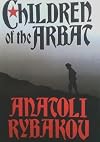
These are the first two volumes in a trilogy (the third is Dust and Ashes). Rybakov is an excellent storyteller. His many characters and intertwining plot(s) sweep you along in mid-1930s USSR, setting out the background to and beginning of Stalin’s Terror. His characters take part in a vividly portrayed Moscow social scene with interspersed scenes—based, I believe, on substantial research—involving Stalin himself and the highest members of the Soviet government. Rybakov is very good at show more depicting Stalin as a person; the scenes he puts together create an absolutely chilling—and completely believable—account of an extraordinarily, dangerously paranoid person. Virtually all of the people and places that Rybakov depicts (from socializing in Moscow to life in exile in Siberia to Stalin strolling near his dacha) are beautifully drawn and he is wonderful at inventing dozens of characters and a wide range of situations. Indeed, having lived through it himself, Rybakov is particularly convincing at showing how ordinary people tried to live their lives under the Terror.
Yet after 1,400 pages, as riveting as Rybakov’s portrayals are, as terrifying as his renderings of everyday life, as successful as his recreation of life and lives, I was disappointed at Rybakov’s failure to address the larger questions that his story so clearly raises. For instance, Rybakov creates an almost spellbinding account of a well-placed (socially) individual who runs afoul of the NKVD. From the tension of merely waiting for the next telephone call to the dread and panic of an interrogation, it’s almost inconceivable that the relationship could be portrayed better. But, as evocative as the writing is, it never seeks serious answers to the great questions.
Irving Howe, an American literary critic (active from about 1950-1990) wrote this in 1988: “At no point does he venture beyond prescribed Leninist orthodoxy…. Neither in his own right nor through his characters…does the novelist ask whether the Bolshevik exaltation of 'the party'…smoothed Stalin's rise to power. (In this respect, Vassily Grossman's Life and Fate, another recently translated Soviet novel about Stalinism, is much bolder.) … The criticism I'm making here, a literary criticism, is not that Anatoly Rybakov or his characters fail to provide congenial answers but that they fail to grapple deeply with inescapable questions. Or to put it another way… the subject he has chosen…requires [either the author or his characters or both to engage in] sustained and independent reflection.”
I think Howe is right. The story itself (the characters, the line-by-line writing) is great; it demands deeper thought which Rybakov fails to provide. And so as much as I liked the story, I was disappointed in the work as a whole. show less
Yet after 1,400 pages, as riveting as Rybakov’s portrayals are, as terrifying as his renderings of everyday life, as successful as his recreation of life and lives, I was disappointed at Rybakov’s failure to address the larger questions that his story so clearly raises. For instance, Rybakov creates an almost spellbinding account of a well-placed (socially) individual who runs afoul of the NKVD. From the tension of merely waiting for the next telephone call to the dread and panic of an interrogation, it’s almost inconceivable that the relationship could be portrayed better. But, as evocative as the writing is, it never seeks serious answers to the great questions.
Irving Howe, an American literary critic (active from about 1950-1990) wrote this in 1988: “At no point does he venture beyond prescribed Leninist orthodoxy…. Neither in his own right nor through his characters…does the novelist ask whether the Bolshevik exaltation of 'the party'…smoothed Stalin's rise to power. (In this respect, Vassily Grossman's Life and Fate, another recently translated Soviet novel about Stalinism, is much bolder.) … The criticism I'm making here, a literary criticism, is not that Anatoly Rybakov or his characters fail to provide congenial answers but that they fail to grapple deeply with inescapable questions. Or to put it another way… the subject he has chosen…requires [either the author or his characters or both to engage in] sustained and independent reflection.”
I think Howe is right. The story itself (the characters, the line-by-line writing) is great; it demands deeper thought which Rybakov fails to provide. And so as much as I liked the story, I was disappointed in the work as a whole. show less

Like Rybakov's last novel, Fear, in Dust and Ashes the author takes the time to catch his readers up to the saga thus far. Yuri is a member of the secret police, Vika is married and living in Paris, her brother Vadim is also an NKVD informant. Maxim is in the Red Army as a commander. Nina is a Communist while her sister, Varya, rejects Communism and remains true to her friends. Sasha has been freed from exile but he is not allowed back in Moscow or any other major Russian city. Dust and show more Ashes begins in 1937. When we left Sasha and Varya, their romance had cooled after Sasha learned of Varya's previous marriage to a gambler. Sasha struggles to make ends meet in various small towns, first as a truck driver and then as a ballroom dance instructor. World War II is almost a central character alongside Sasha Pankratov and Joseph Stalin. This is the era of endless interrogations (when you would rather have chat). Promotions could mean a reshuffling of the personnel deck or a literal death sentence. It is stunning the way Rybakov can seamlessly interject facts into a fictional account of the Great Purge. Details like the assassination of Trotsky. Two battles rage in Dust and Ashes - the delicate dance of Tyrants (Hitler and Stalin) and the Battle for Romance (Sasha and Varya). Who will win? Sometimes, when the target is not persuaded, the only motivation can come from fear. Confessional: the final pages of Dust and Ashes had me holding my breath. I did not want to believe it was the end. Surely there would be another sequel, a fifth installment to the saga. But in actuality, really what more about be said? show less
Lists
Awards


You May Also Like


Associated Authors
Statistics
- Works
- 35
- Also by
- 6
- Members
- 1,383
- Popularity
- #18,590
- Rating
- 4.0
- Reviews
- 21
- ISBNs
- 157
- Languages
- 23
- Favorited
- 4
