
Vladimir Voinovich (1932–2018)
Author of The Life and Extraordinary Adventures of Private Ivan Chonkin
About the Author
Vladimir Nikolayevich Voinovich was born in Stalinabad, Soviet Union on September 26, 1932. He worked as a herdsman and trained as a locksmith before serving in the Soviet Army from 1951 to 1955. He began writing poetry while in the army and in the mid-1950s started publishing stories in the show more magazine Novy Mir. One story, I'd Be Honest if They'd Let Me, about a construction supervisor whose conscience is bothered by the shoddy structures he is ordered to build, was singled out as being dangerous. His novel, The Life and Extraordinary Adventures of Private Ivan Chonkin, did not clear the Soviet censorship bar in 1969 but circulated underground and was published in Europe four years later. He was questioned repeatedly by the K.G.B. He left the country in 1980 and joined faculty of the Institute of Fine Arts in Munich. His Soviet citizenship was revoked in 1970 and he was unable to return for a decade. His other novels included Moscow 2042, The Fur Hat, Monumental Propaganda, and The Crimson Pelican. He died of a heart attack on July 27, 2018 at the age of 85. (Bowker Author Biography) show less
Image credit: Galina Zakhoder
Series
Works by Vladimir Voinovich
A Displaced Person: The Later Life and Extraordinary Adventures of Private Ivan Chonkin (2007) 18 copies, 1 review
Meie elame siin : jutustus 5 copies
De vrijheid verteld : verhalen voor Amnesty International van Adriaan van Dis, Norman Manea, Duoduo, Julio Cortázar, Et (1996) 4 copies
Voinovich: By Means of Mutual Correspondence - Putem Vzaimnoi Perepiski (Russian Texts Series) (1996) 3 copies
Жизнь и необычайные приключения солдата Ивана Чонкина. Книга 1. Лицо неприкосновенное, Книга 2.… 1 copy
Kareivja Ivana Čonkina dzīve un neparastie piedzīvojumi : romāns. 1. grām., Neaizskaramā persona (1992) 1 copy
Нулевое решение 1 copy
Associated Works
Tagged
Common Knowledge
- Legal name
- Войнович, Владимир Николаевич
- Other names
- Voinovich, Vladimir Nikolayevich
Vojnovič, Vladimir Nikolaevič
Woinowitsch, Wladimir
Vojnovič, Wladimir - Birthdate
- 1932-09-26
- Date of death
- 2018-07-27
- Gender
- male
- Education
- Krupskaya Pedagogical Institute
- Occupations
- novelist
painter
satirist - Organizations
- Bavarian Academy of Fine Arts (Corresponding Member)
- Awards and honors
- State Prize of the Russian Federation (2000)
Andrei Sakharov Prize For Writer's Civic Courage (2002) - Cause of death
- heart attack
- Nationality
- Russia
Russia - Birthplace
- Stalinabad/Dushanbe, Tajikistan, USSR
- Places of residence
- Munich, Germany
- Place of death
- Moscow, Russia
- Associated Place (for map)
- Russia
Members
Reviews
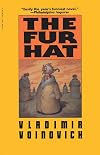
My oh my. I suspect that Mr. Voinovich was not popular with the authorities. A funny, funny book about a writer whose only goal is to get a better hat. The Writer’s Union is having hats made for its members and of course the more distinguished the writer, the more distinguished the fur to be used. Suffice to say, our hero finds that he is in line for a hat made of “fluffy tomcat.” The more he discovers what others are getting, the more incensed he becomes and the book is the story of show more his crusade to get something better. To say more would be telling. If you need a good laugh, read this. show less
The Life and Extraordinary Adventures of Private Ivan Chonkin (European Classics) by Vladimir Vojnovitsj
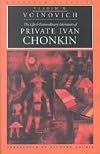
Ivan Chonkin is an inept private in the Soviet army on the cusp of World War Two who first finds himself ordered to guard an airplane in a distant village, then finds himself forgotten by the authorities, and finally remembered and with a vengeance.
`The Life and Extraordinary Times of Private Ivan Chonkin' might be called a Soviet Catch-22 [Catch-22: A Novel (Simon & Schuster Classics)] for its seemingly absurdist send up of life in the Red Army. I say 'seemingly absurdist' because, like show more Catch-22, one suspects there is more than a little truth in Voinovich's portrayal of bureaucratic tomfoolery. Chonkin himself calls to mind George Macdonald Fraser's McAuslan (McAuslan in the Rough), the bumbling private in a Scottish Highland regiment. Others have likened it the The Good Soldier Svejk: and His Fortunes in the World War (Penguin Classics), which I have not yet read.
The background of Stalinist terror gives Voinovich's work a darker cast. Army bureaucrats endeavor at all costs to keep a low profile to avoid attracting the attention of the higher ups. Such attention is too often accompanied in their minds with imprisonment, exile, or death.
A favorite bit occurs late in the book when a regiment has surrounded the village in order to take Chonkin into custody. Chonkin has taken seven members of the secret police captive and the regiment has come to the rescue. (In the meantime, Chonkin has turned this group of seven into such efficient farm workers that word soon reaches the newspapers and even Comrade Stalin. The local chairman feels certain doom is sure to follow such success.) The captain of the secret police escapes, but falls into the hands of army, which he mistakenly thinks is the German army. Much hilarity ensues.
Although the book is somewhat an artifact of the Stalinist era and is almost certainly even better if one can read it in the original Russian (alas, I cannot), the book still rates five stars and my highest recommendation in part for the rare look it provides into life in the wartime Soviet Union and in part for its timeless portrayal of army bureaucracy, and the universal slacker, Ivan Chonkin. show less
`The Life and Extraordinary Times of Private Ivan Chonkin' might be called a Soviet Catch-22 [Catch-22: A Novel (Simon & Schuster Classics)] for its seemingly absurdist send up of life in the Red Army. I say 'seemingly absurdist' because, like show more Catch-22, one suspects there is more than a little truth in Voinovich's portrayal of bureaucratic tomfoolery. Chonkin himself calls to mind George Macdonald Fraser's McAuslan (McAuslan in the Rough), the bumbling private in a Scottish Highland regiment. Others have likened it the The Good Soldier Svejk: and His Fortunes in the World War (Penguin Classics), which I have not yet read.
The background of Stalinist terror gives Voinovich's work a darker cast. Army bureaucrats endeavor at all costs to keep a low profile to avoid attracting the attention of the higher ups. Such attention is too often accompanied in their minds with imprisonment, exile, or death.
A favorite bit occurs late in the book when a regiment has surrounded the village in order to take Chonkin into custody. Chonkin has taken seven members of the secret police captive and the regiment has come to the rescue. (In the meantime, Chonkin has turned this group of seven into such efficient farm workers that word soon reaches the newspapers and even Comrade Stalin. The local chairman feels certain doom is sure to follow such success.) The captain of the secret police escapes, but falls into the hands of army, which he mistakenly thinks is the German army. Much hilarity ensues.
Although the book is somewhat an artifact of the Stalinist era and is almost certainly even better if one can read it in the original Russian (alas, I cannot), the book still rates five stars and my highest recommendation in part for the rare look it provides into life in the wartime Soviet Union and in part for its timeless portrayal of army bureaucracy, and the universal slacker, Ivan Chonkin. show less

I came across ‘Moscow 2042’ in a charity shop and was intrigued by the idea of a USSR satire written and published only a couple of years before the USSR collapsed. However, I forgot that as someone who has only read a couple of books about that period, a lot of the subtleties would sail right over my head. It happened with [b:The Slynx|310722|The Slynx|Tatyana Tolstaya|https://i.gr-assets.com/images/S/compressed.photo.goodreads.com/books/1320532928l/310722._SY75_.jpg|3535], with show more [b:Happy Moscow|341711|Happy Moscow|Andrei Platonov|https://i.gr-assets.com/images/S/compressed.photo.goodreads.com/books/1173894797l/341711._SY75_.jpg|332077], and lo, it has happened again. The translation is very readable, but I suspect there was a lot of wordplay that simply didn’t work so well in English. Nonetheless I enjoyed the fantastical plot, which was what intrigued me in the first place. The narrator, Kartsev, is a Russian writer in exile. In 1982 he takes the opportunity to time-travel to 2042, where supposedly genuine communism has been implemented within Moscow.
The book is divided into seven parts, each with many short chapters, but while reading I felt there were really three elements to it. First, the protagonist’s surroundings, friends, and antagonistic acquaintances are established. This went on for longer than I’d expected. Then he is sent to future Moscow and tours the place, learning its quirks. This central part reads much like [b:Erewhon|516570|Erewhon (Erewhon , #1)|Samuel Butler|https://i.gr-assets.com/images/S/compressed.photo.goodreads.com/books/1175460304l/516570._SY75_.jpg|924128] or a similar, in which a man observes the ways that a strange new place throws light upon his familiar milieu. Although it became somewhat formulaic as it stretched on, this part was quite fun in its generalised mockery of Soviet bureaucracy. One detail Voinovich predicted was that the KGB would take over the Soviet government, except they’d actually be the CIA. Meanwhile back in the US, the KGB would take over the CIA. Some contemporary echoes to be found there. In the final part of the book, it becomes structurally weirder and thus more distinctive. Going beyond political satire, it attempts comment on the roles of satire and fiction themselves.In 2042, Kartsev reads a novel he is yet to write. Great pressure is then put on him to write it differently when he returns to the past, in order to change events in 2042. That novel is called ‘Moscow 2042’, so obviously it’s the novel you’re actually reading. This confusing paradox is semi-resolved by Kartsev’s intransigence and the chaotic intervention of reactionary political forces.
Kartsev isn’t a particularly appealing protagonist, as he’s usually drunk, hitting on women, and jealous of more successful peers. However his relative self-awareness makes him a decent narrator of future-Moscow’s more bizarre elements. I don’t think I learned much about the USSR shortly before its collapse from this novel, but it was an amusing read with occasional moments of profundity. The most memorable of the latter was this:
The book is divided into seven parts, each with many short chapters, but while reading I felt there were really three elements to it. First, the protagonist’s surroundings, friends, and antagonistic acquaintances are established. This went on for longer than I’d expected. Then he is sent to future Moscow and tours the place, learning its quirks. This central part reads much like [b:Erewhon|516570|Erewhon (Erewhon , #1)|Samuel Butler|https://i.gr-assets.com/images/S/compressed.photo.goodreads.com/books/1175460304l/516570._SY75_.jpg|924128] or a similar, in which a man observes the ways that a strange new place throws light upon his familiar milieu. Although it became somewhat formulaic as it stretched on, this part was quite fun in its generalised mockery of Soviet bureaucracy. One detail Voinovich predicted was that the KGB would take over the Soviet government, except they’d actually be the CIA. Meanwhile back in the US, the KGB would take over the CIA. Some contemporary echoes to be found there. In the final part of the book, it becomes structurally weirder and thus more distinctive. Going beyond political satire, it attempts comment on the roles of satire and fiction themselves.
Kartsev isn’t a particularly appealing protagonist, as he’s usually drunk, hitting on women, and jealous of more successful peers. However his relative self-awareness makes him a decent narrator of future-Moscow’s more bizarre elements. I don’t think I learned much about the USSR shortly before its collapse from this novel, but it was an amusing read with occasional moments of profundity. The most memorable of the latter was this:
It is much more difficult to convince one individual of an idiotic idea than an entire people.show less
I read Vladimir Voinovich's short comic masterpiece back in 1989 when first published in English and read it three more times over the years, including this past week. One thing has remained consistent – I laughed out loud on nearly each page. This is a very funny book.
Hardly a whopping surprise since the author is famous for his satire and wit in the dozens of works he’s written - essays, short stories, novels, the most famous The Life and Extraordinary Adventures of Private Ivan show more Chonkin and Moscow 2042. Born in 1932, Mr. Voinovich knew political dissent from an early age as his father spent five years in prison for anti-Soviet agitation. A human rights activist himself, the author and his family were forced to emigrate in 1980 where he settled in Munich, West Germany. Mikhail Gorbachev restored his Soviet citizenship in 1990 and since that date Vladimir Voinovich has spent most of his time in Russia. Even at the advanced age of eighty-five, his writing, as acerbic as ever, continued to flow.
In The Fur Hat we follow one Yefim Semyonovich Rakhlin through the eyes of a friend and fellow Writers’ Union member. Rakhlin is a staunch, longtime member of the Union and author of eleven adventure novels featuring fearless, decent people – geologists, explorers, polar researchers, et al. – courageously fighting an uphill battle against harsh conditions in remote terrain. Although other writers see Rahkllin’s books for what they are – inflated, mawkish drivel (think of a poorly written Reader’s Digest article expanded to novel length), Rakhlin himself judges his writing on the level of Anton Chekhov; well, if truth be told, his own is a little better.
Why not? After all, before turning to fiction, Yefim was a dedicated staff writer for the journal Geology and Mineralogy and his five room apartment is stuffed with foreign imports, things like a Czech Piano, Japanese television, Finnish refrigerator, mostly from monies when his novels were taken up by media people and turned into plays, films and television shows. Chekhov never came close to that! Besides, the reviews have always been glowing. True, geologists and the like, not literary critics, have done the reviewing, but when has true genius ever been recognized by the so called experts? However the narrator is quick to point out: “The reviews – I suspect Yefim wrote them himself – were all similar and had titles like “A Needed Book,” “”Useful Reading,” or “A Fact Everyone Should Know.””
Then the fateful day arrives: Yefim is in his den diligently at work on his next novel, Operation!, when the phone rings. It is Writers’ Union writer Kostya, his closest friend, informing Yefim the Literary Fund’s board of directors decided to distribute hats for writers based on their importance: reindeer fawn for the foremost writers, muskrat for leading writers, marmot for outstanding writers. Kostya goes on to say members of the Writers’ Union, such as “you and me” will be given something like rabbit.
Rabbit! They dare even think of such a low-grade fur! Don’t they know Yefim Semyonovich Rakhlin is the author of eleven novels? Yefim sets out to discover exactly what kind of fur hat he has been given. At the office of a leading official he receives the news: tomcat. Tomcat! Even worse than rabbit - what a blow to Yefim’s self-esteem. Will meek, passive, milquetoast Rakhlin tolerate such injustice? He will not. For readers, the fun has just begun - from this point forward its little man versus big bureaucracy in the tradition of clerk Akaky Akakievich from Nikolai Gogol’s The Overcoat.
On one level The Fur Hat can be taken as offering a moral lesson: the dire consequences when a person equates self-worth with reputation and status, that is, when one places oneself entirely in the hands of others’ opinions. But as we all know, much easier to give rather than take such advice. Let's look at a hypothetical example: the Goodreads people announce mugs will be sent to those reviewers who have written many reviews over the years. The mug will display the photo of an animal that, in the opinion of the judges, accurately represents the quality of the reviewer’s writing - a snow leopard for the best reviewers, a tiger for very fine reviewers, a wolf for good solid reviewers and so forth. They even include a list with a number of the best reviewers, many names I recognize: Manny, Fionnuala, Dolors, Jeffrey, Michael, Lyn, Lisa, Cheri, Robert, Paul, Brian, Seemita, Cheryl, Lynne, Steven, Kal, Zoey, David, Tony, among others.
A week later I receive my Goodreads mug in the mail. By the little black eyes, sharp ears, whiskers, grey hair and long slimy tail, there’s no mistake – I was given a rat. Not exactly what I was expecting. I immediately send an email off with a link to a couple of my favorite reviews and ask if I may have a clarification or if there was perhaps a mistake or mix-up. Shortly thereafter I receive a reply: “No mistake, Glen, the judges don’t have to read any more of those reviews to know you rate rat.”
Very well. At least I have my answer. I’ll let it go. I wouldn’t want to be taken for the Yefim Semyonovich Rakhlin of the twenty-first century. But I’d be fibbing if I didn’t picture a face-to-face with said judges - for starters I’d note how they misspelled my name. All of a sudden I have renewed appreciation for The Fur Hat.
"The writing, as always, was abominable. But I saw in Yefim's eyes such a desperate desire to hear praise that my heart quailed."
Vladimir Voinovich, The Fur Hat show less
Lists
Awards


You May Also Like


Associated Authors
Statistics
- Works
- 43
- Also by
- 2
- Members
- 1,621
- Popularity
- #15,881
- Rating
- 4.0
- Reviews
- 42
- ISBNs
- 164
- Languages
- 19
- Favorited
- 7