
Grayson Perry
Author of The Descent of Man
About the Author
Image credit: Kirsteen
Works by Grayson Perry
Playing to the gallery: helping contemporary art in its struggle to be understood (2014) 249 copies, 8 reviews
Associated Works
Tagged
Common Knowledge
- Canonical name
- Perry, Grayson
- Other names
- Claire
- Birthdate
- 1960-03-24
- Gender
- male
- Education
- Portsmouth Polytechnic (BA|1982)
King Edward VI Grammar School, Chelmsford
St. Mary's Church of England Primary School
Woodham Ferrers Church of England School - Occupations
- artist
writer
broadcaster - Awards and honors
- Knight Bachelor (2023)
Order of the British Empire (Commander, 2013)
Royal Academician (2011)
Royal Institute of British Architects (Honorary Fellow, 2016)
Turner Prize (2003)
Erasmus Prize (2021) (show all 9)
Royal Television Society award (2005, 2017)
South Bank Sky Arts Award (2012)
BBC Reith Lectures (2013) - Relationships
- Perry, Phillipa (spouse)
- Nationality
- UK
- Birthplace
- Chelmsford, Essex, England, UK
- Places of residence
- Bicknacre, Essex, England, UK
London, England, UK - Map Location
- England, UK
Members
Reviews

If I were to make a disparaging remark about this book, the only criticism that I might have is with the title. Whilst I recognise its nod to literary heritage, it does tend to make one expect a negative work: this is not the case, Grayson Perry presents a book of, largely positive, discussions upon the male role in the twenty-first century.
Perry looks at the usual traits of manliness, and offers an insightful examination of their relevance, or lack of same, in the current era. He is show more careful not to become a doom laden, "Things were better when..." merchant, whilst equally, not throwing away all that has built up over the centuries in favour of 'new man'.
White working class males are a group that seem to be getting cast adrift in modern society and their revenge is found in the popularity of the Farage and Trump brigade, who at least do them the honour of pretending to care about their concerns. Perry is the boy from that group who has overcome numerous difficulties to make good.
The term 'Lads Bible', is usually a derogatory term for low literature, however, this book is much more of the positive variety. Were it possible to get lads, of a certain age, to read and inwardly digest this tome, the world would, undoubtedly, be a much better place.
Whilst, this is unlikely, this book should be read by everyone. The insight available and the potential solutions offered would lead to a fighting chance of rescuing a, very nearly, lost generation - and perhaps save the World from political extremism into the bargain. show less
Perry looks at the usual traits of manliness, and offers an insightful examination of their relevance, or lack of same, in the current era. He is show more careful not to become a doom laden, "Things were better when..." merchant, whilst equally, not throwing away all that has built up over the centuries in favour of 'new man'.
White working class males are a group that seem to be getting cast adrift in modern society and their revenge is found in the popularity of the Farage and Trump brigade, who at least do them the honour of pretending to care about their concerns. Perry is the boy from that group who has overcome numerous difficulties to make good.
The term 'Lads Bible', is usually a derogatory term for low literature, however, this book is much more of the positive variety. Were it possible to get lads, of a certain age, to read and inwardly digest this tome, the world would, undoubtedly, be a much better place.
Whilst, this is unlikely, this book should be read by everyone. The insight available and the potential solutions offered would lead to a fighting chance of rescuing a, very nearly, lost generation - and perhaps save the World from political extremism into the bargain. show less

One of the fundamental problems that I can see with gender relations is all to do with nomenclature. The separation of character attributes into 'masculine' and 'feminine' is reductive to the point of stress and tension, and makes it hard for men to address aspects of their character that might fall into the 'wrong' category. If only somebody had had the foresight to name these categories 'Type A' and 'Type Z', so that there would be a whole alphabet of possible combinations of character show more types....
In 'The Descent of Man', Grayson Perry looks at what it means to be a man in the twenty-first century, as well as what it should mean. The term 'toxic masculinity' is one that has become almost cliched, but here Mr Perry wisely dismantles the various arguments for any kind of return to 'traditional' male values. To survive in the modern world, we men must transcend the limits we place on ourselves and on each other, and work more to build the skills that the new world demands. Furthermore, we must not see that making room for people of different backgrounds and origins is necessarily to our detriment - with increased diversity in every field of life comes diversity of outcomes and possibilities for us all. show less
In 'The Descent of Man', Grayson Perry looks at what it means to be a man in the twenty-first century, as well as what it should mean. The term 'toxic masculinity' is one that has become almost cliched, but here Mr Perry wisely dismantles the various arguments for any kind of return to 'traditional' male values. To survive in the modern world, we men must transcend the limits we place on ourselves and on each other, and work more to build the skills that the new world demands. Furthermore, we must not see that making room for people of different backgrounds and origins is necessarily to our detriment - with increased diversity in every field of life comes diversity of outcomes and possibilities for us all. show less
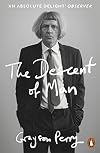
It takes a bit of nerve to use the same title for your book as Charles Darwin did for his 1871 study, but in a way Grayson Perry seems to be saying that modern men are fully capable of evolving, and for the better. It should be possible for them to transition from their traditional dinosaur-like sense of what it is to be a man towards something more fitting for the future, more so now that we are in the era of #MeToo and with urgent demands for well overdue gender parity.
Who is Grayson show more Perry? This is his official bio from the paperback:
Grayson Perry is a man. He is also an award-winning artist, a Bafta-winning TV presenter, a Reith Lecturer and a bestselling author with traditional masculine traits like a desire to always be right and to overtake all other cyclists when going up big hills.
He is also adept at self-deprecation and incisive insights, as well as being a flamboyant cross-dresser (it's hard to miss him in this role for many of his public appearances). A three-episode TV documentary, All Man, went on to explore aspects of masculinity touched on here, but in the meantime this autobiographical memoir explores Perry's boyhood experiences -- he was born in 1960 -- and his changing perceptions of what it means to be a male in a modern world. What he reflects on may be rooted in an English perspective, but much of his ruminations has ramifications in the rest of the western world, and of course elsewhere.
After a semi-biographical introduction his discussion is divided into four sections. 'Asking Fish about Water' expands on the status quo, at the centre of which is Default Man masquerading as the epitome of 'normal' or 'natural'. For anybody wanting to be taken seriously a uniform mindset in uniform clothing is currently expected, and anybody unable to conform is 'other', outside the realms of power and decision-making. This default model, Grayson argues in 'The Department of Masculinity', has little to do with genetics and a lot to do with conditioning -- This is how it's always been, and this is how it's always going to be. If our ideas of masculinity are brought about by cultural conditioning (blue for boys, pink for girls) then surely it's possible to determinedly change that conditioning so that such imbalances in power and authority can be levelled out, for the benefit of both women and men, as well as anyone else on the continuum?
It'll be a hard struggle, Grayson acknowledges in 'Nostalgic Man'. The tug of the familiar (even when notions of what's regarded as 'traditional' evolve almost unperceptively) is always dragging us men and women back towards a perceived norm. As the author writes, visions of
how men might be in the future are thinly sketched ... [B]ecause they are new there is no compelling back catalogue of the kind of role models and narratives that currently form the powerful propaganda of the old-school man.
Finally, in 'The Shell of Objectivity' he further expounds on the disadvantages of being what he calls old-school man. Such men are expected to be strong and silent superheroes, invulnerable and firm as a rock, always capable and armed with the facts, never wrong and certainly must never display any kind of weak emotion: Be a Man! is the usual disgusted response to any male eye-watering. But this armoured shell is not just protective, it's constricting: it stops any personal growth in the areas of sympathy, empathy, compassion; it doesn't allow admissions of failure or an ability -- let alone a willingness -- to change direction, throw off rigid attitudes, admit weakness.
Much of the author's perspective would be understandable to British readers brought up in insular cultural traditions, such as having a stiff upper lip. If non-British readers can get past the topical references and allusions there remains much to enjoy and learn, and of course its core message is universal and relevant right across cultures. Rather than discoursing on a subject that could potentially come over as dry, academic and depressing, Grayson Perry has made the issue of masculinity accessible and recognisable by throwing in lots of personal anecdotes and amusing asides, choosing visually arresting verbal images (as befits an artist) and including as additional commentary cartoons he's based on tropes from popular culture.
If conclusions are now called for, I'd say this: this memoir is strong on analysis, but solutions are not so easy to come by; but if they were, wouldn't we all be tackling them? Perry makes a start with what he calls 'Men's rights', a list of former negatives that he turns into positives. If men can allow themselves to be vulnerable, weak, wrong, intuitive and so on, and allow themselves to not be ashamed of having what have traditionally been regarded as feminine qualities, then there might be real optimism for the future.
If not, then humankind will continue to be at war with itself, with so much individual fulfilment permanently impaired or even nipped in the bud. It's time to put the kind back into mankind. show less
Who is Grayson show more Perry? This is his official bio from the paperback:
Grayson Perry is a man. He is also an award-winning artist, a Bafta-winning TV presenter, a Reith Lecturer and a bestselling author with traditional masculine traits like a desire to always be right and to overtake all other cyclists when going up big hills.
He is also adept at self-deprecation and incisive insights, as well as being a flamboyant cross-dresser (it's hard to miss him in this role for many of his public appearances). A three-episode TV documentary, All Man, went on to explore aspects of masculinity touched on here, but in the meantime this autobiographical memoir explores Perry's boyhood experiences -- he was born in 1960 -- and his changing perceptions of what it means to be a male in a modern world. What he reflects on may be rooted in an English perspective, but much of his ruminations has ramifications in the rest of the western world, and of course elsewhere.
After a semi-biographical introduction his discussion is divided into four sections. 'Asking Fish about Water' expands on the status quo, at the centre of which is Default Man masquerading as the epitome of 'normal' or 'natural'. For anybody wanting to be taken seriously a uniform mindset in uniform clothing is currently expected, and anybody unable to conform is 'other', outside the realms of power and decision-making. This default model, Grayson argues in 'The Department of Masculinity', has little to do with genetics and a lot to do with conditioning -- This is how it's always been, and this is how it's always going to be. If our ideas of masculinity are brought about by cultural conditioning (blue for boys, pink for girls) then surely it's possible to determinedly change that conditioning so that such imbalances in power and authority can be levelled out, for the benefit of both women and men, as well as anyone else on the continuum?
It'll be a hard struggle, Grayson acknowledges in 'Nostalgic Man'. The tug of the familiar (even when notions of what's regarded as 'traditional' evolve almost unperceptively) is always dragging us men and women back towards a perceived norm. As the author writes, visions of
how men might be in the future are thinly sketched ... [B]ecause they are new there is no compelling back catalogue of the kind of role models and narratives that currently form the powerful propaganda of the old-school man.
Finally, in 'The Shell of Objectivity' he further expounds on the disadvantages of being what he calls old-school man. Such men are expected to be strong and silent superheroes, invulnerable and firm as a rock, always capable and armed with the facts, never wrong and certainly must never display any kind of weak emotion: Be a Man! is the usual disgusted response to any male eye-watering. But this armoured shell is not just protective, it's constricting: it stops any personal growth in the areas of sympathy, empathy, compassion; it doesn't allow admissions of failure or an ability -- let alone a willingness -- to change direction, throw off rigid attitudes, admit weakness.
Much of the author's perspective would be understandable to British readers brought up in insular cultural traditions, such as having a stiff upper lip. If non-British readers can get past the topical references and allusions there remains much to enjoy and learn, and of course its core message is universal and relevant right across cultures. Rather than discoursing on a subject that could potentially come over as dry, academic and depressing, Grayson Perry has made the issue of masculinity accessible and recognisable by throwing in lots of personal anecdotes and amusing asides, choosing visually arresting verbal images (as befits an artist) and including as additional commentary cartoons he's based on tropes from popular culture.
If conclusions are now called for, I'd say this: this memoir is strong on analysis, but solutions are not so easy to come by; but if they were, wouldn't we all be tackling them? Perry makes a start with what he calls 'Men's rights', a list of former negatives that he turns into positives. If men can allow themselves to be vulnerable, weak, wrong, intuitive and so on, and allow themselves to not be ashamed of having what have traditionally been regarded as feminine qualities, then there might be real optimism for the future.
If not, then humankind will continue to be at war with itself, with so much individual fulfilment permanently impaired or even nipped in the bud. It's time to put the kind back into mankind. show less
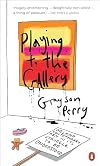
I've become increasingly interested in art in the last few years, but finding well-written books to help me understand the world of art has not been so easy. There are some fine books out there, but they are out-numbered by dense and difficult books that take everything too seriously, or that assume a background knowledge that I simply don't possess.
'Playing to the Gallery' is not like that at all. Based on his Reith Lectures, this book is Grayson Perry's very approachable take on the world show more of contemporary art, and guides you through the major discussion points that people like me will inevitably run into - what is art? What does it mean to be an artist? Is everything art? Who decides?
I loved this book, and steamed through it in little more than a day. Now I need to go out there and find another book to take me further in my art adventure. show less
'Playing to the Gallery' is not like that at all. Based on his Reith Lectures, this book is Grayson Perry's very approachable take on the world show more of contemporary art, and guides you through the major discussion points that people like me will inevitably run into - what is art? What does it mean to be an artist? Is everything art? Who decides?
I loved this book, and steamed through it in little more than a day. Now I need to go out there and find another book to take me further in my art adventure. show less
Lists
Awards


You May Also Like


Associated Authors
Statistics
- Works
- 19
- Also by
- 1
- Members
- 717
- Popularity
- #35,385
- Rating
- 3.8
- Reviews
- 24
- ISBNs
- 40
- Languages
- 3