
Harold Nicolson (1886–1968)
Author of The Congress of Vienna: A Study in Allied Unity: 1812-1822
About the Author
Image credit: from Stanford.edu
Series
Works by Harold Nicolson
Vita and Harold: The Letters of Vita Sackville-West and Harold Nicolson (1992) 169 copies, 2 reviews
The colonial problem 7 copies
The English Sense of Humour 4 copies
Politics In The Train 2 copies
The new spirit in literature 1 copy
Jeanne de Hénaut 1 copy
Ist der Krieg unvermeidlich? 1 copy
Associated Works
The Assassin's Cloak: An Anthology of the World's Greatest Diarists (2000) — Contributor, some editions — 623 copies, 9 reviews
Close to Colette / Maurice Goudeket ; translated by Enid McLeod (1986) — Introduction, some editions — 19 copies
France talks with Hitler : the story of the Allies' struggle to avert war — Preface — 3 copies, 1 review
A Modern Galaxy — Contributor — 2 copies
Poems — Contributor — 1 copy
Tagged
Common Knowledge
- Canonical name
- Nicolson, Harold
- Legal name
- Nicolson, Sir Harold George
- Birthdate
- 1886-11-21
- Date of death
- 1968-05-01
- Gender
- male
- Education
- Wellington College, Berkshire, England, UK
Balliol College, Oxford University (BA|1909) - Occupations
- diplomat
author
Member of Parliament (Leicester West, 1935-45)
diarist - Organizations
- His Majesty's Diplomatic Service
- Awards and honors
- Companion, Most Distinguished Order of Saint Michael and Saint George (1920)
Knight Commander, Royal Victorian Order (1953) - Relationships
- Sackville-West, Vita (wife)
St Aubyn, Giles (nephew)
Nicolson, Nigel (son)
Nicolson, Benedict (son) - Nationality
- UK
- Birthplace
- Tehran, Persian Empire
- Places of residence
- Sissinghurst, Kent, England, UK
Long Barn, Kent, England, UK - Place of death
- Sissinghurst, Kent, England, UK
- Map Location
- England, UK
Members
Reviews
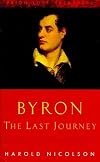
Well-written, and still useful, 1924 study of the unromantic circumstances that led to Byron's personal involvement in the Greek Revolt. A beautifully detailed account of the complete failure of this undertaking in the winter of 1823/1824, and of Byron's growing disappointment and uncertainty, and his final illness and death in the marshes and pouring rain of Missolonghi -- an area so wet that "the dykes of Holland when broken down are are deserts for dryness in comparison", as Byron said -- show more surrounded by unruly Souliot mercenaries, European adventurers, parasites, and incompetent doctors. Despite good psychological insight and a remarkably no-nonsense approach to the poet's life, Nicolson's tone is very apologetic regarding British imperialism, while using Orientalist, even racist terminology to describe the Ottoman Empire -- in sharp contrast to Byron's own approach to the wildly complicated political and ethnic situation in the Ottoman Aegean. show less

Published in 1946 that is, at a time when Europe were just waking up from the military ambtions of dictators that had thrown her into total war, drawing parallels with the last days of the napoleonic saga would have been easy and very tempting. Well, hat off to the author because he doesn't! On the contrary, he insists history is a matter of circumstances and, as circumstances differ with various generations it doesn't repeat itself.
Such a view (again, remarkable considering the context) show more makes of this book more than an account of a diplomatic conference in european history. It's a window open on the circumstances that affected its decisions, from the personalities involved to the events (tragic or downright ridiculous) that changed its agendas more than once.
Being himself a diplomat, the portraits Harold Nicolson offers of Talleyrand, Lord Castlereagh, the Tsar Alexander Ist or, between the lines, Napoleon and Louis XVIII are a gem. Replacing it all in the context of a tumultuous period he, in the end, doesn't hide his admiration for such an endeavour. Indeed, it's easy to criticise the shortfalls and failures of such a conference (e.g. the rise of nationalisms, People's Springs...) but, let's not forget we'll have to wait 1914 for Europe to be plunged again into the chaos of a total war. Having laid the foundations for a century of peace is not that bad, is it?
A nice read. show less
Such a view (again, remarkable considering the context) show more makes of this book more than an account of a diplomatic conference in european history. It's a window open on the circumstances that affected its decisions, from the personalities involved to the events (tragic or downright ridiculous) that changed its agendas more than once.
Being himself a diplomat, the portraits Harold Nicolson offers of Talleyrand, Lord Castlereagh, the Tsar Alexander Ist or, between the lines, Napoleon and Louis XVIII are a gem. Replacing it all in the context of a tumultuous period he, in the end, doesn't hide his admiration for such an endeavour. Indeed, it's easy to criticise the shortfalls and failures of such a conference (e.g. the rise of nationalisms, People's Springs...) but, let's not forget we'll have to wait 1914 for Europe to be plunged again into the chaos of a total war. Having laid the foundations for a century of peace is not that bad, is it?
A nice read. show less

The Congress of Vienna, written in 1945, is still by far the best book on this subject. It also gives a good insight in the workings of diplomacy and is very direct and open about the characters of the main players. On top of this it is very well written.
This book is NOT a gripping read; however, if you want to know about the establishment of modern Europe, and particularly, the British involvement therein, then this is a must read.
Nicolson must have researched extensively for this authoritative and informative book. It is well served by a plethora of notes which would make it ideal for the serious student but, leaving the in depth stuff alone, it acts as an ideal book for the interested amateur too.
Although, I have nothing with which to show more compare this work, to confirm its veracity, I am convinced by its representation of a group of diplomats all fighting in part for their country but equally, for their personal kudos. I was long intrigued by the contempt of Shelly and Byron for Lord Castlereagh: I can see, from this description, why he would not be the sort of man to appeal to their avant-garde outlook on life. show less
Nicolson must have researched extensively for this authoritative and informative book. It is well served by a plethora of notes which would make it ideal for the serious student but, leaving the in depth stuff alone, it acts as an ideal book for the interested amateur too.
Although, I have nothing with which to show more compare this work, to confirm its veracity, I am convinced by its representation of a group of diplomats all fighting in part for their country but equally, for their personal kudos. I was long intrigued by the contempt of Shelly and Byron for Lord Castlereagh: I can see, from this description, why he would not be the sort of man to appeal to their avant-garde outlook on life. show less
Lists
Awards


You May Also Like


Associated Authors
Statistics
- Works
- 63
- Also by
- 16
- Members
- 2,475
- Popularity
- #10,359
- Rating
- 3.8
- Reviews
- 32
- ISBNs
- 101
- Languages
- 6
- Favorited
- 3
