
Willy Ley (1906–1969)
Author of Life Nature Library: The Poles
About the Author
Works by Willy Ley
Our Work in Space 6 copies
Shells and Shooting 6 copies
The Complete Book of Outer Space 3 copies
The Days of Creation 2 copies
Harnessing Space 2 copies
Project Mars: A Master Blueprint for Man's First Exploration Trip to MARS. 21 Art Plates. (1961) 2 copies
Spranget ut i rommet 2 copies
Os Pólos 1 copy
Domando el espacio 1 copy
Mars der Kriegsplanet. 1 copy
Know the missiles 1 copy
La Conquête de L'Espace 1 copy
Nuestra Tarea en el Espacio 1 copy
I misteri di Marte 1 copy
Die Möglichkeit der Weltraumfahrt: Allgemeinverständliche Beiträge zur Raumschiffahrtsproblem. 1 copy
V-2: Rocket Cargo Ship 1 copy
La conquista dello spazio 1 copy
Os Polos 1 copy
Associated Works
SF: The Year's Greatest Science-Fiction and Fantasy: 3rd Annual Volume (1958) — Contributor — 66 copies, 2 reviews
Tom Corbett, Space Cadet: Honor Thy Fellow Spacemen (7-in-1) (2009) — Technical Advisor — 8 copies, 1 review
Tagged
Common Knowledge
- Legal name
- Ley, Willy Otto Oskar
- Birthdate
- 1906-10-02
- Date of death
- 1969-06-24
- Gender
- male
- Education
- University of Berlin
- Occupations
- science writer
- Organizations
- Verein für Raumschiffahrt (VfR - "Spaceflight Society")
Trap Door Spiders - Awards and honors
- Hugo (Excellence in Fact Articles, 1953)
Hugo (Feature Writer, 1956)
Lunar Crater Namesake - Relationships
- Ley, Olga (wife)
Ley, Sandra (daughter) - Nationality
- Germany (birth)
USA (naturalized | 1944) - Birthplace
- Berlin, Germany
- Place of death
- Queens, New York, USA
- Burial location
- cremated
- Associated Place (for map)
- Queens, New York, USA
Members
Reviews

A 1952 popsci book about geographical mythology - Atlantis, Terra Incognita Australis, Eldorado, that sort of thing. I read the 1993 reprint, which doesn't update the text but seemingly has at least one added footnote; it references a 1954 book by de Camp.
This one was mostly stuff I'm already familiar with, the chief exception being the chapter on Sindbad and medieval Arab geographical myths, but well written. Predating the understanding of plate tectonics, some sections on geology are badly show more outdated; most else stand up, the only really obvious clue the book was written a couple generations ago being the unselfconscious way the authors use terms like "primitives".
In a book not above poking fun at erroneous ideas, one might have wished for a bit more stringent fact-checking: I noticed various minor errors of fact. And heavens know where Ley and de Camp got their version of Qara-Khitan history (relevant to the legend of Prester John) from. Keraits and Qara Khitai are not the same, Qara Khitai does not mean "Black Chinese", the Khitans were hardly "unimportant" before their westward trek, and Yelü Dashi was not a Christian.
I also feel the authors are excessively quick to say this or that is "probably" the kernel of truth a myth grew from. All in all, a better book to learn about geographical myths themselves from than to learn of the reality, if any, behind them. show less
This one was mostly stuff I'm already familiar with, the chief exception being the chapter on Sindbad and medieval Arab geographical myths, but well written. Predating the understanding of plate tectonics, some sections on geology are badly show more outdated; most else stand up, the only really obvious clue the book was written a couple generations ago being the unselfconscious way the authors use terms like "primitives".
In a book not above poking fun at erroneous ideas, one might have wished for a bit more stringent fact-checking: I noticed various minor errors of fact. And heavens know where Ley and de Camp got their version of Qara-Khitan history (relevant to the legend of Prester John) from. Keraits and Qara Khitai are not the same, Qara Khitai does not mean "Black Chinese", the Khitans were hardly "unimportant" before their westward trek, and Yelü Dashi was not a Christian.
I also feel the authors are excessively quick to say this or that is "probably" the kernel of truth a myth grew from. All in all, a better book to learn about geographical myths themselves from than to learn of the reality, if any, behind them. show less
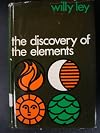
I was hampered in my progress in this book by my lack of knowledge of chemistry, so only read the first few chapters. The story of the discovery of phosphorus by an energetic alchemist was hilarious. The presentation of the understanding of the elements by the ancients was lively yet insightful. I'ld like to return to this book.

My edition is 1952. Amazing book, recommended by one of the astronaut's whose biography I read last month. It begins with an extensive list of literary fictional (hypothetical) space travel from the first century. The author is very excellent at describing concepts, interlaced with anecdotal humorous incidents, and (bias) facts, some of which are disputed in the appendix. When he described his own work, I found it was a little too long-winded, and he kept randomly switching scales (from km show more to feet, Kelvin to Fahrenheit), and sometimes his quoted figures did not match the charts in the appendix, but overall this was a thoroughly interesting and stimulating read. With the aid of the internet today to see the outcomes (and discrepancies) of the rocket experiments, I recommend this book to anyone interested in the subject. show less
This must have been my first "adult" book, given me when I was around 8. It may have set me on the course towards rabid sf fandom and what for a while was a concentration in science and mathematics (later exchanged for languages). The planetary science is horribly obsolete, of course, but the Bonestell illustrations are gorgeous and the book is a very nice publishing job.
Lists
Awards


You May Also Like


Associated Authors
Statistics
- Works
- 83
- Also by
- 45
- Members
- 1,361
- Popularity
- #18,891
- Rating
- 3.7
- Reviews
- 9
- ISBNs
- 38
- Languages
- 3
- Favorited
- 3