
Garry Wills
Author of Lincoln at Gettysburg: The Words That Remade America
About the Author
Garry Wills, 1934 - Garry Wills was born in Atlanta, Georgia in 1934. Wills received a B.A. from St. Louis University in 1957, an M.A. from Xavier University of Cincinnati in 1958, an M.A. (1959) and a Ph.D. (1961) in classics from Yale. Wills was a junior fellow of the Center for Hellenic Studies show more from 1961-62, an associate professor of classics and adjunct professor of humanities at Johns Hopkins University from 1962-80. Wills was the first Washington Irving Professor of Modern American History and Literature at Union College, and was also a Regents Professor at the University of California in Santa Barbara, Silliman Seminarist at Yale, Christian Gauss Lecturer at Princeton, W.W. Cook Lecturer at the University of Michigan Law School, Hubert Humphrey Seminarist at Macalester College, Welch Professor of American Studies at Notre Dame University and Henry R. Luce Professor of American Culture and Public Policy at Northwestern University (1980-88). Wills is also a member of the American Academy of Arts and Sciences and the American Academy of Arts and Letters, and his articles appear frequently in The New York Review of Books. Wills is the author of "Lincoln at Gettysburg," which won the Pulitzer Prize for General Nonfiction in 1993 and the NEH Presidential Medal, "John Wayne's America," "A Necessary Evil: A History of American Distrust of Government" and "The Kennedy Imprisonment." Other awards received by Wills include the National Book Critics Award, the Merle Curti Award of the organization of American Historians, the Wilbur Cross Medal from Yale Graduate School, the Harold Washington Book Award and the Peabody Award for excellence in broadcasting, which was for writing and narrating the 1988 "Frontline" documentary "The Candidates." (Bowker Author Biography) Garry Wills is a Pulitzer-prize winning historian and cultural critic. A former professor of Greek at Yale University, his many books include Lincoln at Gettysburg, Reagan's America, Witches and Jesuits, and a biography of Saint Augustine. He lives in Evanston, Indiana. (Publisher Provided) Garry Wills is a frequent contributor to The New York Times Magazine and The New York Review of Books. He lives in Evanston, Illinois. (Publisher Provided) show less
Image credit: I took this photo!
Works by Garry Wills
Seal of God 1 copy
The Pulse of a Nation 1 copy
Elias and Eliseus 1 copy
Jefferson as artist: Remarks presented on the occasion of the Twelfth Monticello Cabinet Retreat 1 copy
Sappho 31 and Catullus 51 1 copy
Associated Works
Booknotes: America's Finest Authors on Reading, Writing, and the Power of Ideas (1997) — Contributor — 458 copies, 5 reviews
Christian Science (1899) — Introduction, some editions; Introduction, some editions — 318 copies, 4 reviews
The Lincoln Anthology: Great Writers on His Life and Legacy from 1860 to Now (2008) — Contributor — 172 copies, 1 review
Did You Ever See a Dream Walking? American Conservative Thought in the Twentieth Century (1970) — Contributor — 86 copies
The William and Mary Quarterly, July 1987: Constitution of the United States — Contributor — 2 copies
Tagged
Common Knowledge
- Canonical name
- Wills, Garry
- Birthdate
- 1934-05-22
- Gender
- male
- Education
- Yale University (MA|1959|Ph.D|Classics|1961)
Xavier University (MA|1958)
St. Louis University (BA|1957) - Occupations
- historian
public intellectual
university professor - Organizations
- Northwestern University
Johns Hopkins University
Roman Catholic Church
National Review - Awards and honors
- National Humanities Medal (1998)
American Academy of Arts and Letters (1995)
Pulitzer Prize (1993)
American Philosophical Society (2003)
St. Louis Literary Award (2004)
Richard Nelson Current Award of Achievement (2001) (show all 9)
National Book Critics Circle Award (1978, 1992)
Order of Lincoln (2006)
Merle Curti Award (1979) - Relationships
- Buckley, William F., Jr. (employer)
- Nationality
- USA
- Birthplace
- Atlanta, Georgia, USA
- Places of residence
- Atlanta, Georgia, USA
Evanston, Illinois, USA
Cincinnati, Ohio, USA
St. Louis, Missouri, USA
Baltimore, Maryland, USA - Map Location
- Georgia, USA
Members
Discussions
Wills compares Obama's speech on race with Lincoln's speech at Cooper Union in Pro and Con (April 2008)
Reviews

It may seem a little surprising that an entire book could be devoted to a speech that took only a few minutes to deliver and comprised 272 words, but as I was drawn to the Gettysburg Address from my high school days and consider it one of the greatest ever delivered, I decided to give it a try.
Wills sets the stage before analyzing the speech. The battle of Gettysburg in July 1863 took three days and produced 50,000 casualties, roughly equal numbers from both sides. 50,000. It was of course a show more pivotal battle, pushing the Confederates out of the North and turning the tide of the war, which could otherwise have been won by the South. Four months later a cemetery was to be dedicated, and the principal speaker for the day was to be former secretary of state Edward Everett, a member of the intelligentsia who like many in those days was an adherent of classical Greek revival. Everett proceeded to talk for two hours from memory, as was his style. Lincoln was there to speak afterwards to make the dedication more formal, but of course stole the show in his simple, profound way.
As Wills explains, Lincoln truly understood compression and restraint. In one of the sections of the book he maps the speech to classical Greek oratory, how he ‘got it’ far better than Everett, and noting the parallels between his speech and Pericles’ funeral oration during the Peloponnesian War. In another he shows how the speech is self-referential throughout, interlocking the lines in a way which amplified their meaning. This may sound a bit dry to some but I found it very interesting. Wills is insightful throughout, from relating the opening clauses of the speech to Psalm 90, to analyzing Lincoln’s other speeches, including the “before and after” version of his first Inaugural speech; originally penned by William Seward, and improved considerably by Lincoln.
The historical context for all of this is provided, along with the excellent point from the Southern perspective:
“Some think, to this day, that Lincoln did not really have arguments for union, just a kind of mystical attachment to it. That was the charge of Southerners, who felt they had a better constitutional case for secession than he had for compelling states to remain.”
Lincoln’s assertion of the Federal Government over the States was unprecedented and changed America forever, the fuzziness of the ‘rights’ by which he did this, his ambiguous nature of his views on slavery, his ability to see things from a larger perspective, the poetry in his words, and his vulnerability all make him fascinating to me, and Wills brings all of this out.
Quotes:
First, the speech itself. I get goosebumps starting from “But in a larger sense…”, and then continuing to “the world will little note…”, “…the last full measure of devotion”, and then of course the ending. It is absolutely brilliant.
“Four score and seven years ago, our fathers brought forth on this continent a new nation, conceived in liberty, and dedicated to the proposition that all men are created equal.
Now we are engaged in a great civil war, testing whether that nation, or any nation so conceived and so dedicated, can long endure.
We are met on a great battlefield of that war.
We have come to dedicate a portion of that field, as a final resting place for those who here gave their lives that the nation might live. It is altogether fitting and proper that we should do this.
But, in a larger sense, we cannot dedicate – we cannot consecrate – we cannot hallow – this ground. The brave men, living and dead, who struggled here, have consecrated it, far above our poor power to add or detract. The world will little note, nor long remember, what we do here, but it can never forget what they did here.
It is for the living, rather, to be dedicated to the unfinished work which they who have fought here have thus far so nobly advanced. It is rather for us to be here dedicated to the great task remaining before us – that from these honored dead we take increased devotion to that cause for which they gave the last full measure of devotion – that we here highly resolve that these dead shall not have died in vain – that this nation, under God, shall have a new birth of freedom – and that government of the people, by the people, for the people shall not perish from the earth.”
On oneness, from a poem Lincoln wrote in earlier years:
“The very spot where grew that bread
That formed my bones, I see.
How strange, old field, on thee to tread
And feel I’m part of thee.”
On Lincoln’s view of slavery:
“Lincoln was accused during his lifetime of clever evasions and key silences. He was especially indirect and hard to interpret on the subject of slavery. The puzzled his contemporaries, and has infuriated some later students of his attitude.”
It is clearly hard to read the following lines, from Lincoln, in 1858, as he ran for an Illinois senate unsuccessfully against Stephen Douglas, prior to his Presidential election in 1860. In Lincoln’s defense, Douglas was accusing Lincoln of being an abolitionist in a state that had just voted ten years before, in 1848, to deny all free blacks entry to the state, and Lincoln was actually the liberal in this debate … but still…
“I will say then that I am not, nor ever have been, in favor of bringing about in any way, the social and political equality of the white and black races – that I am not nor ever have been in favor of making voters or jurors of negroes, nor of qualifying them to hold office, nor of intermarrying with white people, and I will say, in addition to this, that there is a physical difference between the white and black races which I believe will forever forbid the two races living together on terms of political and social equality … and I, as much as any other man, am in favor of having the superior position assigned to the white race.”
And of course the well-known lines:
“My paramount object in this struggle is to save the Union, and not either to save or destroy slavery. If I could save the Union without freeing any slave, I would do it; if I could save it by freeing all slaves, I would do it; and if I could save it by feeing some and leaving others alone, I would also do that.”
On the other hand…:
“At the framing and adoption of the constitution, they forbore to so much as mention the word ‘slave’ or ‘slavery’ in the whole instrument. … Thus, the thing is hid away, in the constitution, just as an afflicted man hides away a wen or a cancer, which he dares not cut out at once, lest he bleed to death; with the promise, nevertheless, that the cutting may begin at the end of a given time.”
And:
“They [the fathers] did not mean to assert the obvious untruth, that all men were actually enjoying the equality, nor yet that they were about to confer it, immediately, upon them. In fact, they had no power to confer such a boon. They meant simply to declare the right, so that the enforcement might follow as fast as circumstances should permit.”
Lincoln on war a year before Gettysburg; as Wills points out, he had no illusions as to war’s ‘nobility’:
“Actual war coming, blood grows hot, and blood is spilled. Thought is forced from old channels into confusion. Deception breeds and thrives. Confidence dies, and universal suspicion reigns. Each man feels an impulse to kill his neighbor, lest he be killed by him. Revenge and retaliation follow.”
Lastly, on Lincoln’s poetic expression, the first being an example of parenthetical emphasis (the ‘fervently do we pray’ part), and also grammatical inversion (e.g. instead of wording it as ‘We fondly hope and fervently pray’):
“Fondly do we hope, (fervently do we pray), that this mighty scourge of war may speedily pass away.”
“Both parties deprecated war; but one of them would make war rather than let the nation survive; and the other would accept war rather than let it perish. And the war came.”
And finally this one; may we all react to difficult things in life with the ‘better angels of our nature’:
“The mystic chords of memory, stretching from every battlefield and patriot grave, to every living heart and hearthstone, all over this broad land, will yet swell the chorus of the Union, when again touched, as surely they will be, by the better angels of our nature.” show less
Wills sets the stage before analyzing the speech. The battle of Gettysburg in July 1863 took three days and produced 50,000 casualties, roughly equal numbers from both sides. 50,000. It was of course a show more pivotal battle, pushing the Confederates out of the North and turning the tide of the war, which could otherwise have been won by the South. Four months later a cemetery was to be dedicated, and the principal speaker for the day was to be former secretary of state Edward Everett, a member of the intelligentsia who like many in those days was an adherent of classical Greek revival. Everett proceeded to talk for two hours from memory, as was his style. Lincoln was there to speak afterwards to make the dedication more formal, but of course stole the show in his simple, profound way.
As Wills explains, Lincoln truly understood compression and restraint. In one of the sections of the book he maps the speech to classical Greek oratory, how he ‘got it’ far better than Everett, and noting the parallels between his speech and Pericles’ funeral oration during the Peloponnesian War. In another he shows how the speech is self-referential throughout, interlocking the lines in a way which amplified their meaning. This may sound a bit dry to some but I found it very interesting. Wills is insightful throughout, from relating the opening clauses of the speech to Psalm 90, to analyzing Lincoln’s other speeches, including the “before and after” version of his first Inaugural speech; originally penned by William Seward, and improved considerably by Lincoln.
The historical context for all of this is provided, along with the excellent point from the Southern perspective:
“Some think, to this day, that Lincoln did not really have arguments for union, just a kind of mystical attachment to it. That was the charge of Southerners, who felt they had a better constitutional case for secession than he had for compelling states to remain.”
Lincoln’s assertion of the Federal Government over the States was unprecedented and changed America forever, the fuzziness of the ‘rights’ by which he did this, his ambiguous nature of his views on slavery, his ability to see things from a larger perspective, the poetry in his words, and his vulnerability all make him fascinating to me, and Wills brings all of this out.
Quotes:
First, the speech itself. I get goosebumps starting from “But in a larger sense…”, and then continuing to “the world will little note…”, “…the last full measure of devotion”, and then of course the ending. It is absolutely brilliant.
“Four score and seven years ago, our fathers brought forth on this continent a new nation, conceived in liberty, and dedicated to the proposition that all men are created equal.
Now we are engaged in a great civil war, testing whether that nation, or any nation so conceived and so dedicated, can long endure.
We are met on a great battlefield of that war.
We have come to dedicate a portion of that field, as a final resting place for those who here gave their lives that the nation might live. It is altogether fitting and proper that we should do this.
But, in a larger sense, we cannot dedicate – we cannot consecrate – we cannot hallow – this ground. The brave men, living and dead, who struggled here, have consecrated it, far above our poor power to add or detract. The world will little note, nor long remember, what we do here, but it can never forget what they did here.
It is for the living, rather, to be dedicated to the unfinished work which they who have fought here have thus far so nobly advanced. It is rather for us to be here dedicated to the great task remaining before us – that from these honored dead we take increased devotion to that cause for which they gave the last full measure of devotion – that we here highly resolve that these dead shall not have died in vain – that this nation, under God, shall have a new birth of freedom – and that government of the people, by the people, for the people shall not perish from the earth.”
On oneness, from a poem Lincoln wrote in earlier years:
“The very spot where grew that bread
That formed my bones, I see.
How strange, old field, on thee to tread
And feel I’m part of thee.”
On Lincoln’s view of slavery:
“Lincoln was accused during his lifetime of clever evasions and key silences. He was especially indirect and hard to interpret on the subject of slavery. The puzzled his contemporaries, and has infuriated some later students of his attitude.”
It is clearly hard to read the following lines, from Lincoln, in 1858, as he ran for an Illinois senate unsuccessfully against Stephen Douglas, prior to his Presidential election in 1860. In Lincoln’s defense, Douglas was accusing Lincoln of being an abolitionist in a state that had just voted ten years before, in 1848, to deny all free blacks entry to the state, and Lincoln was actually the liberal in this debate … but still…
“I will say then that I am not, nor ever have been, in favor of bringing about in any way, the social and political equality of the white and black races – that I am not nor ever have been in favor of making voters or jurors of negroes, nor of qualifying them to hold office, nor of intermarrying with white people, and I will say, in addition to this, that there is a physical difference between the white and black races which I believe will forever forbid the two races living together on terms of political and social equality … and I, as much as any other man, am in favor of having the superior position assigned to the white race.”
And of course the well-known lines:
“My paramount object in this struggle is to save the Union, and not either to save or destroy slavery. If I could save the Union without freeing any slave, I would do it; if I could save it by freeing all slaves, I would do it; and if I could save it by feeing some and leaving others alone, I would also do that.”
On the other hand…:
“At the framing and adoption of the constitution, they forbore to so much as mention the word ‘slave’ or ‘slavery’ in the whole instrument. … Thus, the thing is hid away, in the constitution, just as an afflicted man hides away a wen or a cancer, which he dares not cut out at once, lest he bleed to death; with the promise, nevertheless, that the cutting may begin at the end of a given time.”
And:
“They [the fathers] did not mean to assert the obvious untruth, that all men were actually enjoying the equality, nor yet that they were about to confer it, immediately, upon them. In fact, they had no power to confer such a boon. They meant simply to declare the right, so that the enforcement might follow as fast as circumstances should permit.”
Lincoln on war a year before Gettysburg; as Wills points out, he had no illusions as to war’s ‘nobility’:
“Actual war coming, blood grows hot, and blood is spilled. Thought is forced from old channels into confusion. Deception breeds and thrives. Confidence dies, and universal suspicion reigns. Each man feels an impulse to kill his neighbor, lest he be killed by him. Revenge and retaliation follow.”
Lastly, on Lincoln’s poetic expression, the first being an example of parenthetical emphasis (the ‘fervently do we pray’ part), and also grammatical inversion (e.g. instead of wording it as ‘We fondly hope and fervently pray’):
“Fondly do we hope, (fervently do we pray), that this mighty scourge of war may speedily pass away.”
“Both parties deprecated war; but one of them would make war rather than let the nation survive; and the other would accept war rather than let it perish. And the war came.”
And finally this one; may we all react to difficult things in life with the ‘better angels of our nature’:
“The mystic chords of memory, stretching from every battlefield and patriot grave, to every living heart and hearthstone, all over this broad land, will yet swell the chorus of the Union, when again touched, as surely they will be, by the better angels of our nature.” show less

Five standalone essays comprise Wills's argument that Lincoln's very short address at Gettysburg in fact re-visioned the American (U.S.) nation's understanding of itself, a new understanding so broadly successful as to no longer seem novel or challenging, today.
EVENT
Lincoln's audience did not arrive at Gettysburg to hear him but for Edward Everett, the leading orator of the American Greek Revival. As anticipated, Everett's presentation took over 2 hours, delivered on a raised platform and show more from memory. As the American Founders looked to the Roman Republic for an ideal polity, so the Romanticists of the mid-1800s looked to Greek Democracy. Everett referenced Pericles' funeral oratory at Athens, comparing that funeral rite to the new cemetery at Gettysburg. At the time, Everett's speech was considered a resounding success; today, most Americans have no idea it was even delivered.
Lincoln had a message for the nation, but not the venue for delivering it. Everett and his venerating public provided one, and Lincoln knew how to best take advantage. Lincoln's oratory followed the expectations of adherents of the Greek Revival, broadly taking as his theme Birth - Death - Rebirth. But of what? Not of the North, nor even of those formerly enslaved. Not the Union government, nor its Army. Lincoln calls for the American Nation to be born again, and frames his appeal in terms of the Declaration of Independence, signed by individual Founders, not the U.S. Constitution, ratified by the several States.
CEMETERY
Gettysburg not only is the site of a battle but the resting place of soldiers fallen there. This was of necessity: the deaths on an immense scale and over just three days, in high summer. Such pragmatic motives might have rendered the resulting graveyard strictly utilitarian, but the nation also was in the midst of the rural-cemetery movement. Cemeteries were places of instruction for the living, not merely hygienic means for handling the dead, and so Gettysburg was designed to help "instill healing truths, of natural death and rebirth, in the cycle of seasons". [65]
Lincoln recognised the setting as well as as he did his audience in fitting his intended message. Lincoln's revolutionary claim, commonplace today, is that the core of the American Nation is an idea, not a legal structure or a political framework; this idea is expressed primarily not in the Constitution, rather in the Declaration of Independence; and the significance of the Civil War, and indeed of American history altogether, is thereafter defined in Lincoln's preferred understanding.
Lincoln wrote years before Gettysburg, prior to his first inauguration: "I am exceedingly anxious that that thing which they [American Revolutionaries] struggled for, that something even more than National Independence, that something that held out a great promise to all the people of the world for all time to come -- I am exceedingly anxious that this Union, this Constitution, and the liberty of the people shall be perpetrated in accordance with the original idea for which that struggle was made." [emphasis Wills] [85]
Since Lincoln thinks of America's claim as intellectual, the Gettysburg Address is highly abstract in its thought and language. But if the argument of Lincoln is abstract, generalizing, and intellectual, his imagery is organic and familial. This is taken from the rural cemetery's normal store of images, having to do with the fertility of nature, the life-giving earth to which the dead have returned. [87-88]
also: 19th Century America's Culture of Death, and concomitant preoccupation with melancholia and liminal states; William Saunders, the architect of Mount Auburn, America's cultural center and the inauguration of the rural-cemetery movement; Lincoln's psychobiographers.
TRANSCENDENTALISM
As a lawyer, Lincoln settled on a general strategy of identifying the "nub" of his position, and then framing his argument around that. Anything extraneous to that position was used as leverage against his adversary, whether to concede in argument, offer up for compromise, or sacrifice for the prime objective. Opponents and observers alike could be confused by this focus, thinking Lincoln did not believe in aspects which Lincoln ceded or on which he remained silent. Wills argues instead, these concessions and compromises merely indicate Lincoln did not deem the underlying points necessary, nothing more.
The opening third of the essay examines Lincoln's concern to preserve political equality, framing it as the chief American value as expressed in the Declaration of Independence; social equality may be desirable but is not crucial and so, subject to compromise if necessary. Wills reviews myriad compromises Lincoln made on matters respecting the black American's equality in society, to ensure never compromising or diluting each and every American person's equality when considered by government or the law.
The last two-thirds discusses Transcendental ideals generally, especially as enunciated by Francis Parker whom Lincoln read in some detail. Parker was one activist (not the sole) taking the position that the Declaration serves as the highest ideal of the American nation, rendering then the Constitution a vital symbol and yet only an approximation of the ideal. Parker's triple-expression of democracy as government "of the people, by the people, and for the people" a recurrent theme in Lincoln's own political speeches, indeed included at the conclusion of the Gettysburg Address.
Americans at that time were reverent toward (prejudiced in favor of) the Declaration of Independence; yet many of them were also prejudiced in favor of slavery. Lincoln kept arguing, in ingenious ways, that they must, in consistency, give up one or the other prejudice. The two cannot coexist in the same mind once their mutual enmity is recognized. [100]
PROPOSITION
Lincoln's political position can be summarized as consistent adherence to dual principles: the equality (political equality) of all people without exception, as argued in the preceding essay; and preserving the Union of the United States. Lincoln's rationale for Union followed Daniel Webster and Henry Clay, departing from these latter primarily insofar as each was willing, for separate reasons, to compromise on Slavery, which Lincoln would not do.
The Declaration of Independence also served Lincoln tactically when arguing for Union. "Webster argued that Americans had constituted themselves a single people long before the Constitution was drafted or ratified." [129] This also was grounds for Lincoln arguing that just as the Southern States had no ethical or political right to secede unilaterally, so too the Northern States had no right to emancipate unilaterally; the right rested with the entire American people, not the several or individual States. This position had practical ramifications which Lincoln was scrupulous to uphold: in how he understood his wartime powers as Commander in Chief of the Army and Navy, in how far and in which circumstances he could extend emancipation. His position, though it provoked confusion and frustration in others not understanding his careful reasoning, was consistent and of a piece with his thinking, and this position he framed in the Address at Gettysburg. Though not everyone understood it then any better than today, Wills argues it is significant that prior to the Address, the common phrase was "The United States are a free government" but afterward, it was always only "The United States is a free government." [145]
also: The status of belligerents versus (non-citizen) enemies of the state; legal grounds and extent for emancipation, as a purely military act; elevating equality to the level of a Constitutional principle (though the Constitution itself does not include the term).
RHETORIC
Lincoln's rhetoric thoroughly modern, even as it borrowed knowingly from classical tropes. The style, in marked contrast to Everett's two-hour-plus oration from memory, his prose flowery and mannered. Lincoln's address is exceedingly brief, just 272 words, a remarkably incisive statement of values. A story long shared: Lincoln's oration was over before the photographer had time for a picture; true or not, there are no known photographs of Lincoln giving his speech. And yet the brevity belies the sweeping compass of the Address, and in no way reflects Lincoln's casual approach to the remarks he gave. A lifelong student of rhetoric and speech, Lincoln worked hard at the style which would come to seem so effortlessly modern.
Lincoln's remarks anticipated the shift into vernacular rhythms that Mark Twain would complete twenty years later. Hemingway claimed that all modern American novels are the offspring of Huckleberry Finn. It is no greater exaggeration to say that all modern political prose descends from the Gettysburg Address. [148]
also: Lincoln's poetry and his rhetorical studies; John Hay; drafts of earlier speeches; relentless search for the "right word".
EPILOGUE
Lincoln's Second Inaugural as the "missing half" of the Gettysburg Address, considering "sin" as was wholly omitted at Gettysburg. His clear-eyed view of war as a cover for crimes and lost rationalism: the Mexican War he opposed, the Black Hawk War he served in, even including the Civil War he conducted.
//
APPENDICES
While Wills is remarkably concise in his essays, his argument is seldom straightforward in that he reviews myriad influences and historical trends. I found the essays difficult to summarize.
Surprisingly, fully half of the book's total pages are taken up with various appendices. These treat of variations in Lincoln's text, examined clearly but with an eye for meaningful variations in transcripts and drafts; disputes over just where in Gettysburg Cemetery the speech was delivered; and four funeral orations which influenced both Everett's and Lincoln's orations.
The essays are preceded by photos of principle personages, map of Gettysburg Memorial Cemetery -- but no photo of Lincoln at Gettysburg, as none was found until well after publication of this book.
//
Lincoln was able to achieve the loftiness, ideality and brevity of the Gettysburg Address because he had spent a good part of the 1850s repeatedly relating all the most sensitive issues of the day to the Declaration's supreme principle. If all men are created equal, they cannot be property. They cannot be ruled by owner-monarchs. They must be self-governing in the minimal sense of self-possession. Their equality cannot be denied if the nation is to live by its creed, and voice it, and test it, and die for it. All these matters are now contained in the pregnant formulae of the Address. Nothing more specific needs to be mentioned, because a nation free to proclaim its ideal is freed, again, to approximate that ideal over the years, in ways that run far beyond any specific or limited reforms, even one so important as emancipation. A return to the ideal is an escape from distracting particulars, a recovery of the long-term tasks of equality and self-government. [120] show less
EVENT
Lincoln's audience did not arrive at Gettysburg to hear him but for Edward Everett, the leading orator of the American Greek Revival. As anticipated, Everett's presentation took over 2 hours, delivered on a raised platform and show more from memory. As the American Founders looked to the Roman Republic for an ideal polity, so the Romanticists of the mid-1800s looked to Greek Democracy. Everett referenced Pericles' funeral oratory at Athens, comparing that funeral rite to the new cemetery at Gettysburg. At the time, Everett's speech was considered a resounding success; today, most Americans have no idea it was even delivered.
Lincoln had a message for the nation, but not the venue for delivering it. Everett and his venerating public provided one, and Lincoln knew how to best take advantage. Lincoln's oratory followed the expectations of adherents of the Greek Revival, broadly taking as his theme Birth - Death - Rebirth. But of what? Not of the North, nor even of those formerly enslaved. Not the Union government, nor its Army. Lincoln calls for the American Nation to be born again, and frames his appeal in terms of the Declaration of Independence, signed by individual Founders, not the U.S. Constitution, ratified by the several States.
CEMETERY
Gettysburg not only is the site of a battle but the resting place of soldiers fallen there. This was of necessity: the deaths on an immense scale and over just three days, in high summer. Such pragmatic motives might have rendered the resulting graveyard strictly utilitarian, but the nation also was in the midst of the rural-cemetery movement. Cemeteries were places of instruction for the living, not merely hygienic means for handling the dead, and so Gettysburg was designed to help "instill healing truths, of natural death and rebirth, in the cycle of seasons". [65]
Lincoln recognised the setting as well as as he did his audience in fitting his intended message. Lincoln's revolutionary claim, commonplace today, is that the core of the American Nation is an idea, not a legal structure or a political framework; this idea is expressed primarily not in the Constitution, rather in the Declaration of Independence; and the significance of the Civil War, and indeed of American history altogether, is thereafter defined in Lincoln's preferred understanding.
Lincoln wrote years before Gettysburg, prior to his first inauguration: "I am exceedingly anxious that that thing which they [American Revolutionaries] struggled for, that something even more than National Independence, that something that held out a great promise to all the people of the world for all time to come -- I am exceedingly anxious that this Union, this Constitution, and the liberty of the people shall be perpetrated in accordance with the original idea for which that struggle was made." [emphasis Wills] [85]
Since Lincoln thinks of America's claim as intellectual, the Gettysburg Address is highly abstract in its thought and language. But if the argument of Lincoln is abstract, generalizing, and intellectual, his imagery is organic and familial. This is taken from the rural cemetery's normal store of images, having to do with the fertility of nature, the life-giving earth to which the dead have returned. [87-88]
also: 19th Century America's Culture of Death, and concomitant preoccupation with melancholia and liminal states; William Saunders, the architect of Mount Auburn, America's cultural center and the inauguration of the rural-cemetery movement; Lincoln's psychobiographers.
TRANSCENDENTALISM
As a lawyer, Lincoln settled on a general strategy of identifying the "nub" of his position, and then framing his argument around that. Anything extraneous to that position was used as leverage against his adversary, whether to concede in argument, offer up for compromise, or sacrifice for the prime objective. Opponents and observers alike could be confused by this focus, thinking Lincoln did not believe in aspects which Lincoln ceded or on which he remained silent. Wills argues instead, these concessions and compromises merely indicate Lincoln did not deem the underlying points necessary, nothing more.
The opening third of the essay examines Lincoln's concern to preserve political equality, framing it as the chief American value as expressed in the Declaration of Independence; social equality may be desirable but is not crucial and so, subject to compromise if necessary. Wills reviews myriad compromises Lincoln made on matters respecting the black American's equality in society, to ensure never compromising or diluting each and every American person's equality when considered by government or the law.
The last two-thirds discusses Transcendental ideals generally, especially as enunciated by Francis Parker whom Lincoln read in some detail. Parker was one activist (not the sole) taking the position that the Declaration serves as the highest ideal of the American nation, rendering then the Constitution a vital symbol and yet only an approximation of the ideal. Parker's triple-expression of democracy as government "of the people, by the people, and for the people" a recurrent theme in Lincoln's own political speeches, indeed included at the conclusion of the Gettysburg Address.
Americans at that time were reverent toward (prejudiced in favor of) the Declaration of Independence; yet many of them were also prejudiced in favor of slavery. Lincoln kept arguing, in ingenious ways, that they must, in consistency, give up one or the other prejudice. The two cannot coexist in the same mind once their mutual enmity is recognized. [100]
PROPOSITION
Lincoln's political position can be summarized as consistent adherence to dual principles: the equality (political equality) of all people without exception, as argued in the preceding essay; and preserving the Union of the United States. Lincoln's rationale for Union followed Daniel Webster and Henry Clay, departing from these latter primarily insofar as each was willing, for separate reasons, to compromise on Slavery, which Lincoln would not do.
The Declaration of Independence also served Lincoln tactically when arguing for Union. "Webster argued that Americans had constituted themselves a single people long before the Constitution was drafted or ratified." [129] This also was grounds for Lincoln arguing that just as the Southern States had no ethical or political right to secede unilaterally, so too the Northern States had no right to emancipate unilaterally; the right rested with the entire American people, not the several or individual States. This position had practical ramifications which Lincoln was scrupulous to uphold: in how he understood his wartime powers as Commander in Chief of the Army and Navy, in how far and in which circumstances he could extend emancipation. His position, though it provoked confusion and frustration in others not understanding his careful reasoning, was consistent and of a piece with his thinking, and this position he framed in the Address at Gettysburg. Though not everyone understood it then any better than today, Wills argues it is significant that prior to the Address, the common phrase was "The United States are a free government" but afterward, it was always only "The United States is a free government." [145]
also: The status of belligerents versus (non-citizen) enemies of the state; legal grounds and extent for emancipation, as a purely military act; elevating equality to the level of a Constitutional principle (though the Constitution itself does not include the term).
RHETORIC
Lincoln's rhetoric thoroughly modern, even as it borrowed knowingly from classical tropes. The style, in marked contrast to Everett's two-hour-plus oration from memory, his prose flowery and mannered. Lincoln's address is exceedingly brief, just 272 words, a remarkably incisive statement of values. A story long shared: Lincoln's oration was over before the photographer had time for a picture; true or not, there are no known photographs of Lincoln giving his speech. And yet the brevity belies the sweeping compass of the Address, and in no way reflects Lincoln's casual approach to the remarks he gave. A lifelong student of rhetoric and speech, Lincoln worked hard at the style which would come to seem so effortlessly modern.
Lincoln's remarks anticipated the shift into vernacular rhythms that Mark Twain would complete twenty years later. Hemingway claimed that all modern American novels are the offspring of Huckleberry Finn. It is no greater exaggeration to say that all modern political prose descends from the Gettysburg Address. [148]
also: Lincoln's poetry and his rhetorical studies; John Hay; drafts of earlier speeches; relentless search for the "right word".
EPILOGUE
Lincoln's Second Inaugural as the "missing half" of the Gettysburg Address, considering "sin" as was wholly omitted at Gettysburg. His clear-eyed view of war as a cover for crimes and lost rationalism: the Mexican War he opposed, the Black Hawk War he served in, even including the Civil War he conducted.
//
APPENDICES
While Wills is remarkably concise in his essays, his argument is seldom straightforward in that he reviews myriad influences and historical trends. I found the essays difficult to summarize.
Surprisingly, fully half of the book's total pages are taken up with various appendices. These treat of variations in Lincoln's text, examined clearly but with an eye for meaningful variations in transcripts and drafts; disputes over just where in Gettysburg Cemetery the speech was delivered; and four funeral orations which influenced both Everett's and Lincoln's orations.
The essays are preceded by photos of principle personages, map of Gettysburg Memorial Cemetery -- but no photo of Lincoln at Gettysburg, as none was found until well after publication of this book.
//
Lincoln was able to achieve the loftiness, ideality and brevity of the Gettysburg Address because he had spent a good part of the 1850s repeatedly relating all the most sensitive issues of the day to the Declaration's supreme principle. If all men are created equal, they cannot be property. They cannot be ruled by owner-monarchs. They must be self-governing in the minimal sense of self-possession. Their equality cannot be denied if the nation is to live by its creed, and voice it, and test it, and die for it. All these matters are now contained in the pregnant formulae of the Address. Nothing more specific needs to be mentioned, because a nation free to proclaim its ideal is freed, again, to approximate that ideal over the years, in ways that run far beyond any specific or limited reforms, even one so important as emancipation. A return to the ideal is an escape from distracting particulars, a recovery of the long-term tasks of equality and self-government. [120] show less
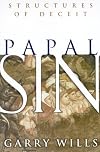
PAPAL SIN should be required reading for all Catholic adults and highly recommended for everyone else.
An unintended result is that whatever religion you do or do not have,
you will become more aware of ALL lies and deceit, thanks to Saint Augustine,
and are likely to become a more moral person.
This book is meticulously researched and documented, chapter by chapter,
demonstrating the most recent (beginning around Pius IX) Vatican and Catholic deceits.
Its scope is worldwide and by now, 17 show more years after publication,
Garry Wills would be having an enhanced field day with the connections between
rampant world population, world climate change, and the Vatican's ongoing idiocy on contraception,
with professed celibates controlling the intimate lives of married and unmarried Catholics.
As well, all of his predictions
regarding an emerging Gay Priesthood have come true, with sad results and jaw-dropping deceits.
His coverage of the cult of the Virgin Mary confirms the bewilderment many of us feel at the endless
mention of SEX in a spiritual setting - why is her hymen glorified or how can you not think about sex
every time it is mentioned?
The Catholic Church, while offering much needed help and solace for the sick and dying,
is a troubling place.
As well, the author confirms that "popes" are never mentioned in the Bible and,
unlike the priests who are modeled after them,
all of the apostles were married.
The alleged divinity and infallibility of the popes receives the condemnation they each deserve.
Unforgettable. show less
An unintended result is that whatever religion you do or do not have,
you will become more aware of ALL lies and deceit, thanks to Saint Augustine,
and are likely to become a more moral person.
This book is meticulously researched and documented, chapter by chapter,
demonstrating the most recent (beginning around Pius IX) Vatican and Catholic deceits.
Its scope is worldwide and by now, 17 show more years after publication,
Garry Wills would be having an enhanced field day with the connections between
rampant world population, world climate change, and the Vatican's ongoing idiocy on contraception,
with professed celibates controlling the intimate lives of married and unmarried Catholics.
As well, all of his predictions
regarding an emerging Gay Priesthood have come true, with sad results and jaw-dropping deceits.
His coverage of the cult of the Virgin Mary confirms the bewilderment many of us feel at the endless
mention of SEX in a spiritual setting - why is her hymen glorified or how can you not think about sex
every time it is mentioned?
The Catholic Church, while offering much needed help and solace for the sick and dying,
is a troubling place.
As well, the author confirms that "popes" are never mentioned in the Bible and,
unlike the priests who are modeled after them,
all of the apostles were married.
The alleged divinity and infallibility of the popes receives the condemnation they each deserve.
Unforgettable. show less

When Esquire magazine commissioned an article from Garry Wills about Richard Nixon and the New Hampshire primary—the opening salvo of the 1968 presidential election campaign— the assumption was that this would be a requiem for a has-been who had dictated his own political obituary to reporters six years earlier, at the close of his failed attempt to win the California governorship.
Yet less than one year later, when Nixon stood on the steps of the Capitol to take the oath of office, there show more was a sense of inevitability that he should become president at that fraught moment in U. S. history.
One of the points Wills stresses in Nixon Agonistes is that it’s a fallacy to believe that the lumbering, flawed American political process churns out, every four years, the best man (and it has always been a man so far). It would be more accurate, Wills maintains, to say that it serves up the most appropriate for a given moment. And this was never so true, in his view, as in 1968. As he writes in his Preface, “What is best and weakest in America goes out to reciprocating strengths and deficiencies in Richard Nixon.”
A second inevitability, in retrospect, is that one article assignment would lead to more, and these, in turn—given that Wills’s expertise extends to a deep-rooted knowledge of the origins of American political philosophy—would result in this book.
Nixon Agonistes stands out in the genre of books that report on political campaigns—a genre that blossomed in the wake of the success of T. H. White’s Making of the President 1960. Less than a third of its six hundred pages are devoted to that. And although Wills is an insightful, observant reporter, it is not this that gives this book its continued relevance.
Instead, the importance of this book lies in the interpretive framework Wills constructs for his deeper analysis. Much of what he writes in these chapters remains true of American society.
This framework views the American political experiment as a market, or rather an interplay of four markets—moral (personified by Ralph Waldo Emerson), economic (Adam Smith), intellectual (John Stuart Mill), and political (Woodrow Wilson). The underlying philosophy of these intersecting markets is, Wills writes, classic liberalism. For all the surface conflict between left and right in the American political spectrum, the debates are framed in terms that originate here, assumptions often unexamined.
Yet classic liberalism, which Wills explains as a combination of the political philosophy of John Locke and the economic views of Adam Smith, has broken into two branches, with those who continue to uphold Smith finding themselves on the right, where their strange bedfellows tend to authoritarian views, while students of Locke tend to cluster on the left. The last intellectual to fully unite both strands was John Stuart Mill. Even Woodrow Wilson was, in his time, an anachronism.
Yet it was Wilson who was Nixon’s model—something Nixon never hid and which Wills takes seriously. But if Wilson was already, in his time, a throwback to an earlier political philosophy, what does that make Nixon? For Wills, “Nixon’s victory was the nation’s concession of defeat, an admission that we have no politics left but the old individualism, a web of myths that have lost their magic.” Wills asks in the title of the book’s final chapter whether Nixon is not the last liberal. By the way, it’s important to recognize that, in addition to writing of “classic liberalism,” at times, Wills uses the term “liberal” in the way it’s commonly used in American political discourse, for instance, in his criticism of Arthur Schlesinger and other academics.
For all the strength of Wills’s analysis, suggesting that Nixon is the last liberal demonstrates the limits of punditry. Like Nixon’s election, this book is a product of its historical moment. Mired in an unwinnable war, riven by domestic turbulence, it truly seemed that—in the memorable phrase of Yeats that Wills used for the title of his second chapter—the center could not hold.
For Wills, classic liberalism, for all its accomplishments, was in terminal decline. The emphasis on individual achievement, inextricably wedded to emulation; the dream of getting ahead balanced by the fear of falling behind had created what he at one point calls “moral monsters.”The crisis of the self-made man Wills diagnoses in the subtitle of his book is not only Nixon but the mainstream American formed by Horatio Alger, Emerson, and Peale. He laments that “[t]here is, in our legends, no heroism of the office clerk, no stable industrial ‘peasantry’ of the men who actually make the system work.” His prescription is that the “facts of community life” be integrated into America’s political theory.
A half-century later, any faltering step in this direction is still decried as “collectivist,” and our political system seems even more in need of an overhaul than it did in 1968, placed in office in 2016, a caricature of Nixon’s worst traits and impulses. The American myth is nothing if not resilient. show less
Yet less than one year later, when Nixon stood on the steps of the Capitol to take the oath of office, there show more was a sense of inevitability that he should become president at that fraught moment in U. S. history.
One of the points Wills stresses in Nixon Agonistes is that it’s a fallacy to believe that the lumbering, flawed American political process churns out, every four years, the best man (and it has always been a man so far). It would be more accurate, Wills maintains, to say that it serves up the most appropriate for a given moment. And this was never so true, in his view, as in 1968. As he writes in his Preface, “What is best and weakest in America goes out to reciprocating strengths and deficiencies in Richard Nixon.”
A second inevitability, in retrospect, is that one article assignment would lead to more, and these, in turn—given that Wills’s expertise extends to a deep-rooted knowledge of the origins of American political philosophy—would result in this book.
Nixon Agonistes stands out in the genre of books that report on political campaigns—a genre that blossomed in the wake of the success of T. H. White’s Making of the President 1960. Less than a third of its six hundred pages are devoted to that. And although Wills is an insightful, observant reporter, it is not this that gives this book its continued relevance.
Instead, the importance of this book lies in the interpretive framework Wills constructs for his deeper analysis. Much of what he writes in these chapters remains true of American society.
This framework views the American political experiment as a market, or rather an interplay of four markets—moral (personified by Ralph Waldo Emerson), economic (Adam Smith), intellectual (John Stuart Mill), and political (Woodrow Wilson). The underlying philosophy of these intersecting markets is, Wills writes, classic liberalism. For all the surface conflict between left and right in the American political spectrum, the debates are framed in terms that originate here, assumptions often unexamined.
Yet classic liberalism, which Wills explains as a combination of the political philosophy of John Locke and the economic views of Adam Smith, has broken into two branches, with those who continue to uphold Smith finding themselves on the right, where their strange bedfellows tend to authoritarian views, while students of Locke tend to cluster on the left. The last intellectual to fully unite both strands was John Stuart Mill. Even Woodrow Wilson was, in his time, an anachronism.
Yet it was Wilson who was Nixon’s model—something Nixon never hid and which Wills takes seriously. But if Wilson was already, in his time, a throwback to an earlier political philosophy, what does that make Nixon? For Wills, “Nixon’s victory was the nation’s concession of defeat, an admission that we have no politics left but the old individualism, a web of myths that have lost their magic.” Wills asks in the title of the book’s final chapter whether Nixon is not the last liberal. By the way, it’s important to recognize that, in addition to writing of “classic liberalism,” at times, Wills uses the term “liberal” in the way it’s commonly used in American political discourse, for instance, in his criticism of Arthur Schlesinger and other academics.
For all the strength of Wills’s analysis, suggesting that Nixon is the last liberal demonstrates the limits of punditry. Like Nixon’s election, this book is a product of its historical moment. Mired in an unwinnable war, riven by domestic turbulence, it truly seemed that—in the memorable phrase of Yeats that Wills used for the title of his second chapter—the center could not hold.
For Wills, classic liberalism, for all its accomplishments, was in terminal decline. The emphasis on individual achievement, inextricably wedded to emulation; the dream of getting ahead balanced by the fear of falling behind had created what he at one point calls “moral monsters.”The crisis of the self-made man Wills diagnoses in the subtitle of his book is not only Nixon but the mainstream American formed by Horatio Alger, Emerson, and Peale. He laments that “[t]here is, in our legends, no heroism of the office clerk, no stable industrial ‘peasantry’ of the men who actually make the system work.” His prescription is that the “facts of community life” be integrated into America’s political theory.
A half-century later, any faltering step in this direction is still decried as “collectivist,” and our political system seems even more in need of an overhaul than it did in 1968, placed in office in 2016, a caricature of Nixon’s worst traits and impulses. The American myth is nothing if not resilient. show less
Lists
Awards


You May Also Like


Associated Authors
Statistics
- Works
- 69
- Also by
- 25
- Members
- 13,302
- Popularity
- #1,754
- Rating
- 4.0
- Reviews
- 157
- ISBNs
- 271
- Languages
- 7
- Favorited
- 24