
Andrei Bely (1880–1934)
Author of Petersburg
About the Author
A symbolist poet, Andrei Bely was also a literary critic and theorist and one of the most important figures in twentieth-century Russian fiction. His Petersburg (1916-35) is one of the century's great novels. He initially studied science but had begun his literary career even before graduation. His show more early poetry was shaped by mystical beliefs associated with the concept of the Divine Wisdom, beliefs shared by Aleksandr Blok and other younger symbolist poets. In later years, Bely was deeply affected by the German anthroposophist Rudolf Steiner, whom he began to follow in 1912. Blok's writings from that time on bear the imprint of his commitment to Steiner's teachings. Bely's prose continued the stylistic traditions of Nikolai Gogol, about whose work he wrote. Brilliantly innovative in language, composition, and subject matter, Bely's fiction had a great impact on early Soviet literature. His novels The Silver Dove (1910), and St. Petersburg (1913) deal with Russian history in broad cultural perspective, focusing especially on East-West opposition. Kotik Letaev (1918), anticipated stream-of-consciousness techniques in Western fiction in its depiction of the psyche of a developing infant. The Christened Chinaman (1927), an autobiographical novel, is also highly innovative in its language and three-level narrative. (Bowker Author Biography) show less
Image credit: ca. 1910s
Series
Works by Andrei Bely
Поэзия слова ; О смысле познания 3 copies
ST. PETERSBURG ... Translated with an Introduction by John Cournos. Foreword by George Reavey. (1959) 2 copies
First Encounter 2 copies
Стихи, поэма, в двух книгах 1 copy
Стихотворения и поэмы, том 2 1 copy
Стихотворения и поэмы, том 1 1 copy
Стихотворения 1 copy
Srebrni golub 1 copy
Simbolizam 1 copy
Zapisi jednog čudaka 1 copy
Majstorstvo Nikolaja Gogolja 1 copy
Moskva na udaru 1 copy
Maske 1 copy
Cristo è risorto 1 copy
Арабески 1 copy
geheime aufzeichnungen 1 copy
Versuri 1 copy
Associated Works
Anton Chekhov's Selected Plays [Norton Critical Edition, 2nd ed.] (2005) — Contributor — 72 copies, 1 review
Saint Petersburg in Russian Poetry of the 18th to the Early 20th Century: A Poetic Anthology (2001) — Contributor — 1 copy
Tagged
Common Knowledge
- Legal name
- Bugaev, Boris Nikolayevich
- Other names
- Белый, Андрей
- Birthdate
- 1880-10-26
- Date of death
- 1934-01-08
- Gender
- male
- Education
- University of Moscow
- Occupations
- novelist
poet
literary critic
librarian - Organizations
- Free Philosophical Society
House of Arts
Academy of Spiritual Culture - Relationships
- Bugaev, Nikolai Vasilievich (father)
Dmitrievna, Aleksandra (mother)
Turgeneva, Asya (wife)
Vasilieva, Klavdiya (wife) - Nationality
- Russian Empire (birth)
- Birthplace
- Moscow, Russian Empire
- Places of residence
- Moscow, USSR
Switzerland
Berlin, Germany - Place of death
- Moscow, Soviet Union
- Burial location
- Novodevichy Cemetery, Moscow, Russia
- Map Location
- Russia
Members
Discussions
Bely's Petersburg in Fans of Russian authors (July 2019)
Reviews
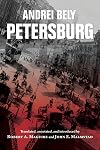
“He was simply seized by an animal feeling for his own invaluable life; he had no desire to return from the corridor; he did not have the courage to glance into his own rooms; he now had neither strength nor time to look for the bomb a second time; everything got mixed up in his head, and he could no longer remember exactly either the minute or the hour when the time expired: any moment might prove to be the fatal one. All he could do was wait here trembling in the corridor until show more daybreak.”
One of the most unusual novels I have read. It is set in Petersburg in 1905 during the first Russian Revolution (the one we have largely forgotten). Published in 1913, this book portrays the city just before a series of revolutions that would dramatically change the course of history. It is not typical Russian literature – it does not follow a straight-forward plot or structure. The city itself serves as one of the main characters.
The narrative is infused with shapes:
“After the line, of everything symmetrical the figure that soothed him most was the square. He would give himself over for long periods to the unreflecting contemplation of: pyramids, triangles, parallelepipeds, cubes, trapezoids. Disquiet took hold of him only at the contemplation of a truncated cone. Zigzag lines he could not bear.”
and a whirl of colors:
“To their left the last gold and the last crimson fluttered in the leaves of the garden; on coming closer, a blue tit could be seen; a rustling thread stretched submissively from the garden on to the stones, to wind and chase between the feet of a passing pedestrian, and to murmur as it wove from leaves a red-and-yellow web of words.”
It is slow-paced. There are many digressions. It is occasionally absurd – the statue of the Bronze Horseman (Peter the Great) jumps off its pedestal and gallops around the city. The tone is one of foreboding. It is mostly dark, with a few hints of humor.
I read the English translation by John Elsworth. His afterword sheds light on some of the difficulties in translating it. This book is considered a classic and is worth reading for the historical perspective alone. I recognize the literary merit of this book but did not always enjoy reading it. I found it inventive and modernistic for its time. show less
One of the most unusual novels I have read. It is set in Petersburg in 1905 during the first Russian Revolution (the one we have largely forgotten). Published in 1913, this book portrays the city just before a series of revolutions that would dramatically change the course of history. It is not typical Russian literature – it does not follow a straight-forward plot or structure. The city itself serves as one of the main characters.
The narrative is infused with shapes:
“After the line, of everything symmetrical the figure that soothed him most was the square. He would give himself over for long periods to the unreflecting contemplation of: pyramids, triangles, parallelepipeds, cubes, trapezoids. Disquiet took hold of him only at the contemplation of a truncated cone. Zigzag lines he could not bear.”
and a whirl of colors:
“To their left the last gold and the last crimson fluttered in the leaves of the garden; on coming closer, a blue tit could be seen; a rustling thread stretched submissively from the garden on to the stones, to wind and chase between the feet of a passing pedestrian, and to murmur as it wove from leaves a red-and-yellow web of words.”
It is slow-paced. There are many digressions. It is occasionally absurd – the statue of the Bronze Horseman (Peter the Great) jumps off its pedestal and gallops around the city. The tone is one of foreboding. It is mostly dark, with a few hints of humor.
I read the English translation by John Elsworth. His afterword sheds light on some of the difficulties in translating it. This book is considered a classic and is worth reading for the historical perspective alone. I recognize the literary merit of this book but did not always enjoy reading it. I found it inventive and modernistic for its time. show less
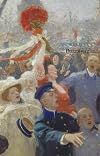
Petersburg is an exhausting book. Not exhausting in the sense that you just want to crawl off to bed, but rather exhausting because it is full of motion; there is no rest. Things are always moving, they never stay still. Just when the reader might think there is a pause, Bely will repeat some actions, some sentences.
All this movement is accompanied by colours and sound, often smells, adding layers of depth to the narrative.
The Petersburg street in autumn penetrates your whole organism: it show more turns the marrow of your bones to ice and tickles your freezing spine; but as soon as you escape from it into a warm room, the Petersburg street flows in your veins like a fever. The stranger now experienced the quality of this street as he entered a grimy vestibule, densely crammed with black, blue, grey and yellow overcoats, swanky hats, lop-eared hats, dock-tailed hats, and galoshes of every description. A warm dampness enveloped him; in the air hung a milky steam: steam that smelled of the pancakes.
As the book progresses, it becomes clear that the different colours represent different people and states of mind. A character's change of colour choice often indicates a change of mind. The one constant is the green swirling mist, coming in off the marshes, hiding who knows what, enveloping the Bronze Horseman who created it all. There is a threat out there, undefined as yet, but in October 1905 Petersburg, everyone sensed it.
Just like navigating in a mist, nothing is ever clear. There is a plot on the part of radicals to kill a high government official, but who dreamed it up? Was it the person entrusted to carry out the assassination, or was it the bomb-maker, the Fugitive? Maybe it was even the Person, he who directs it all (maybe). The designated killer and the Fugitive both obsess over ten days until nothing is clear to either. The reader too is often left befuddled until the action circles around again and more is revealed and then a bit more.
This world of obsession and hallucination makes the omniscient narrator work hard; circling back, making connections, speaking up when things get too absurd. Nothing is sure until the very end, when suddenly everything is resolved.
This is a book I imagine people spend years studying, reading it over and over. Despite an excellent translation, I suspect it can only ever be fully grasped in the original Russian. This Pushkin edition did not have notes and they were sorely missed. Reading it, there was always a feeling of "If only I knew more about..."; "If only I knew more about the accepted stereotypes behind regions and family names"; "If only...". This is not to take away from the book in any way whatsoever. Rather, it is to suggest that there is always something more [Petersburg] has to offer the reader. As the quote from the New York Times Book Review on the back cover put it, this book is regarded by many as "The most important, most influential, and most perfectly realized Russian novel written in the twentieth century." show less
All this movement is accompanied by colours and sound, often smells, adding layers of depth to the narrative.
The Petersburg street in autumn penetrates your whole organism: it show more turns the marrow of your bones to ice and tickles your freezing spine; but as soon as you escape from it into a warm room, the Petersburg street flows in your veins like a fever. The stranger now experienced the quality of this street as he entered a grimy vestibule, densely crammed with black, blue, grey and yellow overcoats, swanky hats, lop-eared hats, dock-tailed hats, and galoshes of every description. A warm dampness enveloped him; in the air hung a milky steam: steam that smelled of the pancakes.
As the book progresses, it becomes clear that the different colours represent different people and states of mind. A character's change of colour choice often indicates a change of mind. The one constant is the green swirling mist, coming in off the marshes, hiding who knows what, enveloping the Bronze Horseman who created it all. There is a threat out there, undefined as yet, but in October 1905 Petersburg, everyone sensed it.
Just like navigating in a mist, nothing is ever clear. There is a plot on the part of radicals to kill a high government official, but who dreamed it up? Was it the person entrusted to carry out the assassination, or was it the bomb-maker, the Fugitive? Maybe it was even the Person, he who directs it all (maybe). The designated killer and the Fugitive both obsess over ten days until nothing is clear to either. The reader too is often left befuddled until the action circles around again and more is revealed and then a bit more.
This world of obsession and hallucination makes the omniscient narrator work hard; circling back, making connections, speaking up when things get too absurd. Nothing is sure until the very end, when suddenly everything is resolved.
This is a book I imagine people spend years studying, reading it over and over. Despite an excellent translation, I suspect it can only ever be fully grasped in the original Russian. This Pushkin edition did not have notes and they were sorely missed. Reading it, there was always a feeling of "If only I knew more about..."; "If only I knew more about the accepted stereotypes behind regions and family names"; "If only...". This is not to take away from the book in any way whatsoever. Rather, it is to suggest that there is always something more [Petersburg] has to offer the reader. As the quote from the New York Times Book Review on the back cover put it, this book is regarded by many as "The most important, most influential, and most perfectly realized Russian novel written in the twentieth century." show less
Three stars for my enjoyment plus two for my respect. Given the date of its composition (first published in 1916), this is a mind-numbingly original and remarkable book. The story is so simple it can be told in a sentence or two. But this is a book that, ultimately, defies easy explanation or, indeed, translation. It is so clearly and deeply rooted in Russian culture, in St. Petersburg (both history and culture), and in its times (about the 1905 revolution) that one simply has to either know show more about those things (i.e., be born Russian) or rely as I did upon very substantial and extensive notes. Don’t misunderstand: the notes were brilliant and indispensable. But the more I read, the more I realized that this almost impossibly inventive book is inextricably interwoven with its context. (Example: the lengthy note explaining the significance in why a particular building is painted yellow!) All that said: read this book! I highly recommend the translation I read (Maguire and Malmstad: 290 pages plus 60 pages of notes). I simply would not have understood this book at all without the notes. And I cannot praise it highly enough. It’s not entirely my cup of tea, but the achievement is so plain, so enormous, and so…mind-boggling, that I can understand why Nabokov considered it one of the four greatest books of the 20th century.
I enjoyed Petersburg. Really. It is, I think unarguably, a very dense work, though, and a fair amount of work on the part of the reader. I will say, however, that the narrative is mostly very clear. Indeed, sometimes I think Bely was trying to be purposefully obtuse. Still, though I started it with great apprehension, I did enjoy it and I would recommend it. show less
I enjoyed Petersburg. Really. It is, I think unarguably, a very dense work, though, and a fair amount of work on the part of the reader. I will say, however, that the narrative is mostly very clear. Indeed, sometimes I think Bely was trying to be purposefully obtuse. Still, though I started it with great apprehension, I did enjoy it and I would recommend it. show less

“He was simply seized by an animal feeling for his own invaluable life; he had no desire to return from the corridor; he did not have the courage to glance into his own rooms; he now had neither strength nor time to look for the bomb a second time; everything got mixed up in his head, and he could no longer remember exactly either the minute or the hour when the time expired: any moment might prove to be the fatal one. All he could do was wait here trembling in the corridor until show more daybreak.”
One of the most unusual novels I have read. It is set in Petersburg in 1905 during the first Russian Revolution (the one we have largely forgotten). Published in 1913, this book portrays the city just before a series of revolutions that would dramatically change the course of history. It is not typical Russian literature – it does not follow a straight-forward plot or structure. The city itself serves as one of the main characters.
The narrative is infused with shapes:
“After the line, of everything symmetrical the figure that soothed him most was the square. He would give himself over for long periods to the unreflecting contemplation of: pyramids, triangles, parallelepipeds, cubes, trapezoids. Disquiet took hold of him only at the contemplation of a truncated cone. Zigzag lines he could not bear.”
and a whirl of colors:
“To their left the last gold and the last crimson fluttered in the leaves of the garden; on coming closer, a blue tit could be seen; a rustling thread stretched submissively from the garden on to the stones, to wind and chase between the feet of a passing pedestrian, and to murmur as it wove from leaves a red-and-yellow web of words.”
It is slow-paced. There are many digressions. It is occasionally absurd – the statue of the Bronze Horseman (Peter the Great) jumps off its pedestal and gallops around the city. The tone is one of foreboding. It is mostly dark, with a few hints of humor.
I read the English translation by John Elsworth. His afterword sheds light on some of the difficulties in translating it. This book is considered a classic and is worth reading for the historical perspective alone. I recognize the literary merit of this book but did not always enjoy reading it. I found it inventive and modernistic for its time. show less
One of the most unusual novels I have read. It is set in Petersburg in 1905 during the first Russian Revolution (the one we have largely forgotten). Published in 1913, this book portrays the city just before a series of revolutions that would dramatically change the course of history. It is not typical Russian literature – it does not follow a straight-forward plot or structure. The city itself serves as one of the main characters.
The narrative is infused with shapes:
“After the line, of everything symmetrical the figure that soothed him most was the square. He would give himself over for long periods to the unreflecting contemplation of: pyramids, triangles, parallelepipeds, cubes, trapezoids. Disquiet took hold of him only at the contemplation of a truncated cone. Zigzag lines he could not bear.”
and a whirl of colors:
“To their left the last gold and the last crimson fluttered in the leaves of the garden; on coming closer, a blue tit could be seen; a rustling thread stretched submissively from the garden on to the stones, to wind and chase between the feet of a passing pedestrian, and to murmur as it wove from leaves a red-and-yellow web of words.”
It is slow-paced. There are many digressions. It is occasionally absurd – the statue of the Bronze Horseman (Peter the Great) jumps off its pedestal and gallops around the city. The tone is one of foreboding. It is mostly dark, with a few hints of humor.
I read the English translation by John Elsworth. His afterword sheds light on some of the difficulties in translating it. This book is considered a classic and is worth reading for the historical perspective alone. I recognize the literary merit of this book but did not always enjoy reading it. I found it inventive and modernistic for its time. show less
Lists
Awards


You May Also Like


Associated Authors
Statistics
- Works
- 85
- Also by
- 8
- Members
- 2,265
- Popularity
- #11,335
- Rating
- 4.0
- Reviews
- 32
- ISBNs
- 195
- Languages
- 16
- Favorited
- 17

