
Alvin Tresselt (1916–2000)
Author of White Snow, Bright Snow
About the Author
Works by Alvin Tresselt
Dandelion Library: My Mother Is the Most Beautiful Woman in the World / I Saw the Sea Come In (1965) — Contributor — 61 copies
wonder fish from the sea 1 copy
A Day with Daddy 1 copy
Associated Works
Tagged
Common Knowledge
- Birthdate
- 1916-09-30
- Date of death
- 2000-07-24
- Gender
- male
- Occupations
- defense plant worker
children's book author
managing editor
executive editor
dean of faculty - Organizations
- Authors' Guild
Humpty Dumpty
Parent's Magazine Press
Institute of Children's Literature - Awards and honors
- Caldecott Medal (1948)
- Short biography
Alvin Tresselt Wake Up, Farm!
White Snow Bright Snow Hide and Seek Fog
Born in Passaic, New Jerysey on September 30, 1916, Alvin Tresselt was a pioneer in children's books. With his poetic prose style, he created the "mood" picturebook, which relied not on plot and character but on setting and description. Many of his books were popular with teachers who wished to teach about the environment. From 1946 to 1952, Mr. Tresselt worked in advertising and display graphics. During this time, he began writing children's books. His book, White Snow, Bright Snow, illustrated by Roger Duvoisin, was awarded the Newbery Medal in 1948. In 1952, he became editor of Humpty Dumpty magazine. Later, he was executive editor at Parent's Magazine Press, as well as chief editor of their book imprint. In 1974, he became an instructor and then Dean of Faculty at the Institute of Children's Literature in Redding, Connecticut. He married Blossom Budney, another children's book writer, and they had two daughters.- Nationality
- USA
- Birthplace
- Passaic, New Jersey, USA
- Places of residence
- Passaic, New Jersey, USA (birthplace)
Redding Ridge, Connecticut, USA
Burlington, Vermont, USA - Place of death
- Burlington, Vermont, USA
- Associated Place (for map)
- USA
Members
Reviews

A small town experiences a heavy snowfall in this Caldecott Medal-winning picture book from 1947. As a number of different townsfolk—the postman and farmer, policeman and his wife—prepare and react in their own ways, a beautiful snowy day dawns, and the local children and rabbits have great fun playing outdoors. The book concludes with the eventual melting of the snow, and the first signs of spring...
White Snow, Bright Snow is only the second book I have read from author Alvin Tresselt, show more following upon his 1964 The Mitten: An Old Ukrainian Folktale, and the third from illustrator Roger Duvoisin, following upon Easter Treat (1966) and Wobble, the Witch Cat (1958). I thought it was quite lovely, and although it isn't destined to become a personal favorite, I did enjoy both story and artwork. The initial poem was probably my favorite thing about it, as it had such a lovely cadence, and so perfectly captured the peaceful feeling of softly falling snow. It begins: "Softly, gently in the secret night, / Down from the North came the quiet white. / Drifting, sifting, silent flight, / Softly, gently in the secret night." The narrative continues in prose, after the three-stanza poem, and has a charming quality of its own. The accompanying illustrations from Duvoisin, who won the 1948 Caldecott Medal for them, have a vintage, 1940s appeal to them. I was reminded of certain childhood favorites, like Mike Mulligan and His Steam Shovel. Recommended to anyone who appreciates vintage picture books, and to those seeking engaging wintry stories for children. show less
White Snow, Bright Snow is only the second book I have read from author Alvin Tresselt, show more following upon his 1964 The Mitten: An Old Ukrainian Folktale, and the third from illustrator Roger Duvoisin, following upon Easter Treat (1966) and Wobble, the Witch Cat (1958). I thought it was quite lovely, and although it isn't destined to become a personal favorite, I did enjoy both story and artwork. The initial poem was probably my favorite thing about it, as it had such a lovely cadence, and so perfectly captured the peaceful feeling of softly falling snow. It begins: "Softly, gently in the secret night, / Down from the North came the quiet white. / Drifting, sifting, silent flight, / Softly, gently in the secret night." The narrative continues in prose, after the three-stanza poem, and has a charming quality of its own. The accompanying illustrations from Duvoisin, who won the 1948 Caldecott Medal for them, have a vintage, 1940s appeal to them. I was reminded of certain childhood favorites, like Mike Mulligan and His Steam Shovel. Recommended to anyone who appreciates vintage picture books, and to those seeking engaging wintry stories for children. show less
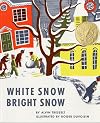
This classic book published in 1947 wraps me in a soft fuzzy blanket of nostalgia and makes me crave the good ol' days of clean white snow and sledding, rubber boots and all the neighborhood children playing together in the huge drifts. It takes me back to being snowed-in, warm fire in the fireplace, hot cocoa and the Postman whose name I knew bringing armloads of Christmas cards. The world depicted in this book does not include the sound of a snow-blower or a snow-mobile. It does not have show more Doppler radar to let me know it's going to snow. In this book we rely upon the ache in a woman's big toe and the fact that a farmer says it smells like snow. The rabbits know it and the kids search the grey sky waiting for the first snowflakes. This book takes us from those first feathery flakes through a really deep snowfall. We're there as the townspeople shovel themselves out. We're there as the grown-ups contend with the winter snow and the children revel in it. Eventually Spring comes and is greeted with as much gladness as the first snowflakes. The simple four color watercolor illustrations are just wonderful and made me yearn for the days when we didn't hurry from climate controlled houses to climate controlled cars to shopping malls with trees and fountains, for the days when we were on speaking terms with the weather. The writing in this book is so lyrical and gentle that it makes a perfect bedtime story and it is sure to warm the heart of the adult who's doing the reading. For example, "Then without a sound, just when everybody was asleep, the snow stopped, and bright stars filled the night. In the morning a clear blue sky was overhead and blue shadows hid in all the corners." show less

Originally published in 1964, and recently re-released, Alvin Tresselt's retelling of this Ukrainian folktale is probably one of the most textual adaptations available. A simple progression tale about a series of woodland animals who take up temporary residence in a lost mitten, there isn't much to this story. In fact, the other versions I have seen, Jan Brett's 1989 retelling amongst them, all have fairly minimal text. Here, Tresselt adds a little bit to the story, with more description and show more more animal dialogue, making for a much more satisfying narrative.
Yaroslava's delicate illustrations, alternating from a white to a blue background, are charming. An online friend described them as having a true "fairy-tale quality," and I would agree with that assessment. All told, this is one of my favorite versions of this story, although I think it is interesting to read it in conjunction with others. show less
Yaroslava's delicate illustrations, alternating from a white to a blue background, are charming. An online friend described them as having a true "fairy-tale quality," and I would agree with that assessment. All told, this is one of my favorite versions of this story, although I think it is interesting to read it in conjunction with others. show less
Summary: This book takes rain drops and take them from mountain brooks to lakes to rivers to oceans while incorporating several ecosystems.
Personal reflection: I especially liked this book because of the illustrations and the nature content. I think a lot of children's literature can focus on stories rather than using nature to explore a point like the flow of water in part of the water cycle. I think this book would help small children learn the simple concepts of the environment, different show more cycles in nature, and where certain animals live.
In the classroom: I would use this book as a text set for weather or water cycles or a chapter that pertains to ecosystems. I could also use it as a group activity, asking students why lakes, ponds, rivers, etc. are formed and why they are important for ecosystems including our own. show less
Personal reflection: I especially liked this book because of the illustrations and the nature content. I think a lot of children's literature can focus on stories rather than using nature to explore a point like the flow of water in part of the water cycle. I think this book would help small children learn the simple concepts of the environment, different show more cycles in nature, and where certain animals live.
In the classroom: I would use this book as a text set for weather or water cycles or a chapter that pertains to ecosystems. I could also use it as a group activity, asking students why lakes, ponds, rivers, etc. are formed and why they are important for ecosystems including our own. show less
Lists
Precious People (1)
Awards


You May Also Like


Associated Authors
Statistics
- Works
- 44
- Also by
- 6
- Members
- 7,703
- Popularity
- #3,160
- Rating
- 3.8
- Reviews
- 99
- ISBNs
- 128
- Languages
- 5
- Favorited
- 2