
Benjamin Radford
Author of The Martians Have Landed!: A History of Media-Driven Panics and Hoaxes
About the Author
Benjamin Radford is deputy editor of the science magazine The Skeptical Inquirer. The author of a dozen books and numerous articles on urban legends, the paranormal, critical thinking, films, and media literacy, Radford has appeared on CNN, the History Channel, and the National Geographic Channel. show more He lives in Corrales, New Mexico. show less
Works by Benjamin Radford
The Martians Have Landed!: A History of Media-Driven Panics and Hoaxes (2012) — Author — 47 copies, 12 reviews
Mysterious New Mexico: Miracles, Magic, and Monsters in the Land of Enchantment (2014) 28 copies, 1 review
Tagged
Common Knowledge
- Canonical name
- Radford, Benjamin
- Other names
- Radford, Ben
- Birthdate
- 1970-10-02
- Gender
- male
- Education
- University of New Mexico (BS, Psychology)
State University of New York, Buffalo (MEd)
Dartmouth College (MS, Public Health) - Organizations
- Phi Beta Kappa
Delta Omega
Members
Reviews
When I started reading this book, I thought the hoaxes and panics featured would be mostly 19th Century and involve fantastic stories nobody today would believe, written by reporters for unreliable tabloids. Was I ever wrong!
Although the “batmen” on the moon and Martians in New Jersey were chronicled by the authors, many were about more contemporary examples of media-generated panic, stories spun around flimsy, fabricated or non-existent evidence: bad behavior by refugees from Katrina, show more poisoned Halloween candy, anti-inoculation propaganda and kidnapper-clowns.
The Martians Have Landed has 36 short chapters, each relating the story of a particular panic or hoax and attempting to relate what happened, why and how people were bamboozled. Individually, they’re quick reading, but the cumulative effect is startling. I consider myself a pretty discerning media consumer, somewhat cynical about most of what I read or hear. But The Martians Have Landed will make me an even more critical reader. (Believers of any of the “contested” material may be more negative about the book. The reviews should be interesting.)
Review based on publisher-provided advanced readers’ copy of the book. show less
Although the “batmen” on the moon and Martians in New Jersey were chronicled by the authors, many were about more contemporary examples of media-generated panic, stories spun around flimsy, fabricated or non-existent evidence: bad behavior by refugees from Katrina, show more poisoned Halloween candy, anti-inoculation propaganda and kidnapper-clowns.
The Martians Have Landed has 36 short chapters, each relating the story of a particular panic or hoax and attempting to relate what happened, why and how people were bamboozled. Individually, they’re quick reading, but the cumulative effect is startling. I consider myself a pretty discerning media consumer, somewhat cynical about most of what I read or hear. But The Martians Have Landed will make me an even more critical reader. (Believers of any of the “contested” material may be more negative about the book. The reviews should be interesting.)
Review based on publisher-provided advanced readers’ copy of the book. show less
 This review was written for LibraryThing Early Reviewers.
I was excited when I learned that I'd won The Martians Have Landed! from the January Early Reviewers batch and equally disappointed when months passed without it coming. It finally arrived on June 11, 2012.
The famous 1938 Orson Wells War of the Worlds radio broadcast was the media hoax I knew best and this book taught me things I hadn't known before. (If you've thought the reaction to that broadcast was extreme, you should read about the reaction to the version broadcast in Ecuador in show more chapter 3.)
Radio hoaxes may be presented first, but TV, newspaper, and Internet hoaxes come right after. One thing that struck me was how often those involved in stories and broadcasts that caused panics were surprised that their efforts were taken seriously. I felt sorry for them. I didn't waste my sympathy on the stories of persons who created hoaxes or magnified stories for better ratings, sales, etc.
The chapter on the Taiwan ghost slasher reminded me of a book I read about the 18th century London Monster. http://en.wikipedia.org/wiki/London_Monster If you feel sorry for Williams in the older case, read about a poor young woman who was accused of being the slasher. Page 195 of the chapter about organ theft scares has even more chilling fates of innocent people assumed to be guilty.
There are several chapters about fears for children's safety from various threats. The point the authors make about where the real dangers lie is a good one.
On. page 74 there's a partial quotation, 'Before these children's eyes with heartless indiscriminate horrors unimaginable are ... presented night after night.... Terrific massacres, horrible catastrophes, motor-car smashes, public hangings, lynchings.... All who care for the moral well-being and education of the child will set their faces like flint against this new form of excitement.' It turned out to be quite a bit older than I'd guessed. That quotation is followed by a mini-history of moral panics that should be read by anyone who reads or watches the latest blame game for what's wrong with today's society.
The chapter on the bird flu panic mentions the swine flu panic of 1976 on p.60. I was a university student at the time and remember getting my swine flu shot. When I later read about Guillain-Barre syndrome in a nursing (?) article, I knew why, as the book says, the vaccine had become more feared than the disease. I haven't let that stop me from getting flu shots, though. I'm glad the authors provide information to reassure the public.
If you're expecting the 'Hook Hoax' to be about the urban legend of the homicidal maniac with a hook for a hand, it's about something less bloody, but still strange.
The chapter on killer vaccines affected me the most. Learning the cause of that hoax about the MMR vaccine causing autism infuriated me, as did the reason for the anti-Gardasil campaign. I grew up when kids routinely caught measles, mumps and rubella (German measles). I remember catching the last two. I don't recall if I ever had measles, but I do remember my experience as a high school volunteer at a small local home for developmentally disabled girls. The patients who had been born that way didn't distress me as much as the girl my age who was still mentally three years old -- the age she'd been when she'd caught the measles. If only the vaccine had been available in time to save her!
I wanted to read that the lawyers involved had been disbarred and beggered for their roles. I wanted to read that every person who successfully frightened parents into not getting their children vaccinated had to face a personal confrontation with the children who caught the preventable diseases and their parents. Sadly, those things either didn't happen or weren't reported in this book.
Complaints:
I do wish the book had a better copy of the 'Christ in the Snow' photo on p.150. I had to keep returning to it for several minutes before I finally saw what I was supposed to see.
I also wish publishers would give up the habit of placing all the chapter notes together in one section near the end of the book. Footnotes were so much easier to follow and are as easily ignored by readers who aren't interested.
A few errors:
My thanks to reviewer yarmando -- I missed the incorrect date for the attack on Pearl Harbor on p.21. I suspect that was just a typo that didn't get caught. Near the bottom of p.177, where the authors write about how often most real cops fire their guns in the line of duty, 'upholster' appears instead of 'unholster'. (That error does make for an amusing mental image, though.)
I believe that famous cartoon described but not named on p.52 is Show Biz Bugs. Read about it here: http://en.wikipedia.org/wiki/Show_Biz_Bugs (I just watched the ending at You Tube to verify the substances Daffy Duck swallows and the list at Wikipedia is correct.) If there is a cartoon with a similar plot in which Daffy swallows only a lighted stick of dynamite, my apologies to the authors.
Information hard to fit in the LibraryThing format:
Peter Hassall is the author of chapter 13.
Bill Ellis is the the author of chapter 24.
David Clarke is the author of chapters 26 & 27.
Felicity Goodyear-Smith and Helen Petousis-Harris are the authors of chapter 36.
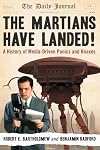
The cover is a combination image: that of a young Orson Welles (CBS Radio/Photofest) with background (Shutterstock).
Did I enjoy The Martians Have Landed? You bet! Am I sneering at the gullibility of the persons who fell for these hoaxes? No. Sure, I roll my eyes at conspiracy theories, but I remember that when I first watched 'The Curse of the Blair Witch mockumentary, I thought it was a real documentary about some bit of folklore I'd never heard about before. At least the friend who clued me in was kind.
Besides, the book has already provided me with several conversational tidbits. Thank you! show less
The famous 1938 Orson Wells War of the Worlds radio broadcast was the media hoax I knew best and this book taught me things I hadn't known before. (If you've thought the reaction to that broadcast was extreme, you should read about the reaction to the version broadcast in Ecuador in show more chapter 3.)
Radio hoaxes may be presented first, but TV, newspaper, and Internet hoaxes come right after. One thing that struck me was how often those involved in stories and broadcasts that caused panics were surprised that their efforts were taken seriously. I felt sorry for them. I didn't waste my sympathy on the stories of persons who created hoaxes or magnified stories for better ratings, sales, etc.
The chapter on the Taiwan ghost slasher reminded me of a book I read about the 18th century London Monster. http://en.wikipedia.org/wiki/London_Monster If you feel sorry for Williams in the older case, read about a poor young woman who was accused of being the slasher. Page 195 of the chapter about organ theft scares has even more chilling fates of innocent people assumed to be guilty.
There are several chapters about fears for children's safety from various threats. The point the authors make about where the real dangers lie is a good one.
On. page 74 there's a partial quotation, 'Before these children's eyes with heartless indiscriminate horrors unimaginable are ... presented night after night.... Terrific massacres, horrible catastrophes, motor-car smashes, public hangings, lynchings.... All who care for the moral well-being and education of the child will set their faces like flint against this new form of excitement.' It turned out to be quite a bit older than I'd guessed. That quotation is followed by a mini-history of moral panics that should be read by anyone who reads or watches the latest blame game for what's wrong with today's society.
The chapter on the bird flu panic mentions the swine flu panic of 1976 on p.60. I was a university student at the time and remember getting my swine flu shot. When I later read about Guillain-Barre syndrome in a nursing (?) article, I knew why, as the book says, the vaccine had become more feared than the disease. I haven't let that stop me from getting flu shots, though. I'm glad the authors provide information to reassure the public.
If you're expecting the 'Hook Hoax' to be about the urban legend of the homicidal maniac with a hook for a hand, it's about something less bloody, but still strange.
The chapter on killer vaccines affected me the most. Learning the cause of that hoax about the MMR vaccine causing autism infuriated me, as did the reason for the anti-Gardasil campaign. I grew up when kids routinely caught measles, mumps and rubella (German measles). I remember catching the last two. I don't recall if I ever had measles, but I do remember my experience as a high school volunteer at a small local home for developmentally disabled girls. The patients who had been born that way didn't distress me as much as the girl my age who was still mentally three years old -- the age she'd been when she'd caught the measles. If only the vaccine had been available in time to save her!
I wanted to read that the lawyers involved had been disbarred and beggered for their roles. I wanted to read that every person who successfully frightened parents into not getting their children vaccinated had to face a personal confrontation with the children who caught the preventable diseases and their parents. Sadly, those things either didn't happen or weren't reported in this book.
Complaints:
I do wish the book had a better copy of the 'Christ in the Snow' photo on p.150. I had to keep returning to it for several minutes before I finally saw what I was supposed to see.
I also wish publishers would give up the habit of placing all the chapter notes together in one section near the end of the book. Footnotes were so much easier to follow and are as easily ignored by readers who aren't interested.
A few errors:
My thanks to reviewer yarmando -- I missed the incorrect date for the attack on Pearl Harbor on p.21. I suspect that was just a typo that didn't get caught. Near the bottom of p.177, where the authors write about how often most real cops fire their guns in the line of duty, 'upholster' appears instead of 'unholster'. (That error does make for an amusing mental image, though.)
I believe that famous cartoon described but not named on p.52 is Show Biz Bugs. Read about it here: http://en.wikipedia.org/wiki/Show_Biz_Bugs (I just watched the ending at You Tube to verify the substances Daffy Duck swallows and the list at Wikipedia is correct.) If there is a cartoon with a similar plot in which Daffy swallows only a lighted stick of dynamite, my apologies to the authors.
Information hard to fit in the LibraryThing format:
Peter Hassall is the author of chapter 13.
Bill Ellis is the the author of chapter 24.
David Clarke is the author of chapters 26 & 27.
Felicity Goodyear-Smith and Helen Petousis-Harris are the authors of chapter 36.
The cover is a combination image: that of a young Orson Welles (CBS Radio/Photofest) with background (Shutterstock).
Did I enjoy The Martians Have Landed? You bet! Am I sneering at the gullibility of the persons who fell for these hoaxes? No. Sure, I roll my eyes at conspiracy theories, but I remember that when I first watched 'The Curse of the Blair Witch mockumentary, I thought it was a real documentary about some bit of folklore I'd never heard about before. At least the friend who clued me in was kind.
Besides, the book has already provided me with several conversational tidbits. Thank you! show less
This review was written for LibraryThing Early Reviewers.This is a collection of short chapters/articles about various instances in which the mass media has created or contributed to misguided panic or widespread misinformation. It starts out with fictional broadcasts that people failed to realize were fictional, such as the famous War of the Worlds radio broadcast. (Fascinatingly, it turns out that radio adaptations of The War of the Worlds managed this feat three separate times, the last of which occurred in Quito, Ecuador, and resulted in an show more angry mob burning down the radio station after realizing they'd been taken in.) Then there are hoaxes, from the 19th century newspaper that reported that astronomers had discovered life on the moon in a (successful) attempt to boost ratings, to a modern radio DJ who staged his own kidnapping as a publicity stunt. There are cases of the media reporting wild rumors as facts, as in inaccurate reports of horrific crimes committed in the wake of Hurricane Katrina, or serving as propagators of mass hysteria, as in a 1944 incident in which people in a small town in Indiana were convinced that some maniac was lurking around trying to gas people in their sleep. There are urban legends and conspiracy theories spread on the internet, including a global panic over a non-existent e-mail virus. And there are examples of ways in which the media sensationalizes, exaggerates and distorts real dangers all out of proportion, such as the "shark attack summer" of 2001, in which there were actually fewer shark attacks than average. (Hey, it was a slow summer for news.)
It's a little bit of a mixed bag. The early chapters feel somewhat repetitive; there are only so many accounts of people mistaking fictional broadcasts in faux-news formats for reality you can read before you find yourself muttering, "Yeah, I get the point, already." A few of the chapters, especially the urban legends, feel a little out of place, somehow. And some subjects are dealt with in a lot more depth than others; several of them could probably have used more examination than they got. But I do like the skeptical tone of the book, and think the general points they're making about the media are worth making. Some of the specific topics they address are important, too. Others are just really interesting. (I mean, come on! A phantom plague of scary clowns! How can you not love a story like that?) And,while I already knew most of the stuff covered in the section on fears the media has whipped up out of next-to-nothing, those who didn't may find it eye-opening to learn what the statistics really say about how much risk your kids are at from sexual predators or tainted Halloween candy.
I do feel compelled to point out that this book does seem to need some editing, as there were a few typos and slightly mangled sentences here and there, although I didn't find that as distracting here as I usually do. Well, except for the point where they were talking about "upholstering" a gun. That was pretty hilariously distracting. show less
It's a little bit of a mixed bag. The early chapters feel somewhat repetitive; there are only so many accounts of people mistaking fictional broadcasts in faux-news formats for reality you can read before you find yourself muttering, "Yeah, I get the point, already." A few of the chapters, especially the urban legends, feel a little out of place, somehow. And some subjects are dealt with in a lot more depth than others; several of them could probably have used more examination than they got. But I do like the skeptical tone of the book, and think the general points they're making about the media are worth making. Some of the specific topics they address are important, too. Others are just really interesting. (I mean, come on! A phantom plague of scary clowns! How can you not love a story like that?) And,while I already knew most of the stuff covered in the section on fears the media has whipped up out of next-to-nothing, those who didn't may find it eye-opening to learn what the statistics really say about how much risk your kids are at from sexual predators or tainted Halloween candy.
I do feel compelled to point out that this book does seem to need some editing, as there were a few typos and slightly mangled sentences here and there, although I didn't find that as distracting here as I usually do. Well, except for the point where they were talking about "upholstering" a gun. That was pretty hilariously distracting. show less
This review was written for LibraryThing Early Reviewers.What hurts this book the most is the inconsistency. In some instances, the incidents described are given very brief assessment- two or three pages. In others, there is much more detail about what. In some instances, there is a historical description of what happens. In others, it is as though the author is writing an academic treatise. (And in some cases guest authors are brought in to do that writing. These are often the most detailed – in some cases, the most tediously detailed). In some show more (the shortest) I beg to know more. In others (the longest) I beg for a merciful end. And the content seems mixed – some of the incidents are true hoaxes, some are pure panic, and others are urban legends gone wild.
And let’s add one more thing to that inconsistency – an inconsistency in how well each section is written. In the worst cases, the authors seem to have lost the thread of their discourse going back to the same points they have made before when the narrative feels it is moving on.
With all that being said, I still like this book because it made me think about the information we are fed. You see, I think the authors are trying to make a statement about how media drives panic and misinformation. And when you get past everything I’ve complained about, it does make that point. After reading it, I find myself taking a much more critical look at the news and information I receive daily.
So, when a book changes the way you perceive things – when that change makes you a better consumer of information – then that can’t be a bad thing. And it makes for a book I would recommend. Just be aware of the potholes on the way. show less
And let’s add one more thing to that inconsistency – an inconsistency in how well each section is written. In the worst cases, the authors seem to have lost the thread of their discourse going back to the same points they have made before when the narrative feels it is moving on.
With all that being said, I still like this book because it made me think about the information we are fed. You see, I think the authors are trying to make a statement about how media drives panic and misinformation. And when you get past everything I’ve complained about, it does make that point. After reading it, I find myself taking a much more critical look at the news and information I receive daily.
So, when a book changes the way you perceive things – when that change makes you a better consumer of information – then that can’t be a bad thing. And it makes for a book I would recommend. Just be aware of the potholes on the way. show less
This review was written for LibraryThing Early Reviewers.Awards


You May Also Like


Associated Authors
Statistics
- Works
- 12
- Members
- 287
- Popularity
- #81,378
- Rating
- 3.5
- Reviews
- 17
- ISBNs
- 17
