
Alan Wolfe
Author of The Transformation of American Religion: How We Actually Live Our Faith
About the Author
Alan Wolfe is the director of the Boisi Center for Religion & American Public Life at Boston College, & author of the best-selling "One Nation After All". (Bowker Author Biography)
Works by Alan Wolfe
The Transformation of American Religion: How We Actually Live Our Faith (2003) 176 copies, 3 reviews
Return to Greatness: How America Lost Its Sense of Purpose and What It Needs to Do to Recover It (2005) 29 copies
The Power Elite 5 copies
0079 - Beneficios a través del marketing estratégico. Las claves del éxito en el nuevo entorno competitivo de los negocio (1994) 1 copy
Los límites de la legitimidad. Contradicciones políticas del capitalismo contemporáneo (1987) 1 copy
The Big Shrink 1 copy
A Questão da democracia 1 copy
The Tilt Toward War 1 copy
Hvad er altruisme? 1 copy
Associated Works
The Life of Meaning: Reflections on Faith, Doubt, and Repairing the World (2007) — Contributor — 132 copies, 5 reviews
Public Intellectuals: An Endangered Species? (Rights & Responsibilities) (2006) — Contributor — 10 copies
Tagged
Common Knowledge
Members
Reviews
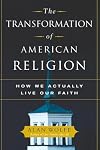
In 2005, Christian Smith coined the term "Moralistic Therapeutic Deism" to describe the beliefs of most American teenagers: exceedingly vague, it's a belief system more about providing therapeutic benefits to its adherents than matching any sort of doctrine. This wouldn't be a surprise to anyone who read (in 2003, when it was published) Alan Wolfe's "The Transformation of American Religion", which points out that this is extremely common among the religious of all ages, largely an effect of show more religious institutions' adaption to modern America and their almost capitalistic efforts to attract adherents.
"Transformation" covers more broad ground than doctrine, however - the book handles several aspects of religion in turn. This leads to some repetitiveness, given the shared source of many of the changes, but each aspect has its own details. I worried a bit about Wolfe hitting every nail of the changes with his individualism hammer, but he picks out the different strains on occasion and the sourcing never really strains. Still, the book can actually get more interesting when it switches to a sub-topic, like smaller groups (Mormons, Buddhists) and immigrants where the central theme has more complicated results.
Said theme being that churches - to stay alive and attract people - increasingly draw from individualism and pop culture, from the surge of some conservative denominations (such as Pentecostalism), to the weakening of doctrine and denominational differences even in more formal churches, to the very modernistic mega-churches, to a number of other issues. Wolfe leans very heavily on interviews and ethnographers, but while I would have liked more statistical grounding, there's enough here to stop it from falling apart. The only prose problem was he occasionally slips into writing from the perspective of the people he's talking about, which can be disorienting.
His approach runs into trouble in the last chapter, though, where he misapplies the non-denominationalism into politics. Evangelicals may not have that much fixed doctrine, but they can be relied on to vote a certain way. Further, he misunderstands the anti-democratic nature of the courts blocking some religious populism as a bug, when it's a feature; they're a necessary check on populist approaches. This isn't to say there's not a complicated issue over the intersection of religion and politics; just that he fails to approach it correctly.
"The Transformation of American Religion" could have used a little rebalancing of content, but is recommended for a look at the cultural background of current religion; just don't expect anything useful about the political side of things from it. show less
"Transformation" covers more broad ground than doctrine, however - the book handles several aspects of religion in turn. This leads to some repetitiveness, given the shared source of many of the changes, but each aspect has its own details. I worried a bit about Wolfe hitting every nail of the changes with his individualism hammer, but he picks out the different strains on occasion and the sourcing never really strains. Still, the book can actually get more interesting when it switches to a sub-topic, like smaller groups (Mormons, Buddhists) and immigrants where the central theme has more complicated results.
Said theme being that churches - to stay alive and attract people - increasingly draw from individualism and pop culture, from the surge of some conservative denominations (such as Pentecostalism), to the weakening of doctrine and denominational differences even in more formal churches, to the very modernistic mega-churches, to a number of other issues. Wolfe leans very heavily on interviews and ethnographers, but while I would have liked more statistical grounding, there's enough here to stop it from falling apart. The only prose problem was he occasionally slips into writing from the perspective of the people he's talking about, which can be disorienting.
His approach runs into trouble in the last chapter, though, where he misapplies the non-denominationalism into politics. Evangelicals may not have that much fixed doctrine, but they can be relied on to vote a certain way. Further, he misunderstands the anti-democratic nature of the courts blocking some religious populism as a bug, when it's a feature; they're a necessary check on populist approaches. This isn't to say there's not a complicated issue over the intersection of religion and politics; just that he fails to approach it correctly.
"The Transformation of American Religion" could have used a little rebalancing of content, but is recommended for a look at the cultural background of current religion; just don't expect anything useful about the political side of things from it. show less

A surprising take on the question of whether Jews can live happily outside of the Promised Land deeded to Abraham. It offers some convincing arguments to be grateful for their homes away from home. This will no doubt be a controversial topic for some, but the author avoids the theological quandries by focusing on the humanistic advantages of living in diverse environments.
 This review was written for LibraryThing Early Reviewers.
This is an unsettling book, and my more Zionist Israel-is-always-right friends will hate it. It doesn't criticize Israel, mind you, but our general culture surrounding the relationship between Israel and the Diaspora. Wolfe deals with, among other topics, the rejection of the legitimacy of life in Diaspora ("Diaspora negation"), a culture established on survivor guilt ("Six million Jews...did not die so that another six million could lead the good life in New York....Every living Jew must show more understand that he or she is taking the place of another who never had the opportunity." (p. 4) He looks at the founding of the State of Israel and attitudes the yishuv had toward Diaspora Jews, as well as early relations Israel had with the Diaspora community, including arguing against the founding of Brandeis University. He looks at the ongoing tension between Jewish prophetic universalism and a more parochial particularism, and how that tension determines the relationship between the Diaspora and Israel. The universalism/particularism tension also sets messages regarding intermarriage and other crises that the Jewish community faces -- but he suggests that Jews have survived a great many things, and intermarriage will be no different (this ignores the Orthodox perspective that counts only matrilineal Jews). Wolfe also questions that notion that anti-Semitism is as pervasive and dangerous as our standard narrative says, and suggests, provocatively, that the "the world is out to get us" narrative is disingenuous and manipulative. As he documents claims of widespread anti-Semitism, he eventually even accuses Jews of ingratitude toward the Diaspora: "Jews seem lacking in the confidence that would enable them to become a little more appreciative of just how securely this one part of the Diaspora has offered them a home." (p. 172) He considers the conflation of anti-Zionism with anti-Semitism to be an expansion of the manipulation, with the argument that since insufficient real anti-Semitic examples can be found, those setting the narrative have to reach for criticism of Israel (and there are plenty of examples of that) to bolster their case. (He notes the irony that major Jewish organizations have "welcomed those who utter" real contempt for Jews in the name of accessing e.g. Evangelical Christian support for Israel.) "It may seem odd for Jewish organizations to reach out to right-wing Christians, but once the criterion for finding anti-Semitism becomes not what one things of the Jews but how much one supports Israel, Christians who dislike Jews but love Israel are preferable to those who cite the Hebrew prophets as forerunners but are critical of the Jewish state." (p. 178) Not that he denies that there is real anti-Semitism, but he sees the expansion of "anti-Semitism" into the Israel realm as essentially giving company to the real anti-Semites. In the end he comes out in favor of exile as good for the Jews, and concludes "There remain large sections of world Jewry convinced that the linked memories of the...Holocaust and salvation offered by statehood must never be forgotten...For them, a younger generation of new, more universalistic Jews will be written off as too narcissistic...to recognize why Israel must always remain at the center of everything Jewish. But the events of the 1930s and 1940s are not the only events constituting Jewish memory." (p. 215)
I'm not sure I agree with everything he says, but he supports most of his statements with documentation, and certainly holds a challenging mirror up to how Jews think about themselves in the Diaspora and in Israel. show less
I'm not sure I agree with everything he says, but he supports most of his statements with documentation, and certainly holds a challenging mirror up to how Jews think about themselves in the Diaspora and in Israel. show less
This review was written for LibraryThing Early Reviewers.The controversy over the Jewish Diaspora is something I've only been familiar with in passing, and yet I found that Wolfe's work was not only readable and clear, but offered with depth and insight. In some cases, I'm positive I would have gotten more out of his arguments if I'd had more background, but for the most part, I felt Wolfe did an impressive job of balancing his writing to benefit a variety of readers. Wolfe's argument that Diaspora has, in large part, been a good thing for Jews -- show more despite many scholars and religious leaders arguing the opposite -- is delivered thoughtfully and with real depth, and offers a lot of inspiration for further discussion and thought.
All told, I'd have to recommend this work to anyone interested in the subject, or in religion at large. show less
All told, I'd have to recommend this work to anyone interested in the subject, or in religion at large. show less
This review was written for LibraryThing Early Reviewers.Awards

You May Also Like


Associated Authors
Statistics
- Works
- 39
- Also by
- 7
- Members
- 846
- Popularity
- #30,226
- Rating
- 3.6
- Reviews
- 15
- ISBNs
- 69
- Languages
- 4
